There’s a moment every artist knows well. You’ve been working on something for days, weeks, maybe longer. The piece is good — really good — but something’s missing. It lacks that spark, that element that transforms competent work into something transcendent. Then you make one small adjustment, add one final detail, and suddenly the whole thing clicks into place. Everything changes with nothing more than a single stroke.
This is the magic behind 画龙点睛 (huà lóng diǎn jīng), one of the most evocative idioms in the Chinese language. Literally translated as “adding the eyes to complete the dragon,” it describes precisely this phenomenon: the crucial finishing touch that brings something to life. But unlike many idioms that have become abstract and removed from their origins, 画龙点睛 comes with a vivid, almost magical story that makes its meaning impossible to forget.
The idiom has traveled far beyond the walls of ancient temples. Today you’ll hear it in creative studios and boardrooms, in writing workshops and philosophy lectures. Someone finishes a presentation with a perfect quip that crystallizes the entire argument, and colleagues exchange glances and say: “That was the 画龙点睛 moment.” A musician adds one final note that transforms a good song into an unforgettable one, and listeners instinctively understand what has just happened. The phrase has earned its place in the language precisely because it captures something true about how excellence actually works.
The Painter and His Legendary Dragons
The story dates back to the Liang Dynasty, around the year 500 CE, during the reign of Emperor Wu (梁武帝). This was a period of remarkable cultural achievement in China — Buddhism was flourishing, poetry and painting were reaching new heights, and the court attracted the finest minds and talents from across the realm. The capital Jiankang (modern Nanjing) was one of the largest and most cosmopolitan cities in the world, a place where ideas from India, Central Asia, and Southeast Asia mixed and merged with indigenous Chinese traditions to produce something entirely new.
Among these talents was a painter named Zhang Sengyou (张僧繇), whose work would eventually become the stuff of legend. Zhang Sengyou is historically recognized as one of the great masters of early Chinese painting, and his influence would echo through the centuries, shaping how subsequent generations understood the possibilities of the brush. He was appointed as a court painter, a position of tremendous prestige and responsibility. His specialty was figure painting, particularly Buddhist subjects, and his brushwork was renowned for its vitality and grace.
But it was his dragon paintings that would cement his legacy forever, spawning a story so vivid that it has been retold for fifteen hundred years without losing any of its power to astonish.
The tale most commonly told involves Zhang Sengyou being commissioned to paint dragons on the walls of a Buddhist temple — the Anle Temple (安乐意) in certain versions of the story, though some accounts simply refer to a nameless temple somewhere in the capital region. The walls were vast, and the task was daunting. Dragons, after all, are not simple creatures to render. They coil and undulate, their scales shimmer with an almost metallic gleam, their whiskers flow like silk underwater, their claws grip the air with terrible strength. Capturing their essence on a wall requires more than technical skill. It demands something else — something almost mystical, a quality that separates masters from merely capable practitioners.
The First Attempt: Dragons Without Eyes
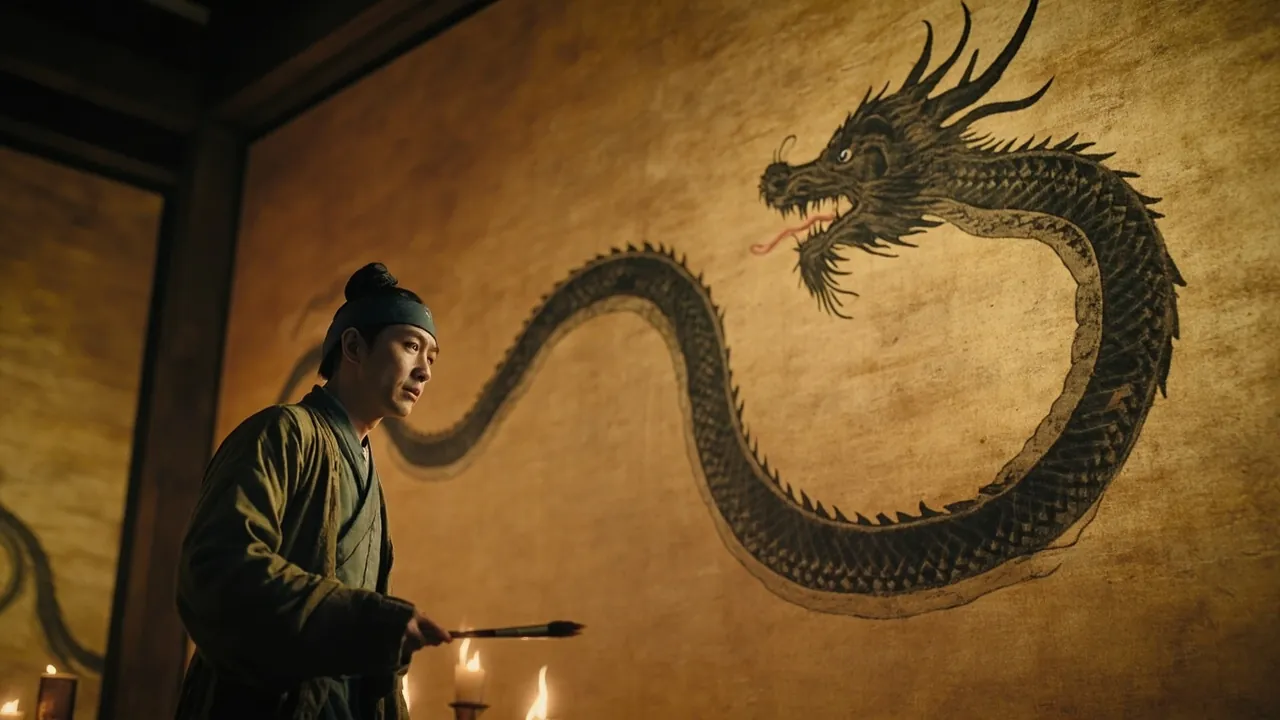
According to the story, Zhang Sengyou painted several magnificent dragons on the temple walls. They were breathtaking works of art — every scale rendered with precision, every contour flowing with organic life, the bodies twisted into dynamic poses that suggested both power and grace. People came from far and wide just to gaze upon his work, and their admiration seemed unlimited. Visitors would stand before the painted dragons for hours, pointing out details, marveling at the sense of movement Zhang Sengyou had somehow captured in static pigment.
But there was something peculiar about these dragons that unsettled observant visitors. Zhang Sengyou had painted them without eyes.
This omission was glaring once you noticed it. The great serpentine bodies curved across the walls in perfect form, but where eyes should have been — those crucial features that give a painted creature its animating spark — there was only blank wall. Empty space where life should have resided. Visitors couldn’t help but wonder about this choice, this strange decision to leave the most expressive feature off creatures that were otherwise so lifelike.
When visitors asked him why, his answer was as puzzling as it was firm: he refused to add the eyes. The reason, he explained, was simple and terrifying in its certainty — if he painted the eyes onto the dragons, they would come alive and fly away.
This answer struck people as the ravings of an artist whose imagination had finally overtaken his sanity. Dragons were mythical creatures, symbols on banners and decorative motifs, images that appeared on everything from imperial robes to common pottery. They didn’t exist in the real world, certainly not in the literal sense that Zhang Sengyou seemed to suggest. How could painted dragons possibly come to life? The very notion seemed absurd.
The skepticism was understandable. Paint remained paint; walls remained walls. Nothing in ordinary experience suggested that images could become alive. But Zhang Sengyou held firm in his refusal, maintaining his position despite growing pressure from temple officials and curious visitors alike. The painted dragons, he insisted, were not ordinary images. They carried something of the dragon’s spirit within them, a trace of the celestial creature’s essence that the artist’s brush had somehow captured and imprisoned in pigment. Add the eyes — the windows to the soul, the features that allow a creature to see and thus to be seen — and that spirit would have the means to escape the flat surface of the wall and return to the heavens from which dragons came.
The Wager That Changed Everything
Not everyone accepted this explanation, of course. A visiting official, or in some versions a particularly stubborn scholar from the capital, found the painter’s reasoning absurd. This skeptic challenged Zhang Sengyou repeatedly, accusing him of using superstition as an excuse for laziness or perhaps even fraud. The dragons were magnificent, the critic admitted, their technical execution beyond reproach. But their incompleteness — those glaring missing eyes — undermined their perfection. How could anyone claim mastery over dragon painting when the most important feature remained unpainted?
“Paint the eyes,” the skeptic demanded, “and prove your ridiculous claim. If the dragons truly come alive and fly away, I will admit my error publicly and compose an ode to your mastery. If they don’t, you will have proven yourself a fraud and a charlatan who has hoodwinked an innocent public.”
Zhang Sengyou was reluctant. He understood the power of what he was working with, the thin boundary between the painted world and the real one. He had seen things in his years as a painter that had taught him to respect the magical potential of art, the ability of a master to trap not just images but essences. But the pressure mounted, and eventually he recognized that some lessons can only be taught through direct experience. Words would never convince the skeptic. Only demonstration would do.
He agreed to paint the eyes. But he would do so on only one dragon, to demonstrate the principle without fully unleashing its consequences. He would choose one of the smaller dragons, he reasoned, to minimize the potential damage when the creature departed. It seemed like a reasonable precaution, given the circumstances.
The Moment of Transformation
The story describes what happened next in terms that blur the line between art and reality so thoroughly that readers for fifteen centuries have been unable to entirely dismiss it as metaphor. Zhang Sengyou selected one dragon from among the many he had painted — one of the large ones, though not the largest, a creature whose coiled form dominated a section of wall near the temple entrance. He dipped his brush in fresh ink, steadied his hand, and prepared to apply the first stroke that would change everything.
As soon as the first eye was completed, something extraordinary happened. The temple filled with a sudden, intense light — some accounts describe it as sunlight suddenly focusing through a lens, others as a glow emanating from the painted surface itself. The walls seemed to tremble, or perhaps it only seemed that way to the terrified witnesses. The painted dragon’s scales began to shimmer and shift, the carefully applied pigments taking on an almost holographic quality as the creature’s form began to separate from the flat surface that had contained it.
A wind — though the temple was enclosed, though there were no windows open, though the day had been perfectly still — swept through the chamber with impossible force. Temple hangings billowed outward. Torches guttered in their brackets. Witnesses stumbled backward, raising their arms against the sudden gust.
Before anyone could find words to express their dawning horror, Zhang Sengyou completed the second eye.
The effect was instantaneous and absolute. The dragon’s painted form began to move with terrible purpose, its coils uncoiling from the flat surface of the wall as if the wall itself had become a liquid. The creature that had been trapped in pigment for weeks or months suddenly had room to be what it had always essentially been. With a thunderous crack that some accounts describe as resembling the splitting of clouds during a summer storm, the dragon broke free from its imprisonment in the painted world and soared upward. It crashed through the roof of the temple in a shower of tiles and beams, the ancient construction providing no resistance whatsoever to a creature that existed partially outside the rules of ordinary matter. And then it was gone, disappeared into the sky, leaving behind only a void where its magnificent form had been and a hole in the roof through which the heavens could be seen.
The witnesses stood in stunned silence. They looked at the wall and saw the empty space where the dragon had been, the absence of its coils, the rectangular gap in the temple’s protection against the sky. Then they looked at each other, and any remaining doubts about Zhang Sengyou’s wisdom in refusing to paint the eyes melted away like morning frost. Those who had mocked him now found they had no words at all.
The remaining dragons on the wall — still eyeless, their painted forms still lacking that crucial animating feature — stayed exactly where they were. They remained perfect images, frozen in paint, for as long as the temple stood. They never moved again, never threatened to depart, never did anything more than decorate the walls with their magnificent incomplete forms. The one dragon that had received its eyes had gone, taking with it any doubt about what eyes truly meant to a painted dragon.
What 画龙点睛 Means and How to Use It Today
Today, the idiom 画龙点睛 has expanded far beyond its origins in temple painting and Buddhist miracle tales. It is used whenever someone adds the crucial element that transforms something from good to extraordinary, from merely complete to genuinely alive with meaning or power. The phrase appears in professional contexts, creative discussions, and everyday conversation with equal ease.
You’ll hear it in discussions of writing: a brilliant concluding sentence that gives an essay its true weight, an unexpected metaphor that suddenly clarifies everything the author has been trying to say. In business strategy, it describes the key insight that makes a complex plan click into place, the single decision that transforms a struggling product into a market leader. In engineering and design, it refers to the feature that makes a good product great, the detail that users remember long after they’ve forgotten everything else.
In art and music, the concept is perhaps most directly applicable. Musicians talk about the note that elevates an entire composition. Architects discuss the element that gives a building its soul rather than merely its function. Chefs understand the ingredient that makes a dish coherent, that makes all the separate flavors cohere into something that transcends their individual contributions.
The phrase carries a suggestion of economy — the idea that this final touch is small in effort but massive in impact. It’s not about the hours of labor that went into the underlying work, as essential as that work is. It’s about that one precise moment of insight or action that made everything else matter, that gave purpose to all the preparation that came before. You can labor for days on a project, investing enormous effort in getting the foundations right, and still fail to complete it properly if you neglect that final essential element. Add it, and you bring the dragon to life. Fail to add it, and you have only a magnificent eyeless creature that will never truly live.
The Philosophy Embedded in the Story
There’s something deeply Chinese about the philosophy embedded in this story — the idea that perfection sometimes includes incompleteness, that some boundaries exist for good reason, and that the gap between representation and reality is far narrower than most people typically assume. Zhang Sengyou’s refusal to paint the eyes wasn’t a failure of courage or technical skill. It was an acknowledgment that some powers are not meant to be unleashed, that the greatest art holds something in reserve, that even perfection has edges beyond which one should not venture.
Yet the story also celebrates the transformative power of the right addition at the right moment. The skeptic who demanded the eyes was wrong about the dragons coming to literal life, but he was right about one thing: the eyeless dragons, for all their beauty and technical mastery, were incomplete. They lacked the final element that would make them truly whole, truly themselves, truly what they had the potential to be. The idiom doesn’t celebrate the painter’s initial reluctance — it celebrates what happened when he finally did add that essential touch, and the magic that resulted when completion occurred.
This tension between restraint and completion, between holding back and fully realizing something’s potential, gives 画龙点睛 its enduring resonance across fifteen centuries of retellings. It’s a reminder that the difference between almost and entirely often comes down to a single element, and that recognizing what that element is — and having the courage to add it — is one of the most valuable skills anyone can develop, in art and in life.
Recommended Reading and Products
1. The Art of Chinese Painting: A Journey Through 5,000 Years A comprehensive guide to understanding Chinese artistic traditions, from ancient pottery to court paintings. Perfect for readers who want to place Zhang Sengyou’s work within the broader context of Chinese art history and understand how Buddhist painting influenced the cultural landscape of his era.
2. Traditional Chinese Brush Painting Set Experience the magic of Chinese brushwork yourself. This complete starter kit includes premium wolf-hair brushes, sumi ink, and rice paper — everything you need to explore the art form that produced legends like Zhang Sengyou and to discover what it feels like to work with the same basic tools that created the original temple paintings.
3. The Book of Chinese Wisdom: Idioms, Stories, and Philosophy A beautifully curated collection of Chinese idioms with their stories, meanings, and practical applications. Great for language learners and culture enthusiasts alike who want to explore more of the wisdom encoded in four-character phrases.
4. Dragon Motifs in Chinese Art: An Illustrated History Delve deeper into how dragons became China’s most powerful cultural symbol. This illustrated volume traces dragon imagery from ancient shamanic art through to imperial symbolism and beyond, showing how creatures like the one Zhang Sengyou painted fit into a millennia-long tradition.
5. Incense and Contemplation: A Guide to Traditional Chinese Meditation The Liang Dynasty was deeply connected to Buddhist practice, and Zhang Sengyou himself painted primarily Buddhist subjects in temples designed for worship and meditation. This guide offers an accessible introduction to contemplative practices that shaped the spiritual culture of his time and gave his art its deepest meaning.
Next time you find yourself working on something that’s almost perfect but not quite there, remember the painter who brought dragons to life with nothing more than a brushstroke. Ask yourself: what is the missing eye that will complete your dragon? And do you have the courage to add it when you find it?