The problem of time before clocks
If you live in 2026, you have a clock on your wrist, your phone, your microwave, your car dashboard, and probably your refrigerator. If you’re the average American, you glance at a clock more than 30 times a day without thinking about it. The technology of mechanical timekeeping is so woven into modern life that it can be hard to imagine a world where it didn’t exist.
China in 200 BCE was exactly that world. Sundials worked during the day, but only when the sun was visible — not at night, not on cloudy days, not in winter at high latitudes. Sand glasses (hourglasses) existed in some form but were too small for civic timekeeping. Burning incense sticks could mark long durations (a Chinese incense clock, 香篆, used specially shaped incense trails that took a known number of hours to burn) but were imprecise. What the imperial government needed — for tax collection, for court audiences, for astronomical observations, for the calendar — was something that could keep time continuously, day and night, in any weather, for as long as the device was kept supplied with water.
The Chinese answer was the clepsydra, or water clock. The Chinese word is 漏壶 (lou hu), literally “leaking pot,” or 漏刻 (lou ke), “leaking刻” — where 刻 refers to a traditional time unit, about 15 minutes. The basic idea: water flows from one container into another at a steady rate, and the level of the water (or the amount collected) tells you the time.
It’s an old idea, much older than China. Egyptian water clocks existed by 1500 BCE. Babylonian astronomers used them. Greek and Roman engineers refined them. But the Chinese took the clepsydra further than almost anyone else, and they did it earlier than most.
The Han dynasty clepsydra: precision for an empire
By the Western Han dynasty (around 200 BCE), the clepsydra was a serious piece of imperial technology. The historian Sima Qian mentions water clocks in the Shiji (Records of the Grand Historian), and from the Eastern Han dynasty (25–220 CE) onward, water clocks were standard equipment in the imperial palace and provincial government offices.
The basic Han clepsydra design was a single bronze vessel with a small hole near the bottom. Water flowed out at a roughly steady rate, and the dropping water level was read against marked gradations on the inside of the vessel. A rod floated on the water surface, and a crossbar attached to the rod pointed to the hour markings.
The problem with this design is that the water flow rate is not actually constant. As the water level drops, the pressure at the outlet decreases, so the water flows out more slowly. A naive clepsydra loses accuracy over the course of a day. A 12-hour day might lose 20 minutes by the end.
Han dynasty engineers — including a famous one named Zhang Heng (张衡, 78–139 CE), better known as the inventor of the first seismoscope — worked on this problem. The solution was elegant: use multiple vessels, with water flowing from one to the next, so the rate was equalized.
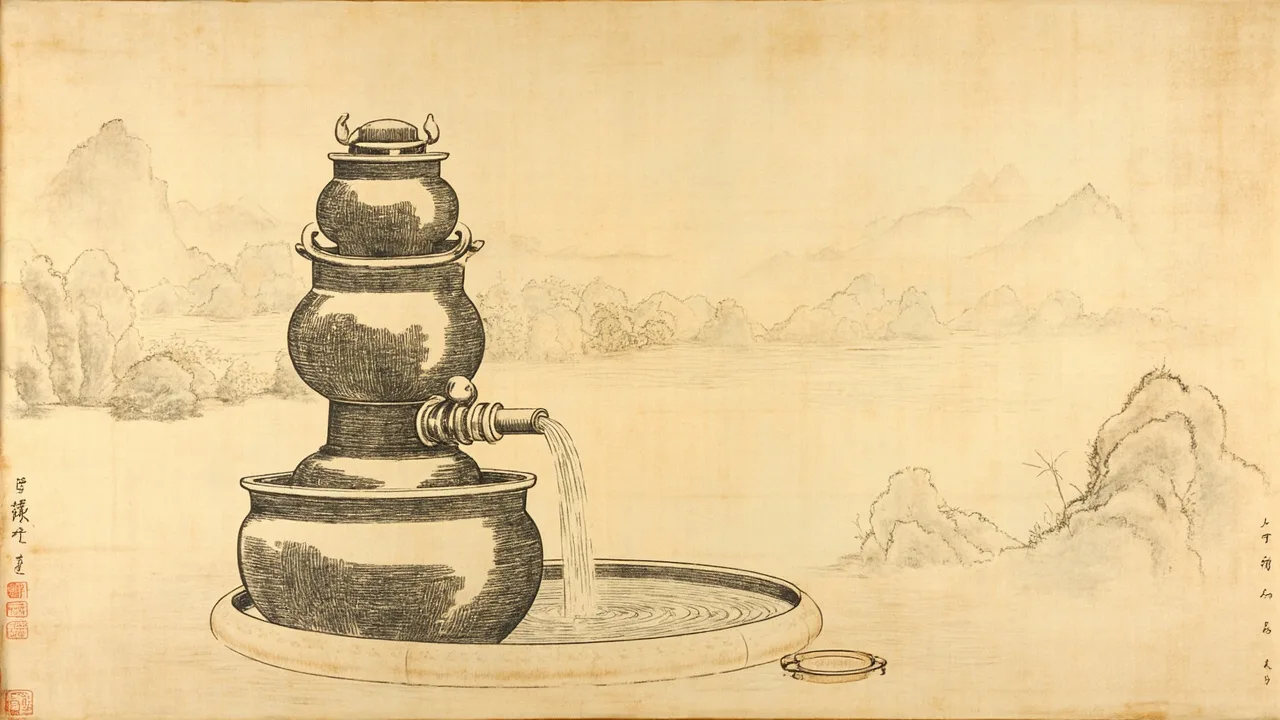
By the later Han and into the Wei-Jin period (220–420 CE), the standard design was a multi-tiered clepsydra with two, three, or four bronze vessels stacked vertically. Water flowed from the upper vessel into the next, and so on, until it reached the lowest vessel, where it dripped out through a calibrated hole. Because each vessel was kept at a roughly constant level by the inflow from above, the pressure at the bottom outlet was constant — and the drip rate was steady.
The accuracy of these later Han clepsydras is genuinely impressive. Surviving texts and reconstructions suggest accuracy within 20 seconds per day at best, perhaps 1 to 2 minutes per day on average. That’s not quartz-crystal accuracy, but it’s enough to time astronomical observations, schedule court audiences, and — most importantly — keep a civil calendar running across the empire.
The clepsydra also became the standard for measuring night watches (更, geng). The night was divided into five watches (about 7 PM to 7 AM, with each watch being about 144 minutes), and the clepsydra was used to mark them. Military garrisons, palace guards, and astronomical observers all relied on the same instrument.
Su Song’s astronomical clock tower: a medieval wonder
The most spectacular Chinese water clock was built in the 11th century by a polymath named Su Song (苏颂, 1020–1101 CE).
Su Song was a court astronomer, engineer, and pharmacologist during the Northern Song dynasty. In 1088 CE, he and a team of assistants completed the Xin Yi Xiang Fa Yao (新仪象法要), a treatise on a new astronomical clock tower. The tower itself, built in Kaifeng (the Song capital) around 1092 CE, was about 30 feet tall and combined three functions:
- An astronomical armillary sphere (a model of the celestial sphere with rings representing the celestial equator, ecliptic, and other reference circles).
- A celestial globe that rotated once per day to track the stars.
- A clock face with moving mechanical jacks that rang bells and gongs to mark the hours.
The mechanism driving all of this was a water clock — but Su Song’s version used a critical innovation: the escapement.
An escapement is a mechanical device that converts a continuous energy source (like a falling weight or flowing water) into discrete, regular steps. It’s the heart of every mechanical clock. The European invention of the verge escapement in the 13th century is usually credited with starting the European mechanical clock tradition.
Su Song’s water-driven escapement predated the European verge escapement by about 200 years. It worked like this: a water wheel turned by the clepsydra’s drip drove a chain that rotated the celestial globe and the clock face. To regulate the speed, a small lever mechanism engaged with the teeth of a wheel, allowing one tooth at a time to pass. The result was a clock that ticked.
Su Song’s original tower was lost — almost certainly destroyed when the Jurchen Jin dynasty captured Kaifeng in 1127 CE and the Song court fled south. But Su Song’s written description survived, and modern reconstructions (most famously a full-scale working replica at the Beijing Ancient Observatory and another at the Song-dynasty-themed Kaifeng restoration) prove that his design would have worked.
The Su Song clock tower is one of the genuinely remarkable objects in the history of science. It combined astronomy, timekeeping, mechanical engineering, and water-flow physics into a single instrument, and it ran on water power without requiring a human operator to be present. It was, in modern terms, an automated precision instrument.
The science: how you keep water flowing steadily
The interesting thing about the Chinese water clock tradition, beyond its historical importance, is the science that had to be figured out to make it work.
The physics of a water clock is governed by something close to Torricelli’s law: the speed at which water flows out of a hole depends on the height of the water above it, roughly as v = √(2gh), where g is gravitational acceleration and h is the height. So if the water level is dropping, the flow rate drops with it. A simple single-vessel clepsydra cannot keep accurate time over a full day.
The Chinese solution was to maintain a constant head (a constant height of water above the outlet) by replenishing the supply vessel from a higher reservoir. This is exactly the principle of a modern toilet tank, and it works the same way.
The other major challenge was calibrating the outlet hole. Too large a hole and the flow was too fast and turbulent; too small and it would clog. The Chinese used carefully shaped bronze inserts, sometimes called “water-flow regulators” (流量调节器), to standardize the flow rate. Excavated clepsydra parts show that the inserts were made to specific dimensions and could be swapped out for different seasons — because water viscosity changes with temperature, and a winter clepsydra might need a slightly different orifice than a summer one.
By the Tang dynasty (618–907 CE), clepsydras had reached a high level of standardization. The imperial palace used clepsydras with as many as four tiers, and the markings were standardized so that any clepsydra in the empire should have given the same reading as any other. There was also a tradition of cross-checking clepsydra readings against sundials and astronomical observations, with corrections logged when the clepsydra drifted.
The clepsydra was not a single instrument. It was a network.
How the Chinese clepsydra compares to the European tradition
It’s worth pausing on this, because there are two common ways this story gets told wrong.
The first wrong version: “the Chinese invented the clock centuries before Europe.” This is partly true — Su Song’s escapement did predate the European verge escapement. But Su Song’s clock did not lead to a continuous tradition of mechanical clock-making in China. The Chinese clepsydra tradition continued, but it did not evolve into spring-driven mechanical clocks the way the European one did. The European mechanical clock, once invented, got steadily better over centuries. The Chinese water clock got better more slowly and never quite crossed over into fully mechanical timekeeping.
The second wrong version: “the West was technologically ahead and the East was behind.” This is also false. The Chinese clepsydra of the Han dynasty was at least as accurate as anything in the Roman world. The Song dynasty astronomical clock tower was genuinely world-class. The Chinese tradition of astronomical observation — which depended on the clepsydra — was arguably the most sophisticated in the world between the 1st and the 13th centuries.
What is true is that the two traditions took different directions. European mechanical clock-making, after the 13th century, was driven in part by monastic prayer schedules and the desire to ring bells at exact hours — a real institutional incentive. Chinese clepsydra-making was driven by the imperial bureaucracy’s need to keep a unified calendar across the empire. The Chinese had less institutional pressure to miniaturize the device into a portable spring-driven clock.
The result: by 1500, European clocks were small, portable, and increasingly accurate. Chinese clepsydras were large, stationary, and accurate enough for astronomical observation. Both were working. Both were useful. They were just different solutions to slightly different problems.
Where to see a Chinese water clock today
If you’re traveling in China, there are a few places worth visiting.
Beijing Ancient Observatory (北京古观象台). On the roof of the old observatory building, in central Beijing, there’s a working replica of a Han-style clepsydra, plus the famous Ming and Qing dynasty astronomical instruments (the armillary sphere, the celestial globe, the quadrant — these are largely European-influenced by the 17th century, but they’re adjacent to the clepsydra tradition). The site has been an observatory since 1442 in its current location, with earlier observatories on or near the site going back to the Yuan dynasty.
Kaifeng (开封). The Henan provincial museum has a working model of a Su Song astronomical clock tower, and there is an outdoor replica in the reconstructed Song-dynasty theme park area. Kaifeng was Su Song’s home base.
Xi’an (西安). The Shaanxi History Museum has Han dynasty bronze clepsydra parts on display. Some of the most important Han clepsydra fragments were excavated from Western Han tombs in this region.
Hong Kong Space Museum and Hong Kong Science Museum. Both have small interactive exhibits on Chinese timekeeping history, including working water clock demonstrations. Worth a stop if you’re passing through.
If you’re in the West, the Science Museum in London has a Su Song clock tower model. The Smithsonian National Museum of American History in Washington has a small collection of Asian timekeeping instruments. The Adler Planetarium in Chicago has Chinese and Japanese astronomical instruments.
For working reproductions you can buy — most of these are smaller decorative pieces, often combined with a traditional Chinese incense clock or a brass mechanical movement — there are specialty makers in Fuzhou, Hangzhou, and Suzhou. Expect to pay between $30 and several hundred dollars depending on size and finish. A serious clepsydra for home display is on the same order as a good sundial — a few hundred dollars for a quality piece.
Why a 2,000-year-old water clock is worth thinking about
It’s tempting, in a year where you can buy a $10 wristwatch with quartz accuracy, to dismiss the clepsydra as a curiosity. A device that loses a minute a day, requiring careful calibration, humidity control, and a steady supply of clean water? Why bother?
But the clepsydra is more interesting than it looks. It was the first precision scientific instrument the Han dynasty had. It made possible the Chinese astronomical tradition that ran from the Han dynasty through the Song dynasty — over a thousand years of continuous observation, the longest sustained scientific data-gathering project in human history. The clepsydra is why Chinese astronomers knew the length of the year to within minutes by the 5th century CE. The clepsydra is why Chinese court astronomers could predict solar eclipses accurately enough to schedule imperial rituals around them. The clepsydra made all of that possible.
And the clepsydra is, in the end, a beautiful object. A four-tiered bronze clepsydra with steady water dripping between vessels is a quiet, hypnotic thing to watch. It has the same quality as a sundial or a campfire — a slow, steady, physical thing in a world that increasingly runs on the invisible. I have stood in front of the working Su Song replica at the Beijing Ancient Observatory for longer than I would like to admit, just watching the water drip.
If you’re building a home library or a school science project, the clepsydra is a great place to start. You can make a basic working clepsydra in an afternoon with a plastic bottle, a drill, a measuring cup, and some tape. It loses accuracy as the water level drops — that’s the problem the Han dynasty engineers solved. Once you’ve seen the problem, you understand why they built four-tiered bronze instruments with carefully calibrated orifices. You understand why Su Song’s tower mattered.
And you understand, finally, why a modern wristwatch is not a small thing. It is the compressed outcome of 2,000 years of human attempts to keep time — water dripping through bronze vessels, sand running through glass, weights falling through gears, springs unwinding, pendulums swinging, quartz crystals vibrating, atoms resonating.
The clepsydra is the part of that story that came first. In China, it came first to a lot of people, and stayed in use for a very long time. The fact that we don’t think about it much now is mostly because the watch on your wrist does its job. But the watch on your wrist is, in a real sense, the descendant of a leaking pot in the Han imperial palace.