The Anshi Rebellion: How Eight Years of Chaos Broke the Tang Dynasty
December 16, 755 CE. In the northern frontier town of Fanyang, a 700-pound military governor with a Sogdian mother’s blue eyes raises his army of 150,000 soldiers and marches south. His name is An Lushan (安禄山), and within weeks his cavalry will be inside the Tang Dynasty’s capital of Chang’an. The Tang had ruled China for 137 years, presiding over the most cosmopolitan, prosperous, and culturally brilliant civilization on Earth. By the time the dust settled more than a decade later, an estimated 13 to 36 million people would be dead, the emperor would be a refugee in his own empire, his beloved consort would be buried in a roadside grave, and the Tang would stagger on for another century and a half — a living dynasty that never recovered its soul.
This is the story of the Anshi Rebellion (安史之乱, Ān Shǐ zhī Luàn) — eight years of apocalyptic civil war that turned China’s golden age into its long decline. No single event did more damage to imperial Chinese civilization than this one. To understand why the Tang fell, you have to understand An Lushan, the frontier military system that gave him the power to rebel, the imperial couple whose love affair distracted them from governing, and the fateful moment at Mawei Slope when history’s most famous beauty was strangled by a silk cord on a roadside in front of her emperor-lover.
The Man Who Shook an Empire: Who Was An Lushan?
An Lushan is one of the most unusual figures to ever threaten a Chinese dynasty. He was not Han Chinese at all. Born around 703 CE, he was the son of a Sogdian (Central Asian Iranian) mother and a Turkic father — a true child of the Silk Road, a melting-pot of the steppe empires that bordered Tang China. The Sogdians were famous throughout Eurasia as merchants, diplomats, and translators; their language was the lingua franca of the Silk Road, and their communities stretched from Samarkand to the markets of Chang’an. Sogdian women often married into Turkic military families, producing exactly the kind of cosmopolitan, multi-ethnic, multi-lingual children who thrived on the frontier.
His background is essential to understanding both his rise and his rebellion. An Lushan was a master of cultural code-switching long before the term existed. He spoke at least six languages, including Sogdian, Turkic, and Chinese. He understood the steppe tribes. He understood the Tang bureaucracy. Most importantly, he understood how to be useful to people in power — and how to make himself indispensable.
{{AFFILIATE_PRODUCT_1: Silk Road History Books, history, illuminates the multi-ethnic Sogdian/Turkic world An Lushan came from — the same networks of merchants and translators that connected Chang’an to Samarkand}}
His career began as a low-level translator and horse-trader on the northern frontier. The Tang military, especially under the Kaiyuan era (713-741 CE), recruited heavily from non-Han peoples. Han Chinese soldiers were notoriously poor cavalrymen compared to Turks and other steppe peoples, who grew up on horseback and were bred for war. An Lushan rose through the ranks by being brilliant at what Tang frontier generals most needed: managing tribal politics, supplying horses, and translating languages nobody else in the army could speak.
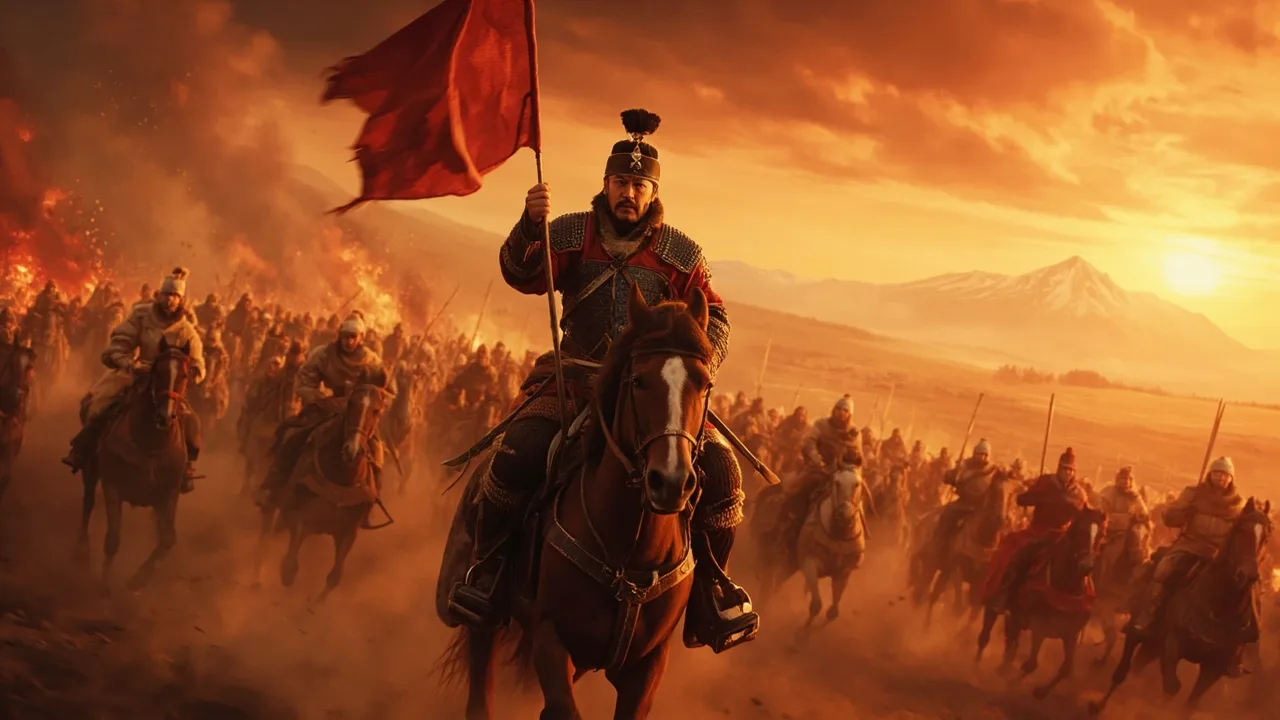
By his late thirties, An Lushan had become a figure of extraordinary power. In 744 CE, he was appointed military governor (jiedushi 节度使) of Fanyang — one of three frontier commands guarding the northeastern approaches to the Tang heartland. His territory stretched across modern-day Hebei and Liaoning provinces. He commanded perhaps 80,000 soldiers directly, and through alliances with tribal leaders, could mobilize far more. By 752 CE, An Lushan was the single most powerful military figure in the empire — a warlord in everything but name, with a sword pointed directly at Chang’an.
One of the more bizarre chapters in An Lushan’s career is his relationship with Emperor Xuanzong (唐玄宗, r. 712-756 CE). The emperor, then in his sixties, genuinely loved An Lushan — or performed a love so convincing that it became imperial ritual. Court records describe An Lushan being received in the palace, where he would toss the emperor’s infant son in the air three times in a barbaric Sogdian ritual called “the flying child.” Xuanzong adored him. Yang Guifei, the emperor’s young and breathtakingly beautiful consort, adopted An Lushan as her own son — though he was fifteen years her senior. The emperor, the consort, and the warlord performed the roles of an imperial family. Every visit to Chang’an, every imperial banquet, every moment of “fatherly” affection from the aging emperor, was a brick in a wall of personal loyalty that protected An Lushan from rivals at court. For fifteen years, this strategy worked brilliantly. Ministers who tried to warn the emperor that An Lushan was building a private empire were silenced, demoted, or exiled.
The Trigger: Yang Guozhong vs. An Lushan
The fuse that finally lit the rebellion was personal. Yang Guozhong (杨国忠) was the cousin of Yang Guifei, and after years of imperial favoritism had clawed his way to the position of chief minister — effectively the most powerful civilian official in the empire. He was widely despised. He was also terrified of An Lushan, who had been mocking him in front of the emperor for years. The two men despised each other openly.
Yang Guozhong made a fatal miscalculation. Beginning around 754 CE, he began systematically trying to provoke An Lushan into rebellion, reasoning — perhaps correctly — that a war would destroy his enemy and let him emerge as the emperor’s savior. He surrounded Fanyang with hostile forces. He arrested and tortured several of An Lushan’s allies in Chang’an. He made no secret of his intention to destroy the warlord.
The plan backfired catastrophically. Instead of being destroyed, An Lushan decided to strike first. On December 16, 755 CE, he declared a rebellion aimed not at the emperor himself — his formal grievance was against Yang Guozhong — but at the entire imperial establishment that had humiliated him. Within weeks, his army, swelled by Turkic cavalry, was sweeping south across the Yellow River. By the summer of 756, An Lushan had captured the eastern capital Luoyang and declared himself emperor of a new dynasty called Yan (燕). Within months, Chang’an itself fell.
{{AFFILIATE_PRODUCT_2: Tang Dynasty History Books, history, gives the deep background on the Yang Guozhong vs. An Lushan rivalry and the frontier military system that let a single commander hold the empire hostage}}
Mawei Slope: The Death of Yang Guifei
The flight of the imperial court from Chang’an in the summer of 756 CE is one of the most dramatic scenes in Chinese history. Emperor Xuanzong, then seventy-one years old, abandoned the great capital with all its million inhabitants. He took with him his consort Yang Guifei, the Yang family, and a slim escort of imperial guards. Behind them, the city burned. An Lushan’s cavalry was just hours behind.
The imperial entourage had not gone far before it reached Mawei Slope (马嵬坡), a remote mountain post about forty miles west of Chang’an, on the road to Sichuan. There, the imperial guards mutinied. The soldiers, exhausted, hungry, and terrified, demanded justice. They killed Yang Guozhong — dragging him from his horse and hacking him to death. They killed his son. Then, when their blood was up, they made a more terrible demand: the emperor must surrender Yang Guifei, or they would not march another step.
Yang Guifei was thirty-seven years old. She had been the emperor’s companion for nearly two decades — his lover, his confidante, the mother of his late-in-life joy. But Xuanzong, surrounded by armed men with no loyalty left, was in no position to refuse. According to the most detailed accounts, a high-ranking eunuch named Gao Lishi led Yang Guifei to a Buddhist shrine at the roadside. There, in front of the pine trees, she was strangled to death with a silk cord — not by sword. The silk cord, not the blade, was the proper instrument of execution by imperial decree for women of consort rank. Her body was wrapped in a blue blanket and buried in a hastily dug grave on the slope.
Xuanzong was not allowed to see her face again. He lived another forty years, an aging phantom wandering the western court at Chengdu, writing poems about her beauty and his loss. One of the most famous poems in the Chinese language — Bai Juyi’s “Song of Lasting Sorrow” (长恨歌), written sixty years later — is built around this scene: the emperor who loved a woman so much that he broke his empire, and the woman who paid for it with her life on a forest road.
The mutiny at Mawei Slope marks a turning point in Chinese political culture. From this point forward, military force — not imperial authority — would determine who ruled China. The emperor’s bodyguards had, in effect, deposed the chief minister and executed the imperial consort. The implicit message to every warlord and regional commander in the empire was unmistakable: the throne could be coerced.
Eight Years of Fire and the Long Tang Decline
The rebellion did not end with the taking of Chang’an or the death of Yang Guifei. It dragged on for seven more years. An Lushan himself was murdered in 757 CE by his own son, who in turn was killed by another son, who was in turn overthrown by the general Shi Siming (史思明). Shi Siming and his son Shi Cha-yi continued the rebellion until 763 CE, when the last rebel holdouts finally surrendered. Hence the name “An-Shi” — from An Lushan and Shi Siming, the two rebel commanders whose combined efforts brought the Tang Dynasty to its knees.
The human cost was staggering. Contemporary records describe entire regions depopulated. The imperial census, which had recorded about 53 million registered people before the rebellion, fell to about 17 million by the war’s end — though most of that decline reflects people fleeing registration or dying, rather than pure battlefield casualties. Modern demographic estimates suggest somewhere between 13 and 36 million dead from war, famine, plague, and displacement. To put those numbers in perspective, the population of Europe at the time was perhaps 30 to 40 million. The Anshi Rebellion killed more people than lived in most contemporary European kingdoms.
The economic cost was just as devastating. The Yangtze and Yellow River plains — the heart of Tang agricultural production — were repeatedly overrun by armies, their fields burned, their granaries emptied, their farmers conscripted or killed. Tax collection collapsed. The central government lost control of its own treasury. The Tang court had to borrow from regional military governors just to pay its own soldiers — a debt that was never fully repaid, politically or financially.
Culturally, the loss was incalculable. The imperial libraries at Chang’an were destroyed when the capital fell. Court records, official histories, poetry collections, and Buddhist scriptures accumulated over a century — all gone. The Tang court of the 8th century was the most artistically accomplished ruling class in the world at that time; the poets Li Bai and Du Fu both lived through the rebellion and wrote about its horrors. Du Fu, perhaps the greatest Chinese poet of the era, spent years as a refugee, his family starving. Li Bai joined the rebellion briefly — possibly under coercion — and was later exiled for it. The poetry of the late Tang is haunted by the disaster: elegies for lost cities, laments for friends killed in the war, meditations on the impermanence of earthly glory.
{{AFFILIATE_PRODUCT_3: Chinese Historical Novels, literature, novels based on the Anshi Rebellion — especially the Tang Dynasty romantic epics — bring the court intrigues and battlefield horrors to life in a way no history textbook can}}
{{AFFILIATE_PRODUCT_4: Tang Dynasty Replica Artifacts, replica, museum-quality reproductions of Tang bronze mirrors, sancai ceramic horses, and Sogdian merchant figurines evoke the cosmopolitan culture that the rebellion destroyed}}
The Tang after 763 CE was not the same dynasty that had entered the 750s. The central government had lost the military power to enforce its will. Tax collection was delegated to regional military governors, who kept most of what they raised. The emperor still sat on the throne in Chang’an, but real power had migrated to the provinces — to the same kind of frontier commanders who had rebelled under An Lushan in the first place.
The result was a structural weakness that only got worse. By the late 9th century, the imperial court was a puppet, dominated by eunuchs in the palace and military governors in the provinces. The Huang Chao rebellion (874-884 CE) finished the job the An Lushan rebellion had started, devastating the Yangtze heartland and triggering the final collapse of Tang authority. When the last Tang emperor was deposed in 907 CE, the dynasty that had ruled for 289 years ended not with a great battle but with a quiet murder in the palace — a far cry from the days when Tang emperors had looked out over a unified empire stretching from Korea to Central Asia.
What the Anshi Rebellion Teaches Us Today
The Anshi Rebellion is more than a historical event. It is the central pivot of Chinese imperial history — the moment when one of the world’s greatest empires began its irreversible decline, and when a culture of openness, cosmopolitanism, and centralized confidence gave way to defensiveness, regionalism, and suspicion of foreigners.
Before 755 CE, the Tang Dynasty had been a confident, outward-looking civilization. Its capital at Chang’an held Persian, Sogdian, Turkic, Korean, Japanese, and Indian communities side by side. Buddhism, Daoism, and Confucianism coexisted in the empire. Foreign fashions, foreign foods, foreign music, and foreign religions were fashionable at court. A man like An Lushan — a Sogdian-Turkic half-breed from the frontier — could rise to the highest ranks of the military.
After 763 CE, that cosmopolitanism was gone. The trauma of the rebellion hardened cultural attitudes. Foreigners became suspect. The military frontier system that had allowed men like An Lushan to rise was dismantled in principle (though never quite in practice). The Tang court increasingly looked inward, distrustful of regional power and obsessed with central control it could no longer enforce.
The Anshi Rebellion also created the template for almost every subsequent Chinese civil war. From the Five Dynasties and Ten Kingdoms chaos that followed the Tang’s collapse, through the Song, Yuan, Ming, and Qing dynasties, the same pattern repeated: a powerful central state, fractured by corruption and over-mighty regional commanders, torn apart by rebellion, followed by partial reunification under weaker and more centralized regimes. An Lushan did not invent warlord politics in China, but he gave it its classical form.
The figure of Yang Guifei, strangled at Mawei Slope, also became a permanent fixture in Chinese culture. She was the dangerous beauty whose love had cost an empire her life — a cautionary tale for every ruler who forgot that personal passion and political power do not mix. For more than a thousand years, Chinese artists, poets, and opera composers have returned to her story. In some tellings, she is a scapegoat — a woman killed for the failures of men. In others, she is a tragic heroine — the most beautiful woman in Chinese history, who loved an emperor enough to die for him on a forest road.
The rebellion also transformed how Chinese historians thought about ethnic minorities. An Lushan had been a foreigner — a non-Han outsider whose rise had destroyed the dynasty. The lesson that many historians drew was that the Tang had been too generous to non-Chinese generals, and that future dynasties needed to be more careful. In practice, this rarely worked; the Song, Yuan, and Qing dynasties all relied heavily on non-Han soldiers and officials. But the suspicion persisted.
{{AFFILIATE_PRODUCT_5: Chinese Calligraphy Scrolls, art, classical calligraphy scrolls — particularly works copied from poems by Du Fu and Li Bai — let you hold the artistic legacy that survived the dynasty’s military ruin}}
For modern readers, the Anshi Rebellion offers lessons that feel surprisingly contemporary. It is a story about what happens when an empire becomes complacent, when military commanders are given too much autonomy for too long, when a charismatic leader falls in love and stops paying attention to governance, and when personal rivalries at the top of government spiral into national catastrophe. The frontier military system that allowed An Lushan to rebel was, in many ways, the Tang equivalent of modern imperial overstretch — a strategy that worked when the empire was strong and the commanders were loyal, and that turned catastrophic when those conditions changed.
It is also a story about scapegoating. Yang Guifei was killed because she was convenient. Yang Guozhong was hated because he was arrogant and corrupt. But the real causes of the rebellion — the structural weaknesses of Tang frontier policy, the mismanagement of the military system, the emperor’s long neglect of governance — were not addressed by killing one woman and one minister. You cannot solve a systemic crisis by murdering its most visible symbols.
If you want to read more about the human side of this catastrophe, our article on Yang Guifei tells the story of the woman who paid the price. And for a longer view of how the Tang’s decline led into the chaos of the Five Dynasties and eventually the Qing Dynasty many centuries later, the Anshi Rebellion is the hinge on which that whole story turns.
The Tang Dynasty is remembered as China’s golden age — and it was. But the men and women who lived through the Anshi Rebellion also left behind another, darker legacy: a warning about what happens when great empires forget the price of their own greatness.