In the eleventh month of the year 806 CE — winter, in the cold hills west of modern Xi’an — a 34-year-old Tang dynasty official named Bai Juyi sat down in his modest government lodgings and wrote a poem about an emperor and his consort who had been dead for almost exactly half a century. He finished it in something close to a single sitting. The poem ran to 120 lines of seven-character regulated verse, about 840 Chinese characters, and its title was Changhenge (长恨歌) — “Song of Everlasting Sorrow.”
It is, by any reasonable measure, the most famous love poem in the Chinese language. Chinese schoolchildren still memorize parts of it. Every major Tang dynasty anthology prints it. Dozens of full-length English translations exist. It has inspired operas, paintings, novels, plays, ballets, and at least one Hong Kong film that runs almost three hours. If you have ever heard someone quote a Tang dynasty line about heaven and earth lasting forever while a single sorrow goes on and on — that is this poem.
But here is the thing most readers do not realize. Bai Juyi did not sit down to write a love poem. He sat down to write a cautionary tale about a fatuous emperor who neglected his empire for a beautiful woman and, in doing so, almost destroyed it. The love story that made the poem immortal is, in some real sense, the wrong reading Bai Juyi intended. But the poem was so good that it overrode its author’s intentions, and Chinese readers have spent the last 1,220 years quietly choosing romance over morality. That argument is part of what makes Changhenge worth reading now.
Let me tell you who Bai Juyi was, what exactly happened to Emperor Xuanzong and Yang Guifei, what the poem actually says, and why it has never gone out of print.
Who Bai Juyi Was (772 – 846 CE)
Bai Juyi (白居易) was born in 772 CE in Xinzheng, Henan province, into a family that had seen better days. His father, Bai Jiugao, was a minor official who had once had higher hopes. The family was poor enough that when Bai Juyi was young they lived for stretches near the family estate at Langzhong in Sichuan — a thousand kilometers from the central political stage — and the boy grew up speaking more Sichuan-inflected Chinese than the court Mandarin of the capital. He never fully lost the accent. Courtiers in his later career occasionally made fun of it.
He was, by his own account in his autobiographical prose, a strange child. He could read by age five or six. By nine he was already writing poetry. By sixteen he had moved to Chang’an, the Tang capital, to take the imperial examinations, which he failed at first and then passed at twenty-eight. He entered government service in the early 800s and quickly became known for two things that would define his career.
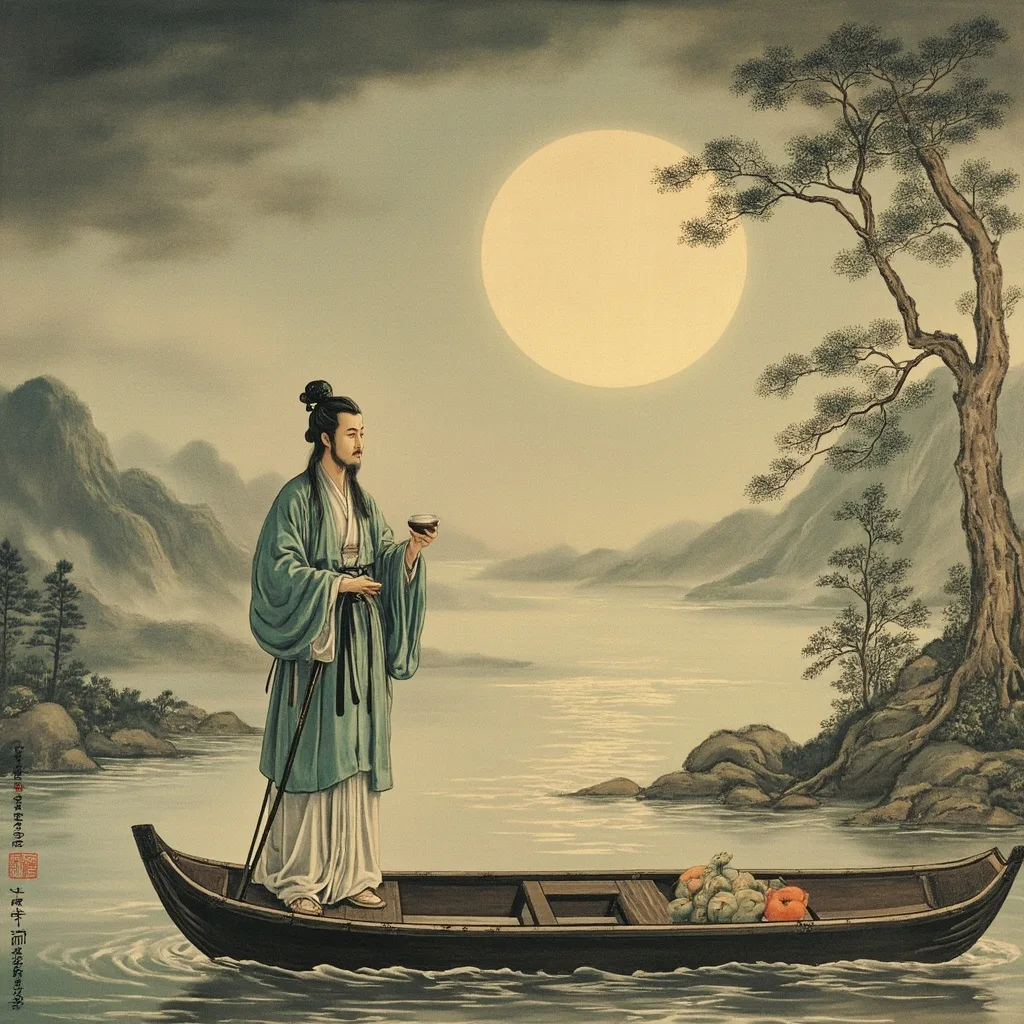
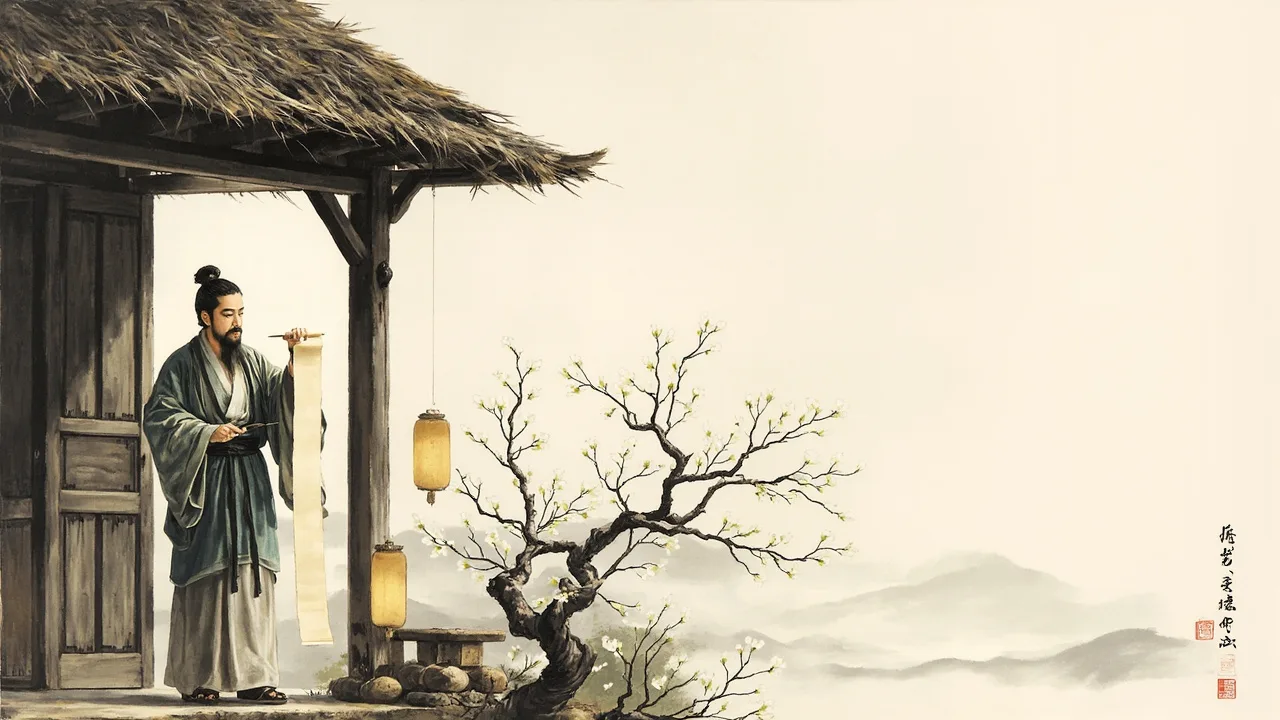
First, he wrote poetry that ordinary people could understand. In an era when the most fashionable court poetry was obscure, allusive, and stuffed with classical references only the educated could catch, Bai Juyi wrote plain. His subjects were common — a mother sewing by lamplight, a peasant girl sold to be a concubine, an old woman selling flowers in the snow, the price of rice, the sound of pipa music from a neighbor’s house. The Tang historian and critic Meng Qi, writing only a few decades after Bai Juyi’s death, recorded the famous story that when Bai Juyi finished a poem he would read it aloud to an old peasant woman. If she did not understand it, he would rewrite it. The story is almost certainly apocryphal, but it captures something true about the poetry.
Second, he was a career censor. This matters. The early Tang dynasty was one of the great periods of Chinese literature; it was also a period when the central government was beginning to wobble in ways that would, by the mid-800s, lead to the dynasty’s effective collapse. Bai Juyi served as a remonstrance official — a kind of staff writer attached to the emperor whose job it was to point out, politely but firmly, when the emperor was being an idiot. He got away with more than most because he was a good poet and the emperors liked having him around. He also got demoted more than most — exiled, in turn, to Jiangzhou, to Suzhou, to Hangzhou, to other minor posts — usually because he had written or said something that was a little too accurate.
By any honest accounting, he was the most popular poet in Tang dynasty China.
The History Behind the Poem: Xuanzong and Yang Guifei
To understand Changhenge, you have to understand the story it tells.
Emperor Xuanzong (唐玄宗, r. 712–756 CE) was one of the longest-reigning and most consequential Tang emperors. The Tang dynasty (618–907 CE) under his rule saw the empire at or near its cultural peak. Chang’an, his capital, was, by some contemporary estimates, the largest city in the world — close to a million people, a magnet for Sogdian merchants, Korean monks, Japanese students, Persian visitors, Tibetan envoys. Xuanzong himself was a gifted musician, an amateur calligrapher, a competent administrator in his early years, and an obsessive patron of the performing arts. He was also, by the time he reached his sixties, increasingly detached from the business of actually ruling.
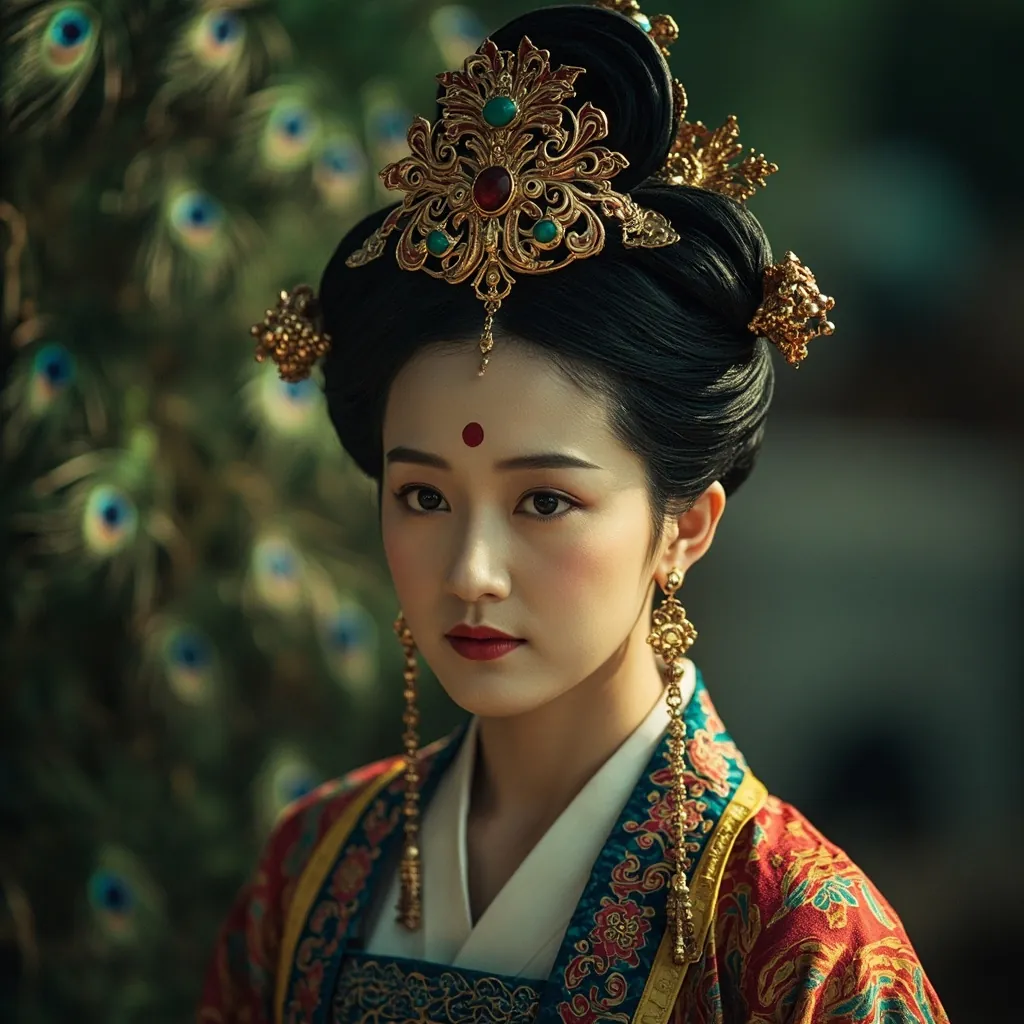
In 745 CE, at the age of about 60, Xuanzong fell in love with a young woman named Yang Yuhuan (杨玉环), the daughter of a mid-ranking official. She was 26 or 27. The Tang historical sources describe her as musically gifted, a fine horsewoman, slightly plump by later Chinese standards but ideal by Tang standards, and possessed of a kind of effortless social presence that even hostile chroniclers found it hard not to admire. She became his favorite consort, was given the title Yang Guifei (杨贵妃, “Noble Consort Yang”), and over the next decade dominated his private life.
Here is where the story becomes politically ugly. Yang Guifei had a cousin, Yang Guozhong, who was nobody’s idea of a competent official. He was, however, related by marriage to the emperor’s favorite woman, and that was, in the slackening politics of Xuanzong’s later reign, sufficient. Yang Guozhong rose to become chancellor — essentially prime minister. Other relatives of Yang Guifei were showered with titles. One of her brothers was given a sinecure military governorship he was not remotely qualified to hold. The Yang family’s wealth and arrogance began to alienate large sections of the court and military.
By 755 CE the situation had rotted badly enough that one of the empire’s senior frontier generals — a Sogdian-Turkic soldier named An Lushan — revolted. The An Lushan Rebellion that followed lasted eight years, devastated the Tang heartland, killed an estimated 13 to 36 million people (the figures are heavily debated; the population of the empire dropped sharply), and ended the Tang as a serious political power. The dynasty limped on for another 150 years, but never recovered its pre-755 strength.
In the chaos of the rebellion’s first year, with An Lushan’s army advancing on the capital, Xuanzong and his court fled Chang’an for Sichuan. At the way station of Mawei Slope (马嵬坡), near modern Baoji in Shaanxi, the imperial guard mutinied. They blamed the Yang family for the disaster. They demanded the deaths of Yang Guozhong and Yang Guifei. Xuanzong tried to refuse. The guard commander made it clear the alternative was the emperor himself. Yang Guifei was handed over and, by the official history, hanged from a pear tree on the slope. She was 38. It was the summer of 756 CE.
Xuanzong lived another twenty-six years, most of them in a kind of gilded captivity in the western palace at Chang’an, watching his son rule in his place. He died in 762 CE. Chinese legend says he spent his last decades searching for some way to be reunited with Yang Guifei in the afterlife. Whether or not that is literally true, his last years were famously melancholy, and his broken-hearted image became one of the most durable in Chinese literature. Bai Juyi, who grew up hearing the older generation tell and retell the story, eventually turned it into a poem.
What the Poem Says
Changhenge is a ballad in the Tang tradition — closer in form to a folk song than to the allusive, densely referential court poetry that dominated the period. This matters. Bai Juyi is doing something deliberate when he picks this form: he is telling a story, plainly, in chronological order, with named characters and clear scenes. The 120 lines divide naturally into four movements.
Movement 1: How They Met (lines 1–32)
The poem opens with one of the most famous opening lines in the Chinese canon:
Han di zhong se, qin wang jiu shi — “The Han emperor, a man of middle years, sought a beautiful woman; throughout his life, he never found one.”
(Chinese literary convention often codes Tang figures as Han, which is why Xuanzong here is “the Han emperor.”) The emperor’s mother dreams of a goddess; an astrologer points out the Yang family; the emperor meets Yang Yuhuan and immediately adores her. The lines describing her beauty are the part almost every Chinese reader knows by heart:
One smile from her, a hundred flowers bloom; Spring breezes brush her slender sleeves.
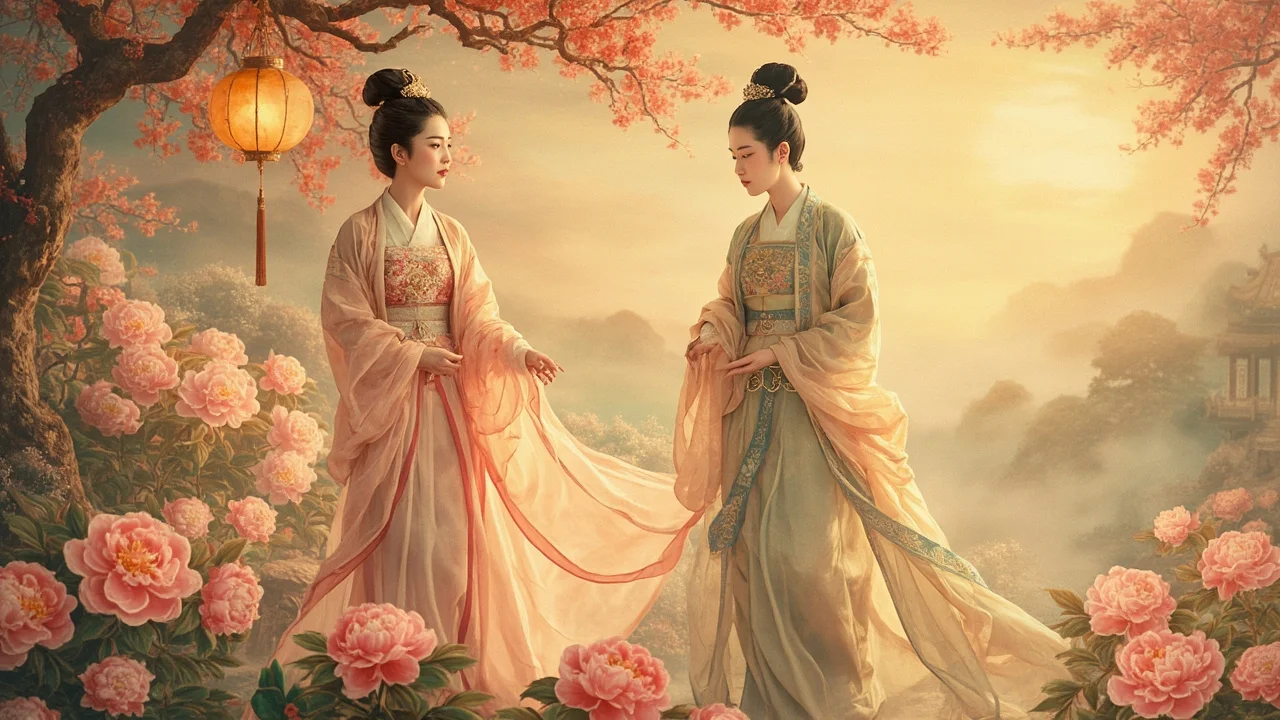
The famous “Lovesick Lamp” (长恨灯) scene — the emperor lighting a single lantern and wandering with Yang Guifei through the imperial garden, drinking, listening to music, watching flowers bloom — is in this section, and it became one of the most-painted scenes in Chinese art history.
Movement 2: How It All Went Wrong (lines 33–64)
The poem turns. Xuanzong neglects state business. Yang Guifei’s family grows powerful and corrupt. Music fills the palace day and night. Then the rebellion. The flight from Chang’an. The halt at Mawei Slope. Yang Guifei’s death. The single pear tree.
Movement 3: The Lonely Emperor (lines 65–88)
Xuanzong returns to Chang’an after the crisis has passed. The palace is still there. The flowers bloom. But she is not. He sends a Daoist priest — the poet knows his mythology — to search for her spirit in the afterlife. The priest wanders through the heavens, finds her on a fairy island in the eastern sea, surrounded by jade maidens. She has, the priest reports, become an immortal. She sends a message back through him. She still remembers. She is sorry.
Movement 4: The Reunion in the Afterlife (lines 89–120)
The poem ends with one of the most quoted couplets in Chinese literature:
In heaven, we shall be birds flying wing to wing; On earth, we shall be trees with branches intertwined. Heaven and earth may grow old, but this sorrow endures; And someday, in some other life, we shall meet again.
The poem ends not in death, not in judgment, but in the promise of reunion. It is one of the most generous, least moralistic endings in Chinese classical poetry. Bai Juyi, the lifelong censor, declines to actually blame Yang Guifei. He declines to actually condemn Xuanzong. The poem’s final note is sympathy for both of them, and a quiet insistence that the love itself was real.
How the Poem Got Read Wrong (and Right)
Here is the strange afterlife of Changhenge.
Bai Juyi wrote the poem, in his own introduction to it, as a warning to rulers about the dangers of neglecting state affairs for personal pleasure. His preface explicitly says he wants to remind future emperors what happens when a ruler does what Xuanzong did. That was the moral reading the poem was written to support.
The Chinese reading public almost immediately ignored him. Within decades of the poem’s composition, Changhenge had become, in effect, the founding text of the romantic tradition in Chinese literature. It was the first major poem to treat a doomed imperial love affair as the central subject, to refuse to make the woman a villain, and to insist that the feeling itself was more important than the politics. Chinese readers of the ninth, tenth, and eleventh centuries took the poem’s love story and ran with it. The opera tradition of the Yuan and Ming dynasties — most famously Hong Sheng’s The Palace of Eternal Life (长生殿) of 1688 — treats Changhenge as the foundational romantic narrative. So does the painter tradition. So does the popular ballad tradition. By the time you get to the Qing dynasty novels and the twentieth-century Hong Kong film adaptations, the love story has eaten the cautionary tale entirely.
Modern Chinese literary critics tend to split roughly into two camps on this. One camp says Bai Juyi failed — he wrote a moral warning and accidentally wrote the most romantic poem in the language, which is a humbling lesson about how writers cannot control how their work gets read. The other camp says Bai Juyi was smarter than that — that he knew exactly what he was doing when he put real emotional weight into the love story, and that the poem’s greatness lies precisely in the gap between the moral frame and the emotional truth. Either reading is defensible. Both are interesting.
What is undeniable is that Changhenge made certain things possible in Chinese poetry and literature that had not been possible before. It gave later poets a license to treat personal feeling as the legitimate center of a long narrative poem. It gave later novelists and opera writers a ready-made story that audiences already knew. And it gave ordinary Chinese readers, for the first time at this scale, a love story in which the woman was a real person with real feelings rather than a stock figure of moral ruin. That last point is harder to overstate.
Reading It Now, and a Few Places to Start
If you want to read Changhenge in English, the standard scholarly translations are:
- Witter Bynner’s The Jade Mountain (1929) — older but still quoted, very loose but fluent.
- Arthur Waley’s Translations from the Chinese (1919) — the classic Anglo-American modern translation, elegant and a little free with the meter.
- Burton Watson’s Selected Poems of the T’ang Dynasty and his later Chinese Lyricism — more literal, more reliable.
- Stephen Owen’s The Great Tang Dynasty Anthology and his separate volume on Bai Juyi — by far the most careful scholarly translation, with extensive notes; the modern academic standard.
- Wai-lim Yip’s Chinese Poetry: An Anthology of Major Modes and Genres — a useful anthology that includes a full Bai Juyi section with Changhenge.
The story has also been retold as a novel — Wang Anyi’s The Song of Everlasting Sorrow (长恨歌, 1995; English translation 2008) is a modern Chinese novel using the poem as the structural backbone for a story about a Shanghai woman across the twentieth century. If you have read only the poem itself, the novel is a fascinating companion.
A few practical notes on reading the poem. It is long. The four movements are clearly separated by the rhyme schemes (Bai Juyi changes rhyme pattern when the scene changes, which is one of the subtle technical achievements of the piece). Read it in two or three sittings the first time, not all at once. The second half is denser and more mythological; if you are going to skim, skim the first half rather than the second.
If this article has made you want to actually buy some of these texts — and possibly a teapot, a length of silk, a set of brushes — here are a few items that will hold up.
- Tang Dynasty Poetry in Translation (Penguin Classics) — A good general Tang poetry anthology in English. Includes Bai Juyi, Li Bai, Du Fu, Wang Wei, and the major secondary poets. Look for the Burton Watson edition or the Sun, de Bary, Schirokauer edition for the academic standard.
- The Song of Everlasting Sorrow (single-poem translation) — Several translators have published Changhenge as a standalone volume. The most commonly encountered are Arthur Waley’s and Witter Bynner’s versions. For something more literal, search for Stephen Owen’s Bai Juyi volume.
- Tang Dynasty: The World in the Time of Xuanzong (illustrated history book) — A general-audience illustrated book on the Tang period is the easiest way to get a feel for the material world of Xuanzong’s court.
- Chinese Calligraphy Brush and Ink Set (beginner) — Bai Juyi was himself a fine calligrapher. A basic brush-and-ink kit is the entry point. Wolf-hair brushes for general use, goat-hair for thinner strokes, a stick of sumi ink, and a small inkstone is the entire traditional kit.
- Silk Scarf with Tang Dynasty Peony Motif — Peonies, the flower Bai Juyi associates with Yang Guifei throughout the poem, are the most iconic Tang textile motif. A peony-pattern silk scarf is one of the few ways modern readers can wear something that gestures toward the period without looking like a costume piece.
Read it slowly. The poem is 1,220 years old this year and it is not slowing down. There is a reason it is still in print in every major Tang anthology in every country where Chinese literature is taught. Bai Juyi, the censor who wanted to warn future emperors, ended up writing the one poem the entire Chinese reading public decided was bigger than its author’s intentions. That is not a bad epitaph for a poet.