There’s a moment in the Book of Han — the Hanshu, the dynastic history that covers the Western Han from 206 BCE to 25 CE — where the historian stops writing about emperors and starts writing about a woman. It’s a short biographical sketch, almost an aside, but the fact that it’s there at all is unusual. Most dynastic histories of the period recorded women only as mothers, wives, or cautionary tales. This one records a woman who wrote the history itself.
The author of that passage, and of much of the Hanshu that surrounds it, was Ban Zhao (班昭, 45–116 CE), daughter of a historian, sister of a historian, and the woman who finished what her father and brother had started. She was, depending on how you read her, one of the most brilliant scholars of the Eastern Han or one of the architects of a literary tradition that constrained Chinese women for two millennia. She is also the author of the Lessons for Women (Nüjie, 女诫), a short text of seven short chapters that became the foundational work of prescriptive literature for women in East Asia.
She was a scholar first, a teacher second, and a moralist third. The order matters, because most modern discussions of Ban Zhao put the moralist first and skip the rest. She deserves better than that. What she actually did was harder and more interesting than the debates around her would suggest.
A Family of Historians
Ban Zhao was born into the right family for the job. Her father, Ban Biao (班彪, 3–54 CE), was a historian who had become dissatisfied with how later historians had handled the Western Han and had begun writing a continuation. He died in 54 CE having completed the chronologies and a handful of treatises but with most of the project unfinished. The work passed to his elder son, Ban Gu (班固, 32–92 CE).
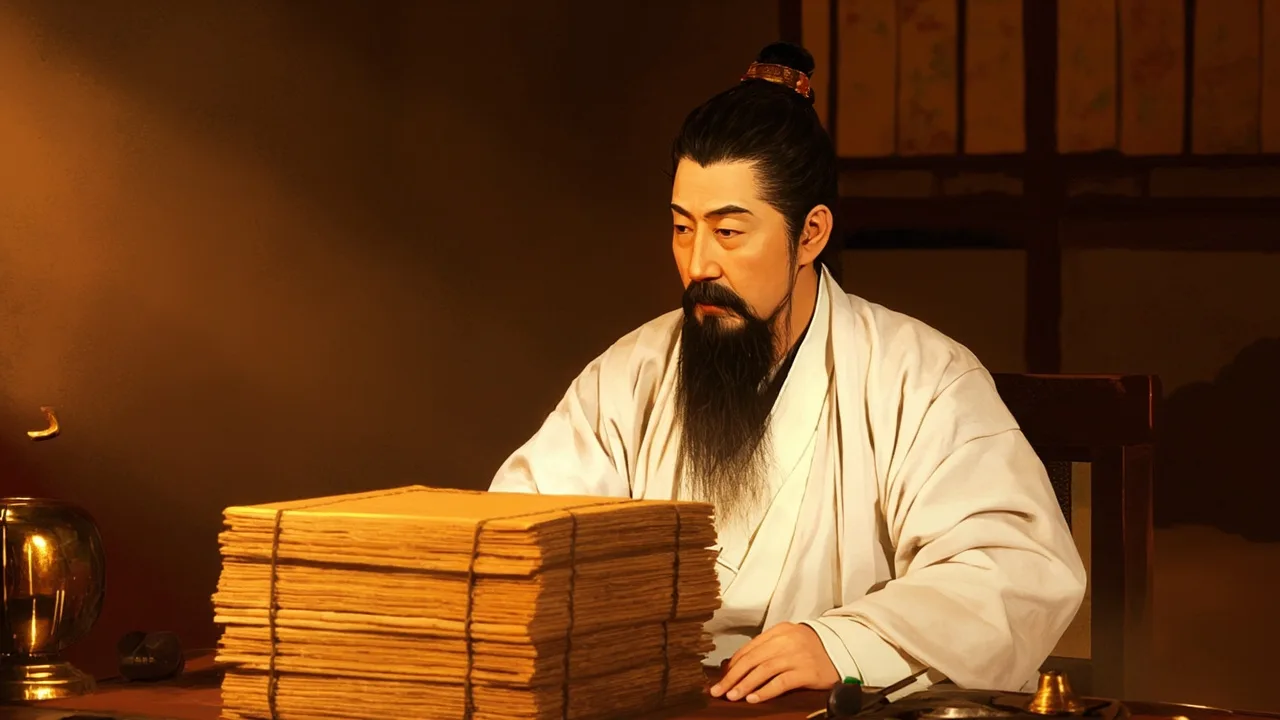
Ban Gu was the family’s star. He had been something of a prodigy — by some accounts reciting classical texts in his boyhood, by others a young man of serious literary talent. He inherited his father’s project and turned it into the Hanshu, a 100-chapter history of the Western Han that included annals, tables, treatises on rites, law, the economy, and the calendar, a chapter on geographical divisions of the empire, a long biographical essay on Wang Mang, and roughly seventy biographical chapters on the figures who had made the dynasty. It was a structural revolution. The form would be imitated for the next two thousand years.
Ban Gu was imprisoned in 92 CE, after the death of his protector, the general Dou Xian, who had fallen in the political turmoil following the death of Emperor Zhang. He died in prison that year, with eight of the Hanshu’s chapters — the biographical sections, including the long tables of imperial genealogies — still unfinished.
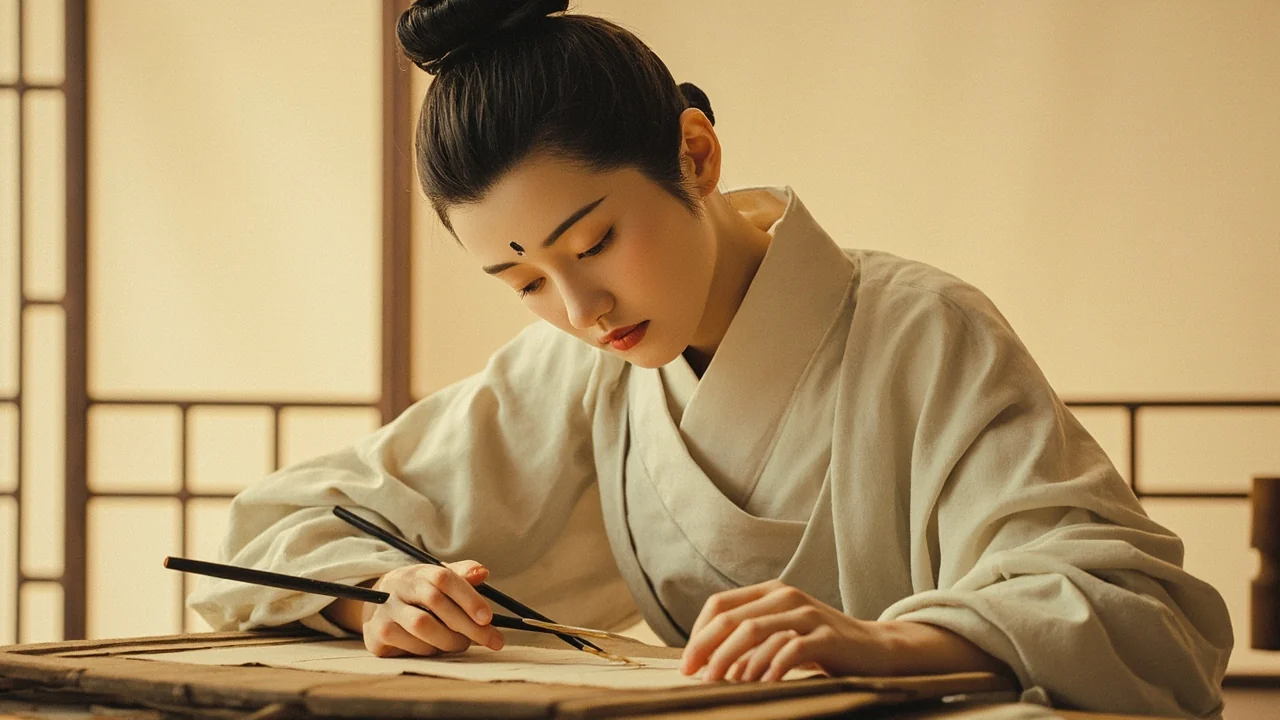
Ban Zhao was, at this point, around forty-seven years old, married, and a widow. She had been educated in the family tradition. She had, according to the Book of the Later Han (the next dynastic history, compiled in the fifth century), already been writing poetry and historical commentary. When her brother died, she picked up where he had left off. She spent roughly twenty years finishing the Hanshu — drafting the missing biographical chapters, sorting the source material, drafting the long tables that organized the imperial lineage.
She did not just complete a manuscript. She also wrote the canonical preface to the Hanshu — the famous opening chapter on the celestial and terrestrial correspondences that frame the dynasty — and she likely contributed, in some form, to the treatises on astronomy and ritual that we now have in her brother’s name. The Hanshu as we read it is, in a real sense, Ban Gu’s book edited by Ban Zhao.
There’s no exact contemporary equivalent for what she did. To get the shape of it, imagine if a modern historian’s unfinished manuscript had to be completed by his sister, who not only finished it but revised it, defended it from political attack, and made it the canonical edition — and then wrote, on top of all that, a work of theoretical scholarship that her contemporaries treated as authoritative.
If you want to engage with the Hanshu directly, Burton Watson’s [product_affiliate: Burton Watson translation of Han Shu, selected chapters from the Book of Han] remains the most accessible English version. For the broader Han historiographical context, including Ban Zhao’s role, Hans Bielenstein’s [product_affiliate: Hans Bielenstein, The Bureaucracy of Han Times, Cambridge University Press] is the standard scholarly reference.
A Teacher of Empresses
Around 88 CE, well before Ban Gu’s death, Ban Zhao had been invited into the household of the imperial family. The sources differ on the exact circumstances. What they agree on is that she became a teacher and tutor to the women of the eastern palace — the residence of the empress dowager and the heir apparent. The empress dowager at the time was Deng Sui (邓绥), the wife of Emperor Zhang’s heir, who became regent after her husband’s death in 88 CE and remained in charge of the empire for sixteen years.
The Deng regency was, by Eastern Han standards, a relatively capable period. Empress Dowager Deng was a serious, well-read woman who had lost her son and governed in the name of a succession of infant emperors. She patronized scholarship. She was a student of the classics. Ban Zhao was one of her teachers.
The teaching relationship is documented in several sources. Ban Zhao is reported to have instructed the empress dowager in astronomy, history, and the classics. The empress dowager, in turn, regularly consulted her on questions of policy and ritual. Ban Zhao also helped with state business — drafting documents, advising on ceremonial questions, and occasionally participating in debates about historical precedent. She was, by the standards of the late first century CE, a public intellectual.
What she was not was a private figure. The picture that survives from the Book of the Later Han and from scattered references in Ban Zhao’s own poetry is of a woman in her fifties and sixties who attended court regularly, knew the emperor’s closest advisors, and was consulted on matters that ranged from calendrical calculation to the appropriate mourning rites for a deceased consort.
She also wrote — a lot, by the standards of her time. We have seven surviving pieces of her prose and poetry, plus the Lessons for Women. The poetry is technical, formal, and not always inspiring. The Lessons for Women is something else.
If you want to handle this period’s material culture — the kind of objects Ban Zhao would have used — a reproduction [product_affiliate: Eastern Han bronze ink well with painted silk cover] is a beautiful object and a window onto the writing tools of the era.
The Lessons for Women and the Trouble It Made
The Lessons for Women (Nüjie) is seven short chapters, totaling maybe 1,600 Chinese characters. It was, by Ban Zhao’s own account in the preface, written as a personal document — advice to her daughters as they went out into marriages with other families. It is structured around seven virtues: humility, husband and wife, careful speech, diligence, womanly behavior, obedience, and the special duties of a woman whose husband has died. The text is moderate in tone. It is not malicious. It does not invent new restrictions on women; most of what it says is built on older texts like the Book of Rites and the Biographies of Exemplary Women by Liu Xiang (劉向).
But it has been read, for most of its history, as prescriptive. Later Confucian commentators, particularly in the Song and Ming dynasties, lifted passages out of the Nüjie and used them to construct a system of female education that emphasized submission, silence, and obedience. The Nüjie became part of the standard dowry education of upper-class Chinese girls, then Japanese girls (via the Onna Daigaku in the seventeenth century), then Korean girls. Ban Zhao’s name became, in the twentieth century, almost synonymous with foot-binding-era gender conservatism.
That is not quite fair. Ban Zhao wrote at the end of a long tradition, not at its beginning. She was, in her own life, a working scholar who had run a household, finished a multi-volume historical work, taught an empress, and raised children after her husband’s early death. She wrote the Nüjie for her daughters, not for the abstract category of women. The text itself is not particularly harsh by the standards of late-Han didactic literature. What happened later was the work of later commentators.
That said, the Nüjie does not, by modern standards, hold up. It is built on assumptions about gender and family that most modern readers reject. It deserves to be read, not for its prescriptions, but for what it tells us about the kind of moral discourse a working woman scholar in the first century CE thought worth offering her daughters. The answer is: a discourse of care, of attention, of small daily disciplines, framed within a Confucian hierarchy that Ban Zhao never questioned. That is worth knowing.
What It Meant to Be a Woman Historian
Ban Zhao was unusual, but she was not the only woman scholar of the Han Dynasty. Her older sister, Ban Jun, was a poet. Her granddaughter, Ban Jieyu, was the famous imperial consort whose story of lost favor became one of the most quoted poems of the Han — a poem in which she protests, in classical Chinese, the emperor’s growing indifference. Ban Jieyu is also credited by some sources with writing an early form of the Admonitions of the Court Instructress (the Admonitions Scroll, famous in the British Museum).
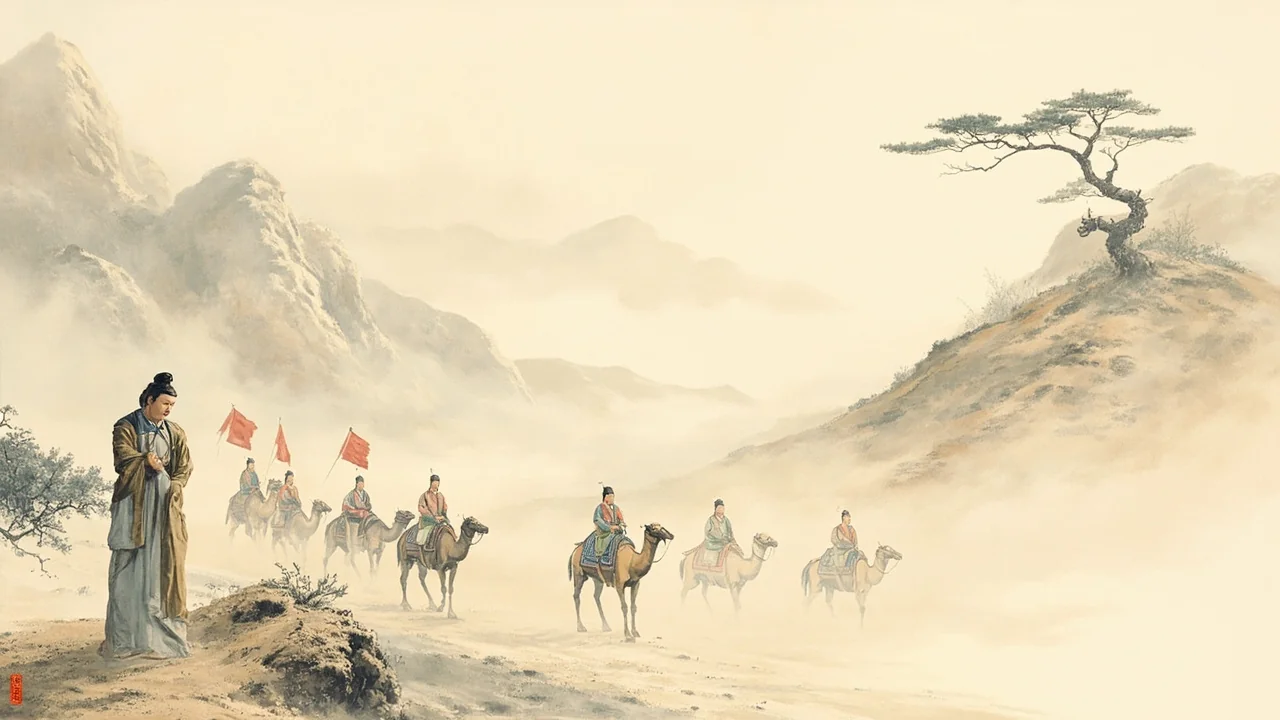
The Ban family as a whole — Ban Biao, Ban Gu, Ban Chao (the general), Ban Zhao — is one of the most distinguished families in Chinese intellectual history. They produced a general who reconquered the Western Regions, a historian who invented a literary form, a poet who became a palace consort, and the woman who held the project together across generations. The women of the family were not decorative. They were participants.
What Ban Zhao shows, in particular, is the cost. To be a working historian in the late first century CE, you needed access to books, leisure time, a family that supported education for girls, and an absence of crisis in the imperial succession. Ban Zhao had the first three. She didn’t have the fourth. She finished her brother’s book across a period of regency, regicide, palace factionalism, and epidemic. She taught an empress who was, in the end, overthrown. She wrote, throughout, in a cultural register that expected her not to exist as a public figure.
For readers interested in this broader picture — the women of the Ban family and their Han context — Bret Hinsch’s [product_affiliate: Bret Hinsch, Women in Early Imperial China, Rowman and Littlefield] is the standard scholarly introduction. For the Lessons for Women itself, [product_affiliate: annotated translation of Ban Zhao’s Nüjie with historical commentary] brings together the text, the historiographical context, and the centuries of later commentary that turned it into a foundational text.
The Afterlife of a Manuscript
Ban Zhao died in 116 CE, probably in Luoyang, the Eastern Han capital. Her sons were minor officials; one of them served in the imperial library. She had outlived her brother by twenty-four years, her husband by most of her adult life, and the political moment in which she had thrived by about a decade.
The Hanshu survived her. So did the Nüjie. So did her poetry, much of which has survived in anthologies where it was preserved, often anonymously, by later editors who could not bring themselves to credit a woman for work they would have credited a man for in a heartbeat. The Book of the Later Han — the dynastic history of the Eastern Han, compiled in the fifth century — preserves a biographical chapter on her, and it is one of the few that focuses on a woman scholar rather than a consort, an empress, or a moral exemplar.
Modern Chinese historiography has been somewhat kinder to Ban Zhao than her later medieval commentators were. The standard scholarly treatment now treats her as a major figure in Chinese historiography, comparable in importance to Sima Qian as a shaper of the genre. The Hanshu’s structure — annals, tables, treatises, biographies — became the model for every subsequent dynastic history, and Ban Zhao’s contribution to that structure is real, not just honorary. She made choices about what to include and how to organize it. Those choices mattered.
She was not, however, a feminist, in the modern sense. She was a Confucian scholar who happened to be a woman. The two facts are not contradictory. Many of the most interesting women of the early imperial period were Confucian scholars first, women second, and they did not see any tension between the two. Ban Zhao finished a major work of Confucian historiography, taught an empress, and wrote a conduct book that defined Chinese expectations of women for two thousand years. She was, on her own terms, one of the most successful women of the Han Dynasty. Whether her success is worth celebrating depends on what you think of the project she helped complete.
Either way, she is a reminder that the people who build literary traditions are not always the people whose names appear on the cover. Sometimes the cover is a brother’s name, sometimes a husband’s, sometimes a dynasty’s. Sometimes the work was done by a woman in her sixties in Luoyang who had outlived everyone who would have remembered her working hours. The manuscript, at least, kept her name.