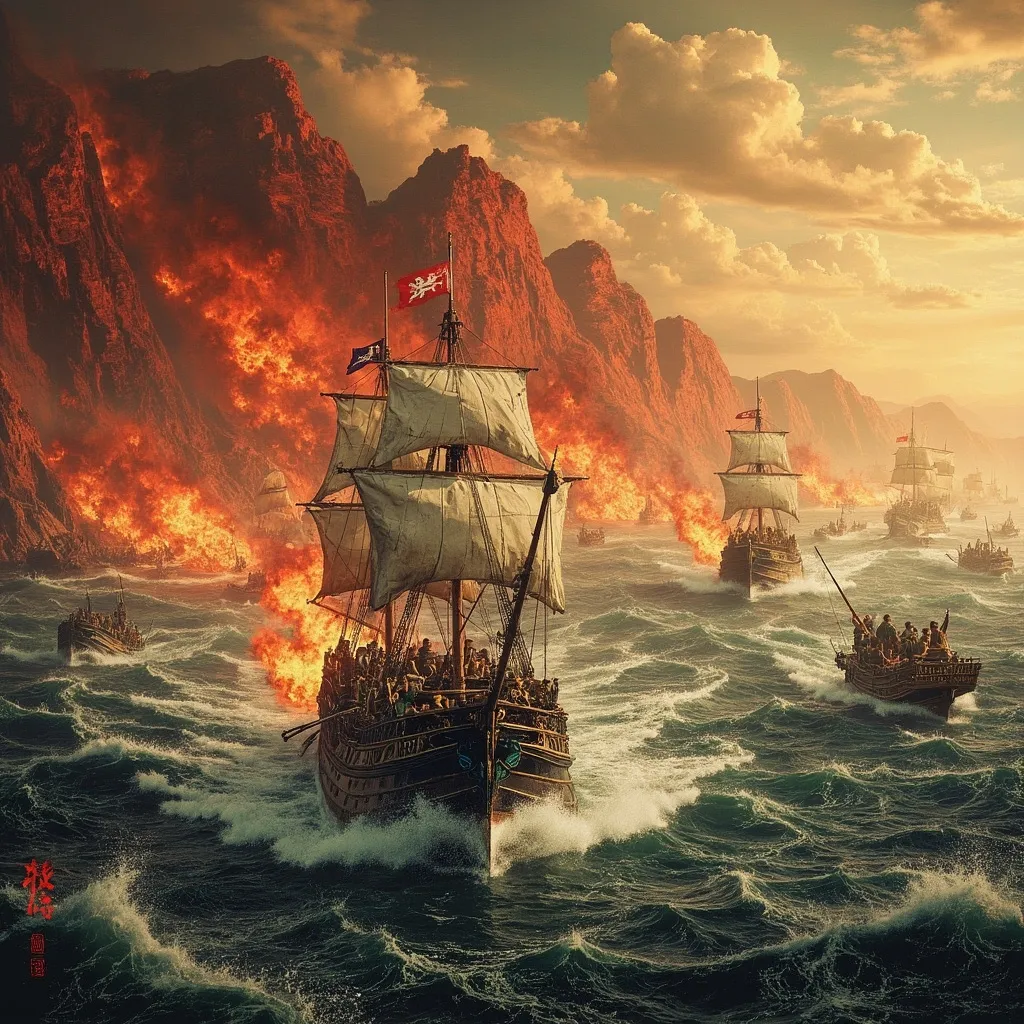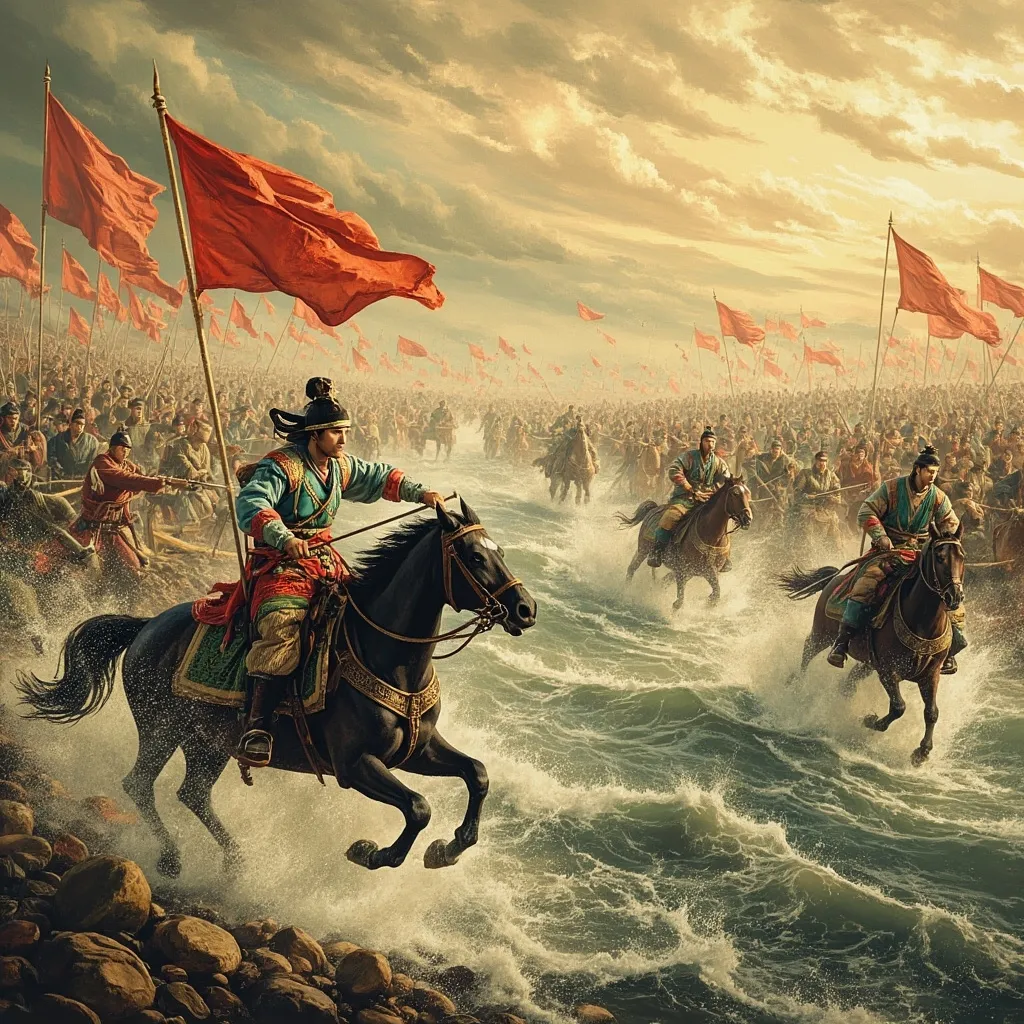
In 383 CE, one of the largest armies ever assembled in ancient China marched south toward the Yangtze River. The man leading it, Fu Jian, ruled over the Former Qin empire — the most powerful state China had seen in centuries. He commanded somewhere between 600,000 and 900,000 soldiers, depending on which source you believe, along with cavalry, supply trains, and all the apparatus of imperial might. His goal was simple: to conquer the remaining southern kingdoms and unify China under his rule for the first time in over a century.
Against him stood the Eastern Jin dynasty, a relatively small state clinging to the Yangtze River valley. Their army numbered perhaps 80,000 to 100,000 soldiers. They were outmatched in every measurable way — in numbers, in resources, in territory. Most strategists of the day gave them virtually no chance.
The Battle of Fei River — Féi Shuǐ Zhī Zhàn in Chinese — is the story of how the small side won anyway, and why that victory mattered more than almost any other battle you probably haven’t heard of.
The World Before Fei River
To understand the stakes, you need to understand what China looked like in the 4th century. The Western Jin dynasty, which had briefly reunified China after the Three Kingdoms period, collapsed in 311 CE when the capital was captured and sacked by non-Chinese invaders. What followed was a chaotic period known as the Sixteen Kingdoms era, during which numerous short-lived states rose and fell across northern China, many of them founded by ethnic minorities from the steppes.
Fu Jian was a member of the Di people, an ethnic group originally from the Tibetan plateau. He had built the Former Qin empire by conquest, unifying most of northern China through a combination of military skill and political cunning. By the 370s, he controlled a vast territory stretching from the Gobi Desert in the north to the Yangtze River in the south. His court attracted scholars and administrators from across the divided empire. He was, by any measure, the most powerful ruler in China.
But Fu Jian had one weakness that would prove fatal: he knew he was powerful, and he believed that power made him invincible. He had crushed every opponent put before him. His generals were loyal, his armies were experienced, and his supply lines were secure. When he decided to add the southern kingdoms to his empire, nobody could reasonably object.
The southern kingdoms, led by the Eastern Jin under Emperor Xiaowu, had one advantage: the Yangtze River. Fighting on the south bank meant fighting on familiar terrain, with supply lines that were shorter and more defensible. But numbers alone seemed to make victory impossible. Fu Jian reportedly laughed when he heard the size of the Jin forces, comparing the prospect of conquest to the ease of crossing a river to visit a friend.
He was about to learn how dangerous it is to laugh before the game is over.
The March South
Fu Jian’s plan was to cross the Yangtze and crush the Jin forces before they could organize a proper defense. He split his enormous army into multiple columns, planning to converge on the Jin capital and overwhelm any resistance. It was a sensible strategy for an army of its size — the problem was that coordinating so many troops across unfamiliar terrain was nearly impossible.
The eastern column, led by Fu Jian’s nephew Fu Rong, reached the southern bank of the Yangtze first and set up a defensive position. The main column, with Fu Jian himself, followed more slowly. The western column never arrived as planned. Communications between units broke down. The massive army, so impressive on paper, began to show cracks before a single major battle had been fought.
On the Jin side, the key figure was a general named Huan Wen — a capable military commander who had previously advocated for aggressive expansion north. When Fu Jian’s invasion began, Huan Wen recognized that the only chance was to meet the Qin forces quickly, before they could consolidate their position. He moved his forces to intercept the eastern Qin column at the Fei River, a tributary of the Yangtze in present-day Anhui Province.
The stage was set.
The Turning Point Nobody Expected
What happened next is one of the great cautionary tales in military history. Huan Wen’s forces crossed the Fei River and attacked Fu Rong’s eastern column. The Qin forces, despite their numerical advantage, were caught off guard and defeated. The Jin forces captured the Qin camp, supplies, and a significant amount of equipment.
But this was just the beginning. Fu Jian, with the main body of his army still largely intact, could have regrouped and continued the campaign. He still outnumbered the Jin forces significantly. He still had most of his experienced commanders and the bulk of his military strength.
Instead, he panicked. Seeing the initial defeat, and apparently believing the situation was worse than it was, Fu Jian ordered a retreat. And that’s when everything fell apart.
In a large army, a disorderly retreat is catastrophic. Soldiers who don’t know why they’re retreating, who haven’t been beaten in a decisive engagement but simply received an order to fall back, lose morale quickly. Rumors spread. Units lose cohesion. The command structure frays.
The Jin forces, seeing the Qin army in disarray, pressed their advantage. They launched cavalry attacks on the retreating columns, captured key positions, and systematically destroyed the cohesion of the Former Qin forces. Thousands of soldiers drowned trying to cross rivers. Thousands more died in the chaos of the retreat. The massive invasion force simply evaporated.
Fu Jian himself barely escaped. He eventually made it back to the capital, but the Former Qin empire never recovered. Within two years, it had collapsed into civil war, splintering into multiple smaller states that fought each other for the next several decades. Fu Jian was assassinated in 385 CE.
Why It Matters: The Defense of Chinese Culture
Here’s where the significance of the Battle of Fei River becomes truly remarkable. If Fu Jian had won — if his massive army had overwhelmed the Jin forces and completed the conquest of southern China — the entire trajectory of Chinese civilization would have been different.
The Former Qin was a non-Chinese dynasty. Its rulers came from the Di ethnic group, and the empire’s culture was a blend of steppe and Chinese traditions. That’s not inherently a problem — China had absorbed many such groups over the centuries — but the pace and scale of conquest under Fu Jian suggested something more like a displacement than an integration.
The Eastern Jin, whatever its weaknesses, represented the continuation of Han Chinese culture in the south. Its officials wrote in Classical Chinese, maintained the rituals of the Han dynasty, and saw themselves as the legitimate inheritors of Chinese civilization. When the Jin court retreated south during the early 4th-century invasions, it carried with it the institutional and cultural memory of Chinese imperial tradition.
Had Fu Jian succeeded, that cultural continuity might have been broken — or at least, profoundly disrupted. Instead, the Jin survived. And when they eventually fell, they were succeeded by the Southern Dynasties, which maintained the cultural thread that would eventually connect to the Sui, Tang, and the imperial traditions that defined China for the next millennium.
Some historians have called Fei River one of the most important battles in world history, precisely because of this cultural dimension. It’s not just that a large army was defeated by a smaller one — it’s that the battle preserved a particular vision of Chinese civilization during a period when it might otherwise have been extinguished.
The Lessons Nobody Learned
Fu Jian’s defeat is a case study in the dangers of overconfidence, but it’s worth asking: did anyone actually learn from it? History suggests the answer is: not really. Armies have continued to underestimate opponents, rulers have continued to believe that numerical superiority guarantees victory, and ambitious leaders have continued to launch massive invasions with inadequate attention to logistics, morale, and the unpredictable elements of warfare.
The Battle of Fei River is also a reminder that military strength isn’t monolithic. Fu Jian’s army was enormous, but it was also diverse — composed of many different ethnic groups, some of which had historical grievances against each other. When the retreat became chaos, those fault lines opened up. The Jin forces, by contrast, were relatively homogeneous and fighting on familiar terrain with clear supply lines.
In the end, the battle was decided not just by tactics but by context: the morale of the troops, the clarity of command, and the ability to adapt when things went wrong. Fu Jian had built the strongest army in China. But strength without wisdom is just raw material for disaster.
The Human Cost of Ambition
It’s easy to get caught up in the grand narratives of battles like Fei River — the strategy, the stakes, the outcome — and forget that thousands of real people died there. Fu Jian’s army, for all its problems, was still an enormous collection of individual human beings: soldiers who had families, hopes, and fears, who had been conscripted or persuaded or paid to march south toward an uncertain fate.
The historical records describe a catastrophe. Soldiers drowning in rivers, crushed in the chaos of retreat, dying of exposure and disease. Entire units wiped out. The scale of the defeat was so total that the Former Qin never recovered. Fu Jian himself, once the most powerful ruler in China, spent his final years as a fugitive, assassinated by his own people in 385 CE.
There’s a lesson here about the human cost of ambitious leadership. Fu Jian’s dream of unifying China was not a small one, and there’s something almost admirable about the scale of his ambition. But that ambition cost tens of thousands of lives, destroyed families, and destabilized an entire region for decades. The question of whether the unification of China was worth that cost is one that historians still debate.
What seems clearer is that the cost was not necessary. Fu Jian didn’t have to launch the invasion when he did, with forces that were too large to coordinate effectively. He didn’t have to laugh at the prospect of Jin resistance. He didn’t have to panic when the first setback occurred. The catastrophe at Fei River was not inevitable — it was the result of choices, and some of those choices were clearly better than others.
A Battle Worth Knowing
You won’t find Fei River in most Western history books. It doesn’t have the name recognition of Thermopylae or Waterloo, and it rarely appears in surveys of world military history. But for anyone interested in how civilizations survive — how cultural continuity is maintained through periods of crisis — the Battle of Fei River is essential.
The Yangtze River still flows through Anhui Province. The Fei River joins it near the city of Chaohu, and there are monuments and memorials near the ancient battlefield. For Chinese visitors, it’s a place of genuine historical significance — a reminder of the time when everything hung by a thread, and the thread held.
Next time you read about the Tang dynasty or the cultural achievements of medieval China, remember Fei River. It’s one of the battles that made those things possible.
Recommended Reading & Products
Interested in exploring the Six Dynasties period and the Battle of Fei River further? Here are some resources to deepen your understanding:
The Search for Modern China: A Documentary Collection — A useful collection of primary sources covering China’s development through the imperial period. Includes material on the Six Dynasties and the transition from Jin to Sui.
China’s Imperial Past: An Introduction to Chinese History and Culture — A comprehensive survey by Derk Bodde, covering the full sweep of Chinese history including the tumultuous 4th and 5th centuries. Excellent context for understanding why Fei River mattered.
The History of the Southern Dynasties — A scholarly translation covering the period of the Southern Dynasties that followed the Eastern Jin. Dense but authoritative — the best English-language resource for this era.
Ancient China: The Rise of Civilization in China — A more accessible illustrated overview of early Chinese history, including the Six Dynasties period. Good for readers who want broad context before diving into specifics.
Chinese Calligraphy Set for Beginners — After reading about the cultural preservation at stake in the Battle of Fei River, you might appreciate exploring Chinese calligraphy — one of the art forms the Jin scholars were working to maintain. This set includes brushes, ink, and a practice guide.