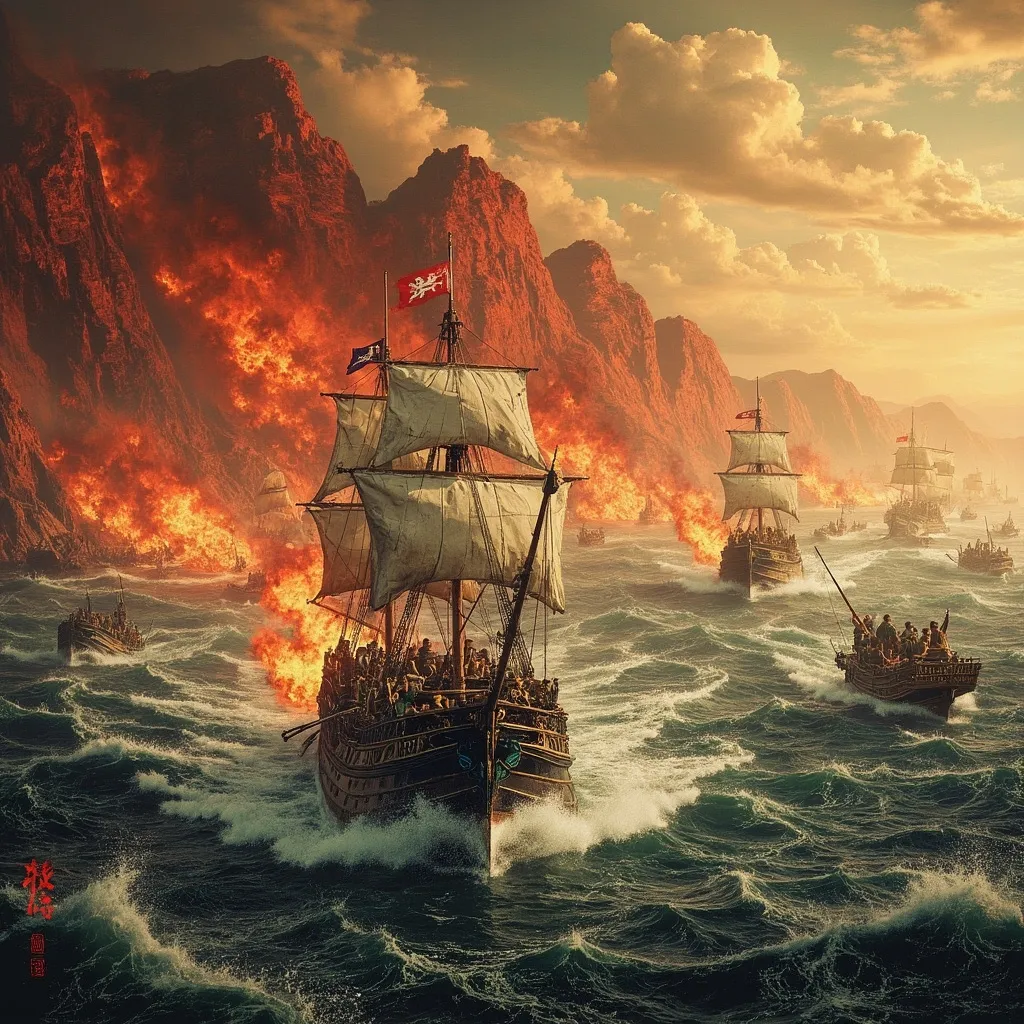
If you had to pick one battle that changed the course of Chinese history more than any other, the Battle of Red Cliffs would be a strong contender. Fought in the winter of 208-209 CE, it was the moment when the ambitions of one man — Cao Cao, the most powerful warlord of his era — were stopped cold by an unlikely alliance between two much weaker rulers. The consequences rippled outward for centuries, eventually giving rise to the legendary Three Kingdoms period that still dominates Chinese popular culture today.
Cao Cao was on the verge of unifying all of China under his rule. He had defeated numerous rivals, built a massive army, and earned a reputation as both brilliant and ruthless. Everything seemed to be falling into place. And then he met two men on the banks of the Yangtze River: Sun Quan, a young lord from the southeast, and Liu Bei, a warlord with a motley crew of followers and a reputation for being more idealistic than practical.
What happened next became the stuff of legend — a story of strategy, fire, wind, and a famous poem that every Chinese schoolchild learns.
How China Got Split and Why Red Cliffs Mattered
To understand why this battle mattered so much, you need a little context about the state of China in the years before it. The Han Dynasty, which had ruled for over four centuries, was collapsing. In the early 200s CE, the empire was effectively fragmenting into regional power bases, with warlords fighting each other for control. Cao Cao emerged as the dominant figure in the north — a skilled administrator, poet, and military commander who understood that controlling the northern heartland meant controlling the empire’s future.
By 208 CE, Cao Cao had consolidated most of northern China and turned his attention south. His army, by most estimates, numbered somewhere between 200,000 and 300,000 men — an enormous force for the time. His stated goal was to unify the empire. His implied goal was to found a new dynasty with himself at the top.
Opposing him stood Sun Quan in the southeast and Liu Bei, who had been bouncing around from city to city after losing his base in the north. Liu Bei had a small but loyal following, including two sworn brothers — the mighty warrior Guan Yu and the hot-tempered Zhang Fei — and eventually, a strategist named Zhuge Liang, who would become one of the most famous figures in Chinese history.
Individually, neither Sun Quan nor Liu Bei could match Cao Cao. Together, though, they might have a chance — if they could figure out how to work together, which wasn’t obvious. Sun Quan and Liu Bei had different priorities, different territorial interests, and a history of friction. But Zhuge Liang, in a famous meeting with Sun Quan, convinced the southern lord that Cao Cao’s goal was total conquest. There would be no negotiated settlement, no peaceful coexistence. It was victory or annihilation.
The Alliance Nobody Saw Coming
The Sun-Liu alliance is one of those moments in history where the improbable becomes real. Zhuge Liang, then in his late twenties, traveled to Sun Quan’s court and made the case for cooperation. The famous dialogue is dramatized in the classic historical novel Romance of the Three Kingdoms, and while historians debate how much of it is literal, the broad strokes are accepted: Zhuge Liang argued that the combined forces could match Cao Cao, that Cao Cao’s army was less formidable than it appeared, and that resistance was not merely honorable but strategically sound.
Sun Quan, after some deliberation, agreed. He committed his naval forces and his best general, Zhou Yu, to the alliance. Liu Bei contributed his ground troops. Together, they faced Cao Cao’s massive army on the southern banks of the Yangtze River, near a set of reddish sandstone cliffs that would give the battle its name.
Cao Cao had some problems of his own. His soldiers were from the north and not accustomed to naval warfare. Many had joined his campaign after being defeated, and their loyalty was uncertain. Disease was spreading through the camps. And Cao Cao, reportedly, had grown overconfident — so convinced of his own superiority that he dismissed the possibility that two weaker opponents could defeat him.
That overconfidence would prove fatal. It would also generate one of the great “what if” moments in Chinese history. If Cao Cao had won at Red Cliffs, he would likely have unified China a decade or more earlier than actually happened, and the Three Kingdoms period as we know it — with its heroes, its legends, its poems and plays and video games — would never have existed.
The Fire That Changed History
The battle itself was a masterpiece of strategy, and Zhou Yu deserves much of the credit. The plan involved using Cao Cao’s weaknesses against him: his reliance on wooden ships (necessary for moving troops across a river but catastrophically vulnerable to fire), his sick and demoralized troops, and his underestimation of the southern forces.
Zhuge Liang is traditionally credited with “borrowing” the eastern wind that made the fire attack possible — there’s a famous episode in the novel where he supposedly prayed for wind at a shrine and it arrived, allowing the fire ships to be driven into Cao Cao’s fleet. Whether you take this literally or not, the historical records indicate that the wind did shift at a critical moment, and the fire spread rapidly through the northern fleet.
The attack itself was devastating. Cao Cao’s ships were lashed together for stability — a common practice for naval warfare at the time — which meant that when one ship caught fire, the flames spread quickly to all the others. The result was a catastrophic defeat: ships burning, men drowning, the carefully assembled northern army in disarray.
Cao Cao barely escaped. He retreated north with what remained of his forces, acknowledging defeat. The southern alliance had won — against overwhelming odds. Zhou Yu pursued and inflicted additional casualties, but the decisive moment had already passed.
The Myth and the Reality
Here’s where things get interesting: the Battle of Red Cliffs is both a historical event and a mythological epic. The Romance of the Three Kingdoms, written by Luo Guanzhong in the 14th century, turned the battle into a saga filled with heroic speeches, clever stratagems, and larger-than-life characters. Zhuge Liang in particular became almost superhuman in the telling — capable of predicting the wind, outsmarting enemies with elaborate schemes, and serving as the wise brain behind Liu Bei’s eventually doomed cause.
In reality, the battle was probably less dramatic but no less significant. The historical records — particularly the Records of the Three Kingdoms compiled by Chen Shou in the 3rd century CE — describe a major naval engagement with fire used as a weapon, followed by a northern retreat. The political consequences were enormous: China remained divided into three competing kingdoms for the next several decades, with Cao Cao’s heirs eventually establishing the Wei dynasty in the north, Sun Quan’s Wu kingdom in the southeast, and Liu Bei’s Shu Han in the southwest.
The battle also cemented a narrative that Chinese culture has never tired of telling: the idea that brains can beat brawn, that an alliance of the outmatched and outgunned can defeat a superior foe through superior strategy, and that noble intentions — or at least, the appearance of noble intentions — matter in the grand scheme of history. These themes echo through Chinese literature, drama, and popular culture to this day.
The Battle’s Cultural Resonance
What makes the Battle of Red Cliffs endure in Chinese culture isn’t just its historical importance — it’s the way it embodies certain ideals that the Chinese have long treasured. The cunning underdog defeating the mighty force through superior strategy. The alliance forged in necessity that proves stronger than empire. The role of individual brilliance in shaping collective destiny.
Zhuge Liang in particular became a cultural archetype: the brilliant scholar-warrior who serves a righteous but weak master, who can predict the movements of stars and the flow of rivers, who drafts battle plans on a handful of bamboo slips while his enemies scramble to match his calculations. He’s essentially the Chinese version of a combination of Merlin and Sherlock Holmes — a figure whose intellectual powers border on the magical.
This archetype has been incredibly influential in Chinese culture. Intellectuals throughout Chinese history have seen in Zhuge Liang a model for their own aspirations: to serve with honor, to deploy their minds in service of worthy causes, to maintain personal integrity even when the political situation made compromise tempting.
Zhou Yu, the general who actually commanded at Red Cliffs, has a more complicated legacy. In the novel, he and Zhuge Liang are initially rivals, and Zhou Yu’s eventual death — from illness and frustration, not battle — is portrayed with a kind of melancholy respect. He was brilliant, but his pride and suspicion ultimately worked against him. The novel suggests that his inability to cooperate fully with Zhuge Liang weakened the alliance and prolonged the war.
The Lasting Legacy
Today, you can visit the site of Red Cliffs (Chibi in Chinese) in Hubei Province, where a memorial park commemorates the battle. The red sandstone cliffs are still there, rising above the Yangtze. There are statues of the key figures, inscriptions, and displays of ancient weapons. It’s a place of genuine historical significance, drawing visitors who want to connect with one of the pivotal moments in Chinese history.
The Battle of Red Cliffs also inspired one of the most famous poems in Chinese literature: Su Shi, the great Song Dynasty poet, wrote Remembrance of Red Cliffs (Chibifu) in 1082 CE, reflecting on the battle and the transience of human ambition. The poem is taught in schools throughout the Chinese-speaking world, and passages from it have become idiomatic expressions used in everyday conversation.
In popular culture, the battle has been adapted into video games, movies, television series, and comic books. The Romance of the Three Kingdoms video game series, which has sold millions of copies worldwide, puts players in command at Red Cliffs as one of its signature campaign scenarios. A 2008 Chinese film, The Epic of Red Cliffs, had one of the largest budgets in Chinese film history and depicted the battle with spectacular naval sequences. Television adaptations have been even more numerous, with multiple series dramatizing the period.
None of this would exist if the wind hadn’t shifted on that winter day in 208 CE. The next time you play a Three Kingdoms video game or watch a martial arts drama set in that era, remember: it all goes back to a fire, a wind, and a very big mistake by a man who thought he’d already won.
Recommended Reading & Products
Want to dive deeper into the Three Kingdoms period and the Battle of Red Cliffs? Here are some resources to get you started:
Romance of the Three Kingdoms by Luo Guanzhong — The classic 14th-century novel that transformed the Three Kingdoms era into legend. In one form or another, this book underlies virtually every modern adaptation. A monumental read at over 2,000 pages, but absolutely essential for understanding the cultural weight of this period.
The Records of the Three Kingdoms by Chen Shou — The historical record, written just a few decades after the events. Less dramatic than the novel, but closer to what actually happened. Essential for anyone who wants to separate history from myth.
The Battle of Red Cliffs: The History and Legacy of the Decisive Battle That Saved Ancient China — A accessible modern overview of the battle, its context, and its significance. Good for readers who want the historical facts without wading through the full novel.
Total War: Three Kingdoms Video Game — Creative Assembly’s acclaimed strategy game set during the Three Kingdoms period. The Battle of Red Cliffs is one of the campaign scenarios. A great way to experience the period interactively and understand the tactical challenges both sides faced.
Three Kingdoms: Complete Television Series (Chinese with subtitles) — A Chinese television adaptation of the Three Kingdoms story, widely considered one of the best adaptations ever made. Beautifully produced and surprisingly faithful to the novel’s major plotlines.