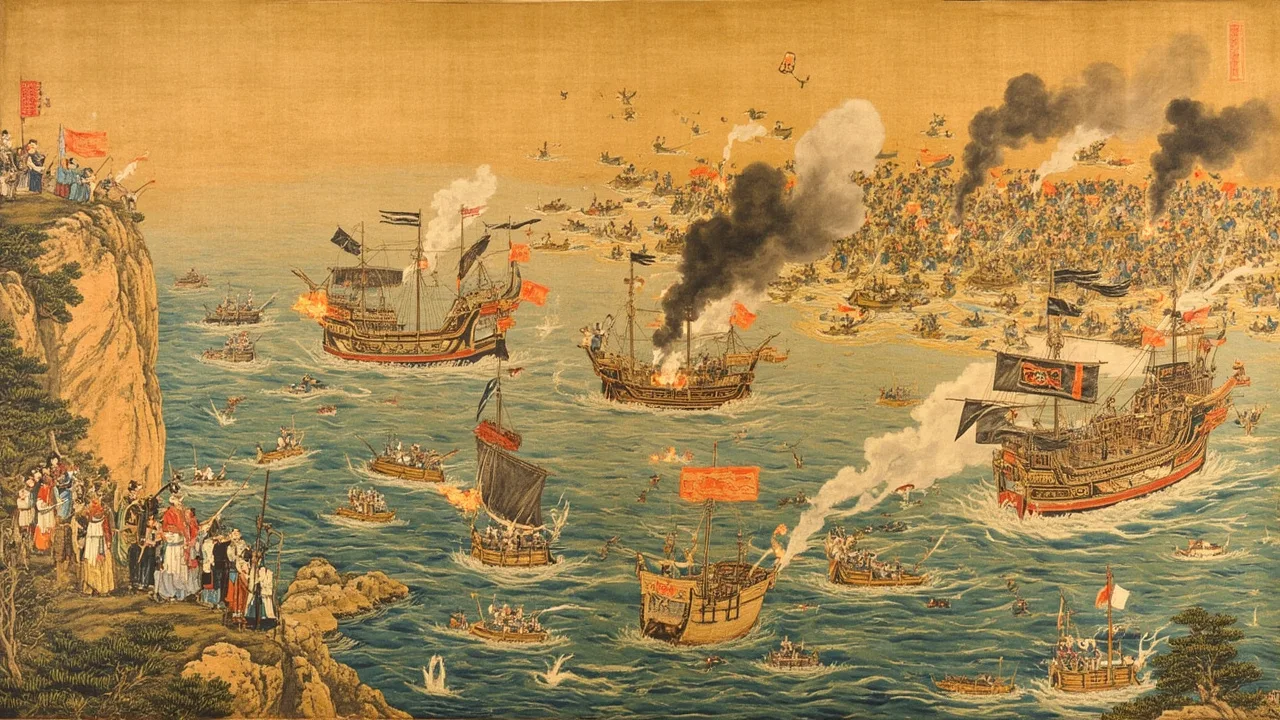
On the morning of February 6, 1279, a seven-year-old boy stood at the stern of a wooden warship in the shallow waters of Yashan, Guangdong Province. He was Emperor Zhao Bing, the last ruler of the Song dynasty — a dynasty that had governed China for more than three centuries. Behind him stood Lu Xiufu, the loyal prime minister who had spent the past three years dragging a crumbling empire from one coastal refuge to the next. Around them, more than a thousand Song warships formed a desperate ring against an enemy Yuan fleet four times their number.
Within hours, the battle would be lost. Lu Xiufu clutched the boy emperor in his arms, declared — according to most accounts — “The dynasty cannot be defeated, yet here the dynasty dies,” and walked into the sea. Between ten and two hundred thousand Song soldiers, officials, and civilians followed him, drowning rather than submit to Mongol rule. The Song dynasty was over. China was about to enter its first non-native imperial era.
The Battle of Yashan is one of the most emotionally charged events in Chinese history — a naval catastrophe that ended not just a dynasty but an entire understanding of what China was. Understanding it requires understanding not just the battle itself, but the political collapse that made it inevitable, the military decisions that shaped it, and the deep cultural resonance it still carries today.
The Road to Yashan: Three Years of Retreat
The Song dynasty did not fall at Yashan. It had effectively collapsed three years earlier, in the spring of 1276, when Mongol forces captured the capital Lin’an — what Americans would recognize as modern Hangzhou.
By 1275, the Mongol Yuan empire had steamrolled through northern China and was pressing hard on Song territory south of the Yangtze River. The Song court, led by Emperor Gong (Zhao Xian), made the agonizing decision to surrender rather than fight to the last possible moment. Emperor Gong was taken to Dadu (modern Beijing), where he lived out his days under what we might charitably call house arrest.
But not everyone surrendered. A group of loyal Song officials — including Chen Yizhong, the naval commander Zhang Shijie, the poet-scholar Wen Tianxiang, and Prime Minister Lu Xiufu — smuggled the two young princes Zhao Qi and Zhao Bing out of the capital and sailed south. Their goal was simple and hopeless: to keep the Song dynasty alive.
For three years, this rump Song government moved from one coastal city to the next — Fujian, then Guangdong — constantly chased by Yuan forces, constantly trying to regroup, constantly losing ground. Zhao Qi died of illness in 1278 at the age of about eleven. The younger brother, seven-year-old Zhao Bing, was immediately declared Emperor Bing. He was, by any measure, a symbolic ruler — a child placed on a throne by adults who understood that the survival of the dynasty itself had become a matter of political legitimacy, not military reality.
Lu Xiufu served as his prime minister and closest advisor. Zhang Shijie commanded what remained of the Song fleet. Wen Tianxiang, whose poetry would later become required reading for Chinese schoolchildren, organized what few ground forces they had left. Together, they represented a dynasty in its final, desperate chapter.
By early 1279, the Yuan army under the general Zhang Hongfan had cornered them at Yashan, a narrow stretch of coastal water near present-day Xinhui District, Jiangmen City, Guangdong. The Song had roughly two hundred thousand soldiers and a fleet of about a thousand warships. The Yuan had around one hundred thousand troops and a comparable fleet. On paper, the Song outnumbered their opponents. In practice, their morale was shattered, their supplies were running low, and they were fighting on unfamiliar terrain against an enemy that had not lost a major engagement in twenty years.
The Naval Engagement: A Desperate Fleet Against Four-Pronged Assault
The battle that unfolded over February 6–7, 1279 was less a conventional military engagement than a final, suffocating siege.
The Yuan general Zhang Hongfan — who had earned his reputation crushing Song resistance elsewhere — chose a strategy designed to exploit the Song fleet’s critical weakness: water supply. The Song warships depended on access to fresh water from the nearby shore, without which their crews and horses could not survive. Zhang Hongfan ordered his forces to construct a palisade of wooden stakes and hardened earth along the shore, effectively blocking the Song fleet from reaching water. This “water sluice and scorched earth” strategy slowly suffocated the Song position.
For weeks, the Song fleet was trapped. They attempted several sorties to break the Yuan encirclement, but each failed. Zhang Shijie, the Song naval commander, tried repeatedly to cut through the Yuan blockade. The Song soldiers fought with the grim determination of men who understood there was nowhere left to retreat. But the Yuan siege was methodical and patient.
On February 6, Zhang Hongfan launched his final assault — a four-pronged attack from multiple directions against the Song fleet. The Song, exhausted and starving, collapsed. Zhang Shijie was killed trying to break through the Yuan lines, his warship overrun. The Song fleet, leaderless and broken, began to disintegrate.
What happened next has been recounted in Chinese historical memory for seven hundred years. Lu Xiufu, the prime minister, strapped the seven-year-old Emperor Zhao Bing to his back and walked off the stern of the flagship into the sea. According to the historical record — and in contrast to the romanticized versions that came later — Lu Xiufu was probably around thirty-eight years old at the time, not the elderly figure depicted in some later paintings. The boy on his back was Emperor Bing, the last Song emperor.
The Mingshi — the official history of the Ming dynasty compiled a century later — records that between ten thousand and several hundred thousand people followed Lu Xiufu into the water. The exact number is impossible to verify and has been a matter of political debate ever since. What is certain is that this was not a small group of officials choosing death over surrender. Large numbers of soldiers, sailors, and civilians aboard the Song ships chose drowning over living under Mongol rule.
Wen Tianxiang, who was not present at Yashan (he had been captured by the Yuan a year earlier and would be executed in 1283), captured the emotional weight of the moment in poetry that still resonates in Chinese culture today. His most famous lines about the battle would be written later, but the event itself became the defining symbol of national loss for generations of Chinese people.
Why This Battle Still Echoes in Chinese History
The Battle of Yashan carries a weight in Chinese historical memory that few military defeats can match. It is not merely the end of a dynasty — it is the end of an entire world.
The first great naval battle in Chinese history. While the Song dynasty had engaged in naval warfare before — most notably at the battle of Tangxi in 1161 — Yashan was on an entirely different scale. The thousand-warship fleet assembled at Yashan represented the largest classical Chinese naval force ever put into the field. It was, in the language of military history, a true “fleet battle” rather than a river skirmish or coastal raid. Chinese historians have called it the nation’s first genuinely large-scale maritime engagement, and it ended with the total destruction of one side’s fleet.
The end of Han Chinese rule in traditional China. For American readers, the closest historical parallel might be the fall of Constantinople in 1453 — not just a military defeat, but the end of an era and the collapse of a world order. The Song had governed China for 319 years, interrupted only briefly by the Jin dynasty in the north. Its fall to the Mongols meant that for the first time since the Tang dynasty, China was ruled by a non-Chinese ethnic group. The “Han Chinese political authority” that had defined imperial governance for centuries ended at Yashan. Mongol rule under the Yuan dynasty would last nearly a century.
The “China is dead, under heaven there is no justice” response. News of the Song’s fall sent shockwaves across East Asia. Japan, which had long looked to China as the cultural center of the civilized world, reportedly closed its borders to Yuan embassies for decades, effectively ending diplomatic contact. Korean historians recorded the event as a catastrophe. In Vietnam, which had long maintained its own tributary relationship with the Song court, officials mourned the fall of what they considered the legitimate center of Chinese civilization. The phrase “China is dead, under heaven has no rightful ruler” — associated with the reaction to Yashan — became a touchstone for later Chinese writers facing national humiliation.
The birth of a nationalist myth. In the twentieth century, as Chinese intellectuals and revolutionaries sought symbols of national resistance, Yashan was transformed from a defeat into a triumph of spirit. The writer and scholar Qiuran Gong (丘逢甲), writing in 1896 about Taiwan’s separation from mainland China, invoked the memory of Yashan with the famous line: “Four hundred million people cry as one voice.” The battle became a template for understanding Chinese national identity as something that could survive military defeat — a story not about winning, but about refusing to submit.
Lu Xiufu’s loyalty to the child emperor, Wen Tianxiang’s subsequent martyrdom, and the collective drowning of Song soldiers and civilians all became symbols of a particular Chinese ideal of patriotic devotion that transcended individual survival. In this reading, Yashan was not a defeat — it was a statement of who the Chinese people were.
The politics of memory. Different governments have used Yashan for different political purposes. In mainland China, the battle is taught as an example of national resistance and the tragic price of defending one’s country. In Taiwan, the same battle has been invoked by those who see the island’s separate political identity as a continuation of the Song tradition — a claim that mainland Chinese historians strongly contest. Both sides claim the same dead. The battle’s meaning remains genuinely contested, which is perhaps the surest sign of how deeply it sits in Chinese cultural memory.
What Survived: Archaeology and Memory at Yashan Today
The battlefield of Yashan is not merely a historical abstraction. For decades, it has been a site of active archaeological investigation and ongoing cultural commemoration.
Between 1976 and 1984, Chinese archaeologists conducted excavations at the Yashan site in Xinhui District. They recovered a remarkable array of artifacts from the Song period: bronze mirrors, copper coins, and most remarkably, a collection of intact Song dynasty porcelain. These objects — ordinary goods from an ordinary naval supply depot — offer a tangible connection to the last days of the dynasty. A bronze scale weight from the period bears the inscription “官” (guan, meaning “official”), suggesting it was part of the Song military’s own equipment. The copper coins recovered span the entire Song period, from the dynasty’s founding in 960 to its final years.
In 2003, the local government in Jiangmen’s Xinhui District established the “Song-Yuan Yashan Naval Battle Cultural Tourism Zone” — a heritage park at the site of the battle. Every year, official commemorative ceremonies are held at Yashan to honor the dead. The event has become a site of pilgrimage for school groups, government officials, and history enthusiasts alike.
For visitors to Guangdong interested in making the journey, the Yashan Memorial Hall displays archaeological finds from the site, including recovered weapons, coins, and porcelain. The memorial itself is positioned on a hillside overlooking the water, offering a view not unlike what Song commanders would have seen in 1279 — a narrow channel, scattered islands, and open sea beyond. Walking the grounds, you can trace the approximate lines of the Song and Yuan fleets from the memorial’s observation platform.
The continuing archaeological work at Yashan is significant because it allows historians to move beyond the mythology that developed around the battle — mythology that has sometimes obscured the actual events with layers of nationalist interpretation. The physical evidence of the Song naval presence at Yashan, recovered through careful excavation, provides a grounding in material culture that no amount of later poetic embellishment can replace.