If you have ever picked up a paperback book, scrolled through a webpage, or watched a newspaper roll off a press, you have used something Bi Sheng thought of first. We are not sure what he looked like. We do not know where he was born. We have no diary entry, no portrait, not even a clean death date. What we have is roughly 250 characters — about a paragraph and a half — written by a friend who thought the man’s invention was worth jotting down. That paragraph, tucked into Shen Kuo’s Mengxi Bitan around the year 1088, is the entire reason anyone still remembers Bi Sheng today.
I want to be careful with him. The temptation, when you write about a Chinese inventor whose name Western schoolbooks do not teach, is to load him up with qualities the historical record simply does not support. Bi Sheng was not the figurehead of a great printing revolution. He was an obscure craftsman working in what is roughly modern Kaifeng or Hangzhou during the Northern Song dynasty, somewhere between 1041 and 1048, who had an idea that should have changed the world and mostly did not — not because the idea was wrong, but because Chinese woodblock printing was already too good, and Chinese was too complicated, and the timing was, as it often is, just slightly off.
So let me walk you through what we actually know, what is plausible but unproven, and the parts of the story that are genuinely fascinating — the Tangut clay type discovered in a dead city, a Korean Buddhist text printed 78 years before Gutenberg’s Bible, and the long quiet afterlife of an invention that beat Europe by four centuries and then watched Europe win anyway.
The Man We Know Almost Nothing About
Bi Sheng, Bi as in “must,” Sheng as in “born into,” lived during the reign of Emperor Renzong of Song. That is about all the biographical detail that survives. Chinese dynastic records of the period are dense with names — ministers, generals, poets, salt commissioners — but Bi Sheng appears in none of them as a titled official. He is mentioned only once, in Shen Kuo’s “Skills” (jiyi) chapter of Mengxi Bitan, and even there he shows up as almost an afterthought. Shen Kuo is describing how a man he knew once made printing faster, and the entire account is a single, dense paragraph.
What can we infer? He was probably a commoner, not a scholar-official, because no official biography records him. He probably worked in a print shop or was connected to one — perhaps the book trade of Kaifeng, the Northern Song capital, or possibly Hangzhou, which would later become the Southern Song capital. He lived during a period of extraordinary book production: between 960 and 1100, Chinese woodblock printing moved from a cottage curiosity into an industrial-scale industry, with some editions running into the thousands of copies. Anyone working in that world would have known the bottleneck. Carving a single page of Chinese text into a wooden block could take a skilled artisan several days. To print a 100-page book meant carving 100 blocks. Every typo meant recutting. Bi Sheng’s contribution was to ask: what if you only had to carve each character once?
The Paragraph That Saved His Name
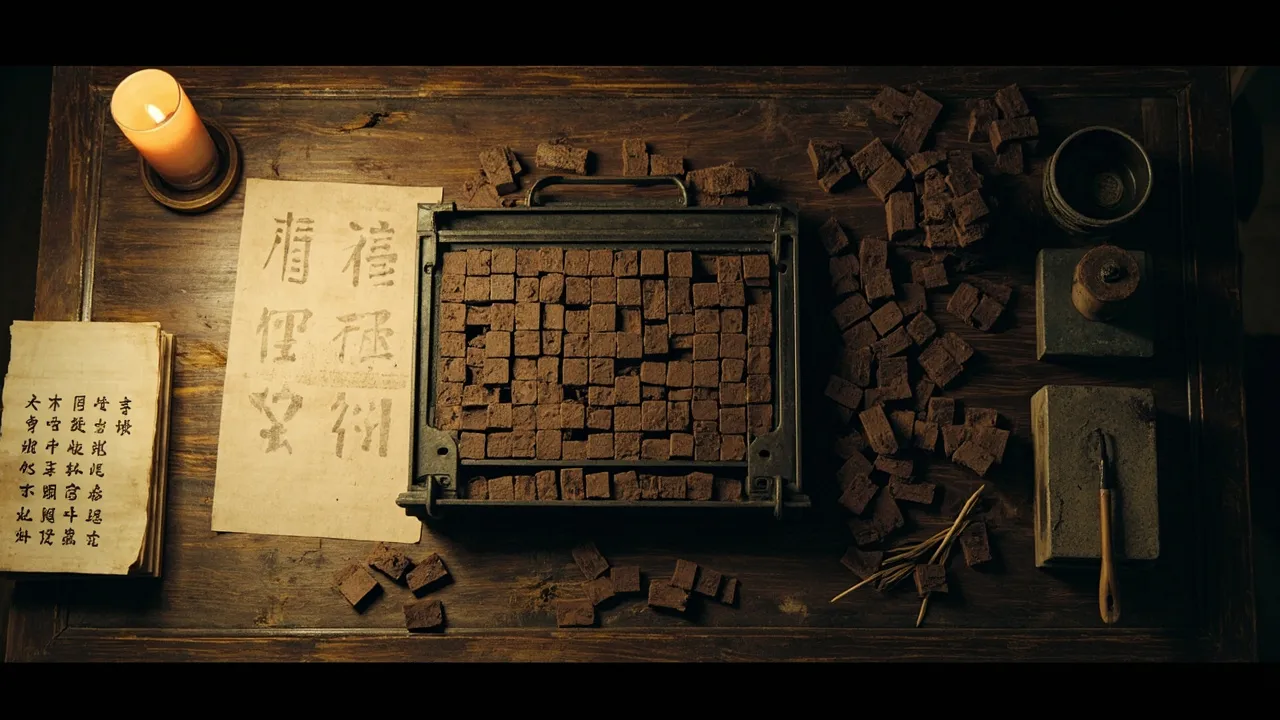
Shen Kuo’s entry on Bi Sheng is one of the most consequential paragraphs in the history of technology. In the standard modern translation, it reads roughly like this: when Bi Sheng was experimenting with printing, he thought of using clay carved character by character. He took clay as fine as the clay used for fine pottery, cut it into small tablets the size of a coin, and carved a single character on each tablet with a knife, then fired the tablets in a kiln to harden them. To print, he set the type tablets on an iron plate coated with a mixture of pine resin, wax, and paper ash. He pressed them flat with another iron plate, so that the type was locked at the level of the surface. Then he inked the type, pressed paper on top, and printed — exactly the same way woodblock printing was done, only with type that could be reused.
When he had finished printing one batch, he would heat the iron plate again until the pine resin and wax softened. Then he could remove the type with a light tap, clean it, and reassemble it for the next page. Shen Kuo adds, almost offhandedly, that Bi Sheng had a set of type stored in two cases, with the case labeled pian (slips with characters) for use and zhong (slips with characters) for storage, and that he sometimes used the same character twice on a single page. The whole thing is matter-of-fact. It sounds like a man describing a useful kitchen tool, not announcing a revolution.
The paragraph matters because Shen Kuo is one of the most meticulous observers in the entire Chinese scientific tradition. His Mengxi Bitan (Dream Pool Essays), written between about 1086 and 1093, records everything from the magnetic compass to the camera obscura, and Shen Kuo personally checked or witnessed most of what he recorded. If he wrote that Bi Sheng did this, Bi Sheng did this. The technique is also internally consistent — every step in the process is plausible to a tenth-century craftsperson. The materials (clay, iron, pine resin, wax) are all available. The procedure is, in fact, exactly what a careful workman would have invented to solve the recurring problem of Chinese woodblock print errors. We are not dealing with a legend. We are dealing with a documented technique that, somehow, almost no one used.
How the Clay Type Actually Worked
The reason Bi Sheng’s process is so interesting is that it solved a real problem in a way that required only the materials already in a print shop. The Chinese printing world at that moment was woodblock printing at scale: for each page, an artisan would paste a piece of thin paper with the page text written on it onto a block of pear or jujube wood, carve the negative space away with a knife, ink the raised surface with a brush, lay paper on top, and burnish the back to transfer the ink. A skilled carver could produce two or three pages a day. A 100-page book required carving 100 blocks, and a printing error in the middle of a run meant recutting from scratch.
Bi Sheng’s clay type broke this into reusable parts. Each character became its own little printing block. To print a new page, the printer arranged the character tablets in an iron frame, locked them in place with an adhesive that could be melted and re-set, and printed the page. When the run was done, he could release the type, sort it back into the storage case, and recompose a different page. For a language with thousands of characters, the storage problem was real — Shen Kuo notes the two-case system — but in principle, you no longer had to carve wood for every page. You carved clay once per character, and you were done.
The technique was not, in any sense, the only way to do it. Chinese printers would later use wooden movable type (the standard method from the Ming dynasty onward) and bronze movable type (used in Korea and parts of China for Buddhist sutras). Western printers, starting with Gutenberg in the 1450s, used a lead-tin-antimony alloy that took the idea and made it industrial. What Bi Sheng did first was to realize that the underlying concept — reusable character blocks locked in a frame — was independent of the material. His choice of clay was clever because fired clay is hard enough to print with, cheap to produce, and easy to recut if you needed a new character. But the choice was also provisional. He was solving a problem for the workshop he was in. He was not solving it for a continent.
Why the Idea Did Not Take Hold in China
Here is the strange part. Bi Sheng’s invention was not lost. It was not suppressed. It was simply ignored for about 400 years, by which point Gutenberg was dead and the Western printing revolution was underway. The reason is mostly arithmetic.
Chinese is a logographic language. A working Chinese vocabulary — literate usage, not counting proper nouns and rare classical forms — runs between 6,000 and 10,000 characters. The number of distinct characters that have ever been used across the entire history of Chinese writing is somewhere north of 80,000, and even a fairly comprehensive set of wooden movable type for a print shop might need 20,000 or more characters. To store, sort, and retrieve that many tablets is genuinely difficult. Woodblock printing, by contrast, worked page by page. You did not have to look anything up. The page was already laid out, with the right characters in the right order. You just printed it.
Woodblock printing had other advantages too. It produced what is still, by general consensus, the most beautiful printed page in the history of the book — the dense black ink, the subtle carving of fine lines, the integration of illustrations and text. A clay type page would look chunkier, with ink distributed unevenly across the joins between adjacent characters. The visual quality of woodblock was simply superior. And in a culture that valued calligraphic refinement, that mattered. The Song and Yuan dynasties had a deep aesthetic of fine brushwork, and printed books were meant to honor that aesthetic, not fight it.
So movable type sat in the historical record as a clever idea that no one quite needed. Wang Zhen of the Yuan dynasty wrote about it in 1313 in his Nong Shu (Book of Agriculture), describing wooden movable type and a friend who had tried it, but treating it as an interesting curiosity rather than an industry standard. By the time the Ming dynasty got serious about printing again in the 15th and 16th centuries, movable type was used in some government printing projects (where many identical forms were needed) but woodblock printing remained the default for everything else. The technique that Shen Kuo recorded in 1088 had become a footnote.
The Tangut Clay Type and the Western Xia Ghost
The earliest surviving physical movable type in the world is not Chinese. It is Tangut. The Tangut people ruled the Western Xia kingdom in what is now northwestern China from 1038 to 1227, and they spoke a language — Tangut, or xixia — that was unrelated to Chinese but logographic in form, with thousands of distinct characters. They also produced movable type, independently or possibly influenced by the Song, and the earliest dated specimens come from the 12th century.
The most famous discovery is from Khara-Khoto, the dead Western Xia city excavated by the Russian explorer Pyotr Kozlov in 1909. Among the ruined libraries, Kozlov found wooden printing blocks, manuscript fragments, and small movable type pieces — wooden and clay — that had been used to print Buddhist sutras and government documents. These are real, dated artifacts. The earliest surviving printed book in any language using movable type is not Gutenberg’s 1455 Bible. It is the Jikji, a Korean Buddhist text printed in 1377 with movable metal type at Heungdeok-sa temple in Cheongju. It is 78 years older than the Gutenberg Bible, and it is in the Bibliothèque nationale de France today, having been recognized by UNESCO in 2002 as part of the Memory of the World.
The pattern is striking. Movable type, once invented, kept being reinvented — by Tanguts in the 12th century, by Koreans in the 13th and 14th centuries, by Gutenberg in the 1450s, and by many smaller workshops in between. The technical idea is simple enough that it occurs to multiple cultures independently. What mattered was whether the culture’s other systems — language, materials, economics, aesthetics — made the idea useful in that particular place and time. Bi Sheng had the idea first. He lived in a culture where the idea was not yet useful.
What Bi Sheng Got Right Anyway
It is easy, looking back, to treat Bi Sheng as a footnote in a longer Gutenberg story. I want to push back on that. Bi Sheng did not just “get there first.” He understood, several centuries before anyone in Europe, that the bottleneck in printing was not the press but the type, and that the type could be reusable. That insight is what Gutenberg would later use to launch a communications revolution. Bi Sheng arrived at the same insight, in a different material, in a different language, in a different economy. The fact that he could not yet exploit it does not make the insight smaller.
Shen Kuo, for his part, knew exactly what he was recording. He wrote the Bi Sheng paragraph in the same chapter that describes the magnetic needle suspension that made the mariner’s compass possible, the use of petroleum in warfare, the discovery of fossils, and the mathematics of the lunar orbit. In the Mengxi Bitan, Bi Sheng sits next to the great inventions of the Song dynasty as one of them. Eight hundred years later, we are still reading that chapter. The name may be obscure. The paragraph is still there.
Recommended Products
- [chinese-printing-history-book]: History of Chinese Printing — A comprehensive survey of woodblock printing, movable type, and the Song dynasty printing revolution, including Bi Sheng and the broader print industry
- [song-dynasty-art-book]: Song Dynasty Art and Culture — Visual survey of Northern Song artifacts, painting, calligraphy, and technological innovation
- [chinese-calligraphy-beginner-set]: Chinese Calligraphy Starter Set — Brush, ink stick, inkstone, and rice paper for practicing Chinese character writing
- [traditional-ink-stone]: Traditional Chinese Inkstone — Carved Duan inkstone for grinding ink, the same tool a Song dynasty printer would have used
Disclosure
Some links above are affiliate links. We earn a small commission if you purchase through these links, at no extra cost to you. We only recommend products we genuinely believe enhance your understanding of Chinese culture.