Every one of us has been there. You’re in a meeting, watching two people argue passionately about the same set of facts, each convinced the other is completely wrong. Or you scroll through social media and see two people interpreting the same event in ways that seem to belong to entirely different realities. You watch a political debate and wonder how two reasonable people can look at identical evidence and reach opposite conclusions. It’s enough to make you wonder: is anyone actually seeing the full picture, or are we all just fumbling around in the dark, describing what we bump into?
The ancient Chinese masters asked the same question, and they told it through a story so simple it almost seems too obvious. Yet somehow, after 2,500 years, we still haven’t fully absorbed its lesson. The story is called 盲人摸象 — máng rén mō xiàng — which translates directly to “blind men touching an elephant.” It’s one of those tales that starts as a children’s story and ends up keeping you up at night once you realize you can’t stop applying it to your own life.
The Story: Six Men, One Elephant, Six Different Beasts
The tale comes from ancient Buddhist texts that found their way into Chinese culture, though variations exist across many Asian traditions — there’s a famous Indian version, a Persian version, and versions scattered across Southeast Asia. The core narrative, however, remained remarkably consistent: a group of blind men encounter something new, each touches a different part, and each becomes absolutely certain of a completely different conclusion.
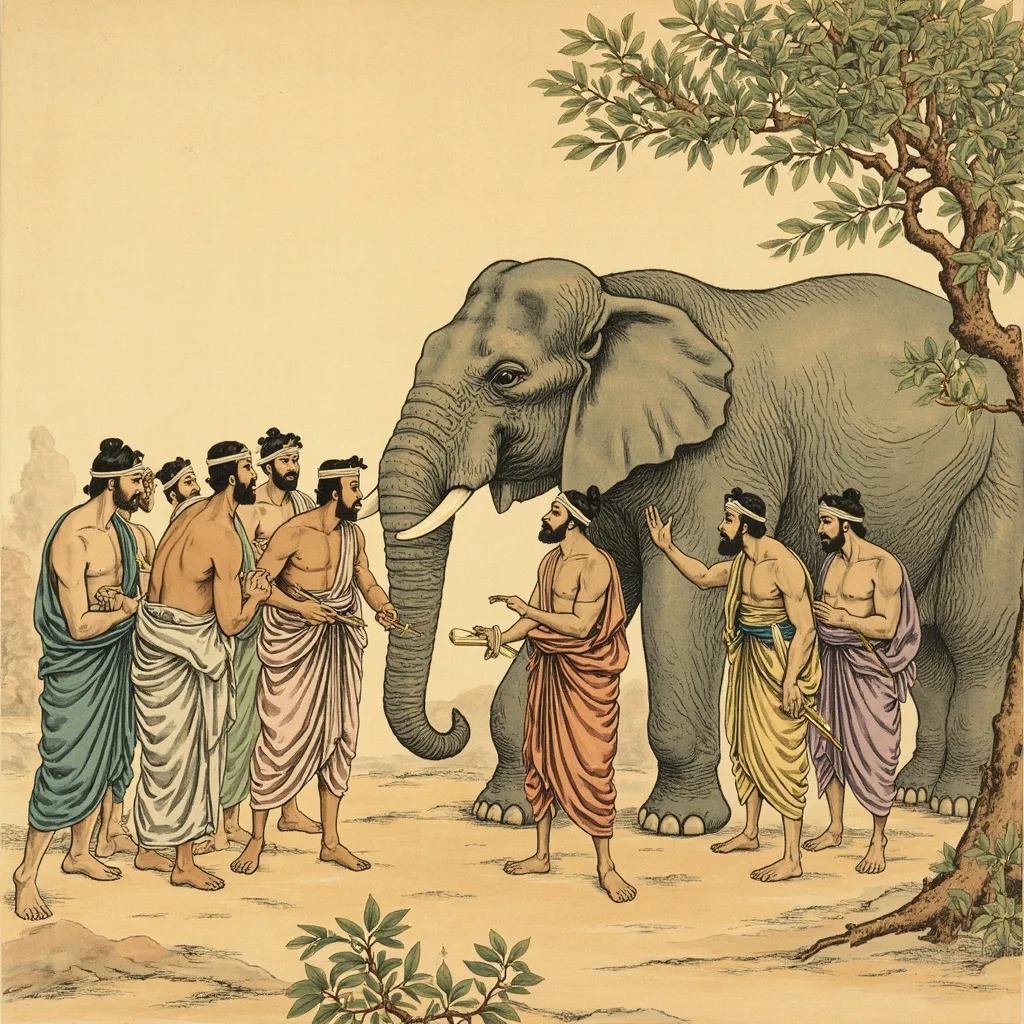
The setup is straightforward: a king decides to settle a philosophical debate by bringing an elephant into a dark room and inviting six blind men to examine it by touch alone. The men have never encountered an elephant before — they don’t even know what an elephant is. They only know shapes, textures, temperatures, and the particular qualities of whatever they’ve touched in their lives.
Each man is given the chance to feel one part of the animal. The first blind man grabs the trunk and declares an elephant is like a snake — long, flexible, moving with a life of its own. The second stumbles upon a tusk — smooth, hard, pointed — and insists it’s like a spear. The third wraps his arms around a leg and argues the beast resembles a pillar, massive and unshakeable. The fourth reaches the flank and confidently announces the elephant is like a wall, broad and flat and stretching endlessly in his perception. The fifth touches an ear and claims it’s like a fan, thin and spread out and fluttering slightly in the nonexistent breeze. The sixth finds the tail and swears up and down that an elephant is nothing more than a rope, thin and wispy and utterly unimpressive.
They fight. They argue. Each insists he’s right and everyone else is wrong. They might come to blows over this — after all, their reputations are at stake. And here’s the punchline that somehow still catches people off guard twenty-five centuries later: none of them are entirely wrong, but none of them are right either. The man who touched the trunk really did feel something snake-like. The man who touched the tusk really did feel something spear-like. Every single man was reporting accurate sensory data. Every single man was also completely missing the point.
The story was originally told to illustrate a spiritual point about the limitations of individual perception when trying to understand ultimate truth — a meditation on how mortal beings can’t possibly comprehend the divine, no matter how many “correct” pieces of information they gather. But you don’t need to be a philosopher contemplating the nature of God to see how the story applies to daily life. You just need to have ever been in an argument.
Why We All Have an Elephant Problem
Think about the last time you formed a strong opinion about something you hadn’t personally experienced. Maybe you judged a colleague’s work habits without knowing what was happening in their personal life — the illness, the family crisis, the sleepless nights caring for a newborn. Maybe you criticized a company’s decision without understanding the legal constraints, the shareholder pressure, the information asymmetry they were operating under. Maybe you were absolutely certain about a political stance before realizing you’d only heard one side of the story, that the “facts” you’d internalized came from a source with a clear agenda.
The uncomfortable truth is that we’re all blind men touching an elephant. We experience slivers of reality, often just the parts that happen to intersect with our own lives, our own families, our own jobs, our own media bubbles — and then we construct entire worldviews from those fragments. We generalize from experience, we fill in gaps with assumptions, and we tend to treat our particular vantage point as the correct one, the objective view, the way things really are.
This isn’t a flaw we can fully eliminate. We’re finite beings with finite attention, finite time, and finite cognitive capacity. We can’t possibly experience everything, know everyone, or be present for every context that would be necessary to see any complex situation “objectively.” The very act of having a perspective means having a point of view, which means necessarily not having other points of view. There’s no God’s-eye view available to mortals, no viewpoint from nowhere. We’re all in the dark room, touching what we can reach.
But recognizing this limitation doesn’t mean we’re helpless against it. The elephant story becomes genuinely useful when we stop seeing it as a lesson about “other people being wrong” and start using it as a mirror. That colleague whose work habits annoy you? You might be grabbing the tail and calling it a rope. That company whose decisions seem idiotic? You might be touching the ear and thinking you understand the whole animal. That political opponent whose positions seem obviously dangerous? You might be feeling a pillar and refusing to consider that it connects to something much larger and more complex than you can see from your angle.
The Danger of Partial Truths and How They Feel Like Complete Truths
Here’s where things get genuinely tricky, and where the blind men story becomes most cautionary. Partial truths feel exactly like full truths from the inside. The blind men weren’t stupid — they weren’t mentally deficient or deliberately obtuse. They were describing what they genuinely felt, reporting their sensory experience with perfect accuracy. The man who touched the trunk wasn’t making up the snake-like shape. He wasn’t lying or exaggerating. He was reporting, completely faithfully, what his hands told him. The problem wasn’t that he was wrong about what he touched. The problem was that one accurate sensation, isolated from everything else, pointed him toward the wrong conclusion entirely.
This is why “I experienced it myself” isn’t the shield against misinformation that people often think it is. You can experience something firsthand and still completely misunderstand what it means. You can have direct sensory contact with reality and still construct an erroneous model of it. A single data point, no matter how real it feels, can lead you spectacularly astray if you treat it as representative of the whole.
Consider someone who has a negative experience with a particular ethnic group — perhaps they were mugged by someone of a specific background. Their direct experience is real and cannot be dismissed. But if they generalize from that single data point to a whole category of people, they have committed the same error as the blind man with the tusk: accurate input, catastrophic output. The experience was real. The conclusion was not justified by the experience.
In the age of hot takes, viral threads, and algorithmic feeds that show us more of what we’ve already engaged with, this should concern all of us. Someone shares a personal story that resonates emotionally, and suddenly a million people are as confident as the blind man with the tusk — convinced they’ve grasped the whole truth from a single touch. The anecdote becomes data becomes worldview becomes policy position, all from one man’s experience of one part of one elephant.
The antidote isn’t to distrust all experience. Your experiences are real and valuable and should inform your worldview. The antidote is to stay humble about any single experience’s ability to capture the full picture, and to actively seek out the experiences of others — especially others whose experiences differ from yours.
What the Elephant Story Teaches Us About Intellectual Humility
The really valuable takeaway from 盲人摸象 isn’t “everyone is wrong.” It’s “no one has the whole picture, including you.” That’s a harder lesson to swallow, but it’s also a more useful one. If the lesson were simply that everyone is equally wrong, we could dismiss the story as relativistic nihilism — nothing means anything, nobody knows anything, might as well give up on truth. But the story doesn’t say that. The story says each man touched something real. Each man had genuine information. Each man’s error wasn’t in having experience but in overclaiming from that experience.
Intellectual humility doesn’t mean abandoning your views or sliding into relativistic mush where every opinion is equally valid and all claims to knowledge are equally hollow. That way lies madness and makes it impossible to function in the world. The man who touched the ear really was feeling an ear — he wasn’t wrong about that. He was wrong to extrapolate from one ear to the entire animal. There’s a meaningful difference between “my experience is valid” and “my interpretation of my experience is the final word on reality.”
Practically speaking, cultivating this kind of humility means getting comfortable with holding two thoughts simultaneously: “I have genuine knowledge and experience that informs my view, and my view is probably at least partially correct” AND “there are dimensions of this situation I almost certainly haven’t encountered, and my view might be missing crucial information.” Both things can be true at once. Your view can be partially correct AND incomplete. Your perspective can be valuable AND limited.
It also means seeking out people who touch different parts of the elephant. Not to convince them you’re right or to be convinced you’re wrong — not to win arguments or lose your convictions — but simply to round out the picture. The man who only touched the trunk would have had a very different understanding of the elephant if he’d spent time feeling the leg, even if the leg contradicted his snake theory. He would have been forced to reconcile two data points rather than generalizing from one. He might still have concluded it was some kind of fantastical creature — but it would have been a more accurate conclusion, a conclusion that accounted for more of the reality available to be touched.
The Elephant in Our Modern Lives
Fast forward to today, and the elephant story feels more relevant than ever. We’re drowning in information, but many of us are simultaneously trapped in information silos — seeing the same part of the elephant over and over, until we’re absolutely certain we know what the whole beast looks like. We mistake the algorithm’s selection for comprehensive reality.
Social media algorithms feed us more of what we’ve already engaged with, creating the illusion of consensus around our corner of the elephant. News outlets cater to audiences who already share their worldview, reinforcing existing perspectives rather than challenging them. We friend and follow people who see things the way we do, creating echo chambers where only certain parts of the elephant are ever discussed. And then we wonder why public discourse has become so fractured, why “the other side” seems so impossibly wrong about everything, why it feels like we’re speaking different languages despite living in the same country.
The blind men didn’t fight because they were bad people. They fought because each was absolutely certain he had the truth, and the others’ disagreement felt like an attack on that truth, a denial of their sensory experience, a challenge to their competence. Sound familiar?
The story doesn’t offer a quick fix. You can’t simply decide to see the whole elephant — none of us can, not fully. The beast is too large, the room is too dark, our reach is too limited. But you can decide to approach disagreements with a little more softness, a little more willingness to say “I’m probably seeing part of this correctly, but I’m almost certainly missing pieces.” You can decide to ask questions instead of making declarations. You can decide to listen to someone who touches a different part, not to change your mind necessarily but to understand what they’re feeling.
That’s not weakness. That’s wisdom. And it’s the kind of wisdom that the ancient storytellers were trying to pass along when they first described six blind men in a dark room, each certain he knew what an elephant was. The next time you find yourself in a heated argument where both sides are absolutely convinced of their correctness, remember the elephant. Remember that reality is usually bigger than any single perspective, and that the person you’re disagreeing with might be touching something real — just not the whole of it. They might be feeling the ear, describing the fan, and completely missing the massive animal attached to it.