Cao Chong Weighs the Elephant: The Seven-Year-Old Who Solved an Impossible Problem
Here’s a riddle: how do you weigh something too heavy for any scale in the world?
That’s not a modern engineering question. It’s a question that was asked in ancient China over 1,800 years ago, and it was answered by a boy who was barely old enough to reach the controls of the scale in the first place.
The boy was Cao Chong (曹冲), the young son of Cao Cao (曹操) — the warlord who dominated northern China during the late Han Dynasty and became the de facto ruler of the Wei state during the Three Kingdoms period. Cao Chong was perhaps seven years old when someone presented his father with an unusual gift: an elephant. And someone, perhaps in jest, asked the obvious question: how much does it weigh?
No scale in the kingdom was large enough. No one had ever needed to weigh an elephant before. And yet the answer came — from a child.
The Elephant in the Room
The historical records about Cao Chong come primarily from San Gu Zhi (三國志), the official history of the Three Kingdoms compiled by Chen Shou in the third century AD. According to these accounts, a foreign envoy once presented Cao Cao with an elephant as a diplomatic gift. Elephants were exotic in northern China — rarely seen, enormously impressive, and completely outside the experience of most officials at court.
Cao Cao was delighted by the elephant. His guests were fascinated. But someone — perhaps a curious official, perhaps Cao Cao himself — posed the practical question: what does this creature weigh? It was a reasonable thing to wonder. You measure valuable things. An elephant was among the most valuable gifts one could receive.
The problem was immediately obvious. The largest weighing scales in the kingdom could handle a few hundred pounds. An adult elephant weighed several tons. There was quite simply no scale large enough, no method available, and no one in the room who had ever attempted anything remotely similar.
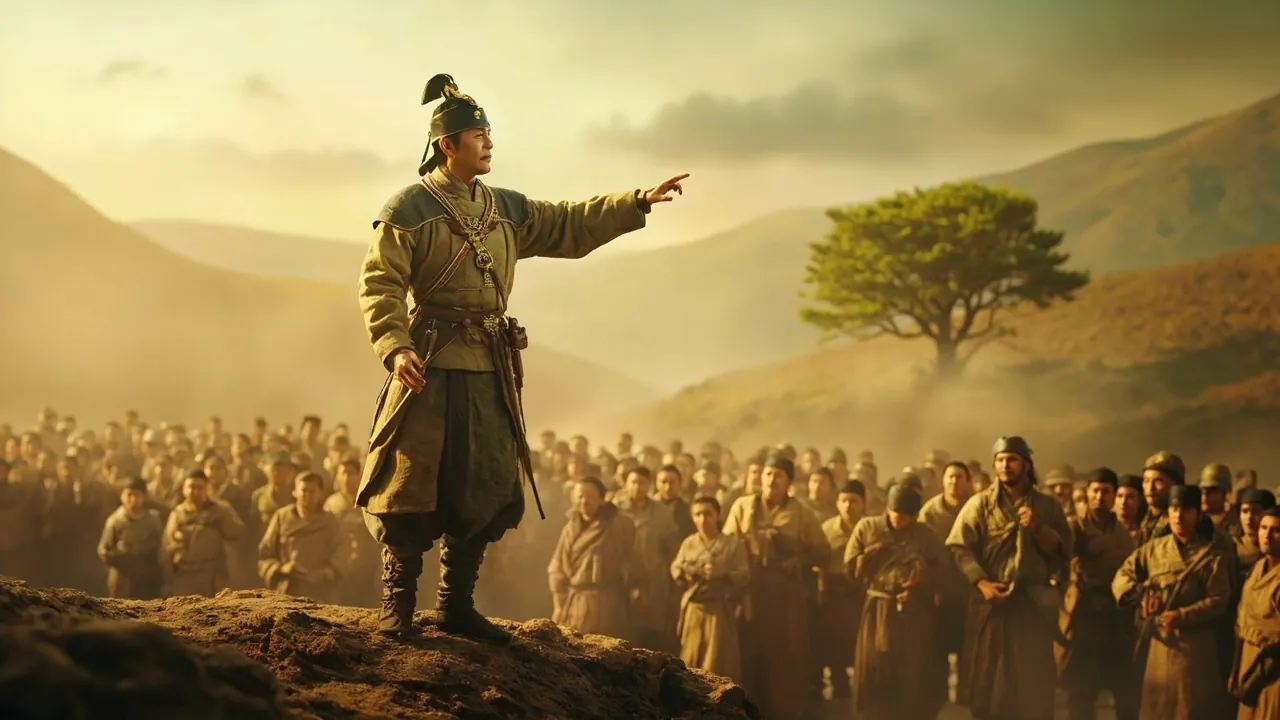
Everyone stood around the elephant, discussing, arguing, proposing inadequate solutions. And then young Cao Chong spoke up.
The Solution: displacement
Cao Chong’s answer was elegant in its simplicity. He suggested the following method:
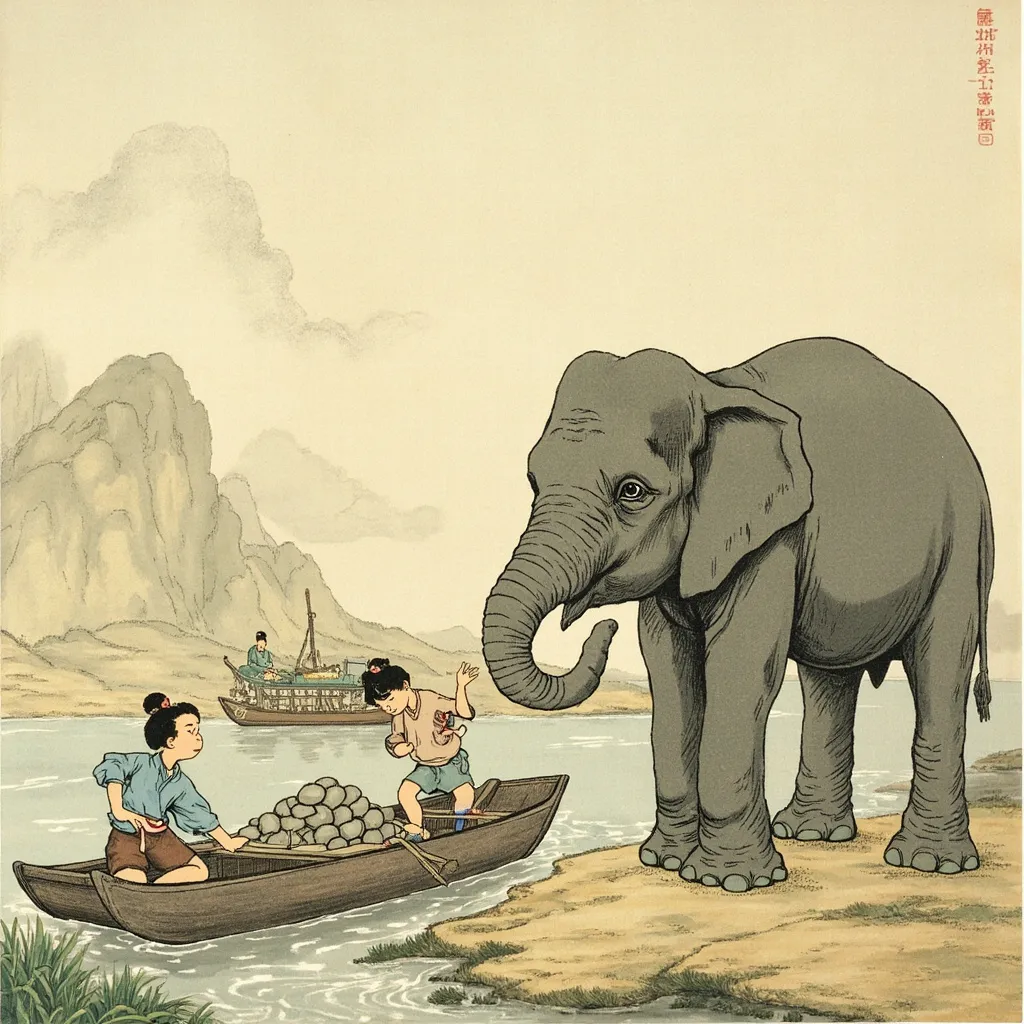
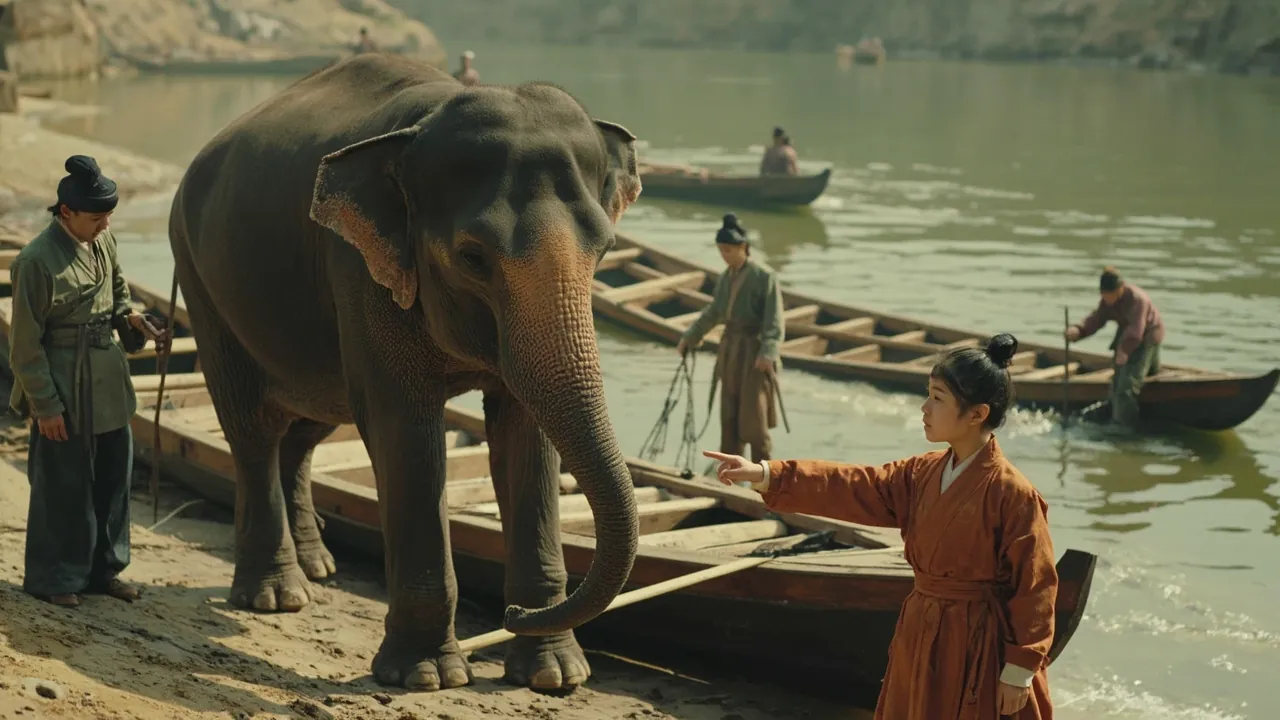
First, bring the elephant onto a boat. As the elephant steps aboard, the boat sinks lower into the water — the weight of the elephant displaces an amount of water equal to its own weight. Mark the waterline on the side of the boat.
Then, remove the elephant and begin loading the boat with rocks or other heavy objects, one batch at a time, until the boat sinks to the same waterline. At that point, the weight of the rocks equals the weight of the elephant. Simply weigh the rocks.
It was a solution based on Archimedes’ principle — the same scientific truth that Archimedes allegedly discovered in the Western world while taking a bath, shouting “Eureka!” The concept: a floating object displaces a volume of water equal to its own weight. By matching displacement, you match weight. No scale large enough required.
Cao Chong, a child in ancient China, had independently arrived at the same scientific insight.
The Father Who Watched
Cao Cao, by most accounts a demanding and pragmatic leader, reportedly watched this demonstration with great interest. When the method was carried out and the elephant was successfully weighed, he celebrated his son’s ingenuity. Historical accounts suggest he was genuinely impressed and made clear his affection for the boy.
Cao Chong was the son of Cao Cao’s favorite concubine, Lady Bian, and he appears to have been a genuinely beloved child. Accounts describe him as unusually perceptive, kind, and intellectually curious — the kind of child who noticed things other people missed and asked questions that made adults think twice.
The weighing of the elephant was not an isolated incident. Cao Cao reportedly consulted his young son on other matters of judgment and was regularly surprised by the boy’s clarity of thinking. It was said that Cao Cao seriously considered making Cao Chong his heir — an extraordinary notion given that Cao Chong was not his eldest son and that succession in Chinese politics was normally a brutal, zero-sum affair. That Cao Cao reportedly entertained the thought at all speaks to how highly he regarded the boy.
Tragically, Cao Chong died in childhood, at the age of thirteen. The cause is not recorded with certainty. His early death left a wound in Cao Cao that was remembered in historical accounts, and it deprived the Three Kingdoms period of what might have been a remarkable adult mind.
Why This Story Became So Famous
The story of Cao Chong weighing the elephant is one of the most celebrated childhood intelligence stories in Chinese cultural memory — part of a tradition that includes Sima Guang smashing the vat and Kong Rong yielding the pear. Together, these stories form a kind of canon of exceptional children who demonstrated adult wisdom through clear thinking and creative action.
What makes the elephant-weighing story particularly powerful is the quality of the thinking. Sima Guang’s solution was about recognizing the cause of a problem (water) and removing it. Kong Rong’s was about moral clarity and the willingness to yield. Cao Chong’s was about scientific reasoning — taking a physical principle and applying it to solve a real-world problem no one had faced before.
This made the story especially valuable in Chinese education. It wasn’t just “be good like Kong Rong” or “be brave like Sima Guang.” It was “think clearly like Cao Chong.” In a culture that deeply valued intellectual achievement and practical wisdom — the Confucian ideal of the scholar-official who could solve problems — Cao Chong became a model of what the mind could do when properly applied.
The phrase 曹冲称象 became a cultural reference point, used in Chinese to describe any situation where a clever, unconventional approach solves what seems like an unsolvable problem.
The Archimedes Parallel
It’s worth pausing on the fact that Cao Chong arrived at a principle of fluid displacement independently, without access to Greek scientific texts or formal training in physics. This was not because Chinese science was primitive — it wasn’t — but because Cao Chong was observing the real world carefully and applying what he saw.
The parallel with Archimedes is often noted in comparative cultural discussions. Both arrived at the same truth through observation — Archimedes through noticing how his own body displaced water in a bath, Cao Chong through watching boats sit in water and thinking about what determined how deep they sank.
It’s a reminder that the natural world reveals its principles to anyone who watches closely enough, regardless of culture, language, or historical period.
How the Story Resonates Today
In modern Chinese children’s literature and education, Cao Chong remains a featured figure. The story appears in textbooks, animated series, and picture books. Parents use it to encourage children to think independently and not assume that problems have no solutions.
There’s also a quietly inspiring message for adults in the story: the person who solves the big problem isn’t always the most powerful or most experienced person in the room. Sometimes it’s the person who looks at the problem differently — who asks “what does the water do?” instead of “where is the big enough scale?”
For American readers, this maps onto familiar stories of innovation: the young inventor, the outsider who saw what experts missed, the person who wasn’t constrained by “how things are done” because they didn’t yet know how things were done. Cao Chong weighing the elephant fits comfortably alongside stories of young American inventors and thinkers who saw past the apparent impossibility to the solution underneath.
A Legacy of Clear Thinking
Cao Chong died young, and we can only speculate about what he might have accomplished had he lived. The Three Kingdoms period was filled with brilliant men — scholars, strategists, poets, statesmen — and Cao Chong might have been among them. Instead, he left behind one story, perfectly preserved, that continues to inspire more than eighteen centuries later.
The next time you face a problem that seems to have no solution, think of the boy by the river. The boat. The waterline. Sometimes the answer isn’t about finding a bigger tool. It’s about understanding what the problem actually is.
If this story of childhood ingenuity resonated with you, you might also enjoy our article on Sima Guang Smashes the Vat, another classic tale of a young person who found a brilliant solution when everyone else had given up thinking.