Every year, on the fifteenth day of the eighth lunar month, hundreds of millions of Chinese families gather to admire the full moon. They eat mooncakes, light lanterns, and tell stories about a beautiful woman who lives on that very moon — a woman named Chang’e. This is her story.
The Woman Behind the Moon
If you’ve ever heard of the Mid-Autumn Festival, you’ve encountered Chang’e, even if you didn’t know her name. That beautiful full moon you see during the festival? In Chinese tradition, it’s home to a goddess — and her story is one of the most romantic and heartbreaking in all of Chinese mythology.
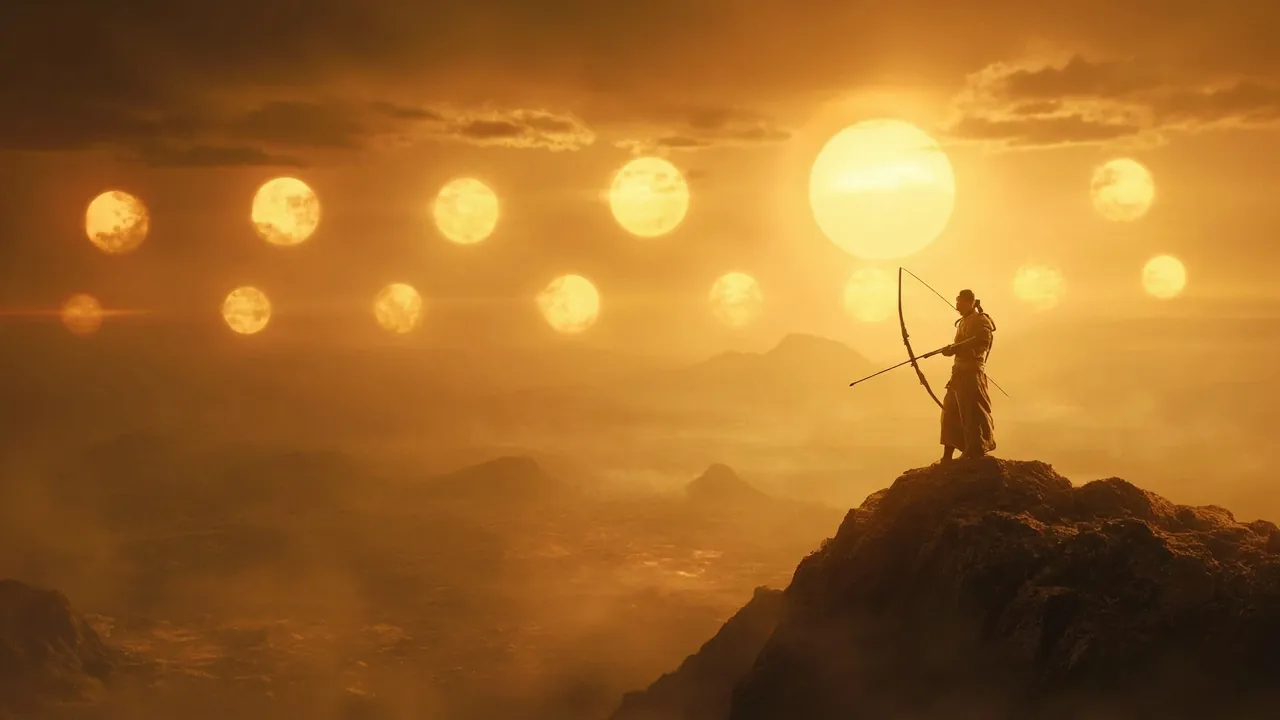
Chang’e was the wife of Houyi, the legendary archer who shot down nine of the ten scorching suns and saved the world (you can read his story in our article on Houyi). But Chang’e’s story is her own. It’s a story about love, sacrifice, and the loneliness that sometimes comes with being extraordinary.
The Elixir of Life
After Houyi saved the world by shooting down the suns, something remarkable happened. The Queen Mother of the West — one of the most powerful deities in Chinese mythology, a goddess who ruled over the celestial realm and controlled access to immortality — heard about what Houyi had done.
The Queen Mother was impressed. Here was a mortal man who had done what no god had been able or willing to do: solve a cosmic crisis. As a reward, she invited Houyi to her palace in the western heavens and gave him something precious beyond measure: the Elixir of Life, also called the Elixir of Immortality.
One small sip of this divine substance would grant eternal life. No more death. No more decay. A place among the immortals.
But there was a complication — a complication that would set Chang’e’s story in motion.
A Dangerous Secret
Houyi was deeply in love with Chang’e. He had no desire to live forever without her. So instead of drinking the elixir himself, he brought it home and gave it to Chang’e for safekeeping. The two of them would share it together, or they wouldn’t share it at all.
Chang’e took the elixir — a small jade bottle filled with luminous liquid — and hid it carefully. She understood its power and its danger. Immortality was precious, but so was the trust her husband had placed in her.
For a time, everything was fine. Houyi continued his life as a mortal hero, beloved by the people. Chang’e kept the elixir safe.
But secrets have a way of getting out.
A man named Peng Meng learned about the elixir. Different accounts describe him differently — as a student of Houyi’s archery, as a villain who sought immortality for himself, or as a figure driven by darker motives entirely. What all accounts agree on is that Peng Meng wanted that elixir, and he was willing to do almost anything to get it.
The Night Everything Changed
The mythology describes a specific night when Peng Meng made his move. Houyi was away — some versions say he was hunting, others that he was visiting friends. Chang’e was home alone when Peng Meng burst through the door.
He demanded the elixir. Chang’e refused.
What happened next is described differently across various versions of the story, but the core elements are consistent: in the struggle that followed, Chang’e found herself facing an impossible choice. If she gave up the elixir, she and Houyi would never share immortality. If she refused, Peng Meng might take it by force — or worse, hurt her to get it.
In a moment of desperation, Chang’e did something remarkable. She drank the elixir herself.
The effect was immediate. The liquid tasted like moonlight feels — cool, pure, and somehow alive. Chang’e’s body began to change. She became lighter, translucent, filled with a soft inner glow. She could feel herself lifting off the ground.
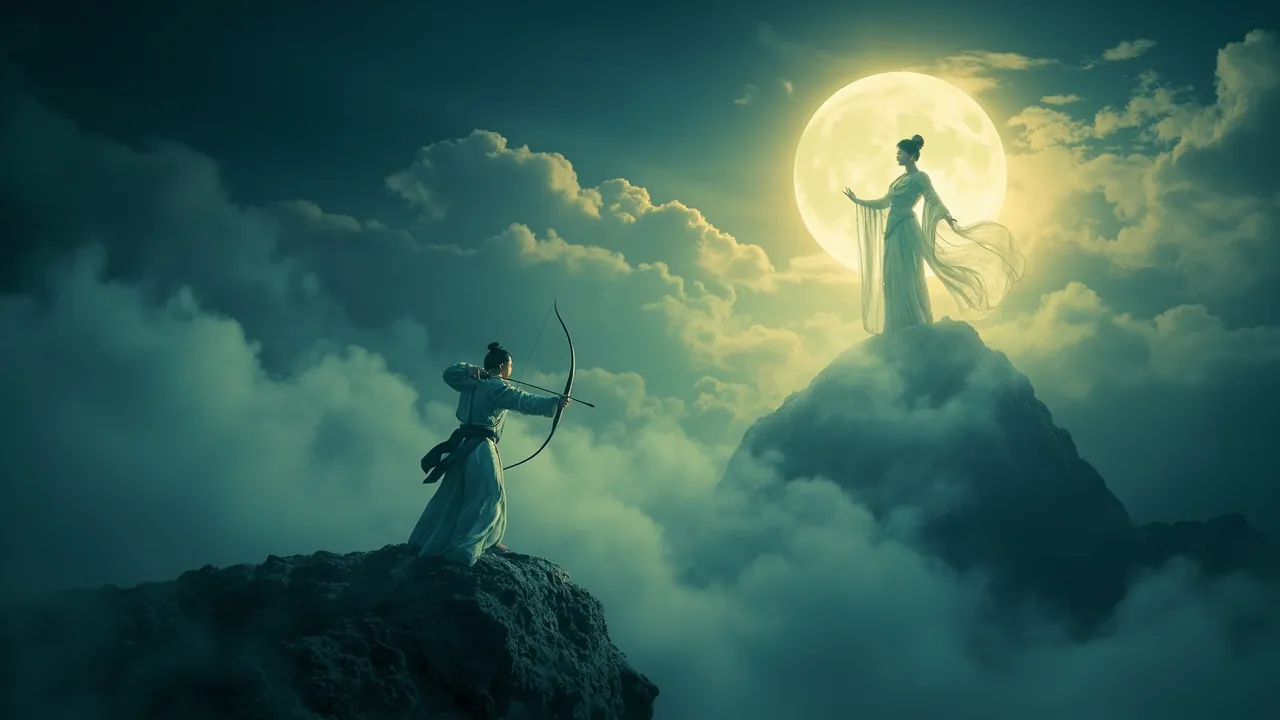
Peng Meng lunged toward her, but it was too late. Chang’e floated up, through the roof, into the night sky. She drifted higher and higher, past the clouds, past the stars, until she came to rest on the moon — the closest celestial body to Earth.
The Loneliness of the Moon
Here’s where Chang’e’s story takes on its most poignant dimension. She was immortal now, safe from death and decay. But she was also alone.
The moon, in Chinese mythology, is a beautiful but desolate place. It’s cold and quiet. Chang’e found herself in a palace of white jade, surrounded by silence, with only a jade rabbit for company (the rabbit, in some versions, had followed her to the moon; in others, it was already there, eternally pounding the elixir of immortality).
The texts describe Chang’e looking down at Earth, watching the small figures going about their lives, knowing she could never return to them. Houyi was down there somewhere, and she loved him more than ever — but the distance between them was now measured in the gap between Earth and moon.
Some versions of the story say Houyi was so grief-stricken that he built a temple to honor Chang’e and spent the rest of his life worshipping her from afar. Others say he never stopped searching for a way to bring her back. The mythology doesn’t give us a neat ending. It gives us a woman on the moon, beautiful and immortal, looking down at the world she left behind.
The Connection to the Mid-Autumn Festival
So how does a story about loneliness and loss become one of China’s most celebrated holidays?
The answer lies in the timing — and in the hope.
The Mid-Autumn Festival falls on the fifteenth day of the eighth lunar month, when the moon is at its fullest and brightest. The ancient Chinese, who were skilled astronomers, noticed that this was a time of maximum lunar beauty — a perfect full moon in a clear autumn sky.
Somewhere along the way, people began to connect this beautiful moon with Chang’e’s story. If she lived on the moon, then the full moon was her home, her beacon, her place in the world. To look at the full moon during the Mid-Autumn Festival was to look at Chang’e’s window.
The holiday became a time for family reunions — because Chang’e’s story reminded people how precious togetherness was, and how easily it could be lost. The mooncakes eaten during the festival are sometimes described as round, like the moon itself, or as representations of the reunion of families. The lanterns lit during the festival are said to guide Chang’e’s light down to Earth, or to represent the hope that loved ones separated by distance might someday be reunited.
In some versions of the story, Chang’e and Houyi are reunited once a year, on the night of the Mid-Autumn Festival. They meet in the moon, or they meet in the stars, or they meet in dreams. The details vary, but the emotional core is the same: a couple separated by cosmic forces, finding each other again, if only for one night.
Chang’e in the Modern World
Today, Chang’e is one of the most recognizable figures in Chinese cultural life. Her name has been given to China’s lunar exploration program — Chang’e 1, Chang’e 2, Chang’e 3, and beyond, all named for the moon goddess who made the moon feel like a Chinese place.
In 2013, the Chang’e 3 lander touched down on the lunar surface, and China became the first nation to land on the moon since the Apollo era. A small rover named Yutu (Jade Rabbit) rolled down the lander’s ramp and began exploring the surface — named, of course, for the jade rabbit that keeps Chang’e company in her lunar palace.
Every time a new Chang’e probe launches, it’s a reminder that the ancient Chinese didn’t just tell stories about the moon. They looked at it and saw a place — a home for a goddess, a destination for exploration, a symbol of something larger than themselves.
Why Chang’e’s Story Resonates Today
There’s something deeply modern about Chang’e’s story, even though it’s thousands of years old.
She faced an impossible situation and made a choice that she hoped was right — even though it came with enormous cost. She sacrificed a life with the person she loved in order to protect something precious. And she lived with that sacrifice, alone on a cold moon, for eternity.
That theme — of choices made under pressure, of costs that can’t be taken back, of love that survives even cosmic separation — is timeless. It resonates whether you’re hearing it for the first time or the hundredth time.
For Americans, Chang’e’s story might bring to mind other tales of sacrifice and loss — the story of Orpheus and Eurydice in Greek mythology, or the lonely figures in science fiction films who venture into space knowing they may never return home. The specific details are different, but the emotional territory is familiar.
What makes Chang’e uniquely Chinese is the way her story has been woven into a national holiday, a lunar exploration program, and a shared cultural memory that spans thousands of years. She’s not just a myth. She’s a presence, felt every time someone looks up at the full moon and thinks of home.
Conclusion: Looking Up at Chang’e’s Moon
The next time you see a beautiful full moon — whether during the Mid-Autumn Festival or any other night — you now know the story behind it. There’s a woman on that moon. Her name is Chang’e. She got there because she loved her husband and protected what was precious to him.
She lives there still, beautiful and alone, looking down at the world below.
And every year, on the night of the Mid-Autumn Festival, millions of people look back up at her — eating mooncakes, lighting lanterns, and remembering that love, even when it’s separated by impossible distances, never really goes away.