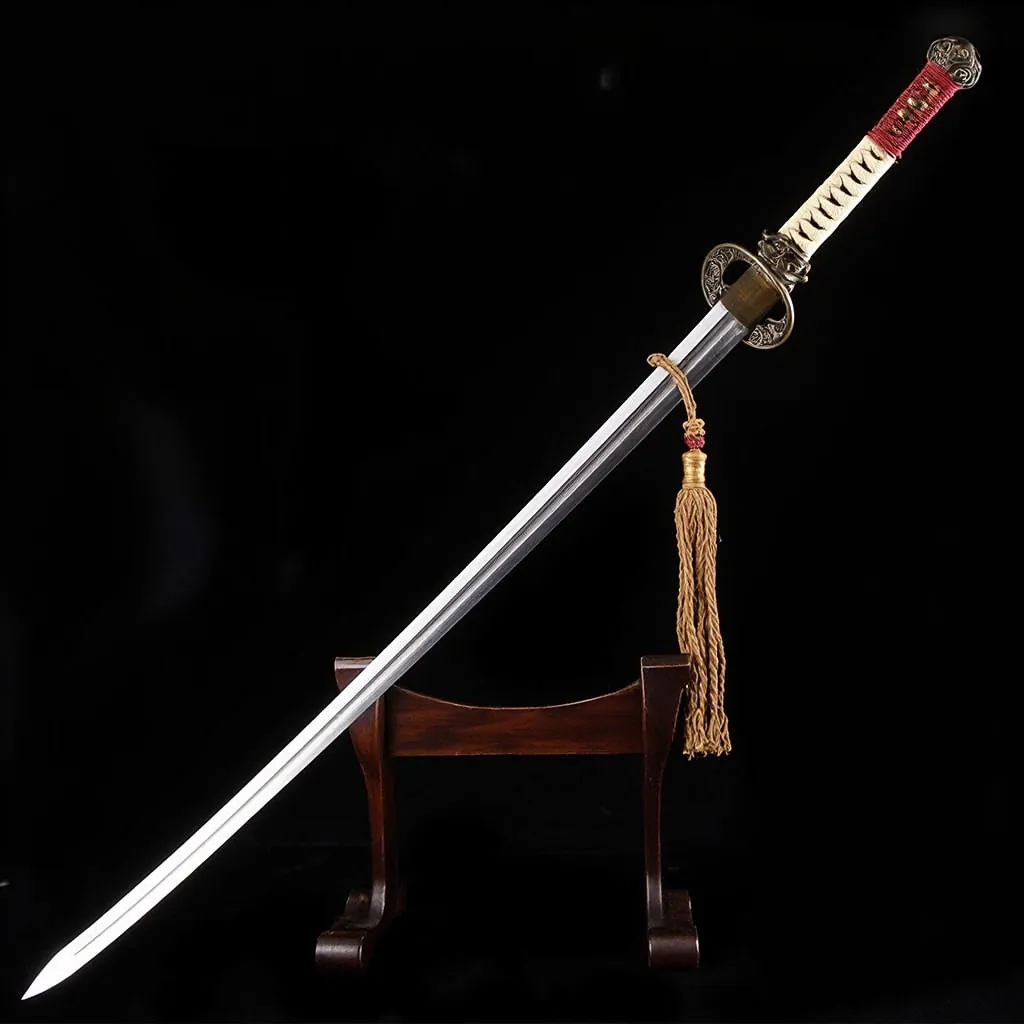
There is a shape that has haunted the Chinese imagination for over three thousand years. It’s slim, elegant, double-edged, and roughly the length of a man’s arm. It has been carried into battle by kings and farmers alike, wielded by poets in moments of fury and by monks in search of enlightenment. It has been forged in hidden mountain workshops, traded across the Silk Road, buried with emperors, and displayed in the homes of scholars who had never learned to fight a day in their lives. This is the jian (剑), and it is far more than a weapon. In Chinese culture, the jian is a philosophy, an art form, and a symbol of something that transcends the physical entirely.
Westerners often confuse the jian with the broader category of “Chinese sword,” but the distinction matters. The jian is specifically the double-edged straight sword — as opposed to the dao, which is the single-edged curved blade more commonly associated with cavalry and infantry combat. Where the dao is powerful and direct, the jian is subtle and precise. It demands technical mastery, timing, and a quality of attention that transforms the person who carries one. This is why, across Chinese history, the jian has been associated with the elite — not necessarily the social elite, but the spiritually and artistically elite. Scholars who practiced calligraphy were said to move the brush with the same fluidity as a sword. Poets carried jian as extensions of their creative will. Martial artists who mastered the jian were said to have achieved a state of unity between body and blade that bordered on the mystical.