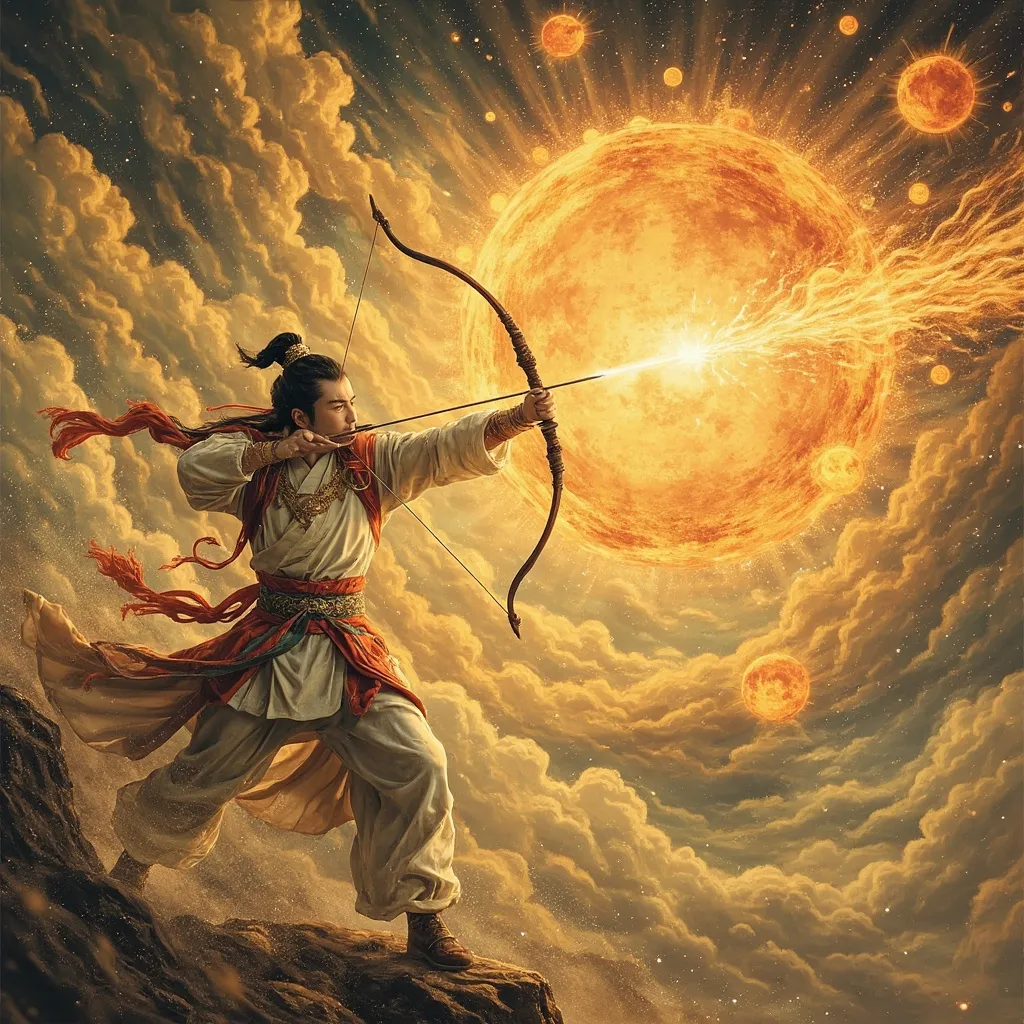
Long before China had emperors or dynasties, before the Great Wall or the Terracotta Army, there was a flood — a massive, world-destroying flood that covered the entire land and seemed to threaten the very existence of the Chinese people. And it took one man thirteen years of grueling work to stop it. His name was Yu. They called him Yu the Great. This is his story.
The Flood That Swallowed the World
In the earliest days of Chinese civilization — a time so ancient that history and myth blur together — the world was a very different place. The Yellow River, China’s great central waterway, didn’t just flow gently through the land. It roared. It surged. It overflowed its banks and kept on overflowing.
The ancient texts describe a catastrophe of almost biblical proportions. The floods didn’t come and go. They came and stayed. Year after year, the water kept rising. Villages disappeared underwater. Farmland became lakes. People fled to the hills and mountains, watching their world drown.
The洪水 (hóngshuǐ — “flood” in Chinese) became so legendary that it’s one of the central events in Chinese mythology, comparable to the flood narrative in the Bible or the Epic of Gilgamesh. Like those stories, the Great Flood of China isn’t just a historical event that people happen to remember. It’s a story about what happens when the natural order goes catastrophically wrong — and what it takes to set it right.
The First Attempt: Gun’s Failure
When the floods began, the Emperor at the time — a figure known as Emperor Yao — decided something had to be done. The people were suffering. Famine was spreading. Something had to change.
Yao looked around his court and chose a man named Gun (also spelled Kun) to tackle the flood. Gun was a capable official, trusted and respected. He was also the father of the man who would eventually solve the problem — but nobody knew that yet.
Gun’s approach to flood control was what engineers call “containment” — building barriers to hold the water back. He traveled to the most flood-prone areas and directed the construction of enormous earthen dams and levees. The work was massive in scale. Gun reportedly worked for nine years on the project.
It didn’t work.
In fact, some accounts say the floods got worse. The water, blocked by Gun’s dams but with nowhere to go, built up pressure and eventually burst through, causing even more catastrophic flooding than before. Gun had tried to fight the water. He had failed.
Emperor Yao was not pleased. He removed Gun from the project and, in some versions of the story, exiled him for his failure. Gun died in exile, his reputation tarnished, his life’s work undone.
But Gun had left behind something important: a son named Yu, who had watched his father’s work and learned from his mistakes.
Yu Takes Over: The Son Who Learned from Failure
After Emperor Yao came Emperor Shun, a new ruler who inherited the flood problem. Shun looked at the situation and made a decision that would change Chinese history: he gave the flood control project to Yu, Gun’s son.
Yu was not a man who wanted the job. He knew how difficult it was. He knew his father’s failure. But he also understood something his father hadn’t: you can’t fight water. You have to work with it.
Where Gun had tried to contain the flood with dams, Yu took the opposite approach. He would dredge — dig channels and canals that would guide the water’s flow, letting it drain naturally into the sea. Instead of fighting the water’s nature, Yu would work with it.
This seems like an obvious solution now, but in ancient China, with the technology available at the time, it was revolutionary. Yu was essentially proposing to re-engineer the entire river system of China — to carve new paths for water that had been flowing the same way for millennia. It was an undertaking of almost unimaginable scope.
Yu accepted the mission. And then he got to work.
Thirteen Years of Wandering
The mythology describes Yu’s flood control project as lasting for thirteen years — thirteen years during which, according to the legends, he never once returned home.
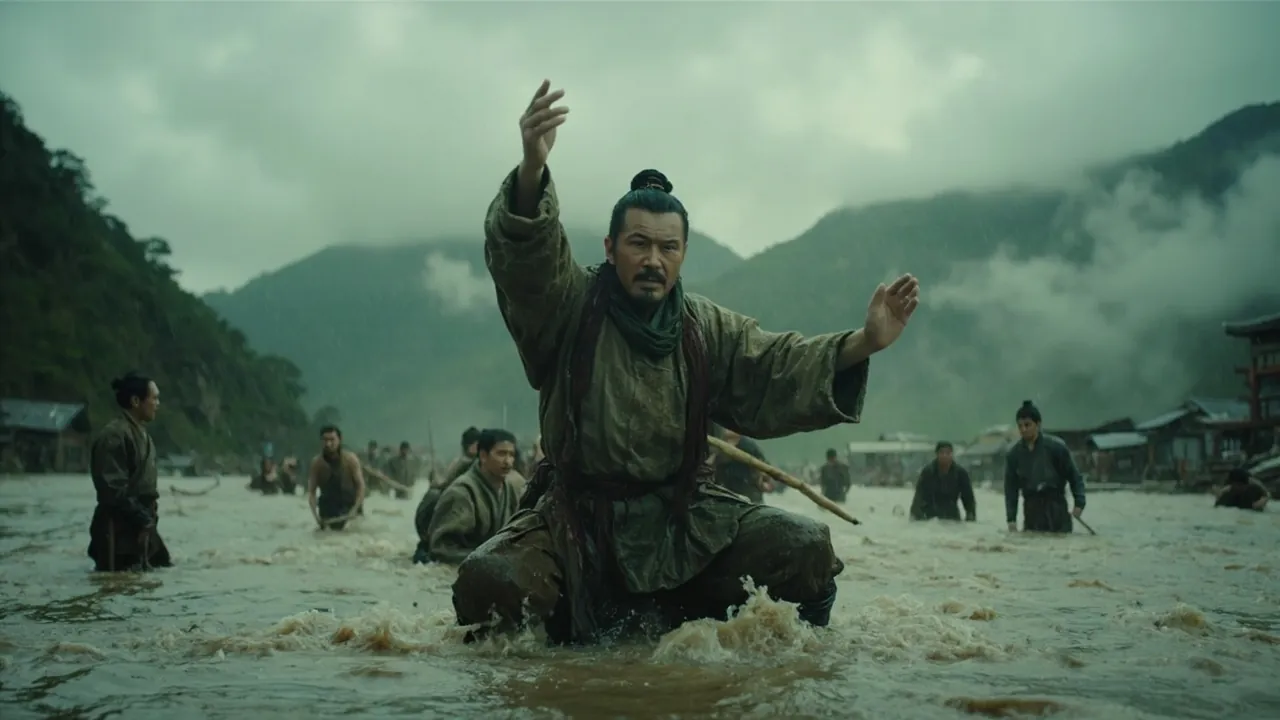
Yu traveled from one end of the flooded region to the other, always moving, always working. He surveyed the land, identified the natural contours and slopes, and figured out where water wanted to flow. Then he organized the digging — canals, channels, drainage paths — that would let the water get where it needed to go.
The stories describe a man who was completely consumed by his mission. He walked through knee-deep mud. He climbed mountains to survey the terrain. He worked alongside the common people, eating simple food, sleeping rough, never taking a rest.
There’s a famous anecdote — whether strictly historical or not, it’s deeply symbolic — that describes how, during his thirteen years of flood control work, Yu passed by his own home three times. On one of those occasions, he heard his wife giving birth to his son. The baby’s cry reached his ears, and he stopped — just for a moment — before pressing on. He didn’t go inside. He didn’t hold his newborn. He kept working.
When his son was old enough to walk, Yu passed by again. The boy ran to greet him, but Yu was already moving on, absorbed in his mission.
This anecdote captures the core of Yu’s legend: a man so dedicated to saving his people that he sacrificed his family life entirely. It’s the Chinese equivalent of George Washington crossing the Delaware — a story that defines what it means to put duty above self.
The Supernatural Help
Yu’s flood control project wasn’t purely human effort. According to the mythology, he received help from unexpected sources.
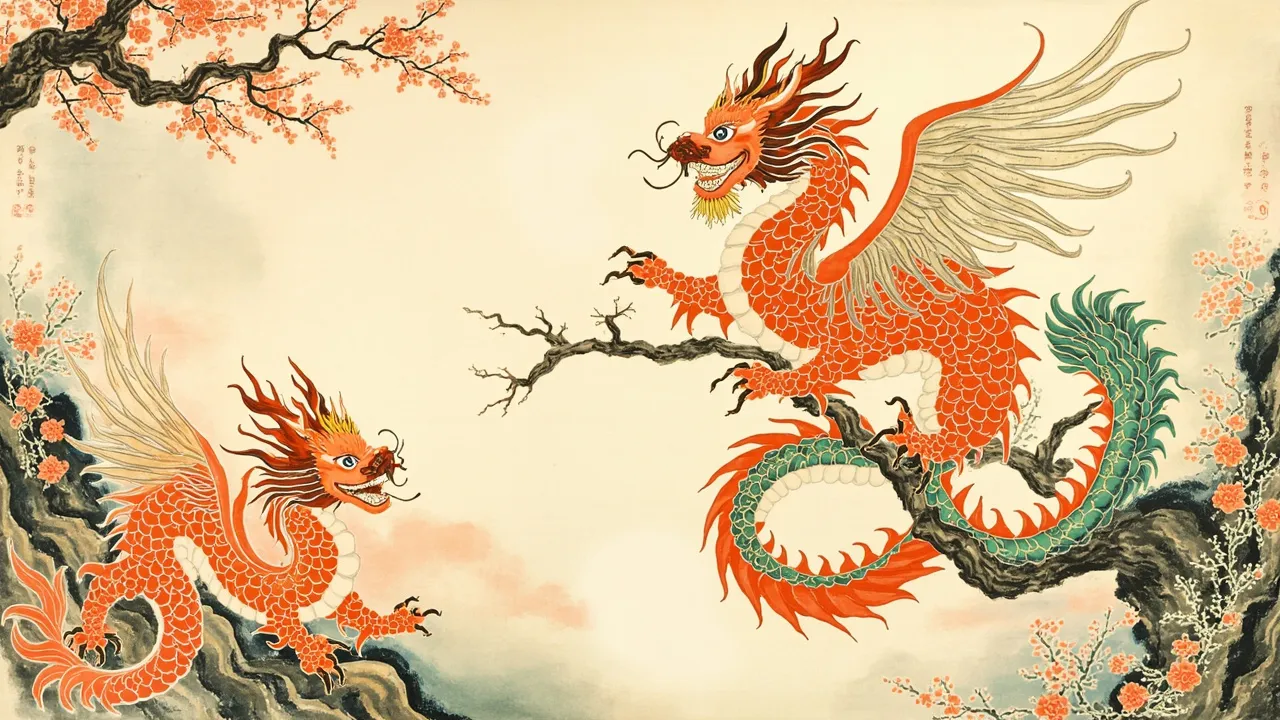
The most famous is a creature called 应龙 (Yìnglóng) — the Ying Dragon, a divine dragon with supernatural powers. In the legends, Ying Dragon helped Yu by using its enormous body to carve channels in the earth. Where it slithered, channels formed. Where it thrashed, valleys opened. The dragon became Yu’s partner in the great work of re-routing China’s water.
Yu also worked with two other figures: 伯益 (Boyi), a man associated with wells and water systems, and 后稷 (Houji), a figure associated with agriculture. Together, the three of them organized not just the physical work of flood control, but also the resettlement of displaced populations and the restoration of farming.
The mythology is clear: Yu succeeded not through individual heroics alone, but through collaboration — with humans and with supernatural beings alike. This is a recurring theme in Chinese mythology: great achievements require the cooperation of many.
Taming the Yellow River
The climax of Yu’s story is the taming of the Yellow River — the most flood-prone of China’s great rivers, and the one that had caused the most destruction.
According to the legend, Yu identified a critical point where the Yellow River’s waters had pooled into a massive lake, unable to flow further because a mountain range blocked their path. The water had nowhere to go, so it sat there, spreading, flooding everything around it.
Yu organized a massive excavation project. Thousands of workers — conscripted from across the region, organized into teams, directed by Yu himself — began cutting through the mountain. They carved a channel that allowed the pooled water to drain eastward, toward the sea.
When the water finally broke through and began to flow through the new channel, the effect was immediate. Lakes shrank. Flooded land emerged. The ground, saturated and boggy for years, began to dry out.
For the first time in memory, people could see the earth again. They could plant crops. They could rebuild their homes.
Yu had done the impossible.
The Reward: Founder of the Xia Dynasty
When Yu completed his flood control work, he was already a legend. The people of China loved him. Emperor Shun, who had given him the mission, was so impressed that he did something unprecedented: he named Yu as his successor — the next Emperor.
When Shun died, Yu didn’t fight for the throne or maneuver for power. The people simply came to him and asked him to lead. And so, according to Chinese tradition, Yu became the first Emperor of the Xia Dynasty — the first dynasty in Chinese history, the beginning of over 4,000 years of dynastic rule.
Yu’s transition to Emperor was peaceful, at least in the mythology. He took the name 大禹 (Dà Yǔ), which literally means “Great Yu.” The title was both a name and a description: Yu had proven himself great by saving his people from catastrophe.
Why Yu the Great Still Matters
Today, Yu’s story permeates Chinese culture in ways both obvious and subtle.
The phrase “大禹治水” (Dà Yǔ zhì shuǐ — “Yu the Great controls the water”) is a set expression in Chinese, used to describe any situation where someone takes decisive, patient action to solve a seemingly impossible problem. It’s the Chinese equivalent of “when life gives you lemons, make lemonade” — but with vastly more historical weight.
Yu’s approach — working with nature rather than against it — is still cited by engineers and environmentalists as a model for modern flood management. The ancient wisdom of “疏导” (dǎoshū — “guiding and draining”) rather than “堵塞” (dǔsè — “blocking and containing”) has influenced Chinese hydraulic engineering for millennia.
In 2016, Chinese President Xi Jinping invoked Yu the Great in a speech about environmental governance, drawing a direct line from ancient flood control to modern ecological civilization. The story of Yu isn’t just a myth — it’s a reference point for how China thinks about its relationship with nature.
The Archaeological Discovery
In 2016, something remarkable happened. Chinese archaeologists announced that they had found evidence of a massive flood event in the Yellow River region, dating to around 1920 BCE — roughly the time when Yu’s flood control project would have taken place according to traditional chronology.
The evidence came from a dam that had collapsed catastrophically, releasing a huge volume of water that left distinctive geological deposits. Combined with other archaeological findings, the evidence suggested that the Great Flood might not be purely myth — that there really was a catastrophic flood in ancient China, and that someone really did bring it under control.
The discovery doesn’t prove that Yu existed as a historical figure — that question remains contested among scholars. But it does suggest that the kernel of the story is real: there was a flood, and it was controlled. Whether the hero was a single man named Yu or a collective effort by many people over many years, the fundamental story — disaster, struggle, triumph — appears to have a basis in reality.
Yu’s Legacy in American Terms
To help Americans understand Yu’s significance, consider this comparison: if the Great Flood of China were equivalent to the Great Mississippi Flood of 1927, then Yu would be the engineer who not only stopped that flood but fundamentally re-engineered the Mississippi River system — and then became the first President of the United States as a reward.
That comparison doesn’t fully capture the scale, but it gives a sense of the magnitude of what Yu supposedly accomplished.
More broadly, Yu’s story represents a type of heroism that Americans will recognize: the ordinary person who rises to meet an extraordinary crisis, who puts the public good above personal comfort, and who achieves something that benefits everyone. Whether you’re talking about Yu or George Washington or the engineers who built the Hoover Dam, the archetype is the same: the person who sees a problem and decides to fix it, no matter the cost.
Conclusion: The Man Who Made the Land
The next time you look at a map of China — or, for that matter, any country where rivers flow and floods are managed — think about Yu the Great. Think about a man who spent thirteen years of his life walking through mud and water, sleeping in the open, eating whatever food was available, working alongside common laborers to dig channels that would reshape the land.
Think about how his son ran to greet him and he kept walking. Think about how he chose duty over family, public service over personal comfort, the greater good over his own desires.
Yu the Great tamed the flood. He made the land livable again. And in doing so, he became the foundation — literally and figuratively — of Chinese civilization.
That’s a legacy worth remembering.