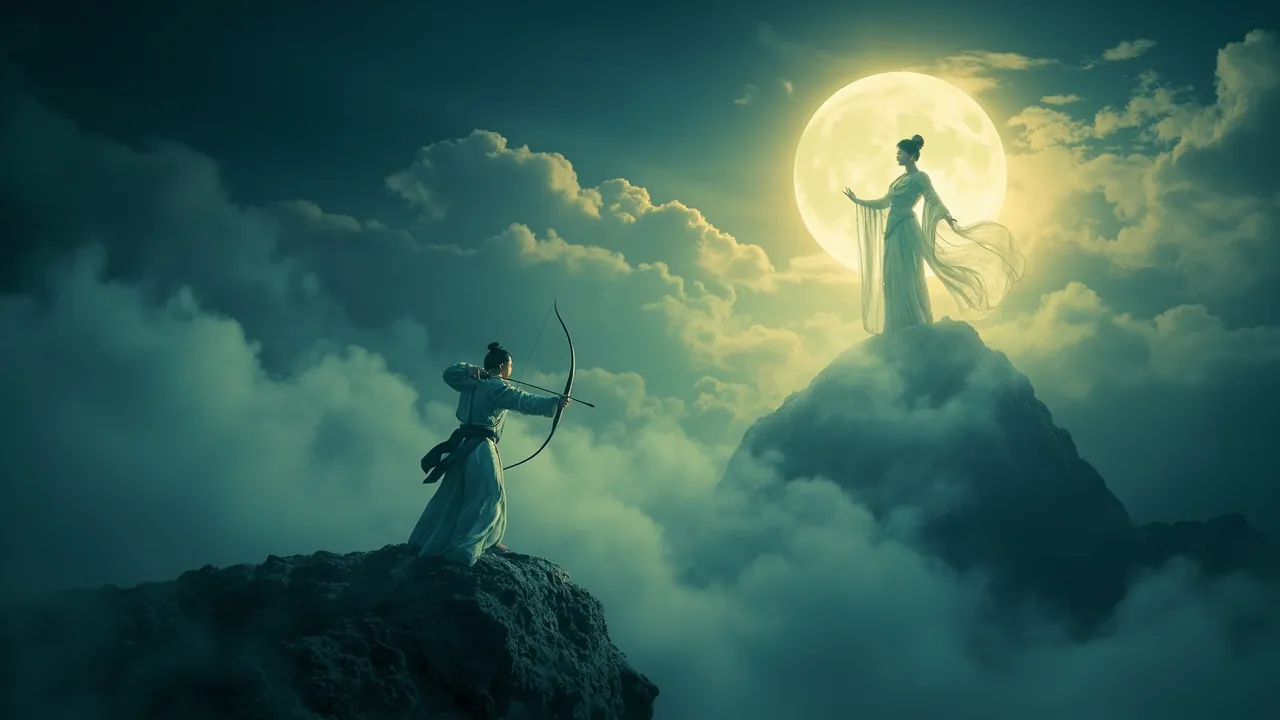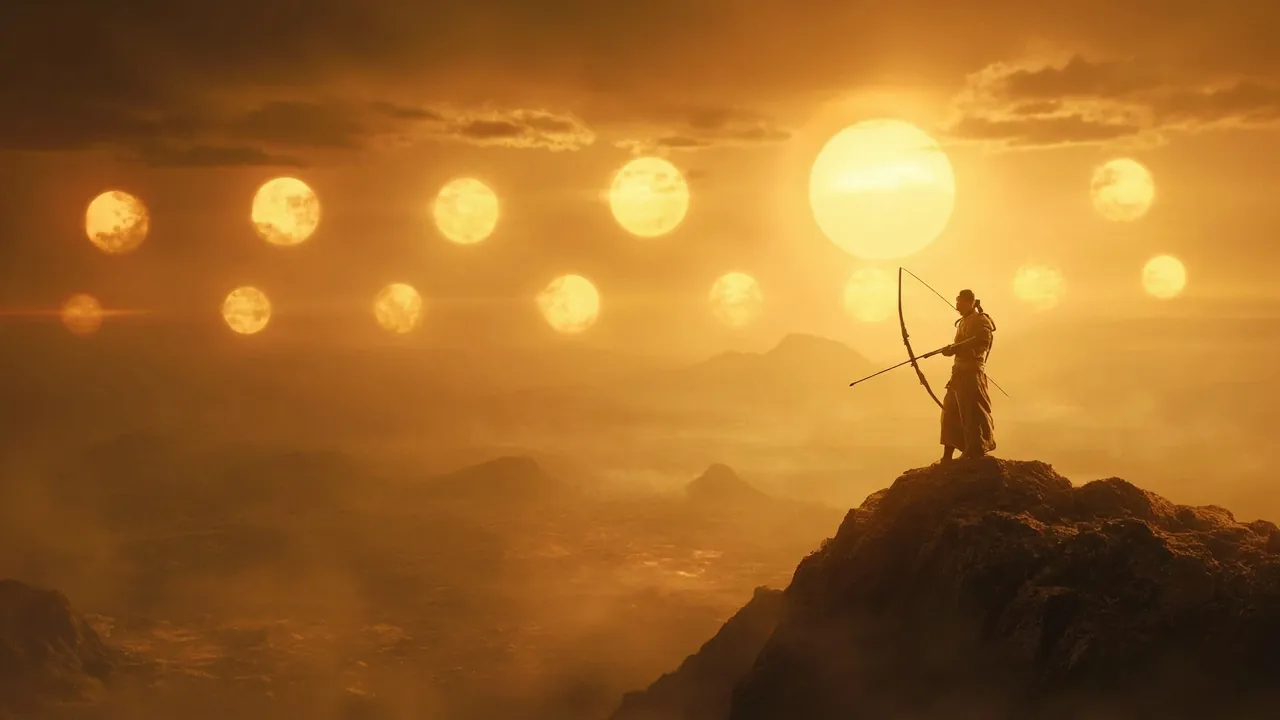
Long ago, ten suns rose together in the sky, their combined heat scorching the Earth. Crops withered, rivers boiled, and people were dying by the thousands. Only one man had the skill to change that — a legendary archer named Houyi. This is the story of how one archer faced down the heavens themselves to save humanity.
The Problem in the Sky
To understand why Houyi had to shoot the suns, you first need to understand what was wrong with the sky.
In ancient Chinese mythology, the world began with order imposed on chaos. The heavenly bodies moved in predictable patterns, and the gods maintained balance between heaven and Earth. But one summer — a summer like no other — that balance broke.
Ten suns appeared in the sky instead of one. Imagine looking up and seeing ten blazing orbs, all radiating heat at once. It wasn’t beautiful. It was catastrophic.
The heat became unbearable. The great forests that covered ancient China caught fire. Mountains cracked. The Yellow River, China’s lifeline, steamed and boiled. People collapsed from heat and thirst. Those who survived were too weak to farm, and famine spread everywhere.
The ancient Chinese texts describe this as a time when the world was on the verge of ending. The suns were literally cooking the Earth alive.
Houyi: The Greatest Archer Who Ever Lived
Houyi was no ordinary man. He was blessed — or perhaps cursed — with extraordinary physical gifts. Where other men could barely draw a bow, Houyi could shoot an arrow with pinpoint accuracy across vast distances. His strength was legendary. His focus was unwavering.
But what made Houyi truly remarkable wasn’t just his physical ability. It was his character. Despite his incredible powers, Houyi was known as a humble man who lived simply among the people. He didn’t seek fame or glory. He hunted to feed his family and his village, nothing more.
When the ten suns appeared and the world began to die, the people looked to their leaders for help. The Emperor of China — a figure known as Di Jun in the mythology — was desperate. The gods seemed angry. The people were suffering. Nothing anyone did seemed to work.
Then someone suggested Houyi.
The Divine Mission
The Emperor summoned Houyi and gave him a seemingly impossible task: descend from the mountain where he lived and shoot down nine of the ten suns. Leave only one, so that the world would have light and warmth without being destroyed by excessive heat.
The task was daunting for one reason above all: the suns were divine beings, the children of the Heavenly Emperor. Shooting them down was an act that could be seen as rebellion against the gods themselves. Many would have refused, fearing divine punishment.
Houyi accepted.
What drove him? The mythology is clear: he couldn’t stand to watch innocent people suffer. The suffering of the many outweighed the risk to himself. This theme — a hero who puts others before himself — would become one of the most enduring motifs in Chinese storytelling.
The Emperor gave Houyi a divine bow and celestial arrows, weapons imbued with supernatural power. These weren’t ordinary weapons. They were capable of striking targets that existed beyond the mortal realm.
The Shooting of the Suns
Houyi climbed to the highest mountain in the land — Mount Kunlun, a place said to be so tall that its peak reached into the heavens. From there, he could see the full horror of what the suns had done to the world. The forests were blackened. The rivers had shrunk to trickles. The land stretched out below him like a broken promise.
He raised his bow.
The mythology describes how Houyi took careful aim at the first sun. He drew the bowstring back — his muscles tensed, his breathing slowed, the world around him fell away. In that moment of perfect focus, he released the arrow.
The first sun fell from the sky.
The crowd that had gathered at the base of the mountain — people who had followed Houyi up the slopes, people who had climbed from villages across the land to witness this moment — let out a collective gasp. The sun didn’t crash to Earth. Instead, it transformed. Some versions say it became a three-legged crow, the creature the Chinese believed lived inside each sun. Others say it simply dimmed and disappeared, cooling into a gentle glow before vanishing entirely.
Houyi didn’t celebrate. He didn’t hesitate. He nocked another arrow and took aim at the second sun.
One by one, nine suns fell from the sky. Each time, Houyi’s aim was true. Each time, the world grew a little cooler, a little more bearable. The rivers began to flow again. The charred forests — some accounts say — actually began to recover, as if the land itself was healing in response to the archer’s deeds.
When the ninth sun fell, only one remained — the sun we know today, the sun that rises each morning and sets each evening.
The Aftermath: A Changed World
The shooting of the nine suns is one of the most dramatic events in Chinese mythology, and its aftermath shaped the mythology for centuries to come.
First, there was gratitude. The people of China celebrated Houyi as a savior, a man who had risked everything to save them. Songs were sung about his deeds. Stories were told in every village. He had done something that no mortal was supposed to be able to do: challenge the divine order and win.
But there were consequences too. The Heavenly Emperor was furious. His children had been shot from the sky, and though he couldn’t bring them back, he could punish the archer who had done the deed. Accounts differ on exactly what punishment the Emperor imposed, but most versions agree that Houyi was banished from heaven — stripped of his divine status and forced to live on Earth as a mortal.
This punishment would prove to be a turning point in another famous Chinese legend: the story of Houyi and his wife Chang’e, and the elixir of life.
Why This Story Matters to Americans
You might be thinking: this is a great story, but what does it have to do with me?
Here’s the thing: Houyi’s story contains themes that Americans know intimately. The idea that one person with extraordinary abilities has a responsibility to use those abilities to help others — that’s the DNA of countless American superhero stories. Superman saves Metropolis. Spider-Man swings in to stop crime. Houyi climbed a mountain and shot down suns to save humanity.
The difference is context. American superhero stories are relatively recent — products of the 20th century. Houyi’s story has been told in China for over 2,000 years. Long before Superman ever lifted a car, Chinese grandmothers were telling their grandchildren about an archer who looked up at a burning sky and decided to do something about it.
There’s also something deeply human about Houyi’s choice. He knew the risks. He knew he was defying divine authority. He did it anyway because people were suffering. That tension — between individual conscience and established authority — is something every culture grapples with, and Chinese mythology is unusually direct about exploring it through figures like Houyi.
Houyi in Modern China
Today, you can find Houyi’s story throughout Chinese culture. The phrase “后羿射日” (Houyi shoots the sun) has become a set expression in Chinese, used to describe situations where dramatic, decisive action is needed to solve an seemingly unsolvable problem.
In 2016, Chinese scientists named a new deep-space telescope array after Houyi. The “Houyi Project” aims to observe distant galaxies and understand the nature of dark energy — a fitting tribute to an archer who once shot at the heavens and changed the world.
The Mid-Autumn Festival, one of China’s most important holidays, also carries echoes of Houyi’s story. While the festival’s central legend belongs to his wife Chang’e, the two stories are inseparable — Houyi’s deeds set the events of the Mid-Autumn Festival in motion.
The Bigger Picture: Order and Chaos in Chinese Mythology
What makes Houyi’s story particularly significant in Chinese mythology is what it says about the relationship between humans and the divine order.
In many Western mythologies, the gods are perfect beings whose decisions should not be questioned. In Chinese mythology, the gods are powerful but not infallible. When the cosmic order goes wrong — when ten suns appear and threaten to destroy the world — it falls to a human being to fix it.
This is a fundamentally different way of thinking about heroism. Houyi isn’t a god playing at being human. He’s a human who rises to meet a divine challenge. His power comes from his own skill and character, not from divine inheritance.
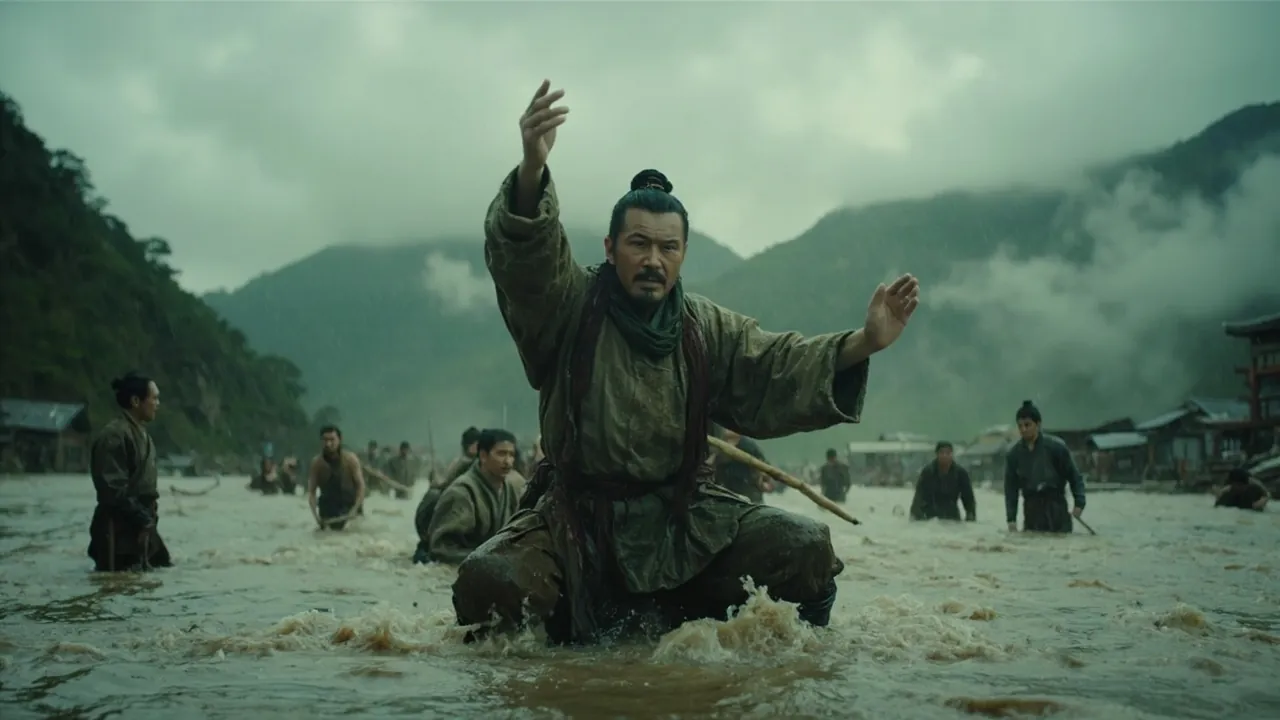
This theme — that ordinary people can achieve extraordinary things through dedication, courage, and moral conviction — runs through Chinese mythology like a golden thread. It connects Houyi to the hero Yu the Great, who tamed the floods. It connects both of them to countless real-world figures in Chinese history who stepped up when the moment demanded it.
Conclusion: The Archer Who Looked Up
The next time you see the sun rise — a single, golden disc in a clear blue sky — you might pause for a moment to think about Houyi. In Chinese mythology, that solitary sun is there because one man, armed with a bow and an unshakeable sense of purpose, looked up at a burning sky and decided that enough was enough.
The world was dying. Houyi saved it.
It’s a story about power and responsibility, about the courage to challenge the established order when that order is causing harm, and about the remarkable things that human beings can achieve when they refuse to accept that the world is beyond saving.
In the end, Houyi’s legacy isn’t just a myth. It’s a reminder — passed down through thousands of years of Chinese storytelling — that the sky is not the limit. Sometimes, with enough skill and enough courage, you can shoot it down.