Kong Rong Yields the Pear: The Four-Year-Old Who Understood Sacrifice Before He Could Read
In most cultures, when a plate of fruit is set before a group of children, the natural outcome is a brief but intense negotiation. Who gets the biggest? Who got more last time? Is this actually fair?
Now imagine one child — just four years old — picks up the largest piece of fruit and hands it to his older brother without being asked. Not because he was forced to. Not because he was bribed. Because it simply seemed like the right thing to do.
That child was Kong Rong (孔融), and the story of that moment became one of the most retold moral tales in Chinese history. It taught children theConfucian virtue of 礼让 (lǐ ràng) — yielding and showing courtesy to others — and it helped shape how Chinese civilization thought about humility, family, and the character of great men.
The Kong Family and a Boy Born for Greatness
Kong Rong was born in 153 AD during the late Eastern Han Dynasty, in the region now known as Shandong province. He came from an extraordinary family: he was a descendant of Confucius himself, the philosopher whose ideas would define Chinese civilization for the next two thousand years. This lineage gave Kong Rong both a legacy to live up to and a particular burden — people watched descendants of Confucius closely, looking for signs that the family wisdom was being passed down.
Kong Rong didn’t make them wait long.
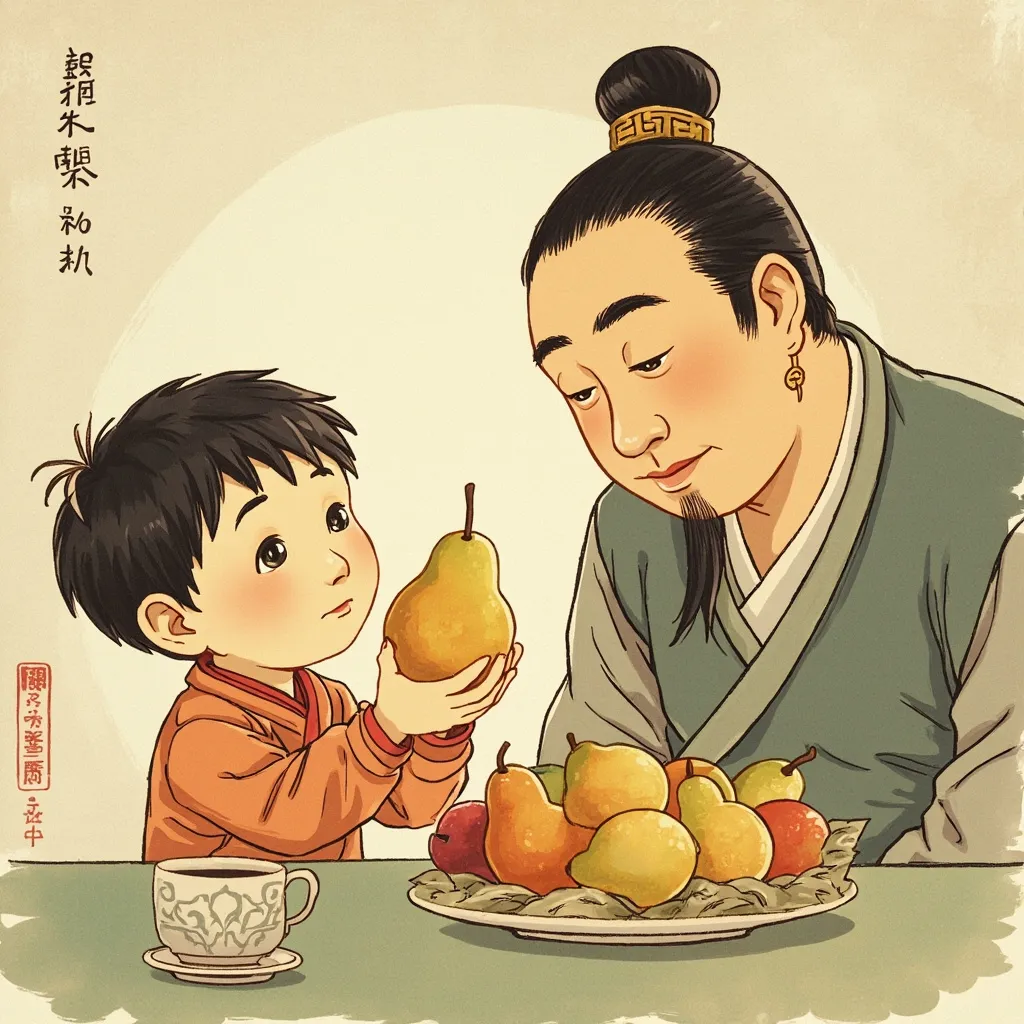
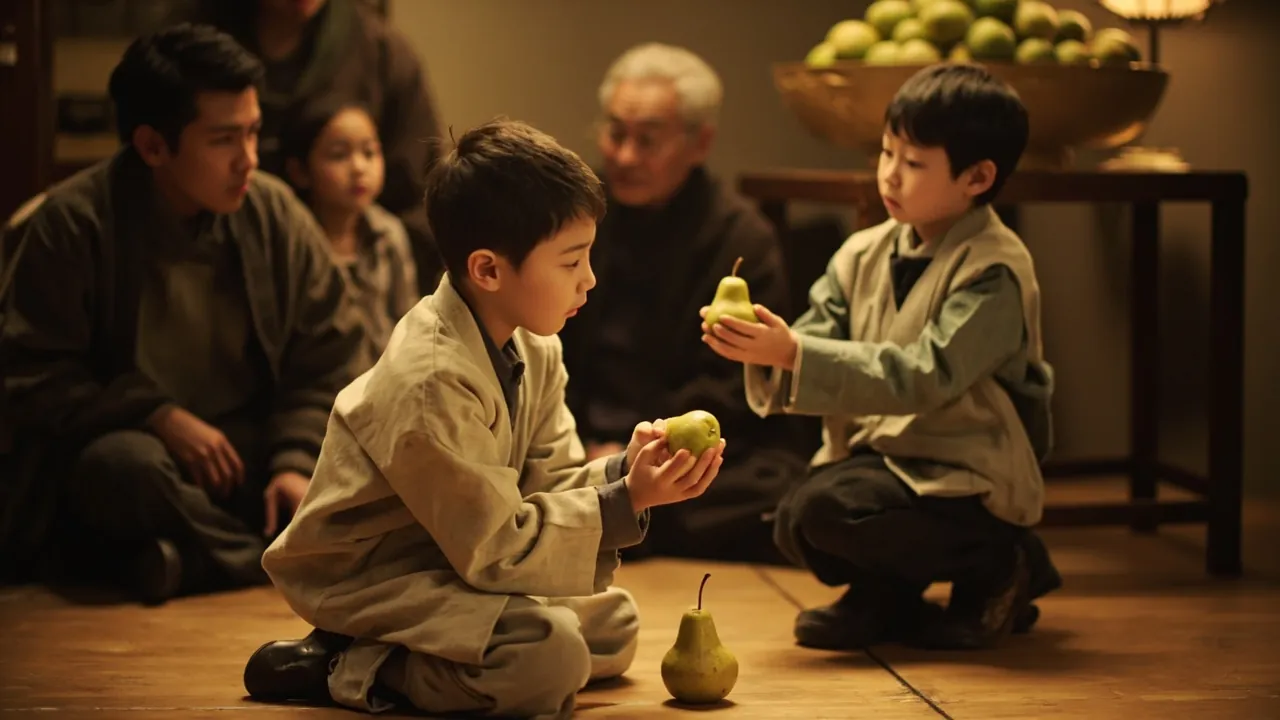
When he was just four years old, a plate of pears was brought before the children of the household. The pears were not all equal — some were larger, some smaller, some more ripe than others. In most families, this would have started a debate. In the Kong household, the adults were about to witness something that would become legendary.
Kong Rong picked up the largest pear. Everyone watched, expecting the boy to claim it for himself. Instead, he walked over to his older brother and offered it to him.
The adults were stunned. When asked why, Kong Rong reportedly said something to the effect that he was younger and should yield to his elders — or as the story was later framed, that a larger person should receive larger fruit, and he was too small to deserve the biggest.
This wasn’t just good manners. It was a philosophical stance, demonstrated through action, by a child who could barely hold a writing brush.
The Idiom That Grew From One Small Act
The phrase 孔融让梨 (Kǒng Róng Ràng Lí) — “Kong Rong yields the pear” — entered the Chinese vocabulary as a shorthand for unselfish behavior, particularly within families. It became one of the most frequently cited childhood virtue stories in Chinese culture, taught to children alongside the basic Confucian principles of filial piety and fraternal duty.
In the classic text Didong Xulu (弟子规), a Confucian primer for children, the behavior modeled by Kong Rong is explicitly referenced as an ideal. The text instructs young readers to “兄道友, 弟道恭” — “when older brothers are friendly, younger brothers should be respectful,” and Kong Rong’s behavior exemplified exactly this.
Over the following centuries, as Chinese education systems became more formalized, the story of Kong Rong yielding the pears became standard curriculum. Children memorized it. Parents told it. Teachers cited it. The story traveled beyond China into Korea, Japan, and Vietnam, where Confucian values also shaped educational philosophy.
Kong Rong’s Adult Life: When Principle Cost Everything
Here’s where the story takes a more sobering turn. The boy who yielded the pear grew into a man of extraordinary intellect and equally extraordinary stubbornness — a man who held fast to his principles even when they put his life at risk.
Kong Rong became one of the most famous scholars of the late Han Dynasty, known for his literary talent, his sharp wit, and his commitment to what he believed was right. He was recruited into the imperial bureaucracy and served in various official posts. He was also, by all accounts, a man of genuine warmth and humanity — someone who took seriously the Confucian ideal of using one’s position to serve others.
But the late Han Dynasty was a treacherous time. The emperor was young and powerless, and the real authority lay with warlords who controlled armies and provinces. Intellectuals like Kong Rong, who spoke honestly and refused to flatter powerful men, were in constant danger.
Kong Rong eventually drew the ire of Cao Cao (曹操), the warlord who dominated northern China and would eventually found the Cao Wei state. Kong Rong’s critical remarks about Cao Cao’s power — and his refusal to bend his principles — made him a target. In 208 AD, at the age of fifty-five, Kong Rong was executed on Cao Cao’s orders.
The man who had yielded the largest pear as a child could not yield to tyranny as an adult. His principles cost him his life, but they also cemented his place in Chinese memory as a man of genuine integrity.
What the Story Means for American Readers
There’s something immediately recognizable here, even across cultural distance. The story of Kong Rong yielding the pear is, at its core, a story about how early childhood behavior can reveal — and shape — adult character. American parents tell similar stories about children who share, who show kindness, who put others first.
The Confucian framework gives the story its particular flavor, but the underlying insight is universal: virtues practiced small are the ones that hold up big. The four-year-old Kong Rong didn’t know he was creating an idiom. He was just doing what felt right. But the habit of putting others first, practiced from childhood, became the foundation of a lifetime of principled behavior.
For Americans, there’s also an interesting parallel in the Christian story of the boy who shared his loaves and fishes — a child whose small offering, offered sincerely, became something much larger through the act of giving. Different traditions, but the same instinct: take what seems small and inadequate, give it away, and watch it transform.
The Deeper Confucian Message
To fully appreciate why this story became so central to Chinese moral education, you need to understand the Confucian concept of 悌 (tì) — fraternal respect, the idea that respect for one’s siblings is the foundation of respect for all others. Confucius taught that you learn to be a good citizen by first being a good family member. You learn to serve the state by first serving your parents and treating your siblings with courtesy.
Kong Rong yielding the largest pear was the perfect embodiment of this teaching. He didn’t have to be told to do it. He didn’t calculate the social advantage. He simply understood, at some intuitive level, that the family worked better when older members were honored and younger ones practiced restraint.
This is why the story was used in Chinese moral education for over a thousand years. It wasn’t about being forced to share. It was about the natural grace of someone who had absorbed the lesson so completely that he acted without prompting.
Legacy and Modern Relevance
Today, the phrase “孔融让梨” is still widely used in Chinese conversations. When a parent wants to praise a child for sharing without being asked, they might say the child “真会孔融让梨” — “really knows how to yield the pear like Kong Rong.” The story appears in children’s textbooks, animated shows, and moral education programs across China, Taiwan, and Chinese-speaking communities worldwide.
There’s also a quieter, more modern reading of the story that resonates with adults. Sometimes “yielding the pear” is about recognizing that you don’t always need the biggest seat at the table, the loudest voice in the room, or the most credit for the work. The child Kong Rong saw clearly: taking the biggest piece isn’t always the wise move. Sometimes it’s the move that makes you smaller.
If you enjoyed this story of childhood virtue and family wisdom, you might also like our article on Mencius’s Mother Moves Three Times, another famous story about a mother who shaped one of China’s greatest philosophers through the power of environment and example.