The Legend of the White Snake: Love, Magic, and the Price of Defying the Natural Order
Few stories in Chinese mythology are as emotionally rich, as visually spectacular, or as deeply beloved as the Legend of the White Snake (白蛇传, Bái Shé Zhuàn). It’s a tale that has everything: a beautiful shapeshifting spirit, a lovesick scholar, a meddling monk, a loyal green-eyed attendant, a mountain of ice, a Buddhist temple, and one of the most heart-wrenching final scenes in all of world mythology. If you’ve ever seen a Chinese opera performance with elaborate costumes and dramatic face-changing, or watched a wuxia film with sweeping romance and supernatural powers, you’ve already encountered echoes of this story.
The White Snake Spirit—known as Bai Suzhen (白素贞, Bái Sùzhēn)—is one of the most iconic figures in Chinese culture. She is beautiful, powerful, kind, and deeply in love with her mortal husband, Xu Xian (许仙, Xǔ Xiān). She is also a snake—a white serpent who has cultivated her powers for a thousand years and now chooses to live as a human woman, not because she must, but because she wants to. Her story asks one of the oldest questions in human storytelling: when love demands that we break the rules, and the rules exist to maintain the order of the universe, what should we do? And what price are we willing to pay?
The Spirit Who Wanted to Be Human
According to the legend, Bai Suzhen was originally a white snake spirit who had been cultivating her inner power for a thousand years at the foot of the Mount Emei (峨眉山, Éméi Shān), one of the Four Sacred Buddhist Mountains of China. Through meditation, virtue, and ancient Taoist cultivation practices, she had transformed from a simple serpent into a powerful spirit being—capable of assuming human form, wielding magical powers, and moving through the world as she pleased.
Her closest companion was a green snake spirit named Xiao Qing (小青, Xiǎo Qīng)—Little Green—who had also cultivated her powers and now served as Bai Suzhen’s loyal attendant and protector. The two had been sisters in spirit for centuries, and Xiao Qing’s fierce loyalty would prove essential in the trials to come.
One spring day, Bai Suzhen and Xiao Qing descended from their mountain retreat to tour the beautiful West Lake (西湖, Xī Hú) in Hangzhou—one of the most scenic spots in all of China. It was a lovely outing, but what neither of them expected was that Bai Suzhen was about to fall in love.
A Meeting at the Broken Bridge
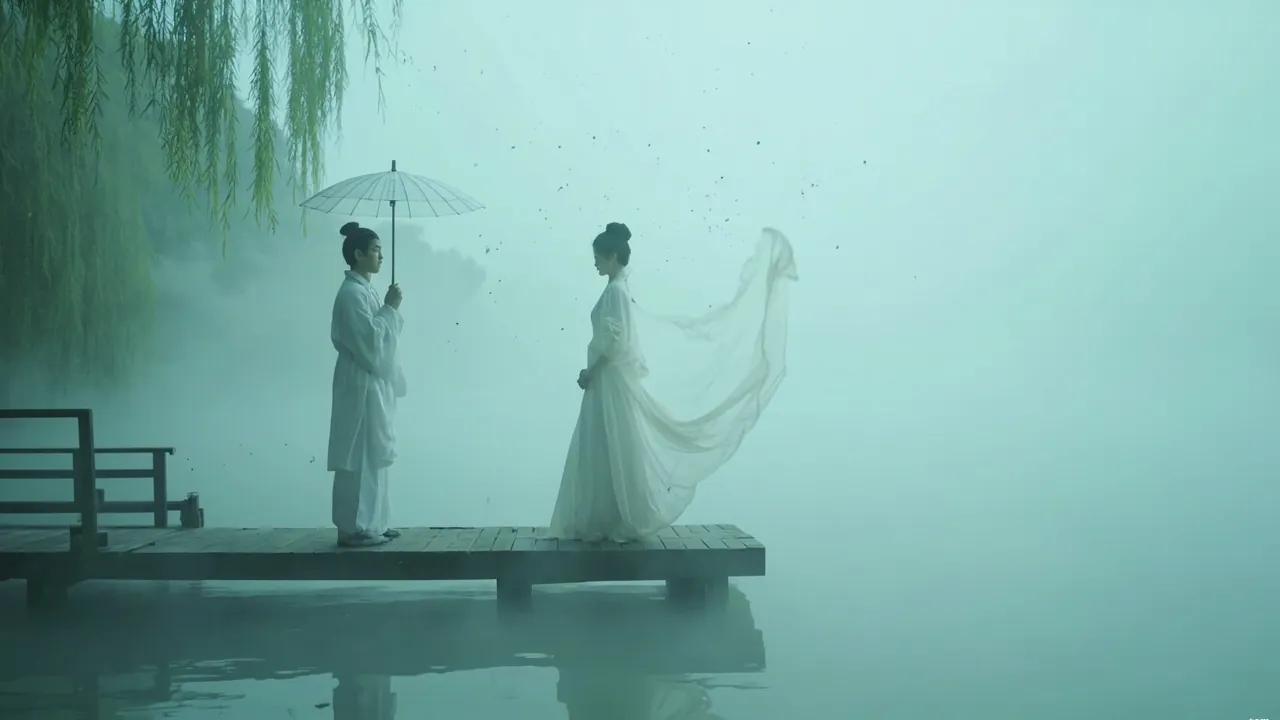
As Bai Suzhen strolled along the shore of West Lake, a sudden spring rain began to fall. She and Xiao Qing took shelter—and found themselves standing beside a young scholar named Xu Xian, who was also caught in the rain. He was a gentle, kind-hearted young man studying at a nearby temple, poor but virtuous, with a warm smile and honest eyes.
Without thinking, Bai Suzhen struck up a conversation. The rain grew heavier, and Xu Xian, ever the gentleman, offered to share his umbrella with the mysterious beautiful stranger. When the rain let up, Bai Suzhen invited him to a tea house, and Xu Xian—who had never encountered a woman so beautiful, so graceful, and so interested in him—accepted with blushing astonishment.
What neither of them knew was that this meeting had been fated. In some versions of the story, the gods themselves had arranged the encounter as part of a larger cosmic plan. In others, it was pure chance—or the irresistible pull of a love that transcended the boundaries between species, between worlds, between the natural and supernatural orders.
Within a few short months, Bai Suzhen and Xu Xian were married. With her magical powers, Bai Suzhen helped Xu Xian open a successful medicine shop in Hangzhou (杭州), and the couple lived in comfortable prosperity. They were deeply in love. Their life together was warm, happy, and seemingly perfect.
The Monk Who Knew Too Much
But the world had other plans.
One day, a wandering monk named 法海 (Fǎ Hǎi) arrived at Xu Xian’s medicine shop. Fahai was a Buddhist monk of great spiritual power who had the ability to see through the disguises of evil spirits and demons. When he looked at Xu Xian, he immediately sensed that something was wrong—the young scholar was surrounded by an aura of spiritual power that no ordinary human should possess. More specifically, he sensed the presence of a serpent spirit.
“Young man,” Fahai said gravely, “you are living with a demon. That wife of yours is not human.”
Xu Xian was shocked and horrified. He loved his wife. He refused to believe the monk’s accusations. But Fahai was persistent—and he gave Xu Xian a packet of realgar powder (雄黄粉, xiónghuáng fěn), a substance that, in Chinese folklore, has the power to drive away evil spirits and snakes. “Put this in her tea,” Fahai instructed. “If she truly is human, nothing will happen. If she is a demon, you will see her true form.”
Xu Xian, torn between his love for his wife and his fear of the monk’s warnings, did something he would regret for the rest of his life. He put the realgar powder in Bai Suzhen’s tea.
The Serpent in the Garden
When Bai Suzhen drank the tea, she felt the poison spreading through her system. The realgar—combined with her barely-suppressed serpentine nature—overwhelmed her magical defenses. She writhed in agony, her human form beginning to dissolve, her true serpentine nature forcing its way through.
Xu Xian watched in terror as his beautiful wife transformed before his eyes. The woman he loved became a giant white serpent—an enormous, coiling snake that filled their bedroom with its massive coils. Xu Xian screamed in horror and fell to the floor, dead of sheer shock.
When Bai Suzhen regained consciousness and realized what had happened, she was devastated. Her husband lay dead at her feet, killed not by any physical harm but by the terror of her true form. She gathered her magical powers and set out to save him.
The only substance powerful enough to resurrect someone who had died of fright, she learned, was a rare herb that grew only at the top of Mount Kunlun (昆仑山, Kūnlún Shān), one of the most sacred and remote mountains in all of China. The journey was perilous, but Bai Suzhen—driven by love and desperation—made it. She stole the herb, returned home, and administered it to Xu Xian. He opened his eyes. He was alive.
When Xu Xian recovered, he was filled with remorse. He had listened to the monk. He had doubted his wife. And she had still saved him. From that moment on, he resolved never to listen to anyone who spoke against her again. He loved her. She was his wife. That was all that mattered.
The Mountain of Ice
But Fahai was not finished. The monk had made it his personal mission to separate Xu Xian from the serpent spirit he believed was corrupting him. When his first attempt through the realgar powder failed—since Bai Suzhen had saved Xu Xian and demonstrated her love—he escalated.
One day, Fahai kidnapped Xu Xian and imprisoned him in the Golden Cicada Temple (金山寺, Jīnshān Sì)—a powerful Buddhist monastery at the foot of the Yangtze River. There, surrounded by monks and sacred relics, Fahai hoped to break Bai Suzhen’s hold on the scholar and force her to return to the spirit world permanently.
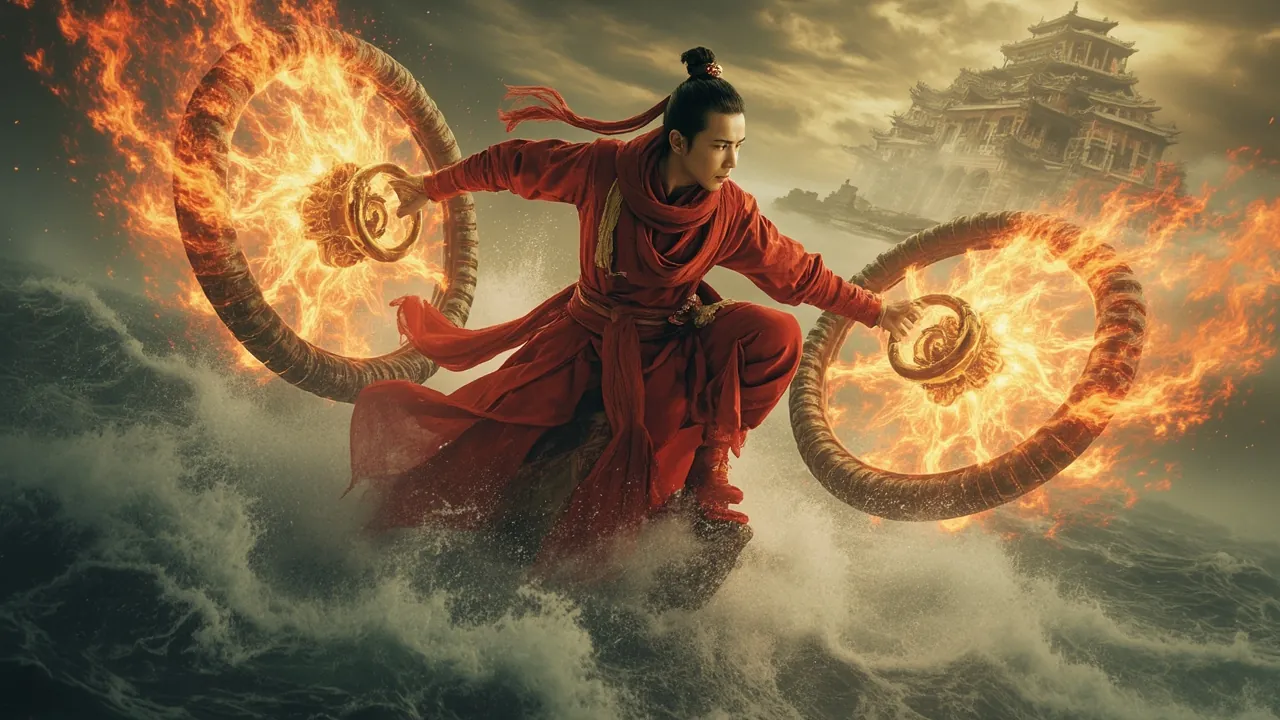
When Bai Suzhen learned what had happened, she was furious. She gathered her powers and, with Xiao Qing at her side, led an army of little spirits and aquatic creatures to the temple. What followed was an epic supernatural battle: Bai Suzhen summoned a massive flood and attempted to drown the monastery, while Fahai countered with sacred Buddhist lightning and fire. The battle raged across heaven and earth, shaking the mountains and terrifying the mortal villagers below.
In the end, Bai Suzhen’s powers were not enough to overcome Fahai’s spiritual authority. She was forced to retreat. But she was not defeated—and she was not about to give up on her husband.
In a final desperate gambit, Bai Suzhen traveled to the Celestial Palace (天庭, Tiāntíng) itself and stole a sacred treasure: a magical fan capable of extinguishing the fires of heaven. She returned to the monastery and used it to extinguish Fahai’s sacred flames. The tide of battle turned. Fahai, outmatched, fled into the mountains.
Xu Xian was freed. The lovers were reunited.
The Final Separation
But the story does not end happily. Fahai, humiliated and desperate, called upon the full authority of the Buddha himself. The Buddha—representing the cosmic order that spirits and mortals should not intermingle—intervened directly. He created an enormous mountain of ice that materialized around Bai Suzhen, encasing her in an impenetrable frozen prison at the foot of Leifeng Pagoda (雷峰塔, Léifēng Tǎ) in Hangzhou.
There, in the cold and the dark, Bai Suzhen remained—imprisoned not because she had done evil, but because she had loved a mortal and refused to let go. She was sealed beneath the earth, beneath the tower, beneath the weight of a cosmic law that said spirits and humans could not be together.
Xu Xian, devastated, became a monk. He devoted the rest of his life to Buddhist practice, living at the foot of Leifeng Pagoda, spending every day in meditation and prayer. Some versions of the story say he spent twenty years there; others say he never left. In all versions, he never stopped loving her.
Their son, born before Bai Suzhen’s imprisonment, was raised by relatives. He grew up to be a successful scholar and eventually passed the imperial examinations—the highest academic achievement in China. On the day of his triumph, when he was celebrating at Leifeng Pagoda, he bowed before the tower and called out to his mother. Bai Suzhen, still imprisoned beneath, heard him. The tower cracked. She was one step closer to freedom.
The Enduring Power of the White Snake
The Legend of the White Snake has been told in Chinese culture for nearly a thousand years. It appears in folk tales, opera performances, novels, films, television series, and video games. The story has everything: romance, adventure, comedy, tragedy, supernatural spectacle, and a heroine who is both powerful and deeply human in her emotions.
Bai Suzhen herself has become a cultural icon—a symbol of passionate love, of female power, and of the tragic cost of defying the established order. She is not evil. She harms no one. She loves sincerely and fiercely. And yet the cosmos punishes her anyway, because she broke a rule—not a moral rule, but a categorical one. She was a spirit who loved a mortal, and that, in the logic of Chinese mythology, was simply not allowed.
For American readers, the White Snake legend offers a rich tapestry of familiar themes. It’s a love story like Romeo and Juliet—two people from different worlds whose love is forbidden by forces beyond their control. It’s also a story about identity and acceptance, as Bai Suzhen’s true nature keeps threatening to destroy the human life she has built. And it is, ultimately, a story about sacrifice—what Bai Suzhen is willing to give up for love, and what she ultimately loses.
The White Snake in Modern China
Today, the White Snake legend is one of the most popular stories in Chinese popular culture. It has been adapted into dozens of films and television series. The 1992 TV series New Legend of the White Snake (新白娘子传奇, Xīn Bái Niángzǐ Chuánqí) is one of the most-watched television programs in Chinese history and is still replayed on Chinese New Year to this day. The 2019 animated film White Snake (白蛇:缘起) and its 2021 sequel White Snake II (白蛇2:青蛇劫起) brought the legend to a new generation and introduced it to international audiences.
In Hangzhou, visitors can tour Leifeng Pagoda and the scenic West Lake area, both central locations in the legend. The surrounding area is beautifully landscaped, and the story of Bai Suzhen and Xu Xian is told on interpretive signs throughout the park. The Broken Bridge (断桥, Duàn Qiáo)—where Bai Suzhen and Xu Xian first met—is one of the most photographed spots at West Lake, a living monument to a love story that has endured for a thousand years.
What the White Snake Teaches Us
The Legend of the White Snake endures because it asks questions that have no easy answers. Is it wrong for a spirit to love a mortal? Should Bai Suzhen have accepted the cosmic order and stayed in the spirit world? Does love give us the right to break rules that exist for good reasons?
The legend doesn’t give us easy answers either. Bai Suzhen is not framed as a villain—she’s framed as a heroine who loves too much and too deeply to be reasonable. Fahai is not framed as evil—he’s framed as a guardian of the cosmic order who genuinely believes he is protecting both mortals and spirits from an unnatural union. The tragedy is that both of them may be right, in their own way.
What we know, watching the story unfold, is that Bai Suzhen’s love for Xu Xian was genuine, selfless, and powerful enough to move mountains—literally. And that love, in the end, is what kept her memory alive for a thousand years. She may be imprisoned beneath Leifeng Pagoda, but she is not forgotten. She never will be.
The Legend of the White Snake is one of the great love stories of world mythology—Chinese in its details, but universal in its emotions. Next time you visit Hangzhou and see West Lake glittering in the moonlight, or walk past Leifeng Pagoda standing stoically against the sky, think of Bai Suzhen. Think of her love, her courage, her sacrifice, and her eternal hope. She is there, beneath the tower, waiting. And she always will be.