The Marriage of the Fairy Maiden: A Love Story Written in the Stars
Once a year, on the seventh day of the seventh lunar month, something magical happens in the sky. Two brilliant stars that spend the rest of the year on opposite sides of the Milky Way drift close together—and on that night, according to Chinese tradition, all the magpies in the world fly up to the heavens and form a bridge with their bodies, so that two lovers separated by the cosmos can meet for just one night. This is the story of how that tradition began: the legend of The Marriage of the Fairy Maiden (天仙配, Tiān Xiān Pèi), also known as the tale of the Weaver Girl and the Cowherd (牛郎织女, Niúláng Zhīnǚ).
It’s a love story so beautiful and so sad that it has been told in China for over two thousand years. It is the original star-crossed romance—a tale of a fairy princess who falls in love with a mortal cowherd, defies the laws of heaven to be with him, and is then punished by being banished to the far side of the sky. Every year, they are allowed one day together. The rest of the time, they gaze at each other across the Milky Way, unable to touch.
This is also the story behind Qixi Festival (七夕节), often called Chinese Valentine’s Day, which is celebrated with romantic dinners, flowers, and heartfelt expressions of love across China. If you’ve ever looked up at the summer sky and wondered about the two bright stars flanking the Milky Way—Vega and Altair—you’ve already encountered this legend. They’re called the Weaver Girl Star and the Cowherd Star, and their story is one of the most enduring love stories in human culture.
The Weaver Girl: A Princess in the Sky
Long ago, before the world was as we know it, there lived a fairy princess named Zhinü (织女, Zhīnǚ)—the Weaver Girl—in the celestial realm. She was the granddaughter of the Jade Emperor (玉皇大帝, Yù Huáng Dàdì), the supreme ruler of the heavens, and her role in the cosmic order was to weave the clouds that painted the sky each day. With her magical loom, Zhinü created the breathtaking displays of color at sunrise and sunset—the pinks, oranges, purples, and golds that made the heavens so beautiful that mortals below would gaze up in wonder.
Zhinü was diligent, talented, and beautiful, but she was also lonely. Her duties kept her constantly at her loom, and she had little time for anything else. She had no friends, no companions, no joy in her work. The heavens were gorgeous, but they were also isolating.
One summer day—according to legend, it was the seventh day of the seventh lunar month—Zhinü and her sisters, other fairy maidens who also served in the heavens, were granted permission to descend to the mortal world below to bathe in a certain lake. This lake, known as Orphan Lake (孤儿湖, Gū’ér Hú) or sometimes the Bathing Pool (沐浴池, Mùyù Chí), was said to have waters with magical restorative properties. The fairy maidens had been looking forward to this excursion for a long time.
The Cowherd: A Poor Man with Nothing but Kindness
On the other side of the mortal world, in a small village, there lived a kind-hearted but desperately poor young man named Niúláng (牛郎, Niúláng)—the Cowherd. His name came from his occupation: he tended the village’s cattle, a humble job that barely provided him with enough to survive. He had no family—the village had taken to calling him “orphan” even though he did have parents, because he seemed to have no one who cared for him.
Niúláng’s life was solitary and difficult. He worked long hours, ate little, and had no prospect of marriage—after all, what woman would want a penniless cowherd with nothing to his name? He spent his days in the fields and his nights alone under the stars.
One day, Niúláng’ old cow—the only companion he had in the world—spoke to him. Yes, spoke. This was no ordinary cow. In many versions of the tale, the cow is actually a fallen immortal, condemned to live as a beast as punishment for some long-forgotten transgression. The cow told Niúláng that if he went to the lake on the seventh day of the seventh month, he would find something precious there. Specifically, he would find the clothes of a fairy maiden who would not be able to return to the heavens without them.
Niúláng, who had little to lose, followed the cow’s advice.
The Meeting at the Lake
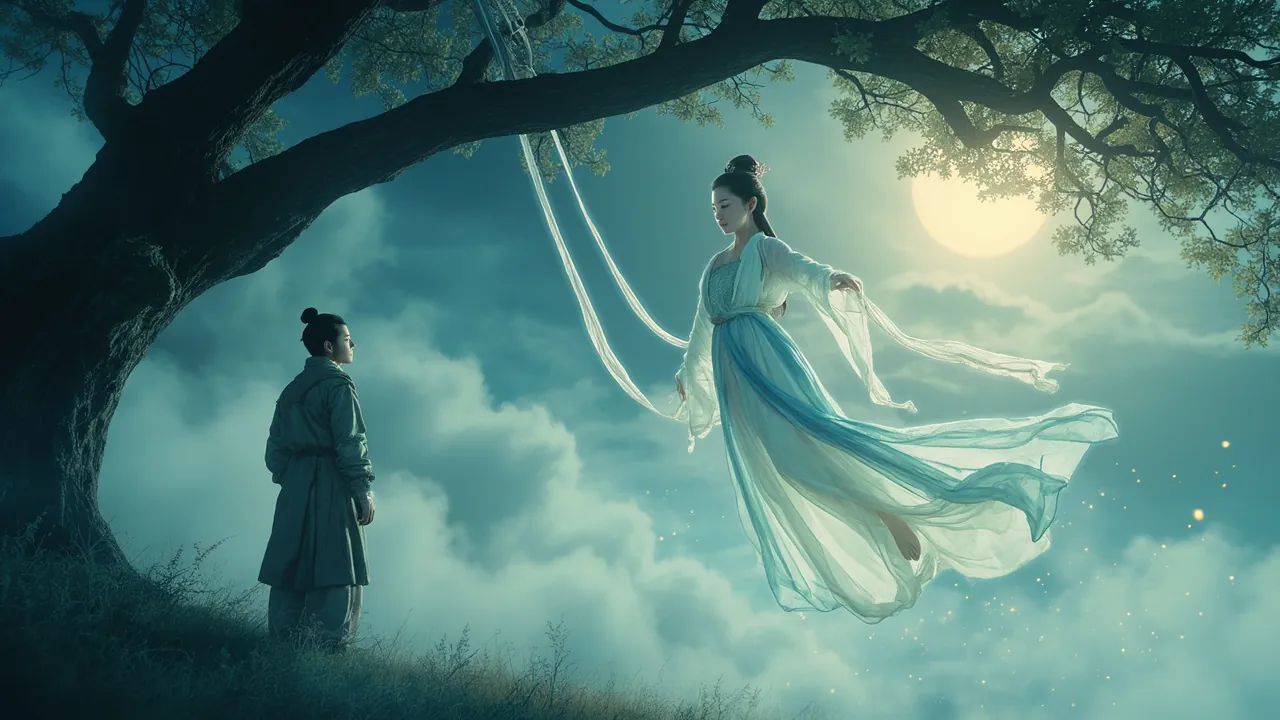
On the appointed day, Niúláng crept to the edge of the lake and found, laid out on the bank, a magnificent bundle of colorful robes. Among them was a garment of shimmering rainbow silk—the clothing of the Weaver Girl, Zhinü. As he watched from behind the trees, he saw the fairy maidens descend from the sky, shed their robes, and dive into the cool waters of the lake.
They bathed and played, laughing and splashing, utterly unaware that they were being watched. But when it was time to leave, all the fairy maidens put on their robes and flew back to the heavens—except for Zhinü. Her robe was missing. She searched frantically, but it was nowhere to be found. In panic and distress, she could not return to the celestial realm.
Niúláng emerged from the trees. He offered to return her robe—but only if she agreed to stay and be his wife. Zhinü, trapped and desperate, agreed. And so began one of the most improbable romances in all of mythology: a fairy princess and a poor cowherd, brought together by a stolen dress and a talking cow.
A Love That Defied Heaven
To everyone’s surprise—perhaps most of all their own—Zhinü and Niúláng fell deeply in love. Without her magical robes, Zhinü could not return to the heavens even if she wanted to. And so she stayed, living as a mortal wife in Niúláng’s humble cottage. She abandoned her celestial weaving duties and instead learned to work the fields, to cook, to live the life of a peasant’s wife. And she was happy—or at least, she chose to be.
Niúláng, for his part, was overjoyed. He worked even harder than before, determined to provide for his new wife. The couple was poor by any material measure, but they were rich in something more important: love, companionship, and the joy of having found each other against all odds. They had two children together—a son and a daughter—and for a time, the story seemed to have a fairy-tale ending.
But the heavens were not about to let this transgression go unpunished.
The Wrath of the Jade Emperor
When the Jade Emperor discovered that his granddaughter had not only stayed in the mortal world but had married a mortal, he was furious. He sent celestial soldiers to capture Zhinü and bring her back to heaven. The soldiers found the family one day as Niúláng was working in the fields. They seized Zhinü, who was holding their children, and dragged her back to the celestial realm against her screams and protests.
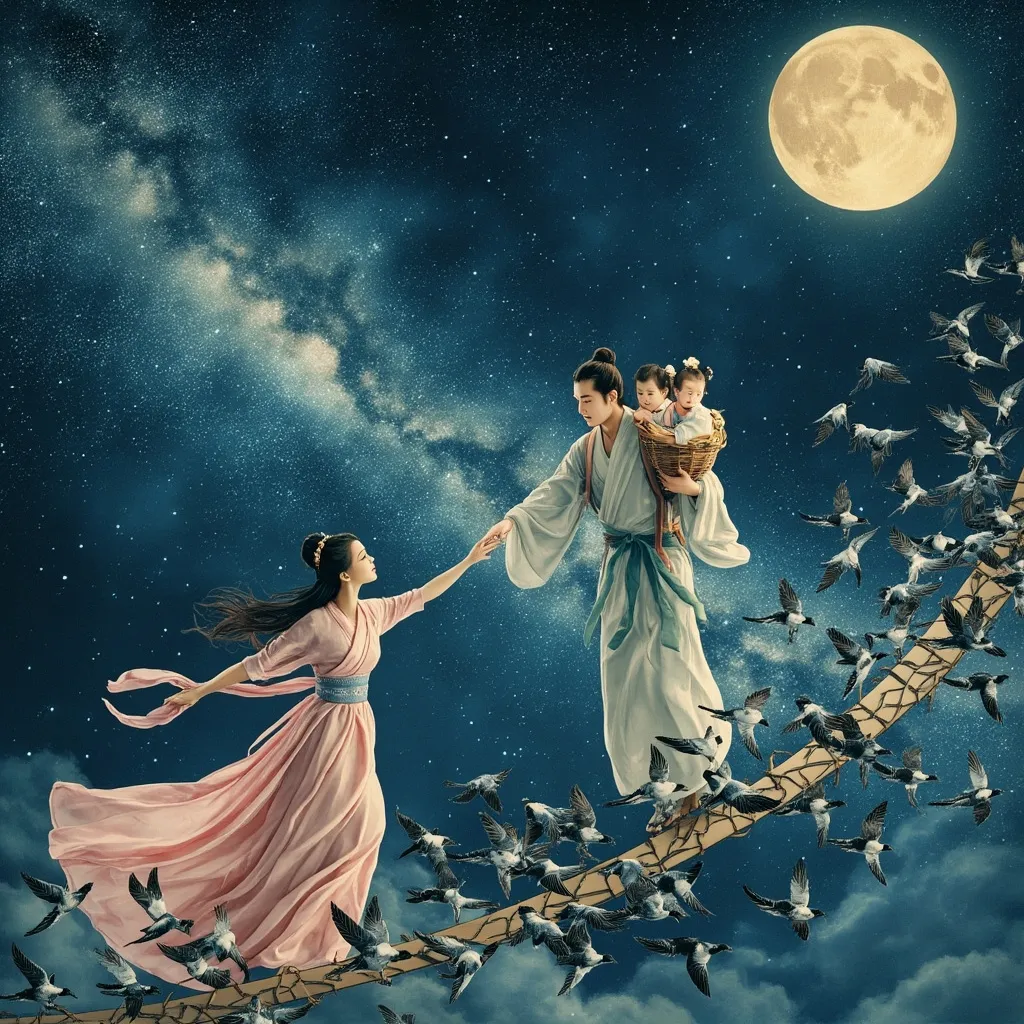
Niúláng returned home to find his wife gone. Their children were crying. The old cow, dying—having used the last of its divine power to help Niúláng—told the cowherd to take its hide, fashion it into a pair of sandals, and fly after his wife. Niúláng did as he was told. He put on the magical hide, took his children, and soared into the sky.
He chased Zhinü all the way to the celestial realm. But just as he was about to reach her, the Jade Emperor appeared—and with a single wave of his hand, he created a barrier between them. A great river of stars—the Milky Way (银河, Yínhé)—flowed between the two lovers, impossibly wide, utterly impassable. Niúláng stood on one side, Zhinü on the other, and the river rushed between them, endless and cold.
The cowherd and the weaver girl stood at opposite ends of the sky, staring at each other across the cosmos, unable to reach one another. It was the cruelest punishment imaginable: not just separation, but separation with hope. They could see each other. They could never touch.
The Magpies of Mercy
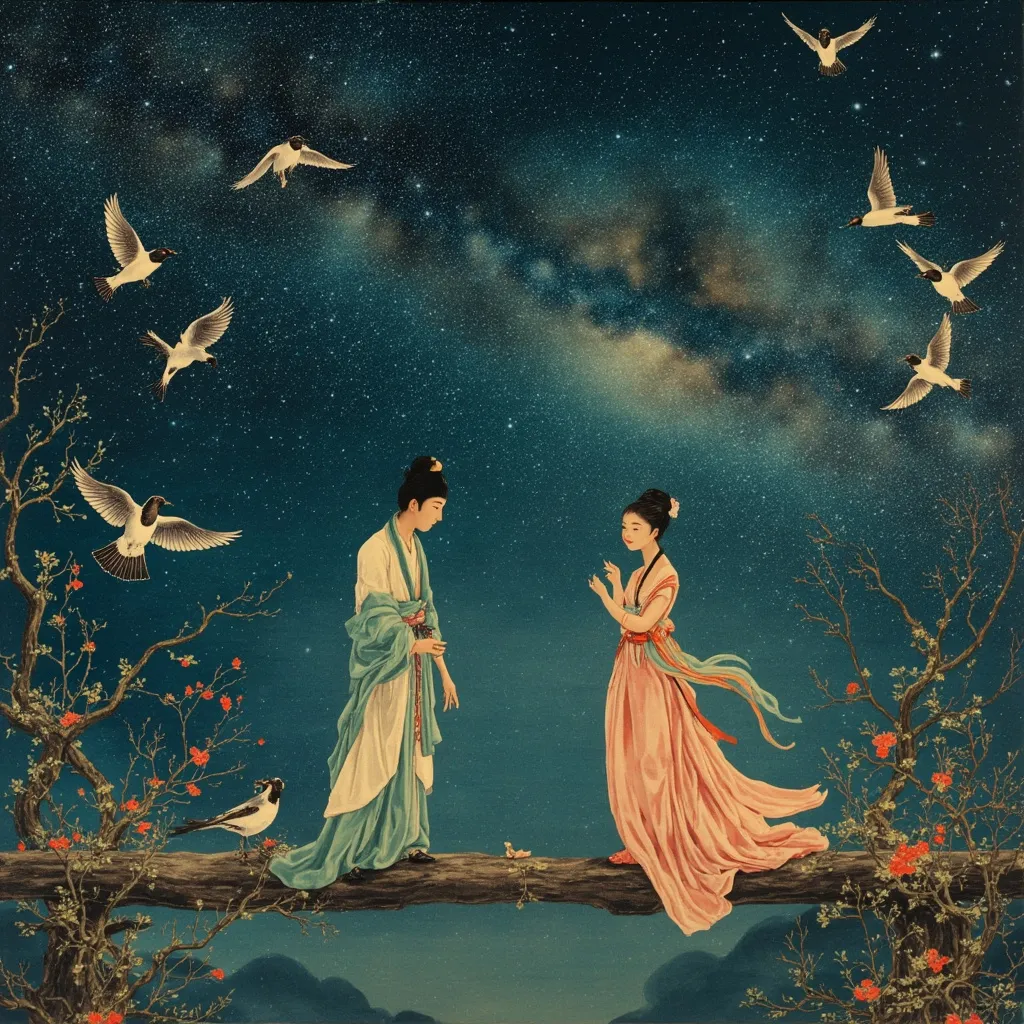
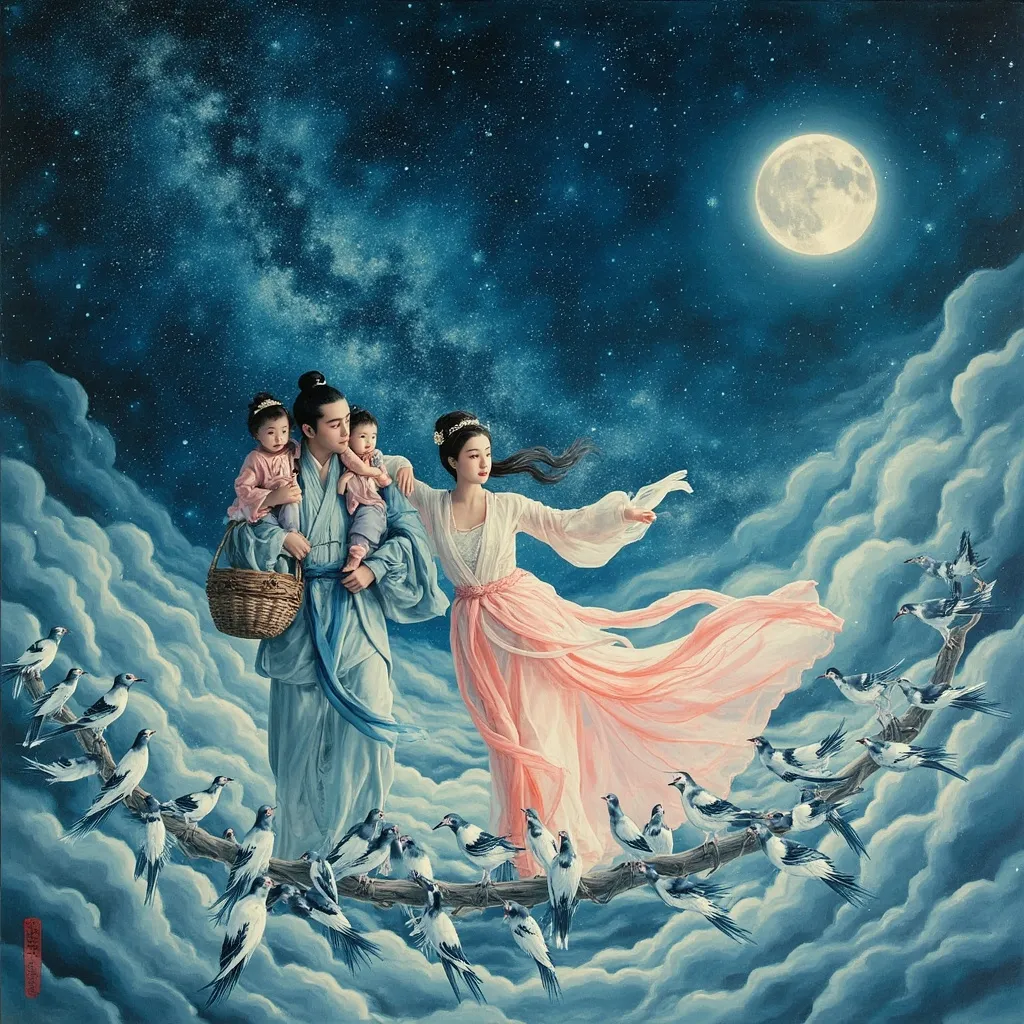
The story might have ended there, in permanent tragedy—but something unexpected happened. The magpies of the world, moved by the couple’s devotion, flew up to the heavens in their millions. They perched on the Milky Way, side by side, wing to wing, until their bodies formed a living bridge across the river of stars. Zhinü and Niúláng ran toward each other across the backs of the magpies and fell into each other’s arms.
The Jade Emperor, witnessing this, was moved—not enough to forgive them entirely, but enough to relent. He decreed that once a year, on the seventh day of the seventh lunar month, the magpies would form their bridge and the lovers would be reunited. The rest of the year, they would remain on opposite sides of the Milky Way.
This is the origin of the annual reunion that Chinese families observe to this day.
Qixi Festival: Chinese Valentine’s Day
Today, the story of the Cowherd and Weaver Girl is celebrated every year on Qixi Festival (七夕节, Qīxī Jié), also known as Chinese Valentine’s Day. The festival falls on the seventh day of the seventh lunar month (usually August), and it is a day for lovers to express their devotion to each other.
On Qixi, couples exchange gifts—often chocolates, flowers, or heartfelt letters. Some couples visit temples to pray for lasting love and happiness. In some regions, young women perform rituals to improve their needlework and weaving skills, honoring Zhinü’s original role as the celestial weaver. And everyone, couples and singles alike, looks up at the summer sky to find Vega (the Weaver Girl Star) and Altair (the Cowherd Star) on opposite sides of the Milky Way, waiting for their one night together.
In a touching modern twist, Chinese tech companies have even created augmented reality experiences that let phone users “see” the magpie bridge forming across their screens when they point their cameras at the night sky during Qixi.
The Universal Language of Love
There’s a reason this story has survived for over two thousand years and shows no signs of fading. At its core, it’s about the most universal of human experiences: the pain of being separated from someone you love, and the hope that love—even if it must overcome impossible obstacles—can bridge any distance.
The specifics are Chinese—the celestial bureaucracy, the magical talking cow, the Jade Emperor’s authority—but the emotions are universal. Every culture has its star-crossed lovers, its separated partners, its tales of love that defies the rules. The Chinese version just happens to have the most poetic staging: two people, separated by a river of stars, allowed to meet for just one night a year, brought together by the kindness of birds.
For American readers, the closest comparison might be the legend of Orpheus and Eurydice from Greek mythology—another story about love that crosses the boundary between worlds. But where Orpheus’s story ends in tragedy, the Chinese legend offers something rarer: a bittersweet compromise. The lovers are separated, but they are not lost. They have each other, even if only one night a year. There is sadness in that, but there is also hope—and hope, as any good love story knows, is what keeps us looking up.
The Marriage of the Fairy Maiden is more than a legend—it’s a living tradition that millions of people celebrate every year. Next Qixi Festival, take a moment to step outside and look at the summer sky. Find Vega and Altair, the two bright stars on either side of the Milky Way. Think of Niúláng and Zhinü, who found each other against all odds, and who wait for each other across the cosmos, year after year, without ever giving up. That’s the kind of love that writes itself in the stars.