Nezha Stirs the Sea: The Boy Hero Who Challenged the Dragon King
Imagine being so powerful at birth that the gods themselves get nervous. That’s exactly what happened with Nezha—born holding a precious jade ring in each fist, already cosmic and already rebellious. In Chinese mythology, few characters capture the imagination quite like Nezha (哪吒, Nézhā), the boy deity who famously stirred the sea, fought a dragon king, and ultimately became one of the most beloved figures in all of Chinese folklore. His story is part superhero origin, part coming-of-age drama, and entirely spectacular.
If you’ve never heard of Nezha, think of him as China’s answer to the most exciting child hero you can imagine—except with more fire-wheels, more cosmic power, and a much bigger fish. His most famous adventure, Nezha Stirs the Sea (哪吒闹海, Nézhā Nào Hǎi), is a story about a boy who refuses to be intimidated by power, even when that power belongs to the ruler of the ocean itself.
The Miraculous Birth of a Deity
The story of Nezha begins not in a hospital or a humble home, but in the celestial realm. His mother, Lady Yin (殷夫人, Yīn Fūrén), was pregnant with him for three years and six months—a suspiciously long time that suggested something extraordinary was brewing. When he was finally born, the baby emerged not as a typical infant but as a glowing orb. His father, Li Jing (李靖, Lǐ Jǐng), a general and a man of reason, was terrified. He raised his sword to strike the orb, and it cracked open, revealing a fully-formed boy sitting inside, already able to walk and speak.
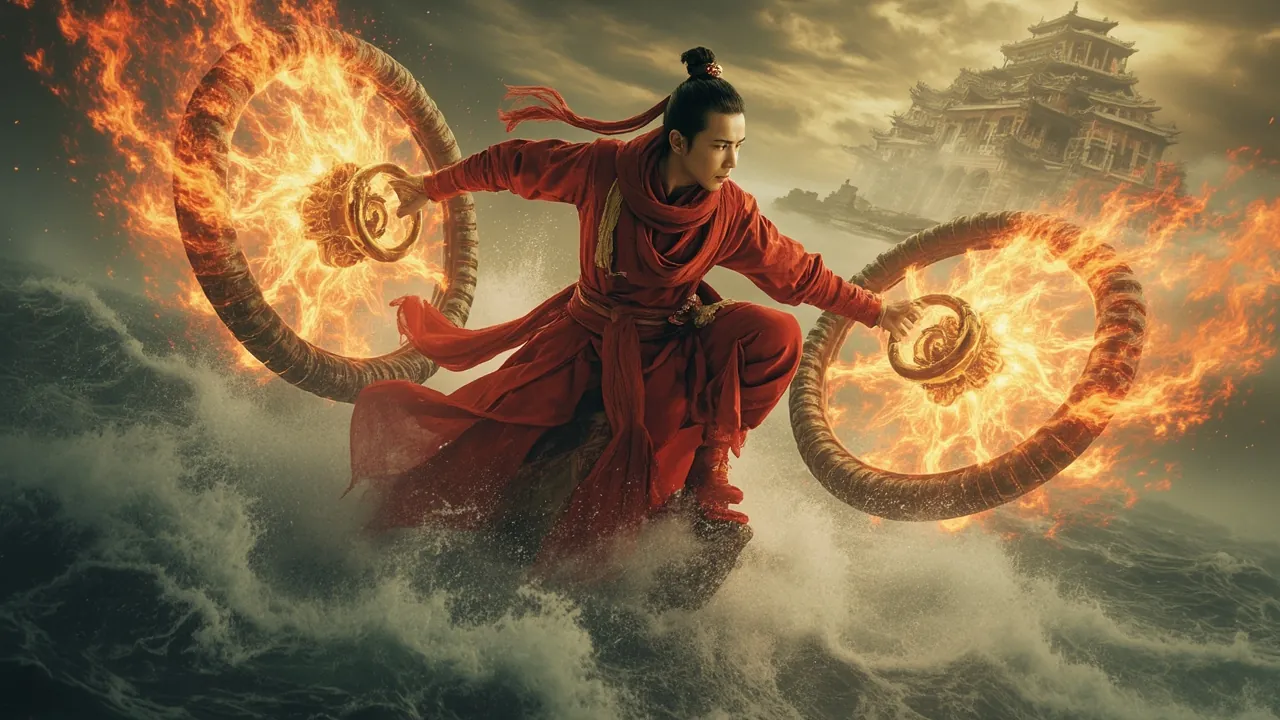
In his hands, the newborn clutched two treasures: the Universe Ring (乾坤圈, Qiánkūn Quān)—a golden hoop with immense power—and a piece of ** cosmos silk (混天绫, Hùntiān Líng)**—a flowing red cloth that could wrap around mountains. These were gifts from his true father, the immortal Taiyi Zhenren (太乙真人), who had been protecting the unborn child in the heavens. From his first moment of existence, Nezha was no ordinary child.
General Li Jing and Lady Yin named him Nezha and raised him as their son, though the boy spent much of his early life training on Mount Xin’an (新安山) under the watchful eye of Taiyi Zhenren. There he learned to master his divine gifts—the ring that could crush iron, the silk that could drag a sea god, and his own fierce courage. By the time he was seven years old, Nezha was already powerful enough to take on forces that would terrify grown warriors.
A Boy, a Sea, and a Dragon King’s Wrath
One scorching summer day, seven-year-old Nezha went out to play with his companions. The heat was unbearable, and they ran to the Long廷 (Eastern Sea, 东海, Dōng Hǎi)—the domain of the Dragon King of the Eastern Sea (东海龙王, Dōng Hǎi Lóngwáng)—to cool off. Nezha stripped off his clothes and dove into the water, which happened to be directly above the Dragon King’s palace.
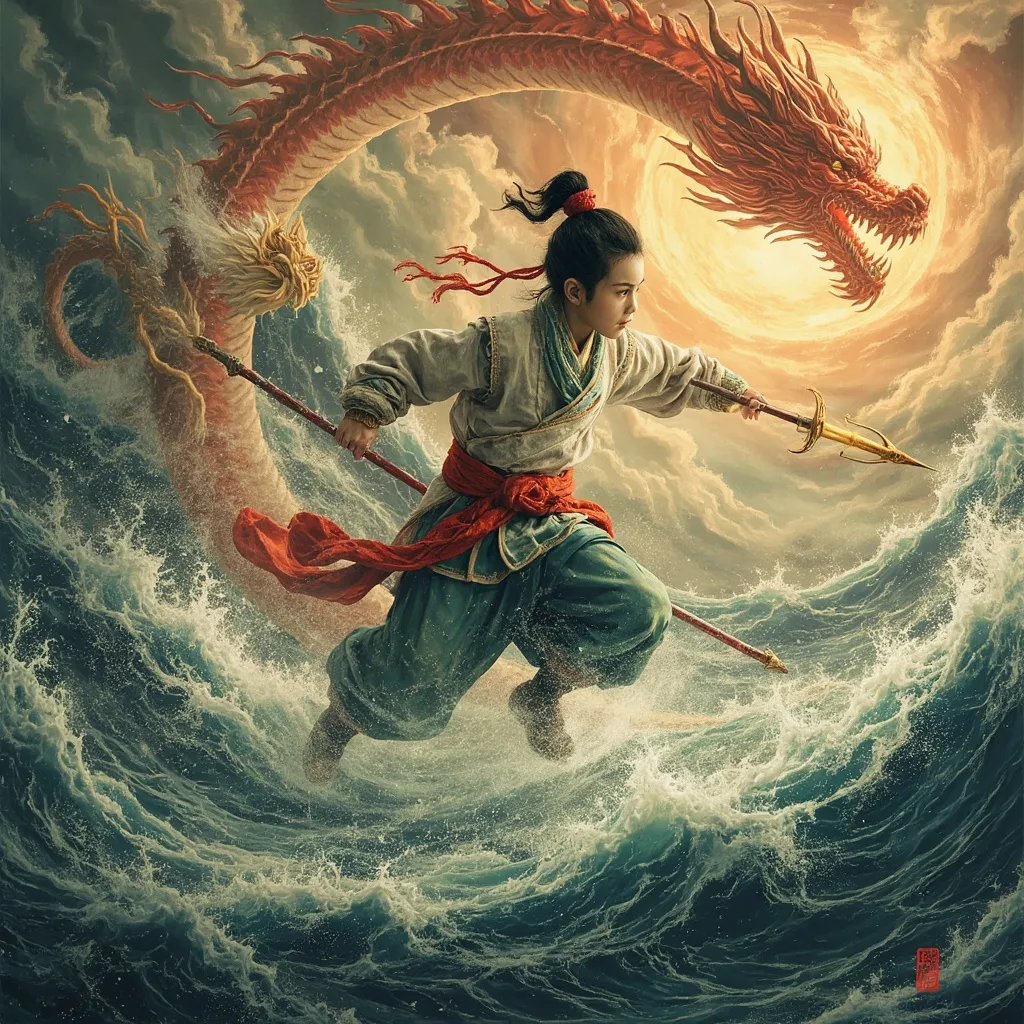
Now, the Dragon King was a powerful deity who controlled the rains, the winds, and the currents of the eastern ocean. He had soldiers, generals, and a vast underwater kingdom. But Nezha, being Nezha, paid no attention to any of that. He grabbed his cosmos silk and began to splash around playfully, stirring up the waters of the entire sea.
The Dragon King’s palace began to shake. His soldiers rushed to investigate and discovered a small boy causing chaos with a piece of red cloth. They sent a crab general to arrest Nezha, but Nezha simply flicked his universe ring and sent the crab spinning away. A lobster general was next; Nezha beat him soundly too. Finally, the Dragon King’s own son—the Third Prince (三太子, Sān Tàizǐ)—came to confront the intruder.
“What insolence!” the Third Prince shouted. “This is my father’s territory! Who are you to disturb our waters?”
Nezha didn’t flinch. “I was just cooling off,” he said. “It’s not my fault your father’s palace is so poorly built that it can’t handle a little splashing.”
The two clashed, and in the fight, Nezha was so powerful that he kicked the Third Prince to death with a single blow. Then he dragged the prince’s body to the shore by the dragon’s tail. When the Dragon King came to find his son, all he found was his son’s corpse.
Furious beyond measure, the Dragon King swore revenge. He planned to flood the entire region and drown Li Jing, Lady Yin, and everyone in their city as punishment for raising such a “criminal.” But Nezha, determined to protect his family, did the unthinkable—he cut the flesh from his own bones and handed it to his parents.
“Take this body and give it back to yours,” Nezha said. “I will repay the debt of raising me. Everything else belongs to you now.”
He then died. His parents, devastated, cremated his body and buried his ashes.
Reborn from Fire and Lotus
But the story doesn’t end there—because Nezha was never going to stay dead. When Taiyi Zhenren learned what had happened, he was moved by the boy’s sacrifice and his loyalty to his parents. He gathered Nezha’s soul and placed it inside a cosmic lotus flower (莲, lián). Through a sacred ritual, he reconstituted Nezha’s body, giving him new divine form—more powerful than before, with wings and wind-fire wheels that let him fly through the air.
When the Dragon King came to take revenge on Li Jing’s family, he found not a frightened general but Nezha—reborn, radiant, and ready for round two. The two faced off in an epic battle across the skies. Nezha’s universe ring and cosmos silk were now even more formidable, and he fought the Dragon King to a standstill. The Dragon King, realizing he had met his match, ultimately agreed to a truce—and to never flood the region again.
Nezha later fought alongside the legendary Shen Gongbao (申公豹) and the future God of War Yang Jian (杨戬), and together they defeated the armies of the King of the Demon Cave (魔家四将). Eventually, Nezha was granted immortality by the Jade Emperor and became a full deity—a protector of children and a symbol of justice against oppression.
The Cultural Legacy of Nezha
Nezha’s story has endured for over a thousand years, passed down through Chinese oral tradition, opera, novels, and art. He appears in the classic novel Investiture of the Gods (封神演义, Fēng Shén Yǎn Yì) from the Ming Dynasty, where his adventure stirring the sea is one of the most dramatic early chapters. He is also central to the later novel Investiture of the Gods: The Stories of Nezha (哪吒闹海), which has been adapted countless times.
In Chinese folk religion, Nezha is worshipped as a deity who protects children and ensures safe childbirth. Parents often hang images of him in their homes to keep their little ones safe. He’s also become a symbol of youthful courage—the idea that even a child can stand up to injustice when armed with conviction and righteousness.
Modern China has embraced Nezha enthusiastically. In 2019, the animated film Nezha (哪吒之魔童降世) became one of the highest-grossing Chinese films of all time, reimagining the legend with a fresh, emotional twist. A sequel, Nezha: Hero Is Back (哪吒之魔童闹海), was released in 2025 and continued the saga. Both films have introduced the legend to a new generation and to international audiences who might never have encountered Nezha otherwise.
Why Nezha Still Matters
What makes Nezha so compelling isn’t just his superhuman powers—it’s the human story underneath. He is a child who takes responsibility for his actions, sacrifices himself for his family, and then comes back stronger. His rebellion against the Dragon King isn’t mere insolence; it’s a refusal to accept that power and privilege are above accountability. When the Dragon King’s son acts like a bully, Nezha stands up to him, even knowing the consequences.
There’s also something deeply Chinese about the way Nezha’s story balances cosmic grandeur with family drama. The tension between Nezha and his father Li Jing—who is torn between duty to the state and love for his son—is one of the most poignant threads of the legend. The moment when Nezha returns to protect his parents after being reborn is a powerful reminder that family bonds can transcend even death.
For American readers, Nezha offers a familiar template: the child hero, the coming-of-age journey, the battle against an oppressive authority figure. But it’s wrapped in Chinese cosmology, Chinese values, and Chinese aesthetics that make it feel entirely fresh. If you enjoy superhero stories, Greek mythology, or tales of young people defying the odds, you’ll find plenty to love in the legend of Nezha.
Experience Nezha for Yourself
If the legend of Nezha has sparked your curiosity, there are wonderful ways to explore this story further. The 2019 animated film Nezha (哪吒之魔童降世) is widely available through streaming platforms and offers a stunning, emotionally rich retelling of the story. For the traditional version, the Investiture of the Gods novel is a Ming Dynasty classic that every Chinese mythology enthusiast should read. You can find it in English translation online or in bookstores.
For those interested in the visual arts, search for Nezha paintings or 哪吒闹海 artwork—Chinese artists have been depicting this story for centuries, and the artwork ranges from traditional ink paintings to vibrant modern illustrations. There’s also a popular Nezha collectible figure market, with detailed statues of Nezha in his iconic pose—wind-fire wheels blazing, universe ring ready—perfect for any mythology fan’s shelf.
Nezha Stirs the Sea is one of the great adventure stories of Chinese mythology—a tale of a boy so brave, so powerful, and so principled that he challenged the ruler of the ocean itself and won. Whether you’re discovering him for the first time or revisiting a childhood favorite, Nezha’s story reminds us that courage isn’t about size or age. It’s about standing up for what’s right, even when the whole sea is against you.