Wu Gang Fells the Cassia Tree: The Man Trapped Between the Moon and the Sun
There’s a man on the moon, and he’s been swinging an axe for several thousand years. He’s not a ghost, not exactly—but he’s not free either. Wu Gang (吴刚, Wú Gāng) is one of the most haunting figures in Chinese mythology: an immortal woodcutter condemned to an eternal, futile labor on the lunar surface, forever chopping at a tree that heals itself the moment he cuts it. His story is part punishment, part tragedy, and entirely hypnotic—a myth about obsession, hubris, and the loneliness of endless, unrewarding work.
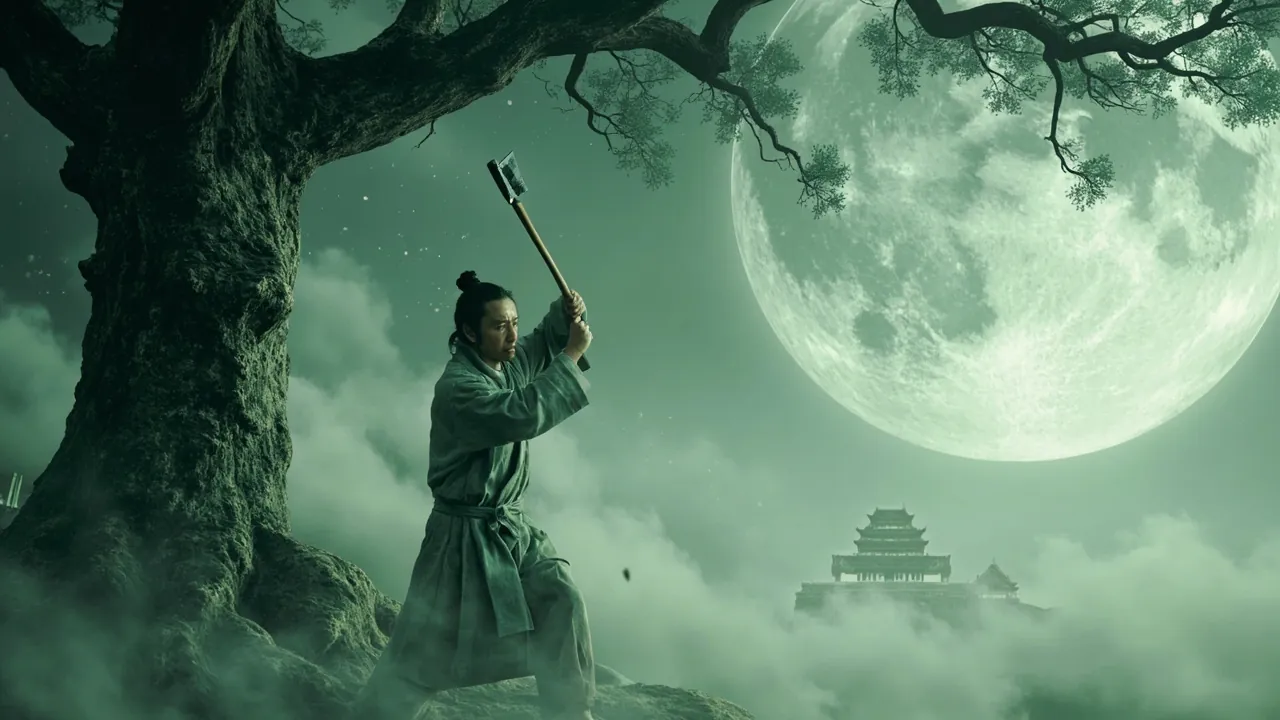
Every Mid-Autumn Festival, when the full moon hangs bright and round in the autumn sky, Chinese families gather to eat mooncakes and gaze at that luminous disc. If you look carefully—really carefully—you can see him up there: a small figure beneath an enormous cassia tree, swinging, always swinging, never stopping. The image of Wu Gang is so iconic that it’s become one of the most recognizable symbols of the Mid-Autumn Festival, right alongside the mooncake and the reunion of family.
The Man Who Reached for Immortality
Wu Gang’s story begins, like many Chinese legends, with a search for immortality. According to the earliest accounts, Wu Gang was a woodsman—or sometimes described as a carpenter or a道术 practitioner—from the mountainous Qingcheng Mountains (青城山, Qīngchéng Shān) in what is now Sichuan Province. He was skilled, strong, and above all, ambitious. He wanted more than a simple life of chopping wood and selling it at market. He wanted to become an immortal—to transcend the mortal world and join the ranks of the celestial beings.
His opportunity came when the goddess of the Western Heaven, the Queen Mother of the West (西王母, Xī Wángmǔ), offered a gift of immortality to those who proved themselves worthy. Wu Gang, driven by his desire, embarked on a long and dangerous journey to seek her favor. He traveled through treacherous mountain passes, crossed rivers, and endured hardships that would have broken lesser men. Finally, he reached the celestial realm and was granted a place among the immortals—or so he thought.
What Wu Gang didn’t know was that his admission to the immortal realm was conditional. The gods had been watching him, and they were skeptical of his character. He had been accepted not as a reward for virtue, but as a test—and Wu Gang, it turned out, was about to fail spectacularly.
The Fatal Flaw: Impatience and Pride
The test the gods set for Wu Gang was deceptively simple: he was to become the guardian of a great cassia tree (桂树, guì shù) that grew on the moon. This was no ordinary tree. It stood an enormous height—some legends say it was thousands of miles tall, its roots reaching deep into the lunar surface, its branches swaying across the heavens. The tree had a miraculous property: every time it was cut, it would heal itself instantly. The cuts would close, the bark would knit back together, and the tree would be whole again as if nothing had happened.
Wu Gang’s task was to chop the tree down. Just one tree. One tree, cut clean through, and his transformation into a true immortal would be complete. How hard could it be?
The gods, of course, knew exactly what they were doing. The cassia tree was designed to be unchoppable—or rather, to be chopped only by someone who possessed the three qualities the gods were testing for: absolute patience, genuine humility, and complete absence of pride. Wu Gang had none of these.
He swung his axe with all his strength. The blade bit deep into the trunk. He stepped back, wiped the sweat from his brow, and watched with satisfaction as the tree… healed. The cut sealed itself. The tree stood whole and unblemished.
Wu Gang frowned. He swung again. Harder this time. The tree shuddered, bark flew, and a deep gash opened in the trunk. He waited, watching. The wound closed. The bark grew back. The tree stood whole.
Again. And again. Wu Gang chopped with the fury of a man who had been promised immortality and was now being cheated. The tree always healed. No matter how hard he swung, no matter how deep the cut, by the time he set down his axe to rest, the tree was as whole as ever.
An Eternal Punishment
The story’s ending depends on which version you read, but the core elements are consistent across all traditions. In one version, Wu Gang simply couldn’t accept the tree’s imperviousness. His frustration turned to obsession, then to madness. He chopped. He rested. The tree healed. He chopped again. He never stopped. The gods, seeing that he had failed the test—that he was too impatient, too proud, too unwilling to accept that some things cannot be forced through brute strength alone—condemned him to his fate forever.
In another version, Wu Gang’s anger grew so hot that he threatened the celestial order itself. He declared that he would bring the tree down even if it took a thousand years, even if it took ten thousand. The gods, unwilling to let such defiance go unpunished, made his sentence eternal: he would chop the tree on the moon forever, never allowed to return to the mortal world, never allowed to stop, never allowed to finish.
In both versions, Wu Gang is trapped in a kind of cosmic purgatory—alive and immortal, but condemned to endless, futile labor. The tree he can never fell has become his prison, his punishment, and his eternal companion all at once. Some versions say that every time his axe strikes, the woodchips that fly off become the fragrant cassia blossoms that scent the autumn air. Others say that the rhythm of his chopping creates the subtle pulses of light on the moon’s surface that astronomers have observed for centuries.
The Cassia Tree: Symbol of the Moon
What makes Wu Gang’s legend so enduring is the pairing of the man and the tree. The cassia tree (桂, guì) is already deeply symbolic in Chinese culture. The word for cassia (桂) sounds identical to the word for “贵,” meaning “expensive” or “noble,” so the tree is associated with honor, wealth, and high status. Cassia bark is used in traditional Chinese medicine and cooking, and the tree’s fragrance has long been considered exquisite.
On the moon, the cassia tree represents beauty and transcendence—but also, in Wu Gang’s story, the cruelty of an unattainable goal. The tree is a mirror: it reflects Wu Gang’s flaw back at him. His inability to cut it down is really his inability to master himself—his impatience, his pride, his need to force outcomes rather than accept the natural order of things.
In Chinese poetry and art, the image of Wu Gang beneath the moonlit cassia tree has become one of the most poignant symbols of human futility—but also, strangely, of perseverance. He keeps swinging, even though he knows he can’t win. There’s something almost admirable in that, even if the myth warns us that stubbornness without wisdom is just another form of destruction.
Wu Gang in the Mid-Autumn Festival
Today, Wu Gang’s legend is inseparable from the Mid-Autumn Festival (中秋节, Zhōngqiū Jié), one of the most important holidays in the Chinese calendar. Held on the 15th day of the 8th lunar month (usually September or October), the festival celebrates the harvest, family reunion, and the beauty of the full moon.
During Mid-Autumn, it’s traditional to gaze at the moon and look for the shadow of Wu Gang and his cassia tree. Mooncakes—the round, dense pastries filled with lotus seed paste, red bean, or other sweet fillings—are shared among family members as a symbol of reunion and completeness. The round shape of both the moon and the mooncake represents the cyclical nature of life and the hope that families separated by distance will one day come together again.
In many Chinese households, elders tell the story of Wu Gang to children as they gaze at the full moon together—a cautionary tale about the dangers of impatience and the importance of humility. It’s a story that has been told in essentially the same way for over a thousand years, passed down through generations as part of the living tradition of Chinese mythology.
What Wu Gang Teaches Us
There’s something deeply modern about Wu Gang’s story, even if it comes from ancient China. He is, in a sense, the ultimate symbol of the person who wants something so badly that they become trapped by the wanting. He can’t accept that the tree is unchoppable. He can’t let go of the goal. And so he swings, forever, alone on the surface of the moon, a prisoner of his own obsession.
But the legend also has another reading. Wu Gang is relentless. He doesn’t give up, even when the task is impossible. He shows up, day after day, century after century, and swings. There’s a kind of dignity in that—even if the myth ultimately frames his persistence as a flaw rather than a virtue.
For American readers, Wu Gang might evoke comparisons to Sisyphus, the figure from Greek mythology condemned to roll a boulder up a hill forever, only to watch it roll back down again. Both are stories about eternal, futile labor—and both raise the same uncomfortable question: is persistence in the face of impossibility admirable or absurd? The Chinese tradition, on the whole, tends to frame Wu Gang more sympathetically than the Greeks frame Sisyphus, perhaps because the cassia tree, unlike the boulder, is beautiful. Wu Gang is trapped next to something lovely, even if he can never possess it.
Experience the Legend
If Wu Gang’s story has captured your imagination, the best way to experience it is to participate in the Mid-Autumn Festival—either by attending a local Chinese cultural event, making mooncakes at home, or simply stepping outside on the night of the full moon and looking up. Try to find the shadow of the cassia tree on the moon’s surface, and think of Wu Gang, still swinging, still trying, after all these centuries.
For those who want to dive deeper, the legend appears in many classical Chinese texts, including the Spring and Autumn Annals of the White Snake (白蛇传) and various collections of Taoist mythology. You can also find beautiful depictions of Wu Gang in traditional Chinese ink wash paintings, where he is often shown as a small, solitary figure beneath the enormous, luminous moon—a speck of humanity against the vastness of the cosmos.
Wu Gang Fells the Cassia Tree is one of the most haunting legends in Chinese mythology—a story about ambition, punishment, and the eternal human tendency to reach for things we cannot have. Next time you look up at the full moon, take a moment to find him. He’s there, swinging away, and he always will be. The cassia tree blooms eternally, and Wu Gang chops eternally, and the story goes on forever—just as the best myths do.