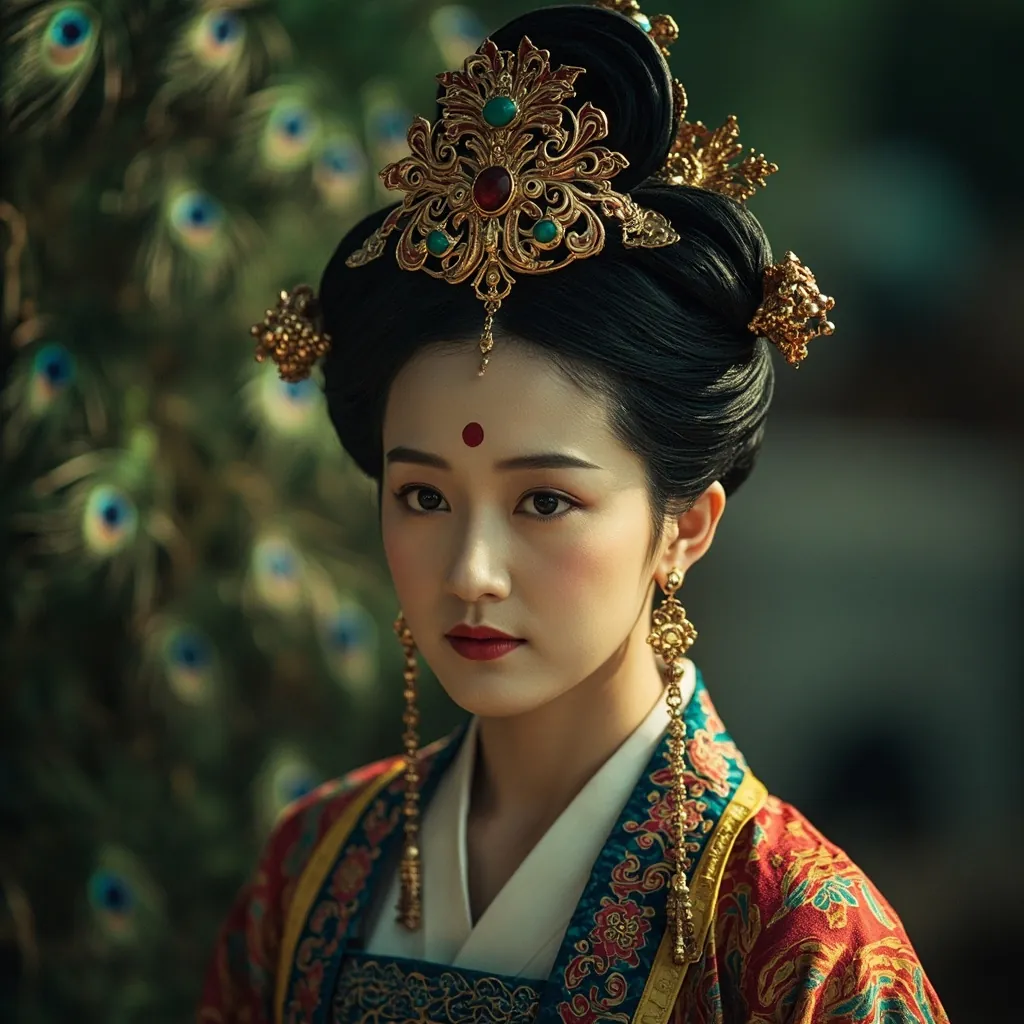
The story of Yang Guifei begins, as so many Chinese love stories do, with a festival. It was the Rainbow Bridge Festival in the capital city of Chang’an, and the streets were alive with music, lanterns, and the hum of crowds. Among the revelers was an eighteen-year-old girl named Yang Yuhuan — beautiful in the particular style of the Tang Dynasty, with her dark hair piled high, her face powdered white, and her lips painted a delicate red. She was the daughter of a minor official, unremarkable in her family background but extraordinary in her appearance. When the emperor’s son, the handsome Prince Li Hong, saw her that evening, he is said to have stopped in his tracks.
What followed was a romance that would become one of the most famous — and most distorted — love stories in Chinese history. Yang Yuhuan would become Yang Guifei, the “Imperial Consort Yang,” the most beloved woman in the world at the time. She would also become a scapegoat for one of the greatest military disasters in Chinese history: the An Lushan Rebellion, which nearly destroyed the Tang Dynasty and killed millions of people. She was blamed, reviled, and ultimately executed by her own subjects. And yet, centuries later, Chinese writers and artists would return to her story again and again, not to condemn her but to mourn her — as a victim of politics, of jealousy, and of an empire’s inability to face its own failures.
Understanding Yang Guifei means understanding the Tang Dynasty at its most glorious and its most tragic. It means understanding how women in the imperial court were used as political pawns, how beauty could be both a gift and a curse, and how history often blames the wrong people for systemic failures.