The Legend of Bo Ya and Ziqi: The Guqin Story That Outlived an Empire
A Complete Guide to the Most Beautiful Friendship Story in Chinese Music
Here is a story about music that does not have a single note of music in it.
Two men live in the same world but move through it differently. One, named Bo Ya, is a master of the guqin — the seven-string Chinese zither that was once played only by scholars and aristocrats. The other, named Ziqi, is a woodcutter who lives a simple life in the mountains. Bo Ya plays his guqin for kings and nobles in the capital. Ziqi chops wood and listens to the wind.
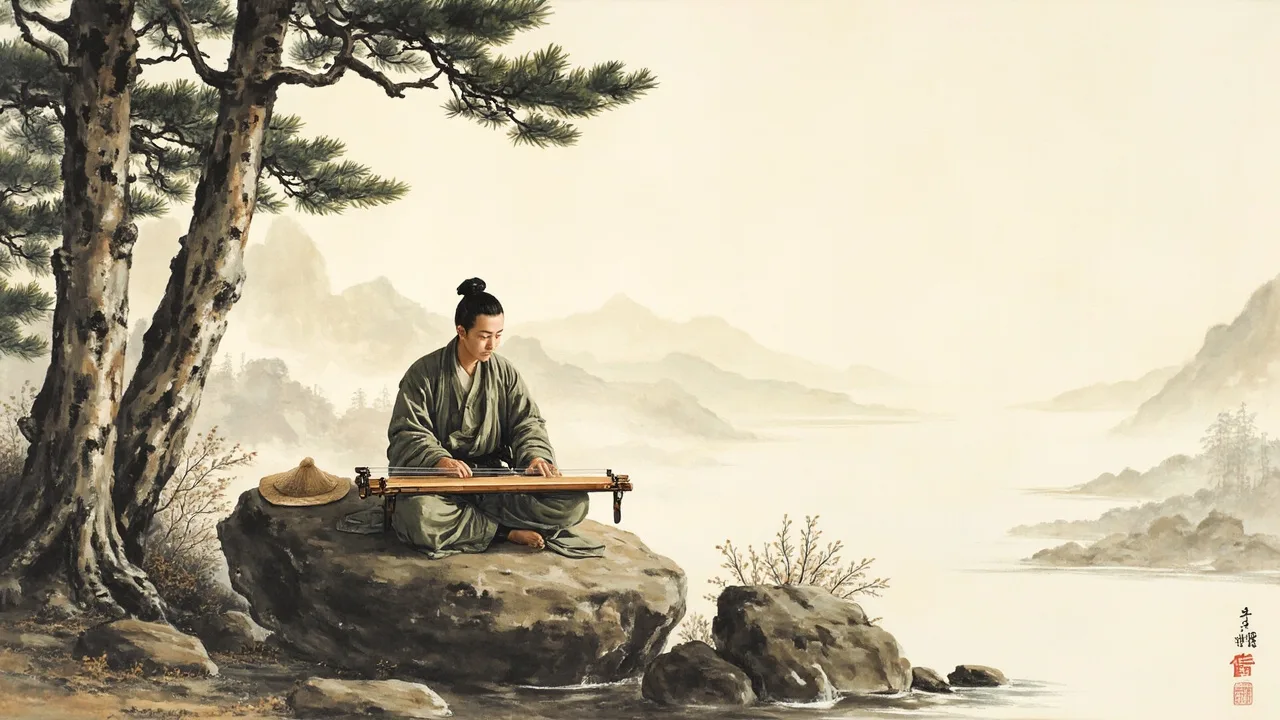
One day, Bo Ya travels into the mountains and hears someone playing a guqin in the forest. He stops to listen, and realizes that the music he is hearing is exactly what he has always wanted to play but never could: music that sounds like the forest sounds, music that makes you hear what the trees are thinking, music that captures the feeling of being alive in a natural world without trying to improve on it. He follows the sound and finds Ziqi, the woodcutter, playing a guqin he has made from a fallen tree.
Bo Ya is stunned. He asks Ziqi where he learned to play like this, and Ziqi says he has not learned — he simply hears the forest and lets the music come out. Bo Ya realizes that everything he has learned from teachers and books and palace performances is getting in the way of the thing he actually wants to say. He plays for Ziqi. Ziqi listens and says: “Your music is very fine. But you are still thinking about the music. You need to forget the music.”
Bo Ya goes home and spends the next seven years practicing, trying to forget the music — to reach a state where the music comes out of him the way it comes out of Ziqi, without technique, without effort, without self-consciousness. Finally, one day, he reaches that state. He goes back to the mountains, finds Ziqi, and plays. When he finishes, Ziqi looks at him and says: “Now. Now you have it.”
Then Ziqi dies.
Bo Ya never plays again.
This is the legend of Bo Ya and Ziqi, and it is one of the foundational stories of the guqin tradition — a story that Chinese musicians have been telling each other for over two thousand years, and that has shaped the way Chinese musicians think about what music is for.
Background: What the Guqin Actually Is
To understand why this story matters so much, you need to know a little about the guqin — the instrument at the center of the story.
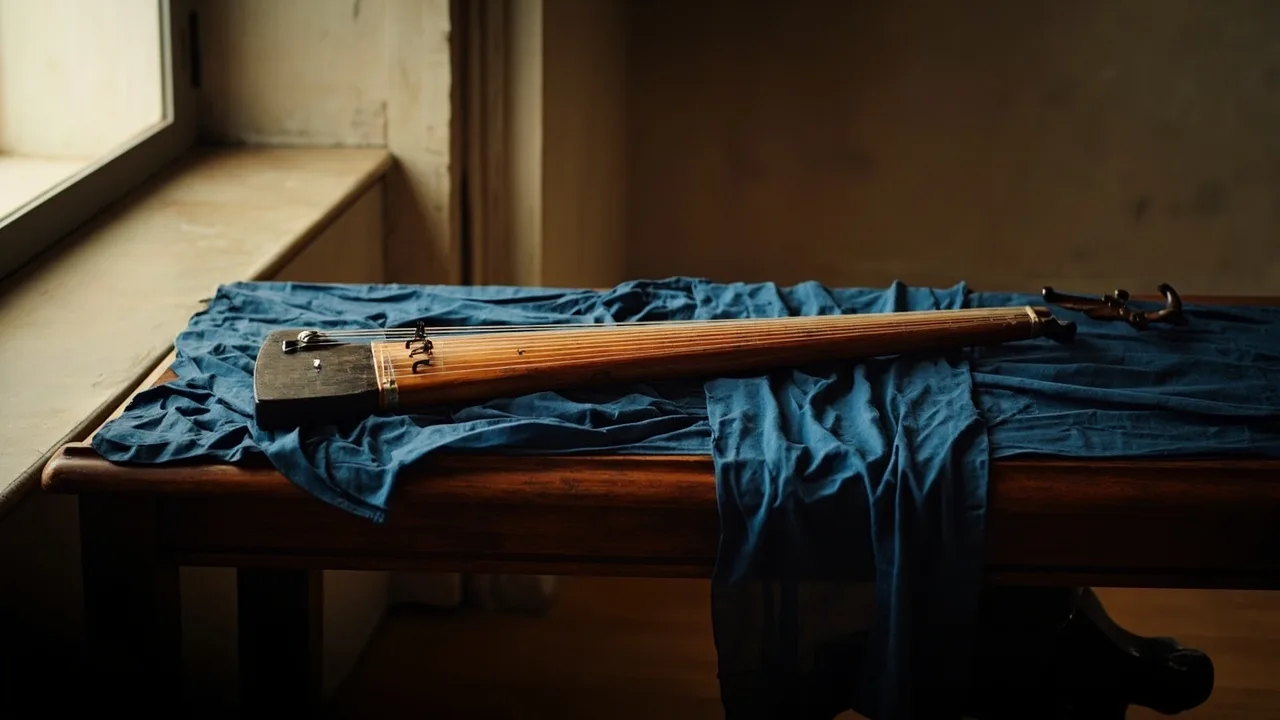
The guqin is a seven-string zither, played horizontally on a table or in the player’s lap. It has no bridges and no frets. The player plucks the strings with the right hand and uses the left hand to press, slide, and bend the notes to create a singing, vocal quality. The instrument’s body is usually around three feet long, made of wood, and produces a quiet, intimate sound that is nothing like the dramatic performances of the pipa (the Chinese lute) or the erhu (the two-stringed fiddle).
The guqin is not a crowd instrument. It cannot compete with drums or cymbals. Its sound does not carry far, and it requires silence around it to be heard properly. This is why it has always been associated with private, intimate settings — a scholar’s study, a garden pavilion, a small gathering of friends. The guqin was not played for audiences; it was played for listeners.
This is also why the Bo Ya and Ziqi story resonates so deeply with guqin players. The story is about the difference between playing for people and playing for the right person. Bo Ya was technically superior — he had studied with the best teachers, he knew all the rules of musical composition, he could play for the most sophisticated audiences in the capital. But he could not play the way Ziqi could, because Ziqi was not trying to communicate anything to anyone except the forest and the wind. His music was completely without agenda.
The story asks a question that musicians still argue about: Is technique in service of expression, or is it a barrier to expression? The legend’s answer is clear: technique must eventually be transcended, not abandoned but gone through, so that the music can come out clean.
The Philosophy Behind the Story: What Chinese Culture Says About Art and Nature
The Bo Ya and Ziqi story is not just a story about music. It is a story about the relationship between human artifice and natural truth, which is one of the central concerns of Chinese philosophy.
The relevant framework is Daoism — the philosophical tradition associated with the Dao De Jing, attributed to the philosopher Laozi, and the Zhuangzi, a collection of Daoist parables and essays. Daoism argues that human civilization — its rules, its institutions, its techniques — is always in tension with the natural world, which operates according to its own logic. The Daoist ideal is to align yourself with the natural world rather than trying to impose human structure on it.
The Zhuangzi, in particular, contains many stories about craftsmen and artists who achieve extraordinary things by surrendering their conscious intention to a larger process. One famous story describes a cook who can butcher an ox with such skill that his knife never dulls because he does not cut against the grain — he lets the ox’s body guide his blade, so to speak. Another story describes a musician who can play the guqin so well that he forgets he exists.
The Bo Ya and Ziqi story is in this same tradition. Ziqi is the Daoist sage — the person who has stopped trying and started listening. He has no technique in the formal sense, but he has something that formal technique cannot provide: direct connection to the source of the music, which is the natural world itself. Bo Ya is the Confucian scholar — the person who has studied hard, mastered the rules, achieved competence — and who now has to learn the harder lesson: that mastery is not enough, that the rules are just a path to the place where you forget the rules.
This is not a uniquely Chinese insight. American readers will recognize it as the same insight described by the jazz musician Miles Davis when he said that “do not play what’s there, play what’s not there” — the idea that the best music comes from the spaces between the notes, not from the notes themselves. It is the insight described by the painter Pablo Picasso when he said “learn the rules like a pro, so you can break them like an artist.” The difference is that the Bo Ya and Ziqi story embeds this insight in a specific narrative about two men and a mountain and a tree, which makes it more memorable and more human than a philosophical abstraction.
How the Story Shaped the Guqin Tradition
The legend of Bo Ya and Ziqi became so central to the guqin tradition that it is essentially the guqin’s founding myth. It appears in the earliest written accounts of the guqin, dating from the Han Dynasty (206 BC – 220 AD), and it has been retold, illustrated, and referenced in guqin music and literature ever since.
The story does several things for the guqin tradition that are worth noting.
First, it establishes the guqin as an instrument of nature rather than a court instrument. Bo Ya plays for the king, but his real education happens in the mountains with Ziqi. The instrument belongs to the forest, not the palace. This has shaped the guqin’s repertoire — many of the most famous guqin pieces have titles that evoke the natural world: “The Flowing Water,” “The Autumn Wind,” “The Cuckoo,” “Plucking the Orchid.” These pieces are not descriptions of nature in the Western sense — they are not program music trying to imitate birdcalls or thunderstorms. They are attempts to access the same quality of direct, unselfconscious expression that Ziqi had.
Second, the story establishes the idea of the ideal listener. Ziqi is the perfect listener — someone who hears without agenda, without expectation, without judgment. The legend implies that the best music requires the best listener, and that these two things develop together. This is why the guqin tradition has always emphasized listening as much as playing. A guqin student is taught not just to produce sounds but to hear what is happening inside the sound — to hear the room, the silence between notes, the way a note continues to vibrate after the finger has left the string.
Third, the story creates a model for the relationship between a teacher and a student that is the opposite of the Western conservatory model. Ziqi does not teach Bo Ya technique — he gives him a conceptual challenge (“you need to forget the music”) and sends him away to figure it out for himself. The Daoist approach to teaching, which is very different from the Confucian emphasis on diligent study and imitation of models, is to create conditions in which the student discovers the truth themselves. This approach has been characteristic of the guqin tradition for two thousand years.
The Moment of Ziqi’s Death: What the Story Says About Loss
The most powerful part of the Bo Ya and Ziqi story is the ending: after Bo Ya finally achieves what Ziqi taught him to find, Ziqi dies, and Bo Ya never plays again.
This is not a happy ending in the conventional sense, but it is a complete one. Bo Ya got what he wanted — the ability to play without self-consciousness — and then lost the person who made it possible. The music was real. The friendship was real. And now both are gone.
Chinese readers who encounter this story often compare it to the ending of other great friendship stories in world literature. Some think of the friendship between Achilles and Patroclus in the Iliad. Some think of the friendship between Samuel Beckett’s Vladimir and Estragon in Waiting for Godot — two people who find meaning in each other’s presence and who cannot imagine the world without each other. The Bo Ya and Ziqi story shares with these stories the sense that a deep friendship is not just pleasant but necessary — that it makes life bearable in a specific way that nothing else can.
The detail that Bo Ya never plays again is crucial. It is not that he cannot play — his technique is still there. It is that there is no longer anyone whose listening can meet his playing. The music required both of them. Ziqi’s death does not diminish Bo Ya’s skill; it diminishes the possibility of the music as he understood it.
This is, again, a very Chinese way of thinking about art. The art exists in the relationship between the artist and the audience, not in the object itself. The paintings in a museum are not the art — they are evidence of an act of communication between an artist and a viewer that happened once and can never be repeated exactly. The music Bo Ya made for Ziqi was real in the moment, and then it was gone, and the thing that made it real was Ziqi’s presence.
Cultural Connection: Bo Ya and Ziqi and the American Folk Music Tradition
The story of Bo Ya and Ziqi has a surprising connection to the American folk music tradition, specifically to the relationship between Lead Belly and John Lomax.
Lead Belly (Huddie Ledbetter) was a Black folk musician from Louisiana and Texas who was serving a prison sentence for murder when the folklorist John Lomax recorded him in the early 1930s. Lomax was looking for authentic American folk music, and Lead Belly’s repertoire of work songs, ballads, and blues was exactly what he wanted. He helped get Lead Belly released from prison and introduced him to a wider audience.
The analogy to Bo Ya and Ziqi is imperfect but suggestive. Bo Ya was the formally trained musician who found something in the music of Ziqi — a woodcutter, a man outside the formal tradition — that his training had not given him. John Lomax was an academic folklorist who found something in Lead Belly’s music — an incarcerated Black musician from the rural South — that the academic tradition had not prepared him to find. In both cases, the formally trained person was educated by the informally trained person, not the other way around.
The difference is that Lead Belly and John Lomax had a productive relationship that lasted until Lead Belly’s death, and Lead Belly’s music continued to develop and be performed. Bo Ya and Ziqi’s relationship, in the legend, ends with Ziqi’s death and Bo Ya’s retirement from music.
But the underlying insight is the same: the most vital art often comes from outside the institutions that claim to preserve it. The music of Ziqi was vital because Ziqi had no stake in the guqin tradition. He was not trying to honor a legacy or pass a technique to the next generation. He was just trying to express something true about his experience in the forest, using the sounds he heard around him. That unconditional relationship to music — the one Bo Ya spent seven years trying to recover — is the thing that gives the legend its power.
Practical Tips: How to Listen to Guqin as an American
Start with the recordings of Liu Xianghua. Liu Xianghua is one of the most respected living guqin players, and his recordings of the classic repertoire pieces are considered definitive. His playing is quiet and contemplative, exactly the right approach for the instrument.
Listen in a quiet room, alone, with no distractions. The guqin is not background music. It will disappear if you are also watching television or scrolling your phone. Put on headphones, close your eyes, and let the sound fill the space around you.
Read the titles but do not look for the sounds they describe. When you see a piece called “The Flowing Water,” do not expect to hear literal water. The piece uses the image of flowing water as a starting point for exploring the feeling of continuity, movement, and impermanence. If you listen for a stream, you will miss the music. If you listen for the feeling the music is actually producing, you will find something more interesting.
Sit with the silence. The silence between guqin notes is part of the music. Do not rush to the next piece. Let the silence breathe. This is one of the hardest adjustments for listeners used to Western classical music, where the norm is continuous sound with minimal silence between movements.
Related Products
If you want to explore the Bo Ya and Ziqi story and the guqin tradition further, these resources can help:
The Guqin: An Instrument, Its Music and Its Players (Book + CD Set) — An accessible introduction to the guqin, its repertoire, and its playing traditions, by the musicologist Robert Garri. Includes recordings of classic pieces.
A Traditional Seven-String Guqin for Beginners — A student-grade guqin with nylon strings, suitable for beginners who want to try the instrument. The instruments come in various price ranges from affordable workshop models to professional-grade pieces.
Guqin String Replacement Set (Silk Wound) — Replacement strings for an existing guqin. Silk-wound strings have a warmer, more traditional tone than modern nylon strings, and are preferred by many players of the instrument.
The Music of the Guqin: A Playlist for Deep Listening — A curated streaming playlist of classic guqin repertoire, including pieces inspired by the Bo Ya and Ziqi story and the natural imagery of the guqin tradition.
Conclusion
The legend of Bo Ya and Ziqi is one of the oldest stories in the world about what it means to really listen to music. It asks questions that musicians and listeners still struggle with: What is the relationship between technique and expression? When does training become a barrier rather than a help? What does it mean to find the right audience? And what do you do when the person who helped you find your voice is gone?
The story has outlasted the dynasties it was told in, the specific political circumstances that produced it, and the particular form of the guqin itself. People who have never played the guqin and may never hear it performed still find something in the story — a recognition of what it feels like to finally understand something after a long struggle, and a grief at finding that the understanding came too late, or that it cost more than you expected.
That is what the best art does: it takes a specific experience and makes it universal. Bo Ya was a guqin player in ancient China, and Ziqi was a woodcutter, and neither of them is likely to have existed in the form the legend describes. But the thing they found together — the music that comes when you forget you are making music — is still there, waiting for anyone who is willing to sit quietly in a forest and listen.
Next: Du Fu: The Poet Who Felt America’s Pain Before America Existed