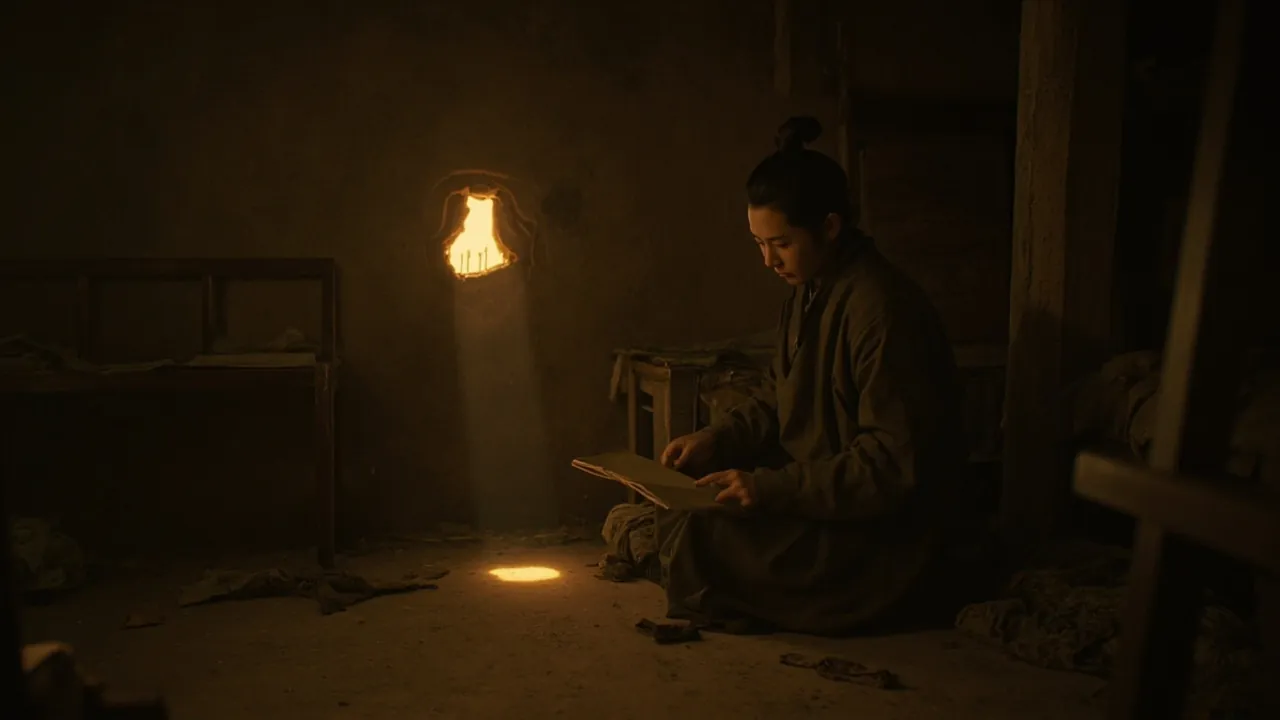
Imagine you’re a young boy living in poverty. Your family can’t afford candles. Your house has no windows that let in much light. But you’re desperate to read — to learn — to escape the life of manual labor that seems to be your only destiny. What would you do? For one boy in ancient China named Kong Xiàng, the answer was to grab a hammer and chisel and make a hole in the wall that separated his home from his neighbor’s — so he could read by the light that came through from the other side.
That single act of desperate creativity gave us the idiom 凿壁偷光 (záo bì tōu guāng), which literally means “bore a hole in the wall to steal light.” It’s one of the most celebrated stories in Chinese culture about overcoming poverty through ingenuity and an unquenchable thirst for knowledge. While most Westerners have heard of Edison’s early experiments or Newton’s apple, the story of Kong Xiàng boring a hole in his wall is the Chinese equivalent of the “rags to wisdom” narrative — the idea that the circumstances of your birth don’t have to determine the limits of your knowledge.
Who Was Kong Xiàng?
Kong Xiàng lived during the Western Han Dynasty (206 BCE – 25 CE), in an era when education was largely reserved for the children of wealthy families. Books were expensive — they had to be copied by hand, often on bamboo strips or silk, making them accessible only to those with means. A poor boy who wanted to learn faced obstacles at every level: no books, no teachers, no time (since poor children often had to work), and no light to read by even if he somehow acquired the first three.
Kong Xiàng grew up in a village in what is now Jiangsu province. His family was so poor that they couldn’t afford even the most basic amenities. His parents worked the land, and Kong Xiàng spent his days helping with the farming — there was no time for the leisurely study that wealthy children enjoyed. But unlike many children in his position, Kong Xiàng had something burning inside him: an intense desire to learn to read and to understand the world through books.
The specifics of how Kong Xiàng got his hands on books vary depending on the source. Some accounts say he borrowed them from neighbors; others say he did odd jobs in exchange for the chance to read. What is consistent across all versions is that once Kong Xiàng had a book, he was utterly determined to read it — and the darkness of his home was his biggest obstacle.
The Wall and the Light
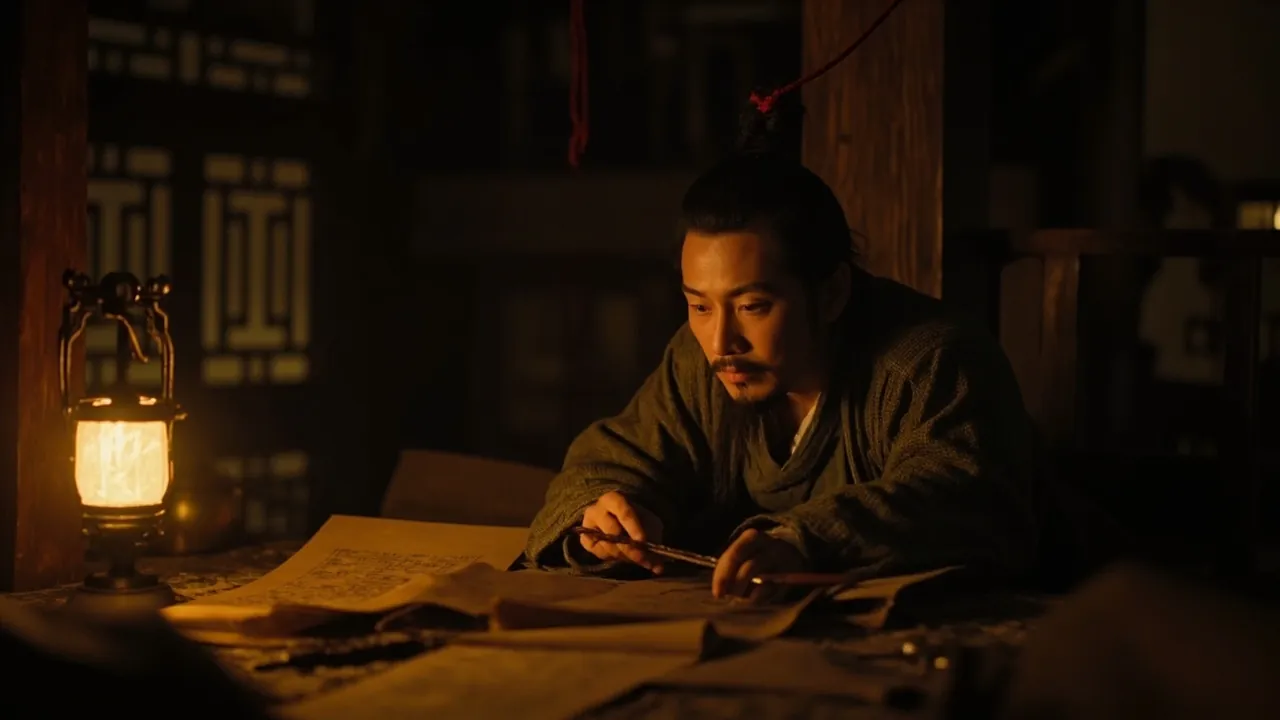
The story goes that Kong Xiàng’s family home had very thin walls — thin enough that when his neighbor’s household lit their oil lamps at night, some of that light would seep through the cracks between the bamboo or wooden strips that formed the walls. It wasn’t much light. Anyone else would have dismissed it as useless for reading. But Kong Xiàng saw opportunity.
He took a hammer and a chisel — tools that would have been common in a farming household for basic repairs — and began to enlarge the natural cracks in the wall between his home and his neighbor’s. He carefully chipped away at the wall, widening the gap until he had created a small hole that admitted a meaningful amount of light. Through that hole, he could read by the glow of his neighbor’s lamp.
The neighbor eventually discovered what Kong Xiàng was doing. Here’s where the story takes a remarkable turn: instead of being angry about the damage to their shared wall, the neighbor was so impressed by the boy’s determination that he invited Kong Xiàng to come and study in his own home, where there was proper light and warmth. Kong Xiàng’s boldness had not only solved his immediate problem — it had attracted the support of someone who could help him further.
This detail of the story matters. Kong Xiàng wasn’t just resourceful in a vacuum; his resourcefulness was accompanied by an openness, a willingness to be seen and to ask for what he needed, that made other people want to help him. The hole in the wall was both a literal opening and a metaphor for his approach to life: he looked for openings everywhere, and when he found them, he pursued them with single-minded determination.
The Broader Context: Why Light Mattered
To understand why Kong Xiàng’s solution was so remarkable, you need to understand how serious the problem of light was for ancient students. The most common lighting fuel in ancient China was oil rendered from animals (later, from plants like rapeseed). This oil was expensive, and a poor family would have used it sparingly — primarily for cooking, not for reading. Candles, made from beeswax or tallow, were even more expensive and were typically reserved for religious or ceremonial purposes.
For a student who wanted to study at night — the only time when farm work didn’t demand his attention — the absence of light was a genuine barrier. It’s not that reading in dim light was impossible; it’s that it was impractical and damaging to the eyes over time. The student who wanted to study seriously needed light, and light cost money that Kong Xiàng didn’t have.
His solution was both practical and symbolically powerful. He didn’t ask his parents for money they didn’t have. He didn’t wait for some benefactor to appear. He took the resources he actually had — a hammer, a chisel, and the walls of his own modest home — and he turned them into a tool for learning. The hole in the wall was an act of engineering as much as it was an act of desperation.
The Power of Seeing Opportunity Where Others See Obstacle
What makes 凿壁偷光 more than just an interesting historical anecdote is the principle it illustrates: the ability to see opportunity where others see only obstacle. Anyone who looked at Kong Xiàng’s dark room and dim wall-crack would have seen a barrier to reading. Kong Xiàng looked at the same things and saw a lighting system waiting to be built.
This quality — what psychologists sometimes call “opportunity awareness” or “constraint creativity” — is a hallmark of people who achieve remarkable things despite humble beginnings. They don’t deny the constraints they face; they work within and around them. They ask “what can I do with what I actually have?” rather than “why don’t I have what I need?”
Kong Xiàng’s story resonates across cultures because so many people have had a version of his experience. The student who studies by the light of a streetlamp because their apartment doesn’t have a desk lamp. The entrepreneur who builds a business from a spare room because they can’t afford office space. The athlete who trains with homemade equipment because they can’t afford a gym. In every case, the key quality is the same: the refusal to let external constraints define the ceiling of your effort.
The Limits of Kong Xiàng’s Approach
It’s worth noting that the story also carries a note of caution. Boring holes in walls to steal light, while clever, also carried risks. Damaging a neighbor’s property — even with good intentions — could easily have gone wrong. A less understanding neighbor might have responded with anger, threats, or violence. Kong Xiàng’s luck in finding a generous neighbor was a crucial variable in the equation. Not everyone who tries to “steal light” in a metaphorical sense will find someone willing to help rather than punish.
There’s also a practical question about what Kong Xiàng could actually read by the thin light that came through a wall hole. It would have been enough to see the general shapes of characters, perhaps, but probably not enough for the kind of careful, precise reading that serious scholarship required. The idiom sometimes gets criticized on these grounds — the light he “stole” was probably more symbolic than practical. The real lesson was about his determination more than his specific method.
But the core insight remains powerful: Kong Xiàng did everything he could with what he had. He didn’t let what he didn’t have paralyze him. He found a way to move forward, and the act of moving forward — even imperfectly — created the conditions for his eventual success.
Modern Applications: When Constraints Drive Innovation
The principle behind 凿壁偷光 shows up everywhere in modern innovation. Some of the most important technological advances have come from people who had to work around constraints rather than being handed resources. The “appropriate technology” movement, for example, focuses on designing solutions that work within the constraints of limited resources — exactly the spirit Kong Xiàng embodied.
In education, the story is often used to encourage students who feel disadvantaged by their circumstances. The message isn’t “you should bore holes in walls” but rather “the resources you need might be closer than you think, even if they’re in someone else’s room.” It encourages resourcefulness over resignation.
In business, the idiom sometimes appears in discussions of “garage startups” — companies that were founded in humble settings with minimal resources, precisely because their founders couldn’t afford fancier environments. Apple started in a garage. Amazon started in a garage. The constraint wasn’t the disadvantage it appeared to be; it was, in some ways, the condition that forced the kind of creative thinking that produced something new.
The Final Legacy of Kong Xiàng
Kong Xiàng went on to become a learned scholar, though the historical records of exactly how far he rose are somewhat thin. What’s clear is that his determination and ingenuity left a lasting mark on Chinese culture. 凿壁偷光 entered the language as a phrase used to describe someone who studies or works with extraordinary determination despite difficult circumstances — often with a note of admiration for the creativity involved.
The phrase is used today in both formal and informal contexts. A teacher might describe a particularly dedicated student as having 凿壁偷光的精神 — the spirit of boring through walls for light. A boss might use it to describe an employee who finds ways to accomplish things despite budget constraints. It’s one of those idioms that works equally well as a compliment and as a description of a challenging situation.
The image of that small hole in the wall, letting through just enough light to read by, captures something essential about the human spirit: the insistence that lack of resources is not the same as lack of possibility. The wall was a barrier, but it was also an opportunity — an opening that Kong Xiàng recognized and exploited. The light that came through that hole was dim, imperfect, and stolen. It was also, for a boy who had nothing else, everything he needed to begin.