凿壁偷光:匡衡如何用一束光改变命运
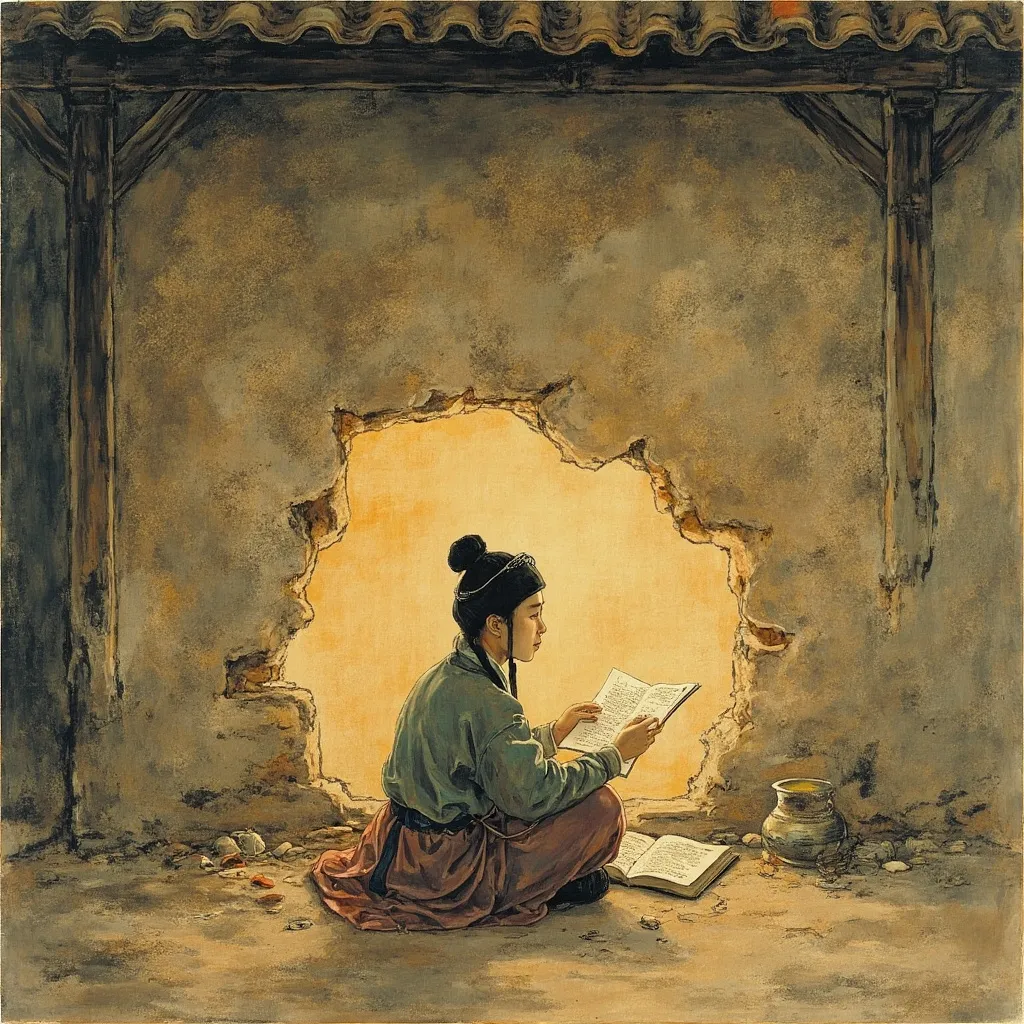
There’s something almost cinematic about the image of a young boy hunched over a book, reading by the thin glow of lamplight seeping through a hole he himself carved in the shared wall of his neighbor’s home. It sounds like a scene from a Dickens novel, or perhaps a modern-day underdog sports movie. But this isn’t fiction. This is the real story behind the Chinese idiom 凿壁偷光 (záo bì tōu guāng), and the boy at the center of it would eventually become one of the most influential figures in ancient Chinese political history.
The phrase literally translates to “boring through the wall to steal light.” It describes an act of desperate creativity in the pursuit of education — and it has become one of the most widely cited Chinese idioms when discussing overcoming adversity through learning. But beyond the surface-level moral of “study hard,” there’s a richer story here about ingenuity, environmental adaptation, and the true nature of opportunity.
Who Was Kong Fang? The Boy Behind the Story
The scholar at the center of 凿壁偷光 is named Kong Fang (匡衡), though some historical sources spell it simply as Kuang Heng. He was born in the Western Han Dynasty, roughly around 77 BCE, in what is now Shandong province. Unlike the scholars in some other famous idiom stories, Kong Fang came from genuinely impoverished circumstances. His family were farmers — not unusual in itself, as most Chinese people in that era made their living from agriculture. But Kong Fang’s family was particularly poor, so poor that they couldn’t afford enough oil to keep lamps burning through the night.
This was a serious problem for a young man with scholarly ambitions. In the Han Dynasty, education was the primary pathway to social advancement. The imperial examination system, while not yet formalized in the way it would be during the Sui and Tang dynasties, still created genuine opportunities for talented individuals from humble backgrounds to enter government service and change their circumstances. But accessing that pathway required extensive study, and study required light.
Kong Fang’s situation seemed hopeless. He couldn’t afford candles or oil lamps that would burn for extended periods. His days were consumed by farm labor. The only time he could dedicate to reading was after sunset, when the work was done and the house was dark. Without adequate lighting, he faced an impossible constraint: however talented he might be, he simply couldn’t read enough to pass the examinations.
Most people in his position would have accepted the inevitable and focused on becoming the best farmer they could be. Kong Fang refused. He looked at his problem from a different angle, found an unconventional solution, and created one of the most memorable stories in Chinese literary history.
The Innovation: Stealing Light in the Dead of Night
Kong Fang’s family lived in a modest house with thin walls — typical of peasant dwellings in ancient China. The walls were made of mud and straw, not the solid brick or stone that wealthier families could afford. This structural weakness, which might have seemed like just another marker of his poverty, became the key to his solution.
One night, Kong Fang noticed something. When his neighbor — a wealthier family living on the other side of the shared wall — lit their lamps, a faint glow seemed to seep through the wall itself. The cracks and gaps in the mud construction, imperfect as they were, allowed small amounts of light to pass through.
An ordinary person might have seen those cracks as a nuisance, a drafty reminder of their lowly status. Kong Fang saw opportunity.
He got up in the middle of the night, found a sharp tool, and began carefully enlarging the gap in the wall between his home and his neighbor’s. He worked with painstaking patience, widening the hole just enough to allow significantly more light to pass through without actually breaking through into the neighbor’s property. By the time he was done, he had created a small opening — roughly the size of a window pane — that admitted enough borrowed light for him to read by.
He sat down with his book and began to study.
The story doesn’t record whether his neighbor ever noticed the gradual increase in the crack’s size. Perhaps they never did, because Kong Fang was careful enough in his method to avoid detection. Or perhaps they did notice and didn’t mind, as long as their own lives weren’t disrupted. Either way, the plan worked. Night after night, Kong Fang would wait until his neighbor’s lamps were lit, then position himself at his improvised window and read until the oil in his neighbor’s lamps burned out.
He didn’t steal the light, of course — light isn’t something you can actually take. But the idiom captures something essential about the nature of his innovation: he found a way to use resources that existed around him but that others would never have thought to exploit. He turned a liability into an asset.
The Broader Context: Why Han Dynasty Education Mattered
To fully appreciate Kong Fang’s story, it helps to understand the social environment in which he lived. The Western Han Dynasty, especially during the reign of Emperor Wen and Emperor Jing, was a period of relative stability and prosperity. The earlier Qin Dynasty’s harsh legalism had given way to a more moderate governance philosophy, and Confucianism was gradually becoming the dominant ideology of the Chinese state.
One of the most significant developments of this era was the establishment of the Xueyuan — the Imperial Academy — in the capital city of Chang’an. This institution provided formal education to future government officials, and entry was theoretically open to anyone with sufficient talent, regardless of birth. In practice, of course, wealth and connections still mattered enormously. But the principle of merit-based advancement was real, and it gave hope to young men like Kong Fang who had nothing but their intellect to offer.
The Han Dynasty also saw the compilation of the Six Classics — the foundational texts of Confucian learning — and the development of commentary traditions that would shape Chinese education for the next two thousand years. Studying these texts wasn’t just an academic exercise; it was preparation for serving the empire and shaping the lives of millions of people. The stakes were high, which made the competition fierce, which made stories of extraordinary dedication like Kong Fang’s all the more compelling.
This was also the era when the civil service examination system began to take recognizable shape. While later dynasties would formalize and expand these examinations into elaborate multi-tiered testing apparatus, the Han Dynasty established the fundamental principle: that government positions should be filled based on demonstrated knowledge and ability, not purely on hereditary privilege. That principle, more than any specific institutional arrangement, is what made Kong Fang’s story possible. Without some genuine pathway to advancement, his nighttime studies would have been nothing more than an interesting hobby.
From Poverty to the Prime Minister’s Office
Kong Fang’s efforts eventually paid off — but not quickly or easily. He continued studying for years, laboring on his family’s farm by day and reading by borrowed light at night. His perseverance impressed the local officials who oversaw the early stages of the examination process. He passed the lower-level civil service exams and was appointed to a minor administrative post.
From there, his career trajectory was remarkable. Kong Fang rose steadily through the ranks of the Han bureaucracy, eventually becoming known as one of the most learned and articulate scholars in the empire. His expertise in the Confucian classics was widely recognized, and he became a favorite lecturer at the imperial court.
When Emperor Xuan came to power, he sought advice from Kong Fang on matters of state policy. Kong Fang’s recommendations — focused on reducing taxation, promoting agriculture, and governin with benevolence rather than harshness — aligned closely with the emperor’s own inclinations. Over time, Kong Fang became one of the most powerful officials in the Han Dynasty, eventually rising to the position of Prime Minister (丞相) — effectively the highest civil official in the empire.
Here is what makes this story so extraordinary: Kong Fang didn’t just pass an exam or earn a degree. He went from being a poor farm boy who couldn’t afford lamp oil to the second-highest office in the Chinese empire. He did it through a combination of extraordinary determination, clever use of limited resources, and genuine intellectual ability. The wall he bored through wasn’t just literal — it was the metaphorical barrier between his birth circumstances and his potential.
What “Stealing Light” Teaches Us About Resourcefulness
There’s a modern lesson hiding inside this ancient story that goes beyond the obvious “try harder” message. Kong Fang’s innovation wasn’t just about willpower. It was about seeing your environment differently and finding creative ways to solve problems that seem intractable.
Think about how most people respond to constraints. When they don’t have enough of something — time, money, connections, knowledge — they assume the solution is to acquire more of that thing. They wait for circumstances to change, for someone to give them a opportunity, for the obstacle to simply disappear. Kong Fang didn’t wait. He looked at what he actually had — a thin wall, a neighbor with light, a desperate need to read — and found a way to make those constraints work for him.
This kind of thinking is sometimes called constraint-driven innovation. Engineers and designers talk about it all the time. The best solutions often emerge not from having unlimited resources but from being forced to work within tight limitations. When you can’t buy the expensive solution, you get creative and find the cheap one. When you can’t access the usual tools, you improvise with what you have.
Kong Fang exemplifies this principle. He couldn’t afford to buy more oil, so he didn’t try to buy more oil. Instead, he found a way to use light that was already being generated and that was going to waste. His neighbor’s lamps were going to burn anyway. The light they produced was spilling out through cracks in the wall and being completely lost. Kong Fang simply captured some of that wasted resource and directed it toward his studies.
You can apply this same thinking to modern challenges. Feeling like you don’t have enough time to learn something new? Look for pockets of wasted time in your day — the hour you spend scrolling through social media, the time spent waiting for appointments, the minutes lost to inefficient transitions. Can’t afford the expensive course or the premium software? Find the free or low-cost alternatives that accomplish the same learning goals. The obstacle is real, but it’s rarely as absolute as it first appears.
The Limits of Kong Fang’s Story: What We Shouldn’t Emulate
Of course, we should be careful not to romanticize Kong Fang’s situation too much. The truth is that his poverty was a genuine injustice — a systemic failure that denied him the basic resources he needed to pursue his education. The fact that he had to resort to stealing light through a hole in his wall reflects a society that provided inadequate support for talented but poor individuals.
We shouldn’t take away from this story the idea that poverty is a character-building experience or that people in desperate circumstances should be expected to innovate their way out of structural problems. Kong Fang’s ingenuity doesn’t excuse the system that made such ingenuity necessary. Plenty of equally talented people throughout history never got the chance to develop their abilities because they lacked the basic support to survive, let alone study.
This is worth remembering in our own era, when feel-good stories about individual perseverance sometimes get used to distract from collective responsibilities. Yes, Kong Fang found a way. But he shouldn’t have had to dig through a wall to do it.
That said, there’s still something valuable in his example — not as a model for what society should expect of people, but as a demonstration of what’s possible when determination meets creativity. The circumstances we face don’t come with instruction manuals. We have to figure out our own solutions, using our own resources, in our own contexts. Kong Fang’s story reminds us that innovation often emerges from necessity, and that the constraints we face can become the raw material for our greatest achievements.
Modern Reflections: Adapting Ancient Wisdom
So how do we take the spirit of 凿壁偷光 and apply it to our own lives without literally boring holes in our walls? Here are some practical thoughts.
Embrace your constraints as creative fuel. The things you think are holding you back might actually be pointing you toward your most innovative solutions. When you assume you don’t have what it takes, you’re probably not looking hard enough at what you actually have.
Capture wasted resources. Kong Fang didn’t create new light — he captured light that was already being produced and wasted. Think about the resources in your life that aren’t being fully utilized. Skills you learned but haven’t applied? Relationships you’ve let go dormant? Time in your day that evaporates without your noticing? You might find enormous potential hiding in plain sight.
Persist in the dark. The final piece of Kong Fang’s story is the simplest and perhaps most important: he kept studying. Night after night, year after year, through every hardship and setback. He didn’t find a shortcut. He just refused to quit. In a world full of productivity hacks and optimization strategies, sometimes the most powerful thing you can do is simply commit to showing up and doing the work, even when no one is watching and nothing seems to be working.