There are moments in history when the gap between what seems possible and what actually happens narrows down to a single audacious idea. Most people look at the obstacles in front of them and see exactly what you’d expect: obstacles. The extraordinary minds look at the same obstacles and see raw material — inputs that can be shaped, redirected, or simply accepted as they are and turned to advantage. Zhuge Liang was one of those extraordinary minds, and the story of the straw boats and the arrows is one of the most satisfying examples of creative problem-solving that has come down to us from ancient China.
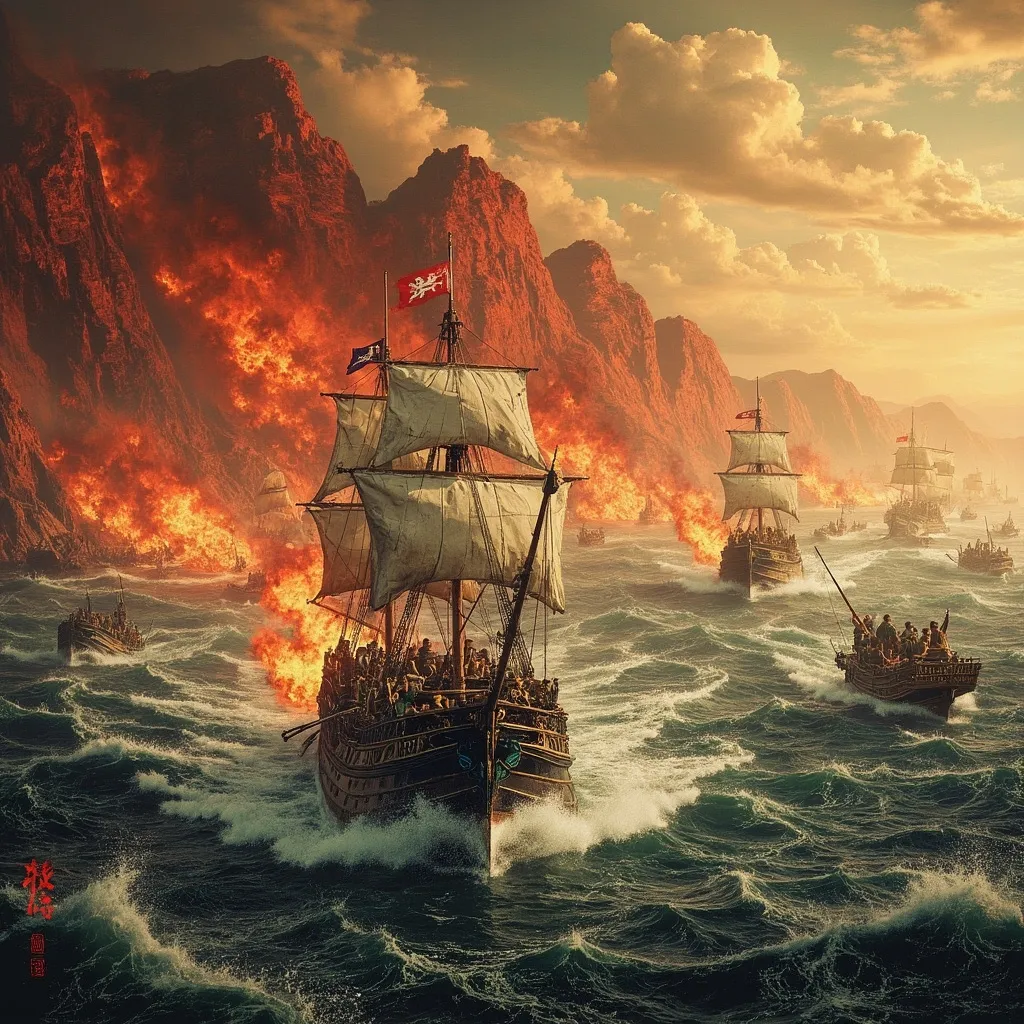
The year was 208 CE. The place was the Yangtze River, somewhere near the strategic area that would soon host one of the largest naval battles in ancient history. The warlord Cao Cao had assembled an enormous army — by most accounts, somewhere between 200,000 and 800,000 soldiers — and was moving south with the intention of unifying all of China under his control. His forces swept through northern China with very little resistance. Jiangling fell. Liu Biao’s heirs surrendered. The southern warlords were next on his list.
The Impossible Assignment
Among those facing destruction were the rulers of the southern territories: Liu Bei, the increasingly desperate warlord who claimed imperial lineage, and Sun Quan, the young lord of Wu whose family had controlled the lower Yangtze for generations. They were natural allies against a common enemy, and Zhuge Liang — who had been serving Liu Bei as his chief strategist for less than a year at this point — had engineered an alliance between the two men. The question now was whether the combined forces of Wu and Liu Bei could actually withstand the approaching tidal wave of Cao Cao’s army.
Cao Cao’s forces had obvious advantages. They were better equipped, better fed, and far more numerous. They had already defeated every major opponent they had faced. The only area where the southern allies had a clear edge was in their knowledge of local waters and, specifically, in the naval forces that Wu could contribute to the alliance. Wu had a powerful fleet, experienced sailors, and captains who knew the rivers and lakes of the south in ways that Cao Cao’s northern soldiers never could.
But there was a problem. The Wu navy had plenty of ships but was short on a critical resource: arrows. Arrows were the primary ammunition for naval warfare in this era. A fleet without arrows was like an army without food — it might look impressive, but it couldn’t function. And manufacturing 100,000 arrows in a short period was simply not something the southern allies had the workshops and craftsmen to accomplish quickly.
Zhuge Liang, in one of those moments that have made him a legendary figure in Chinese cultural memory, looked at this problem and did something that no one expected. He stepped forward and told Liu Bei that he could produce the needed arrows — all 100,000 of them — within three days. Not by commissioning craftsmen. Not by purchasing from traders. By borrowing them from the enemy.
Liu Bei, characteristically, did not dismiss the idea. But he did ask the obvious question: how? Zhuge Liang’s answer was characteristically cryptic. He asked only that three days of foggy weather would be helpful, and that he be given twenty ships, each equipped with稻草人 — straw figures dressed in armor to look like soldiers from a distance.
The Fog Rolls In
The conditions Zhuge Liang had requested materialized with unusual precision. The morning of the third day brought thick fog across the river — the kind of dense, low-lying mist that reduces visibility to almost nothing and makes distant objects impossible to identify clearly. This was not weather that anyone could have guaranteed, which makes Zhuge Liang’s casual request for it all the more interesting. He either had genuine confidence in his ability to read weather patterns, or he was willing to accept a level of risk that would have seemed insane to anyone with less faith in his own capabilities.
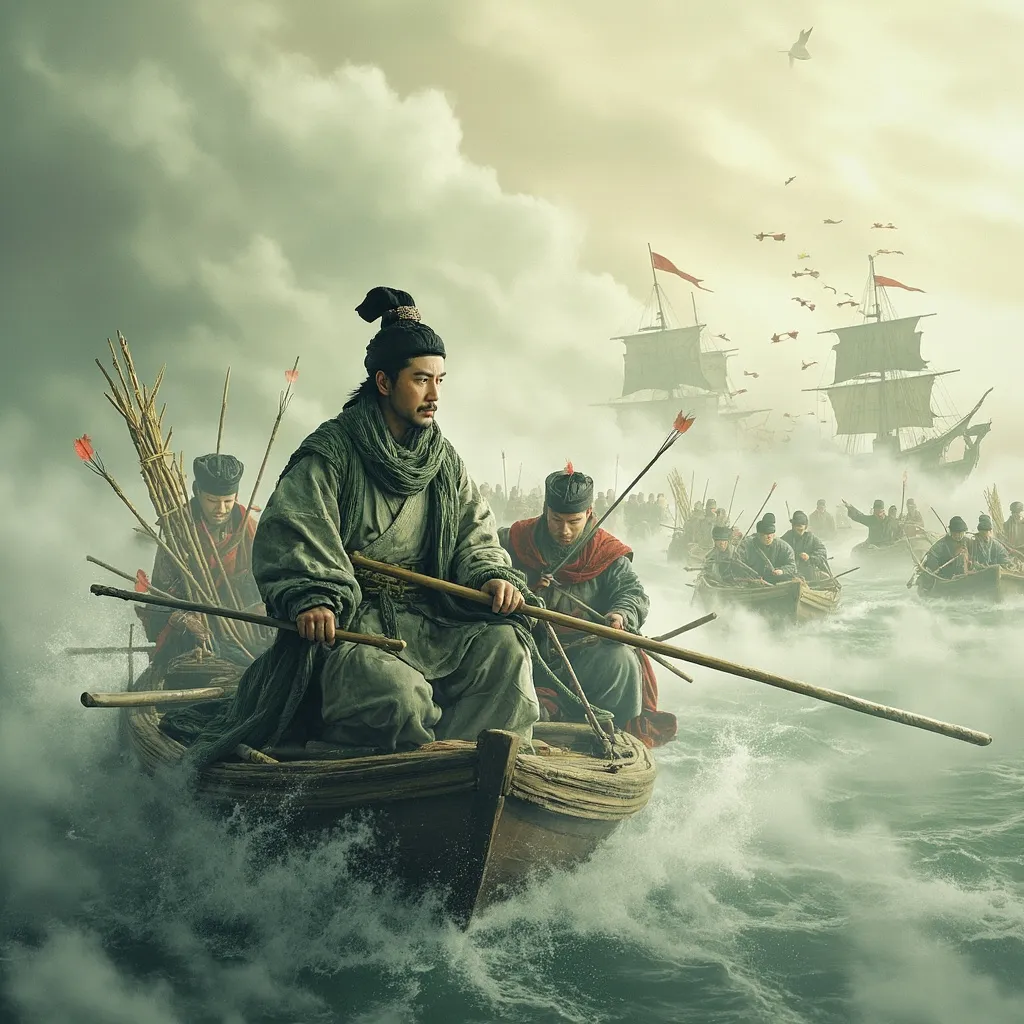
In any case, the fog was perfect. Zhuge Liang loaded his twenty ships with the straw figures, had his sailors prepare the vessels for departure, and then did something that must have alarmed everyone on board: he set sail directly toward the position of Cao Cao’s enormous naval fleet.
The ships moved quietly through the fog, their straw figures standing motionless on deck, indistinguishable from real soldiers in the thick morning mist. As they drew closer to the enemy position, Zhuge Liang ordered his men to beat drums loudly and shout as if preparing for battle. The noise carried across the water and reached Cao Cao’s sentries, who saw the silhouettes of approaching ships materializing from the fog and immediately concluded that they were under attack by a significant naval force.
Cao Cao’s commanders, operating on the principle that it was better to respond to a false alarm than to ignore a real one, ordered their archers to fire at the approaching vessels. volleys of arrows began raining down on the straw figures. The arrows struck the稻草人 and lodged in the straw, accumulating in ever-greater numbers as the archers continued firing, confident they were hitting enemy soldiers.
Zhuge Liang had planned the approach perfectly. He had positioned the ships so that they collected arrows on both sides equally, preventing the vessels from becoming unbalanced. He had kept the ships at the ideal distance — close enough to seem like a genuine threat requiring sustained archery fire, but far enough away that his “soldiers” didn’t actually take casualties. The fog did the rest, preventing the Cao Cao’s archers from seeing that their arrows were hitting稻草人, not men.
Three Days, 100,000 Arrows
After what must have been a remarkable period of time — sitting still in the fog while arrows thudded into the bodies of fake soldiers all around you — Zhuge Liang ordered his ships to turn around and return to base. The fog was beginning to lift, and maintaining the position any longer risked exposing the deception. The ships returned to harbor, and workers were waiting to collect the arrows that had accumulated on each稻草人.
The count was done. The result was impressive by any standard: over 100,000 arrows had been collected in a single night, acquired at zero cost, requiring no craftsmen, no workshops, and no expenditure of resources. Zhuge Liang had accomplished in hours what a normal procurement process would have taken weeks to achieve.
When Cao Cao’s forces realized what had happened — that they had wasted enormous quantities of ammunition on稻草人 and allowed the enemy to sail away unchallenged — it was too late to do anything about it. The fog had lifted, the opportunity for pursuit was gone, and the southern allies now had the arrows they needed for the coming battle.
What makes this story so satisfying, centuries later, is not just the clever mechanics of the plan but the quality of mind it demonstrates. Zhuge Liang looked at the problem of acquiring arrows and reframed it entirely. Instead of asking “how can we make arrows,” he asked “who has arrows, and how can we get them?” The answer to the second question turned out to be surprisingly simple once you were willing to think unconventionally.
The Wider Lesson: Constraints as Creative Fuel
The idiom 草船借箭 — borrowing arrows with straw boats — has survived for nearly two thousand years because it captures something genuinely useful about how creative thinking actually works. The most common obstacle to clever solutions is not a lack of information or resources. It’s the tendency to accept the problem as stated rather than questioning the assumptions embedded in it.
Zhuge Liang could have spent three days explaining to Liu Bei why the arrow shortage was a serious problem. He could have drafted plans for emergency workshops, calculated timber requirements, estimated the number of craftsmen needed. Instead, he identified the actual constraint: not “how do we make arrows” but “how do we get 100,000 arrows quickly.” Once the constraint was correctly identified, the solution suggested itself.
This pattern appears again and again in effective strategic thinking. The best solutions rarely come from adding more resources to a problem. They come from looking at the problem from a different angle and discovering that the “impossible” situation was only impossible because the terms of the problem had been unconsciously accepted. When you can reframe the problem — when you can see that the enemy’s ammunition is also your potential supply, that the fog that blinds them to your deception also blinds them to your vulnerability — the impossible becomes merely difficult.
The story also demonstrates the value of audacity. A less confident strategist might have proposed a modest plan that would have produced some arrows through conventional means. Zhuge Liang proposed something that, if it had failed, would have been a catastrophic waste of time and resources. But the potential upside of the unconventional approach was so much greater than the conventional alternative that the risk was genuinely worth taking. This is the nature of creative problem-solving: it requires a willingness to be embarrassed, to fail visibly, in pursuit of a solution that conventional thinking cannot reach.
Modern Applications and the Products That Capture This Spirit
The principle behind 草船借箭 — using what you need from whoever has it, regardless of whether they intended to provide it — shows up in modern business, engineering, and creative work in ways that continue to surprise. The tools below represent the spirit of resourceful, creative problem-solving that Zhuge Liang embodied:
1. Portable Mini Projector — Like Zhuge Liang’s straw boats disguised as warships, this compact projector transforms any blank wall into a screen. Presentations, movie nights, or strategic planning sessions become possible anywhere, turning ordinary spaces into functional tools.
2. Waterproof Tactical Storage Bags — The Wu naval fleet needed to protect its supplies during the foggy river crossing. These airtight, waterproof bags keep your gear dry and organized whether you’re on the water, hiking, or just preparing for unpredictable conditions.
3. Portable Camping Stove — Armies on the move need to eat, and clever logisticians find ways to cook meals even in challenging environments. This compact camping stove brings the same resourceful energy to outdoor cooking that Zhuge Liang brought to arrow procurement.
4. All-Weather Field Notebook — Every great strategist needs to record plans, observations, and calculations. This waterproof field notebook is designed for conditions that would ruin ordinary paper — fog, rain, river spray — so your ideas survive even when the weather doesn’t cooperate.
5. Retractable Bow Training Set — Of course, having arrows is only useful if you can use them effectively. This training bow set helps build the archery skills that the Wu navy needed to make every arrow count.
Legacy of a Clever Night
The Battle of Red Cliffs — the larger conflict that this episode was part of — ended in a decisive defeat for Cao Cao’s forces. The combined Wu-Liu Bei alliance, despite being vastly outnumbered, leveraged their knowledge of the river terrain, their naval expertise, and the strategic insights of Zhuge Liang to achieve one of the most surprising victories in ancient Chinese military history.
The arrow-borrowing episode was a small but significant piece of that larger success. It demonstrated to Liu Bei’s forces that their new strategist had an unusual quality of mind — the ability to find solutions that no one else could see, the willingness to act on unconventional plans, and the confidence to risk failure in pursuit of disproportionate reward.
In the centuries since, 草船借箭 has become shorthand in Chinese for creative problem-solving under pressure. It describes the person who looks at an impossible situation and finds the hidden opportunity within it. The straw boats are still out there somewhere in cultural memory, sailing silently through the fog, transforming the enemy’s strength into their own advantage. That’s the trick — not to have more resources than your opponents, but to use what they have better than they do.