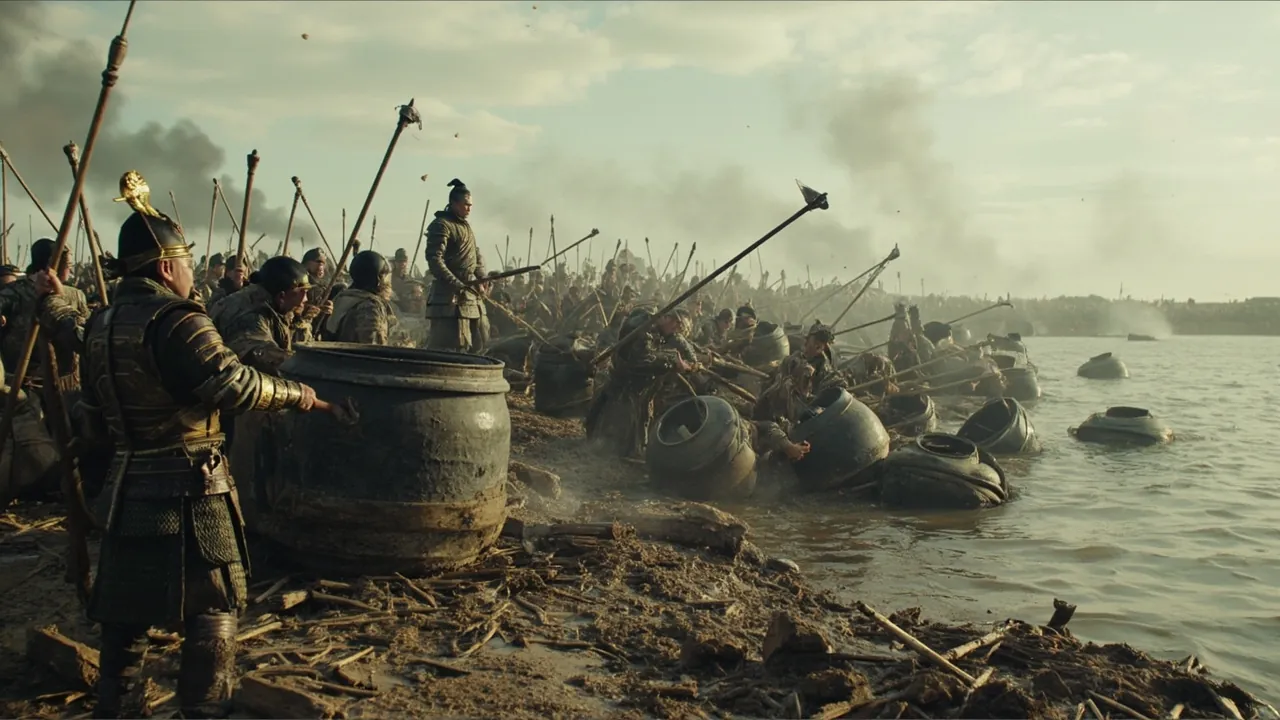
When General Xiang Yu led his 50,000 soldiers across the Zhang River in 207 BC, he made a decision that would echo through Chinese history for over two thousand years. He ordered his men to destroy every cooking pot they carried and to scuttle every boat that had brought them across the water. There would be no retreat. There would be no fallback position. There would be only forward, or death.
The Qin Dynasty was collapsing, and Xiang Yu—one of the greatest military leaders Chinese history has ever produced—was about to fight the battle that would cement his legend. His opponent: a QIN general named 章邯 (Zhang Han), who commanded a force of nearly 400,000 soldiers. Xiang Yu had roughly 50,000.
The math didn’t add up. Everyone knew it. Any sensible commander would have fortified a defensive position, awaited reinforcements, done the reasonable thing. Xiang Yu looked at those numbers and chose the unreasonable path—the path that would make his name synonymous with total commitment for the next twenty centuries.
This is the story behind 破釜沉舟 — pò fǔ chén zhōu — which translates literally to “break the cauldrons and sink the ships.” In English, we say something similar: “burn your boats.” Both expressions mean the same thing: remove every possibility of retreat so that there is only one direction left to go—forward.
The Historical Background: A Dynasty on Its Last Legs
To understand why Xiang Yu made this choice, you need to understand the chaos of late Qin Dynasty China. The Qin emperor Qin Shi Huang had unified China in 221 BC, creating the first imperial Chinese dynasty and building the Great Wall and the famous road network that would shape Chinese civilization for millennia. But his reign was brutal—massive forced labor projects, harsh legalist governance, and constant expansion had stretched the empire to its breaking point.
When Qin Shi Huang died in 210 BC, his son inherited a powder keg. Within two years, revolts were erupting across the empire. The conscripted peasants and forced laborers who had built the Great Wall were now using their weapons against the dynasty that had nearly worked them to death. In the chaos, two leaders emerged from opposite ends of the collapsing empire: Liu Bang in the east and Xiang Yu in the south.
Xiang Yu was a young nobleman from the state of Chu—tall, impossibly strong, said to be able to lift a heavy bronze weighing scale with one hand. He had witnessed the horrors of the Qin firsthand: his grandfather had been a famous Chu general killed in battle against Qin forces. Now, in the final days of the dynasty, Xiang Yu was leading Chu’s armies north to meet the Qin in open battle.
When he crossed the Zhang River, he faced a choice that would define his legacy.
The Battle of Julu: Outnumbered Eight to One
General Zhang Han had earned his reputation as the Qin Empire’s last capable commander. He had defeated several rebel armies and was regarded as the one general who might actually hold the dynasty together. When Xiang Yu arrived at the river, Zhang Han had roughly 400,000 men. Xiang Yu had 50,000.
Xiang Yu’s officers suggested they wait for reinforcements or at least take a defensive position. The numbers were hopeless, they said. Xiang Yu refused. He ordered an immediate crossing of the Zhang River, and once his forces were on the opposite bank, he did something extraordinary.
He told his men to destroy their cooking cauldrons.
In ancient Chinese armies, the cauldron was sacred—the vessel that fed everyone, the symbol of communal survival. Breaking it was a profound symbolic act. Then Xiang Yu ordered the boats destroyed too. There would be no crossing back. No retreat. No escape route. They would fight here, on this side of the river, or they would die here.
The message to his soldiers was simple and brutal: we either win this battle or we die. There is no middle ground.
This is the act that gave us the idiom. In Chinese, the phrase captures both the pot-breaking and the boat-sinking in four characters—pò fǔ chén zhōu—that have become shorthand for committing fully to a course of action with no possibility of turning back.
The Impossible Victory
What happened next confounded every expectation. Xiang Yu’s 50,000 men, fighting with the desperation of people who understood there was literally no way out, engaged Zhang Han’s 400,000 in a series of nine consecutive battles. They won all nine. Zhang Han’s forces, who had every strategic advantage and the comfort of knowing they could retreat if things went badly, found themselves psychologically unprepared for an enemy that fought as if death was preferable to defeat.
In the final assault, Xiang Yu personally led a charge that broke Zhang Han’s center. The Qin army collapsed. Zhang Han surrendered. The battle was over.
Xiang Yu had achieved one of the most lopsided military victories in ancient Chinese history—not through superior numbers, but through superior will. He had taken 50,000 men with nothing to lose and destroyed an army eight times their size because that army, despite all its advantages, never truly believed it could win.
The victory at Julu (巨鹿, in modern Hebei province) effectively ended the Qin Dynasty. Zhang Han would later ally with Xiang Yu, and the Qin empire would collapse entirely within months. Xiang Yu would go on to become the dominant figure in the civil war that followed—the famous Chu-Han Contention—but that’s another story.
What “Breaking Cauldrons and Sinking Ships” Means Today
The idiom pò fǔ chén zhōu is one of the most recognized four-character expressions in Chinese. It appears in business negotiations, military planning, personal goal-setting, and motivational speeches across China and the wider Sinosphere. When someone says you’re being too extreme, too all-in, too unwilling to leave yourself an exit—they might say you’re pò fǔ chén zhōu.
In modern usage, the phrase captures something important about the psychology of commitment. Researchers who study decision-making have found that one of the biggest obstacles to successful completion of any difficult goal is the human tendency to preserve optionality—to always keep a door open, a backup plan available, an escape route in mind. The problem is that keeping those doors open subtly undermines the intensity of your commitment.
When you destroy the cauldron and sink the boat, you’re not just making a dramatic gesture. You’re making a neurological commitment device. You’re removing the mental cost of quitting, which means every ounce of your energy goes into moving forward instead of calculating whether you should back out.
This is why the phrase resonates in contexts ranging from startups to athletic training. A founder who “burns the boats” doesn’t just say they’re committed—they structurally eliminate the option of walking away. An athlete who destroys their fallback plan forces themselves to succeed or face complete loss. The ancient wisdom embedded in Xiang Yu’s dramatic act turns out to have solid psychological grounding.
The Caveat: When “All-In” Goes Wrong
It’s worth noting that not everyone who breaks their cauldrons ends up like Xiang Yu. The idiom exists in Chinese culture alongside another concept: shěn shí duó shì (审时度势), which means carefully assessing the situation before acting. Xiang Yu was a military genius with extraordinary soldiers. His decision was daring, but it wasn’t reckless—he had genuine reason to believe his men could win if they fought with total commitment.
The phrase pò fǔ chén zhōu captures a truth about will and determination, but it’s not a universal prescription for all situations. Sometimes the wise choice is to keep the boats intact and the retreat options open. The idiom doesn’t advise when to use it—it assumes you already know the stakes and have chosen your moment.
What it does say is this: once you’ve decided, commit. Fully. Without reservation. Because the battle that matters is almost never won by the side with the most options. It’s won by the side with the most resolve.
The Lesson That Crossed Oceans
It’s fascinating that nearly identical expressions exist in Western culture. “Burn your boats” is a well-known English idiom, often attributed to various historical incidents (including an incident in the Texas Revolution and various military contexts). The phrase means essentially the same thing: destroy your means of retreat to force total commitment to victory.
This parallel development is a reminder that the human challenge of maintaining commitment in the face of difficulty is universal. Across cultures, across continents, across thousands of years—we keep discovering the same truth: sometimes the thing that stands between you and victory is the door you’ve left open to walk away.
Xiang Yu broke his cauldrons and sank his ships over two millennia ago. We still talk about it. There’s a reason. When you remove the exit, you discover what you’re really made of. And sometimes, what’s you discover is enough to defeat an army eight times your size.
If you found this article valuable, explore our collection of Chinese historical idioms that reveal the wisdom embedded in ancient Chinese stories. Each idiom carries centuries of insight into human nature, strategy, and decision-making.