There’s something deeply satisfying about a story where someone cuts off all possibility of retreat and commits completely to a single course of action. We love these narratives in business, in sports, in personal struggles — the founder who bets everything on an untested idea, the athlete who refuses to hold back, the person who decides that failure simply isn’t an option. That impulse to burn the boats and leave no door open for retreat has been a part of human storytelling for millennia, and nowhere is it more dramatically embodied than in the Chinese idiom 破釜沉舟 (pò fǔ chén zhōu), which literally means “break the cauldrons and sink the ships.”
The phrase has been part of the Chinese lexicon for over two thousand years, and it still resonates today whenever someone needs to describe a level of commitment that goes beyond ordinary determination into something almost reckless in its intensity. It’s not about trying hard. It’s about making sure you can’t try anything else.
The Historical Context: China in Turmoil
To understand why General Xiang Yu gave such an extreme order, you need to understand the situation China faced in the third century BCE. The Qin Dynasty — the first imperial dynasty to unify China under a single ruler — was collapsing. Its founder, Qin Shi Huang, had built an empire through military conquest and iron-fisted administration, but his death in 210 BCE triggered a succession crisis that quickly spiraled into civil war.
The empire was vast, the administration was brittle, and the resentment that had been building for decades — the forced labor, the harsh laws, the confiscation of weapons, the crushing taxation — all erupted at once. Local rulers began declaring independence. Generals carved out their own territories. And from this chaos, two figures emerged as the dominant contenders for power: Liu Bang, a pragmatic and adaptable former peasant official, and Xiang Yu, a young military genius from a family of generals who had served the Chu state.
Xiang Yu was reportedly a physical giant — said to be able to lift a heavy bronze cauldron single-handedly — and a military prodigy who had shown remarkable tactical instincts from an early age. He was also proud, sometimes to the point of arrogance, and deeply committed to the aristocratic traditions of Chu. Where Liu Bang won through diplomacy and the patient accumulation of support, Xiang Yu won through decisive battlefield victories that shattered his enemies’ forces. By 207 BCE, the two men were on a collision course, each leading a coalition of forces opposed to Qin rule.
The Battle of Julu, fought in what is now Hebei Province, became the defining moment of this early struggle. Xiang Yu had marched his army to relieve the siege of the state of Zhao, which had been surrounded by overwhelming Qin forces. The odds were daunting. The Qin army vastly outnumbered the Chu forces, and Xiang Yu’s soldiers were exhausted from a grueling march. Many of his generals advised caution — perhaps a gradual approach, a siege, some form of negotiation.
What Xiang Yu did instead became legendary.
The Order That Changed History
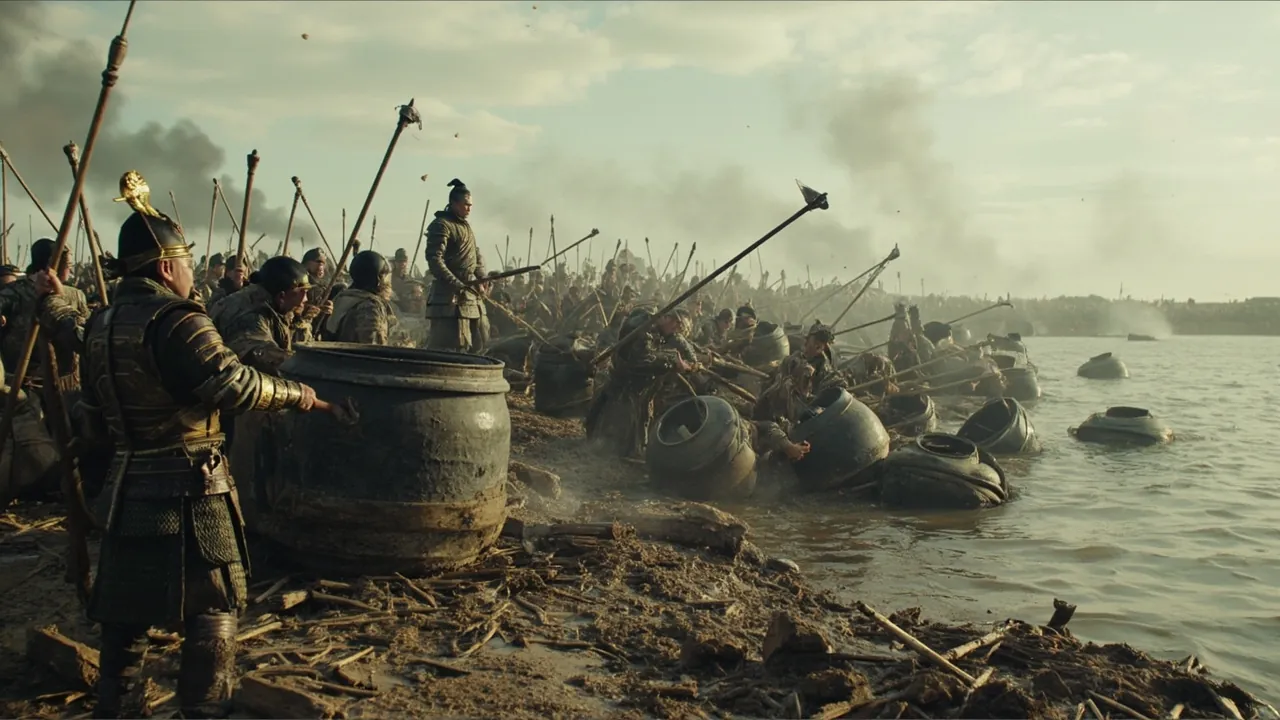
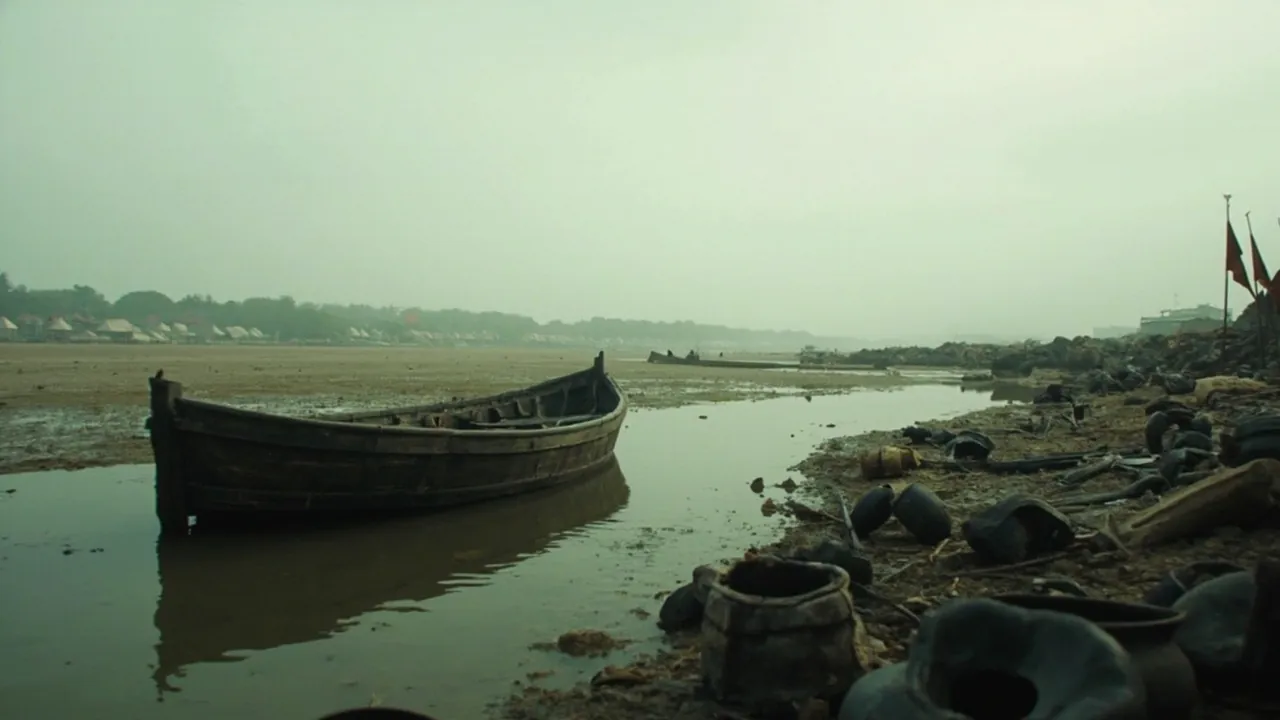
Xiang Yu’s response to his cautious generals was to issue a series of orders that shocked everyone present. He ordered his men to prepare only three days’ worth of rations. Then he ordered the cauldrons used for cooking to be destroyed — not put away for later use, but smashed. And finally, he ordered every ship in the fleet to be sunk.
His men stared at him in disbelief. Cauldrons were essential for feeding an army on the march. Ships were how they crossed rivers, how supplies moved, how wounded men reached the rear. Without these things, retreat was impossible. There would be no cooked food unless they won. There would be no ships to carry them away if things went badly. They would have to win, or they would die.
The story — as recorded in the Records of the Grand Historian compiled by Sima Qian a century later — describes the emotional impact this had on Xiang Yu’s soldiers. Men who had been uncertain, who had been calculating risks and weighing options, suddenly found themselves in a situation where there were no options left to calculate. The choice had been made for them. They could fight with everything they had, or they could die. That was it.
What followed was one of the most decisive military victories in ancient Chinese history. Xiang Yu led his forces in nine successive charges against the Qin lines, each one more ferocious than the last. The Qin soldiers, many of whom had expected an easy victory over exhausted and demoralized troops, found themselves facing an enemy that fought with a desperation they had never encountered. The Chu army broke through not just once but multiple times, with Xiang Yu himself reportedly killing hundreds of enemy soldiers with his own hands. By the end of the battle, the main Qin force had been annihilated, its commander killed, and the siege of Zhao lifted.
The victory at Julu shattered Qin’s last effective field army and accelerated the dynasty’s collapse. Within a year, Qin had fallen, and China entered the Chu-Han Conflict — a four-year struggle between Xiang Yu and Liu Bang for supreme power.
The Psychology of No Retreat
What Xiang Yu understood, whether consciously or through tactical intuition, was something that modern psychologists have extensively documented: the way people perform changes dramatically when escape routes are removed. Remove the possibility of retreat, and something interesting happens to the mind. Fear of failure doesn’t disappear, but it transforms. When there’s nowhere to run, the energy that would have gone into calculating escape routes and contingency plans instead goes into fighting with maximum intensity.
This isn’t just ancient wisdom. Modern military training routinely incorporates variations on this theme — elite units are put through exercises where failure means “death” (a simulated death, of course), where retreat is not an option, where the only possible outcome is success. The stress inoculation this creates prepares soldiers for the reality of combat, where hesitation can be fatal.
Athletes know this too. The basketball player who buries three-pointers in the final seconds of a close game isn’t thinking about what happens if she misses. She’s in a state where missing isn’t part of the mental picture — there’s only the shot. The tennis player who wins a match point after match point in a grueling five-set match is drawing on reserves that only become available when there’s literally nothing left to hold back.
There’s a dark side to this psychology, of course. Xiang Yu’s all-or-nothing approach worked spectacularly at Julu, but it also reflected a pattern that would eventually lead to his defeat in the broader struggle with Liu Bang. He committed fully to military solutions in situations where diplomacy might have served better. He made enemies through his uncompromising style and his insistence on treating surrendering Qin soldiers with brutal severity. His resoluteness was a weapon — but it was also a blind spot.
The idiom 破釜沉舟 captures the power of the mindset without necessarily endorsing every application of it. There’s a difference between committing fully to a worthy goal and refusing to adapt when circumstances change. The first is courage. The second is stubbornness wearing courage’s clothes.
破釜沉舟 in Modern Life
Today, the idiom shows up constantly in Chinese conversation, literature, and media whenever someone describes an irrevocable commitment — starting a business without a backup plan, ending a relationship definitively, taking a position from which there is no graceful retreat.
Entrepreneurs frequently invoke it when describing their decision to leave stable jobs and bet everything on a venture. “破釜沉舟” captures that sense of having crossed a point of no return, of having made the decision so completely that going back would be more frightening than going forward. The language resonates because the underlying feeling is universal: there’s something freeing about having no choice left, something that paradoxically unlocks energy and creativity that was previously trapped by ambivalence.
Personal development coaches sometimes cite the psychology behind the idiom, though they usually frame it in softer terms. They talk about the importance of “committing fully” and “eliminating distractions” and “creating urgency” — all variations on the same theme that Xiang Yu embodied with cauldrons and ships. A person trying to lose weight might throw away all the junk food in their house so that the only option is healthy eating. Someone trying to write a novel might quit their job and move to a cabin with no internet connection. These are modern equivalents of breaking the cauldrons — extreme measures designed to remove the possibility of anything except the one chosen path.
The idiom also appears in political and military discourse, where it’s used to describe situations where a leader or nation has committed so fully to a course of action that reversal is no longer possible. This usage carries a slight edge of warning — to have 破釜沉舟’d yourself can mean you’ve made a decision so irrevocable that you now face consequences you can’t escape, whether or not those consequences turn out well.
Learning from Xiang Yu’s Legacy
Xiang Yu himself ultimately lost the broader struggle for China, defeated by Liu Bang in 202 BCE after four years of war. His military genius couldn’t compensate for political missteps, for alienating potential allies, for underestimating an opponent who was more flexible and pragmatic than he wanted to acknowledge. In the end, Xiang Yu fled with a small contingent of soldiers, found himself surrounded at the banks of the Wu River, and — rather than be captured — took his own life. The man who had broken his cauldrons and sunk his ships to ensure there was no retreat had no retreat when he finally needed one.
This ending haunts the story. 破釜沉舟 can be read as pure inspiration — as proof of what human beings can accomplish when they commit fully — but it can also be read as a cautionary tale. The same resoluteness that enabled victory at Julu eventually became a trap. Xiang Yu couldn’t adapt because adaptation required admitting that an earlier decision had been wrong, and he had invested too much in his identity as someone who never retreats.
The wisdom in the idiom, properly understood, isn’t simply “commit fully.” It’s “commit fully to the right thing.” The power of 破釜沉舟 is real, but it’s a power that must be wielded with judgment, because it eliminates the flexibility that allows us to recover from mistakes. Break your cauldrons when the cause is worthy and the plan is sound, and you can move mountains. Break them when you’re wrong about something fundamental, and you have nothing left to fall back on.
The Lasting Power of an Ancient Command
Two thousand years after Xiang Yu ordered his cauldrons smashed and his ships sunk, the phrase still lives in the Chinese language with undiminished force. It appears in business negotiations when someone wants to signal that they’ve gone as far as they can go. It appears in motivational speeches when a speaker wants to capture the idea of total commitment. It appears in history books and novels and films, always carrying the same weight: this is someone who decided that winning was the only option, and acted accordingly.
The idiom endures because the psychology it describes is permanent. Human beings are always looking for escape routes, always building contingencies, always keeping one foot out the door even when they’ve ostensibly committed to something. Xiang Yu’s gesture cut through all of that with dramatic simplicity. There are no cauldrons now. There are no ships. There’s only forward.
Whether that kind of total commitment leads to glory or disaster depends entirely on whether the forward direction was the right one.