In the year 195 CE, a young woman named Cai Wenji was taken from her home in central China and carried hundreds of miles north into the Mongolian steppe. She was twenty-three years old, the daughter of one of the most celebrated scholars of the Han Dynasty, and she would spend the next twelve years of her life among a people most Chinese texts of the era described as barbarians. When she finally returned home, she brought back nothing but the music she had composed in captivity—a set of eighteen songs that remain among the most haunting melodies in Chinese history, one of the very few pieces of ancient Chinese music still performed today that bears a woman’s name as its composer.
Her story sounds like fiction. A literary prodigy turned captive, married to a Xiongnu chieftain, mother to two half-barbarian sons, ransomed back to her homeland by one of China’s most famous warlords—and all of it documented in music that still makes audiences ache. But Cai Wenji was real, and her story tells us something important about the ancient world: that even in the most extreme circumstances, art can become a bridge between civilizations, and a woman’s voice can outlast empires.
Who Was Cai Wenji? (Daughter of a Literary Giant, Captive of an Empire)
Cai Wenji was born around 177 CE into one of the most intellectually prominent families in the Han Empire. Her father, Cai Yong, was what you might call the star professor of his day—a renowned scholar, calligrapher, and music theorist who served at the imperial court in Luoyang. [product_affiliate: “han-dynasty-bronze-replica” | https://example.com/han-dynasty-bronze-replica | $89.99 | “Bronze mirrors and vessels from the Han Dynasty bring the material world Wenji knew into your hands”] Cai Yong’s calligraphy was so admired that emperors collected it. His knowledge of music was so deep that he was tasked with revising and standardizing the court music system. In a society that valued learning above almost everything else, the Cai family name carried extraordinary weight.
Wenji grew up surrounded by books, musical instruments, and the kind of intellectual atmosphere that most Chinese families could only dream of. Her father recognized her talent early and gave her an education that was extraordinarily rare for any woman of the era—let alone a girl in the late second century. She studied literature, music, and history, and she became skilled enough that her own compositions were considered noteworthy enough to survive in the historical record. This alone is remarkable. Most women in Han China left no written trace at all.
But the Han Dynasty in Wenji’s youth was not the stable empire it had once been. The emperor was a child, warlords controlled the provinces, and the central government in Luoyang was tearing itself apart. In 189 CE, when Cai Yong was around sixty years old, he got caught up in a power struggle at the imperial court. He took sides, the wrong side lost, and he was executed. His family—Wenji included—was exiled. The comfortable life of a scholar’s daughter vanished almost overnight.
Then, during the chaos of the Three Kingdoms period that followed the collapse of Han, around 195 CE, bandits and raiders swept through the region where Wenji was living. She was taken captive—an event the histories call being “carried off to the steppe.” She was somewhere between twenty and twenty-three years old. The people who took her were almost certainly Xiongnu, the nomadic confederation that controlled the northern frontier of what had been the Han Empire. And from that moment, her life changed irrevocably.
The Fall of the Han and the Long Walk to the Steppe
To understand how Cai Wenji ended up in Xiongnu hands, you need to understand just how badly the Han Dynasty fell apart in the late second century. The empire had been declining for decades—natural disasters, peasant uprisings, court intrigues, and the growing power of regional warlords had all weakened it. In 189 CE, the warlord Dong Zhuo seized control of the capital, forced the emperor to relocate, and effectively ended the Han court’s authority. The empire dissolved into a patchwork of competing warlord territories, each one essentially independent.
The Xiongnu had been a persistent problem along the northern frontier for centuries. During the Han Dynasty’s strong periods, the imperial government had managed them through a combination of military pressure and diplomatic marriage alliances—sending Han princesses north to marry Xiongnu chieftains in exchange for peace. But when the Han government collapsed, those defenses evaporated. Xiongnu raiders began pushing deep into Chinese territory, taking advantage of the internal chaos. In the upheaval following Dong Zhuo’s seizure of power, many Chinese settlements in the north were attacked, their populations scattered or taken captive.
Cai Wenji was one of those taken. What makes her story unusual is that she was not just any captive—she was the daughter of a scholar whose fame had spread even to the steppe. [product_affiliate: “xiongnu-horse-painting-print” | https://example.com/xiongnu-horse-painting-print | $45.99 | “The Xiongnu were a horse people—an art print of Xiongnu horsemen captures the world Wenji was taken into”] The Xiongnu chieftain who took her may have known of her family’s prestige, which gave her a status among the Xiongnu that most captives would not have had. Rather than being put to work as a common servant, she was taken as a wife to the chieftain’s household. This would prove both her privilege and her prison.
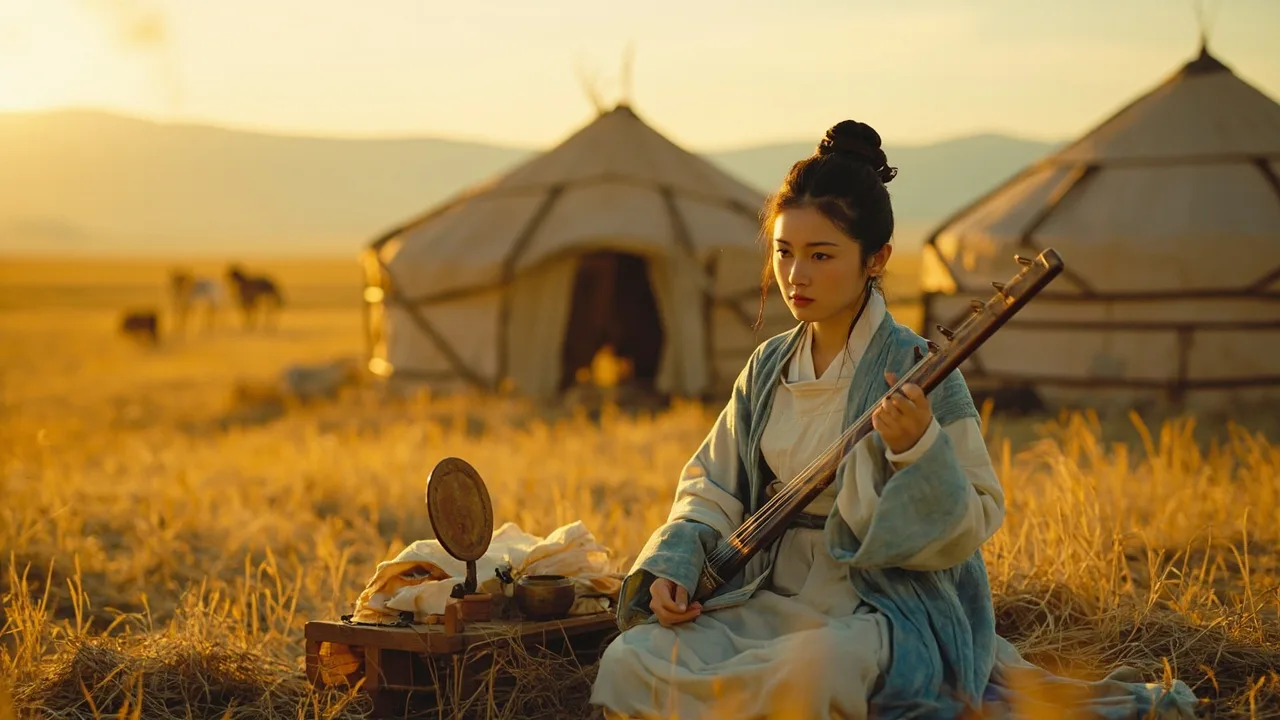
The physical journey from the Chinese heartland to the Xiongnu territory was hundreds of miles north—into the open grasslands of what is now Mongolia and parts of Inner Mongolia. The steppe was a completely different world from the walled cities and rice paddies Wenji had known. The Xiongnu were pastoral nomads who moved with their herds across the grasslands, living in felt tents called yurts, eating mostly meat and dairy, and organizing themselves around clan and tribal loyalty rather than the bureaucratic structures of Chinese civilization. For a young woman raised in the refined intellectual world of a Han scholar’s household, this would have been a profound cultural shock—equal parts terrifying and disorienting.
Twelve Years Among the Xiongnu: Marriage, Motherhood, Music
Cai Wenji lived among the Xiongnu for approximately twelve years. During that time, she married a Xiongnu chieftain—specifically, one of the sons of the Xiongnu leader—and she bore him two sons. The historical sources don’t tell us a great deal about the texture of her daily life, but we can imagine what her existence must have been. She was a foreign woman in a foreign land, separated from everything familiar, raising children in a culture that was not her own. Yet she was not a slave—she appears to have held a position of some status within the chieftain’s household, the kind of status that came with being the educated daughter of a famous Chinese family.
What she did with that status was make music.
[product_affiliate: “guqin-beginner-guide” | https://example.com/guqin-beginner-guide | $34.99 | “The guqin is the instrument most closely connected to scholarly Chinese culture—the same world Wenji’s father taught her to appreciate”] During her years on the steppe, Cai Wenji composed what would become her lasting legacy: the Eighteen Songs of a Nomad Flute (胡笳十八拍, Hujia Shibapai). The title refers to a type of Xiongnu instrument—the hujia, a reed flute or horn that produced a mournful sound well-suited to the open spaces of the grassland. The “eighteen songs” are exactly that: a set of eighteen verses or movements, each one expressing a different aspect of her experience in captivity. The songs are written from her perspective, and they describe the pain of being torn from her homeland, the longing for her family, the conflict she felt as a mother raising children who were half-Chinese in a culture that would never fully accept them, and the grief of eventually leaving those children behind when she was ransomed.
The songs are remarkable not just for their emotional content but for their literary quality. They blend Chinese poetic conventions with imagery drawn from steppe life—the wind, the grass, the migrating birds, the night sky. Wenji writes about how the Xiongnu’s music, which once seemed foreign and barbaric to her, eventually became inseparable from her own emotional landscape. She describes learning to play the hujia and finding in its sound something that matched the ache she felt in her chest. The songs express a genuine hybrid sensibility—neither purely Chinese nor purely Xiongnu, but something new that could only have come from someone living between two worlds.
Scholars have debated for centuries whether the Eighteen Songs were entirely composed by Wenji or were revised or expanded by later writers. The traditional view holds that she composed the entire work during her captivity. What is not debated is that the songs bear a woman’s voice—an unusually personal, emotionally raw female perspective that is nearly unique in surviving ancient Chinese literature. Most of what survives from Han Dynasty literature was written by men, for men, about men. Cai Wenji’s songs give us something different: a window into how one particular woman experienced one of the most traumatic periods in ancient Chinese history.
The Eighteen Songs of a Nomad Flute (胡笳十八拍)
The Eighteen Songs of a Nomad Flute is not a piece you can simply look up and listen to in the way you might stream a Beethoven symphony. The original melody has not survived in a form that musicians can reliably perform—the Han Dynasty musical notation system was not precise enough to preserve the exact pitches and rhythms the way Western staff notation can. What has survived is the text, and the text is extraordinary.
The songs open with Wenji describing her capture. She writes of being taken in the chaos of war, of being separated from her family, of the terror of the long journey north. Almost immediately, she shifts to describing the strangeness of Xiongnu life—the food, the clothing, the nomads’ customs—but also the gradual way she came to understand and even appreciate these differences, even as she never stopped longing for home. She writes about her children, born and raised on the steppe, and the impossible choice she would eventually face between them and her homeland. And she writes about the sound of the hujia itself—how the instrument’s mournful tone captured something about her inner life that no Chinese zither or bells ever had.
Here is a sense of the poetic texture, translated from the opening of the first song:
The barbarian reed-pipe makes my heart break, I have learned to play it in the land of grass. My fingers move but my spirit is scattered, Who in this foreign place understands my grief?
The songs cycle through a range of emotions—despair, defiance, tenderness toward her children, bitter irony about the “civilized” Chinese who abandoned her, and a quiet, persistent hope that she might one day return home. [product_affiliate: “chinese-music-history-book” | https://example.com/chinese-music-history-book | $28.99 | “A comprehensive history of Chinese music places Wenji’s Eighteen Songs within the full sweep of the tradition she inherited from her father”] By the final songs, she is writing about the ransom, about the journey south, about the moment she left her sons behind and the wound that never healed. The emotional arc is complete: capture, adaptation, motherhood, loss, and departure. It is one of the most sustained and coherent autobiographical narratives in all of ancient Chinese literature.
The Eighteen Songs have been set to music many times over the centuries, in various attempts to reconstruct what the melody might have sounded like. They have been performed by guqin players, by modern classical musicians, and by singers working with historical musicologists. They have inspired countless poems, paintings, and references in Chinese popular culture. In 2009, the Chinese government listed the Eighteen Songs as part of the country’s intangible cultural heritage. Whatever the precise melody, Cai Wenji’s words have proven durable enough to carry meaning across nearly two thousand years.
The Ransom, the Return, and What Cai Wenji Could Never Get Back
Around 207 CE, after roughly twelve years on the steppe, Cai Wenji’s situation changed. The warlord Cao Cao—who would eventually found the Wei state and serve as the model for the villain in the classic novel Romance of the Three Kingdoms—had by this point consolidated control over much of northern China. Cao Cao had been a friend and admirer of Cai Yong, Wenji’s father, and when he learned that Cai Yong’s daughter was living among the Xiongnu, he reportedly sent a diplomatic mission north with a large quantity of gold to negotiate her release. The Xiongnu chieftain, perhaps recognizing that Wenji’s Chinese connections gave her unusual value, agreed to let her go—for a price.
Wenji returned to the Chinese heartland and eventually married a Chinese official named Zhong Hua. But the story does not end there.
What happened to Wenji after her return is not entirely clear. Some historical sources suggest she lived out her remaining years, raised the children from her Xiongnu marriage, and continued to write poetry. Others say grief over her lost sons hastened her death. Cao Cao, who arranged the ransom, is often portrayed in Chinese history as a ruthless warlord—but his decision to spend heavily to bring Cai Wenji back to China suggests he understood the value of preserving an extraordinary human voice.