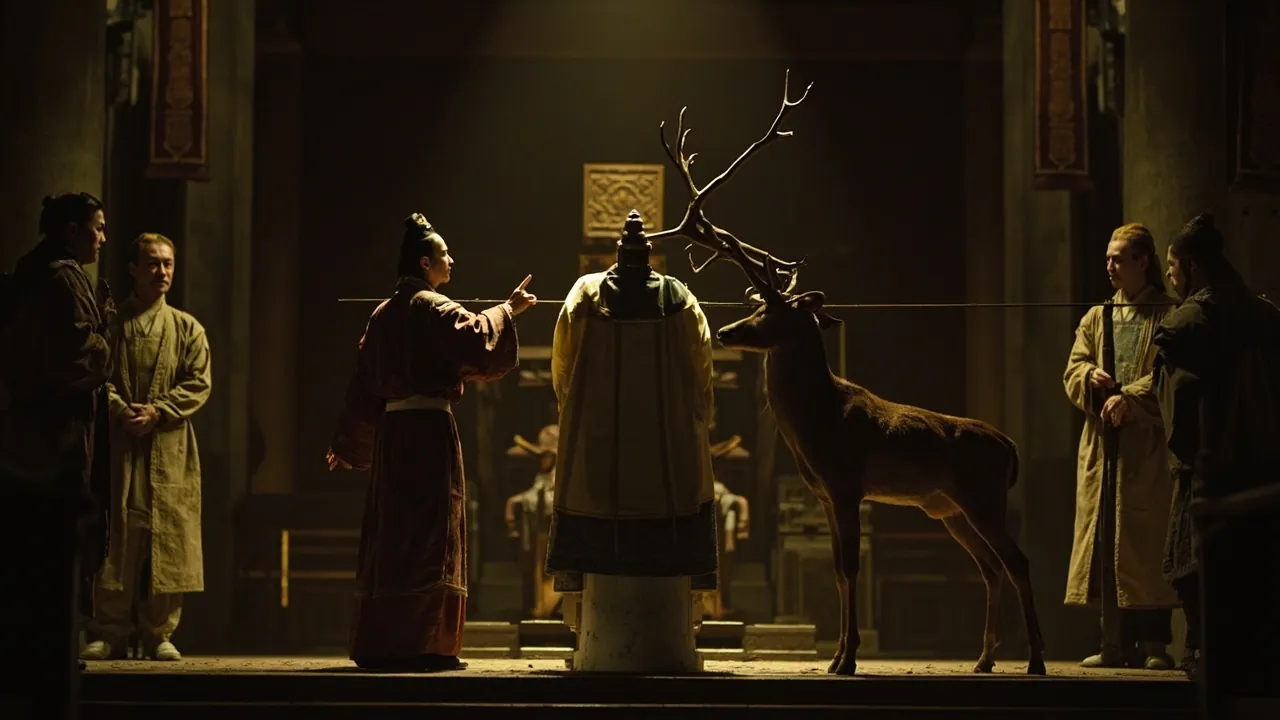
In the dying days of China’s first great empire, a courtier named Zhao Gao presented the emperor’s court with an unusual gift: a deer. He led it into the throne room with considerable ceremony, pointed at it, and announced to the assembled officials: “Your Majesty, I present you with this magnificent horse.”
The emperor, Second Emperor of Qin, looked at the animal—a deer in every visible respect, complete with antlers—and smiled uncertainly. “Minister Zhao,” he said, “that appears to be a deer.”
Zhao Gao’s smile never wavered. He looked at the emperor, then at the assembled ministers, and repeated firmly: “A horse, Your Majesty. A superior horse, the finest in the land. Would any of these honored officials care to disagree?”
And then, in one of the most revealing moments in Chinese political history, the officials in the room began to divide. Some looked at the deer, looked at Zhao Gao, and quietly agreed: yes, a horse. Others, with visible discomfort or defiance, said: no, Minister, that is clearly a deer. Zhao Gao noted every response with meticulous care.
This is the story behind 指鹿为马 — zhǐ lù wéi mǎ — “pointing at a deer and calling it a horse.” It is one of the most frequently cited idioms in Chinese when describing situations of gross corruption, shameless manipulation, and the systematic destruction of truth in service of power. The phrase captures something that every society has faced: what happens when those in power start defining reality itself, and everyone knows it’s a lie, and everyone goes along anyway.
The Historical Context: The Collapse of the Qin Dynasty
To understand why Zhao Gao did this, you need to understand the situation of the Qin Empire in its final, chaotic years. The Qin Dynasty—the first imperial dynasty in Chinese history, founded by Qin Shi Huang in 221 BC—had been brilliant and brutal in equal measure. It unified China, built the Great Wall, created a standardized writing system, and established the framework of imperial governance that would shape Chinese civilization for two millennia.
But it was also极其 repressive. The first emperor had burned books, buried Confucian scholars alive, and worked hundreds of thousands of people to death on massive construction projects. When he died in 210 BC, the empire was held together by his extraordinary personal authority more than by any genuine loyalty to the system.
His son, who inherited the throne as Second Emperor, was a weak and indecisive man entirely unsuited to the role. The real power in the court fell to two figures: the prime minister, Li Si, and the chief of the palace guards, Zhao Gao.
Zhao Gao was one of the most remarkable—and most reviled—figures in Chinese history. He was a man of extraordinary intelligence and political skill who used those abilities entirely in service of his own advancement. He had been a close associate of the First Emperor and had been entrusted with important responsibilities. But as the Second Emperor’s reign began to unravel, Zhao Gao saw an opportunity to consolidate power by systematically eliminating anyone who might oppose him.
The deer-and-horse episode was his opening move.
The Purpose of the Test
At first glance, presenting a deer as a horse seems like a bizarre way to test political loyalty. But Zhao Gao was playing a sophisticated game. He needed to accomplish several things simultaneously.
First, he needed to assess who was loyal to him personally and who remained loyal to the emperor or to the existing power structure. Those who agreed that the deer was a horse were effectively declaring their willingness to accept Zhao Gao’s version of reality, regardless of what their own eyes told them. Those who insisted it was a deer were revealing that they still prioritized truth over political compliance.
Second, Zhao Gao was establishing a precedent. If officials would agree that a deer was a horse—something patently absurd that anyone could verify by simply looking—there was no limit to the false realities they might accept from him in the future. The deer test was practice for more consequential lies.
Third, he was identifying his enemies. The officials who called the deer a deer were now marked. They had publicly contradicted Zhao Gao in front of the emperor and the entire court. They had demonstrated independence, which meant they could not be trusted. Zhao Gao would spend the coming months systematically eliminating every one of them.
The Second Emperor, weak and confused, did not intervene. He saw what was happening—some sources suggest he even laughed at the absurdity of the situation—but he lacked the will to confront Zhao Gao. That hesitation would cost him everything.
The Aftermath: How Truth Dies in a Tyranny
In the weeks and months following the deer episode, Zhao Gao moved with methodical precision against those who had identified themselves as obstacles. Using fabricated charges, he arrested and executed officials who had called the deer a deer. He moved against their families, their associates, anyone who might seek revenge or continue to prioritize truth over compliance.
The court was soon purged of anyone with independent judgment. Those who remained understood the new rules: Zhao Gao’s version of reality was the only acceptable version. Disagreeing with him—even on something as obvious as the species of a mammal—was dangerous. Eventually, it became fatal.
With the court filled with people who had demonstrated their willingness to accept any falsehood, Zhao Gao’s power became absolute. He eventually compelled the Second Emperor to commit suicide, declaring him unworthy of the throne. He installed a new puppet emperor and ruled in his name.
But even Zhao Gao’s end came through the same logic he had established. When the puppet emperor eventually balked at one too many of Zhao Gao’s demands, Zhao Gao attempted to organize a coup—only to find that his own officials, trained in the culture of absolute compliance he had created, turned against him. No one was trustworthy in a system designed to destroy trust. Zhao Gao was executed by the puppet emperor’s associates.
The Psychology of Willful Blindness
What makes the story of zhǐ lù wéi mǎ so enduring is that it describes a phenomenon that appears in every organization and every society, not just in ancient Chinese tyrannies. The systematic practice of forcing people to accept obvious falsehoods—and rewarding them for compliance and punishing them for truth-telling—creates a particular kind of organizational pathology.
Psychologists call this “willful blindness” or “constructive denial.” It arises when the cost of seeing and saying the truth becomes higher than the cost of accepting a comfortable fiction. When Zhao Gao demanded that officials call a deer a horse, he was asking them to calculate: is my job, my freedom, and my life worth this particular truth? For most officials, facing a powerful and ruthless minister, the answer was obviously no.
But the interesting thing is what happened to people who made that calculation. Once you have publicly called a deer a horse, you are now complicit. You cannot later claim you were just going along. You cannot maintain your reputation for integrity. You have demonstrated that you will prioritize survival over truth, which means you can be trusted to do so again in the future. Zhao Gao now owned you.
This is why zhǐ lù wéi mǎ has become the idiom for a particular kind of institutional corruption—not just lying, but the systematic destruction of the conditions that allow truth to exist. The deer is still a deer. But in the ecosystem Zhao Gao created, everyone knows that calling it a deer is dangerous, and eventually the deer becomes a horse because that’s the only safe thing to say.
The Modern Resonance
Today, zhǐ lù wéi mǎ is used in Chinese political commentary, business analysis, and everyday conversation to describe any situation where those in power declare something obviously false to be true and expect compliance. It appears in discussions of totalitarian regimes, corporate cultures where bad news is systematically suppressed, and social situations where speaking truth to power has become too costly.
The idiom is also frequently cited in Western discussions of authoritarian politics, where similar dynamics have appeared repeatedly. The phenomenon of a leader declaring an obvious falsehood and watching the entire political apparatus fall into line is not unique to ancient China. Zhǐ lù wéi mǎ captures something universal about the relationship between power and truth.
There’s also a modern corporate version of the story. Every organization has its own version of Zhao Gao—the powerful figure who punishes those who bring bad news, who creates a culture where saying the emperor has no clothes becomes career suicide. And every organization that creates such a culture eventually finds itself unable to perceive reality accurately, making decisions based on the comfortable fiction that those in power prefer rather than the truth that would save them.
The Lesson About Power and Truth
The deep wisdom of zhǐ lù wéi mǎ is not simply “don’t lie.” It’s something more specific: the danger arises when power becomes so concentrated that it can define reality itself, and when the cost of truth-telling rises so high that everyone calculates that compliance is the only rational choice. At that point, the deer genuinely becomes a horse in the only way that matters—in the shared fiction that everyone maintains because the alternative is unthinkable.
Zhao Gao’s genius was in recognizing that this process could be accelerated and weaponized. He didn’t just want to control the government; he wanted to control what was real. And for a brief moment, he succeeded. The Qin Dynasty—the greatest empire China had ever known—collapsed not because of external invasion or natural disaster but because a man in a throne room pointed at a deer and called it a horse, and everyone went along with it.
The empire fell apart from the inside. The lesson is still being learned.
Explore more Chinese historical idioms that reveal the darker aspects of power, loyalty, and truth in ancient Chinese politics and what they teach us about human nature today.