Before there was writing, there was forgetting.
That’s the part of the story that gets lost when we talk about the invention of writing as an achievement of civilization — the celebration of human ingenuity, the dawn of recorded history, all the grand abstractions. The real story starts smaller and sadder than that. It starts with an official standing in a marketplace, trying to remember how many sheep his lord had sent to market last month, and realizing he had no reliable way to know. It starts with a tax collector who couldn’t prove what he owed, or a soldier who couldn’t prove where he’d been, or a mother who couldn’t tell her children the name of their great-grandfather because names without writing only survive as long as people who knew them are alive.
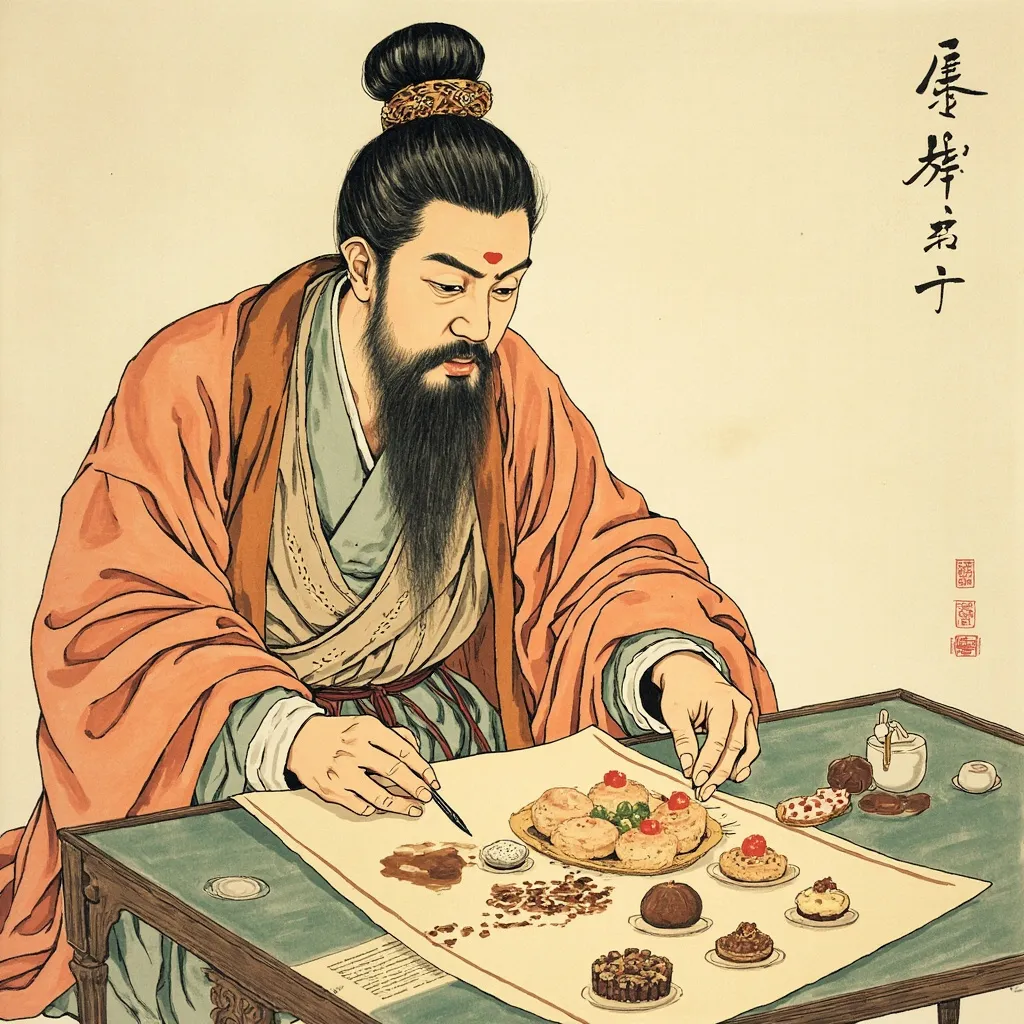
The person who changed all of this was 仓颉 — Cangjie. According to Chinese legend, he was an official working for the Yellow Emperor, one of the ancient rulers who established the foundations of Chinese civilization. His job, whatever else it involved, required him to keep records — of grain stores, of military units, of the names of important people and the dates of important events. And the existing system of knotted cords and tally marks wasn’t enough. The information was too important to trust to memory, and memory was failing people every day.
So Cangjie did something that changed the trajectory of human civilization: he sat down and invented a system for representing spoken language with written symbols.
The legends say it took him years. The legends also say that when he finally succeeded — when the last character was complete and the system was whole — there were signs in nature: four eyes opened in the sky, and the heavens wept, and ghosts began to wail because now, for the first time, humanity had a way to record truth that would outlast any individual human life. Writing was that important. Writing still is.
The Problem of Memory
To understand why Cangjie’s invention was so revolutionary, you need to understand what life was like without it.
In a world without writing, knowledge is embodied. It exists only in living minds, passed from person to person through speech and demonstration. This works fine for small communities — a village of a few hundred people can maintain a rich oral tradition, with genealogies, histories, technical instructions for crafts, songs, and stories all stored in collective memory and reinforced through regular retelling.
But as societies grow larger and more complex, the demands on memory become impossible. How do you keep accurate records of grain taxes when the tax collector has to remember everything? How do you maintain a legal system when contracts exist only in the memories of the people who made them? How do you prevent a powerful lord from simply denying a promise he made last year, when there’s no written record of it?
This is the problem Cangjie faced. He was an official in a complex society — the early Chinese state under the Yellow Emperor — and that society was generating more information than unaided human memory could reliably store. Something had to change.
The earliest Chinese records, before Cangjie or alongside his work, used a system of 结绳 — jiesheng, knotted cords. You tied knots in a cord to represent numbers and events. Different colored cords represented different categories of things. It was better than nothing, but it was severely limited. You could record that something happened, but you couldn’t record what specifically happened, or who was involved, or why it mattered.
Cangjie looked at this system and saw its limits clearly. He needed something that could represent not just numbers, but names. Not just categories, but specific events. Not just that grain was stored, but how much, who stored it, when it was stored, and for whom.
The Breakthrough: Drawing What You See
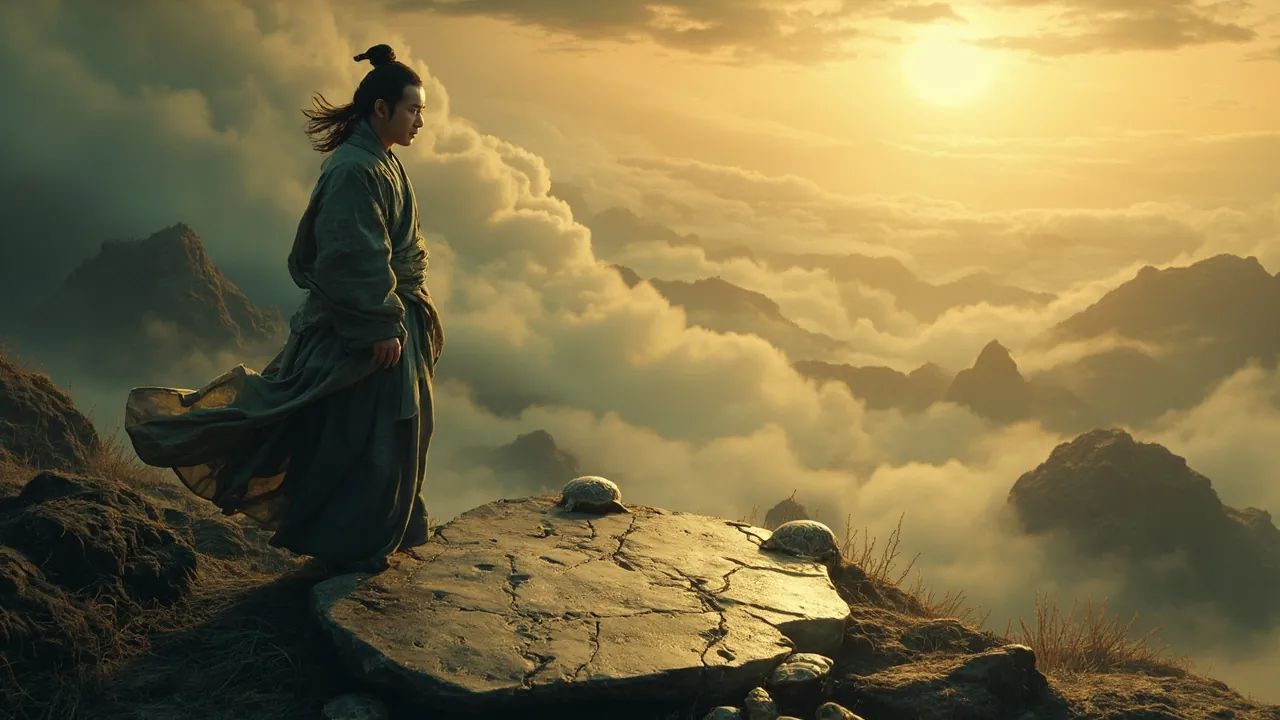
The legend says that Cangjie’s breakthrough came from observation. He watched the world around him and noticed that different things had distinctive appearances — the shape of a mountain, the curve of a river, the pattern of a bird’s footprints in mud, the markings on a turtle’s shell. These natural marks were, in a sense, already a kind of writing — the world was constantly producing marks that corresponded to real things.
He started by drawing pictures. Not abstract symbols, but actual pictures of the things he wanted to represent. A sun was a circle with a dot in the middle. A moon was a crescent. A mountain was a set of jagged peaks. A river was a wavy line. A horse was a recognizable horse. A cow was a recognizable cow.
This was the earliest form of Chinese writing: 甲骨文 — jiaguwen, oracle bone script, named for the turtle shells and ox bones on which it was first written. The characters from this period — dating to the Shang Dynasty, around 1200 BCE — are remarkably concrete and pictorial. You can often guess what they represent just by looking at them, even without knowing Chinese.
But pictures have limits. How do you draw “justice” or “virtue” or “yesterday” or “the third month”? How do you distinguish between similar-sounding words that have different meanings? Cangjie had to develop a system that went beyond direct representation.
The solution, according to the legends, was to combine elements. A character for “sun” plus a character for “eye” could mean “to see” or “clear.” A character for “person” plus a character for “branch” could mean “to lean” or “to rest.” Through combinations and abstractions, Cangjie built a system that could represent any spoken word — not just concrete nouns, but verbs, adjectives, abstract concepts, grammatical relationships.
The system wasn’t perfect from the start. It evolved over centuries, with characters being simplified, standardized, occasionally redesigned for practicality. But the fundamental logic — that written characters could represent spoken language, that they could do so through combinations of meaningful elements, that the writing system could expand to cover any concept that needed to be recorded — this logic was Cangjie’s contribution.
The Cost of Creation
The legend of Cangjie has a darker side that is worth acknowledging. It says that after he created writing, he was struck by a terrible curse: the knowledge he’d brought into the world was so powerful that it disrupted the natural order.
The story goes that Cangjie began to write down things that should have been kept secret — the private matters of individuals, the hidden truths of heaven and earth, the fates of people who hadn’t yet lived. And writing made these things real in a way that speaking them didn’t. Spoken words dissipate. Written words remain. When you write something down, you give it a kind of permanence and authority that spoken language lacks.
This is why, the legend says, the heavens wept and the ghosts wailed when Cangjie completed his work. The natural balance had been disturbed. Before writing, truth was temporary — it lived only as long as the person who held it. After writing, truth became permanent — it could outlast its source, be copied, distributed, preserved for centuries. This was both wonderful and terrifying.
There’s a version of this legend that says Cangjie himself went blind after completing his work — that the effort of seeing the patterns clearly enough to represent them in writing burned out his eyes. He had to rely on others to write for him afterward. The knowledge was worth his sight.
Whether you take this literally or metaphorically, the core insight is the same: creating a writing system was an act of such profound significance that it changed the nature of human existence. It was not merely a technical achievement. It was a transformation in what it meant to be human — in the scope of what could be remembered, communicated, and preserved across time.
What Writing Gave China
The effects of Cangjie’s invention rippled outward for millennia. A civilization with writing could do things that an oral civilization couldn’t.
It could maintain complex administrations. The Qin Dynasty, which unified China in 221 BCE, relied on written law codes, written records, written communication across a vast territory. Without writing, the empire would have been impossible — there was no other way to coordinate governance across hundreds of counties without the written word as the backbone of administration.
It could preserve history. The 中国通史 — Zhongguo Tongshi, the comprehensive histories of China — were written texts that allowed later generations to know what earlier generations had done. Without writing, the Spring and Autumn Annals, China’s earliest historical chronicle, would not exist. The Records of the Grand Historian, Sima Qian’s masterpiece, would not exist. The entire tradition of Chinese historiography, one of the most sophisticated in the world, depends on the written word.
It could develop philosophy. Confucius, Laozi, Mencius, Zhuangzi — all of them wrote, or had their words written down. The entire Confucian canon, the Daoist classics, the Buddhist sutras — all preserved in writing. A civilization that could write could develop ideas that were too complex to be held in any single mind, could build on previous thinkers, could have conversations across centuries.
It could create literature. Poetry, fiction, drama — all depend on writing for their full development. The 300 poems of the Shijing, the verses of Li Bai and Du Fu, the novels of the Ming Dynasty — all of them are gifts of Cangjie’s invention.
The Characters Themselves
One of the remarkable things about Chinese characters is how much history they carry within them. Modern Chinese characters, even in their simplified forms used in mainland China today, often preserve traces of their ancient origins that connect them to the world Cangjie inhabited.
The character for 人 — ren, “person” — looks like a standing human figure. The character for 山 — shan, “mountain” — looks like three mountain peaks. The character for 水 — shui, “water” — looks like a flowing stream with tributaries. These are direct visual inheritances from the earliest pictographic characters, preserved across three thousand years of writing.
Even more abstract characters often contain clues to their origins. The character for 明 — ming, “bright” or “tomorrow” — combines the character for sun (日) with the character for moon (月). Two bright things together create brightness. It’s logical, once you see the components. And those components themselves come from the earliest pictographic period, when people were drawing what they saw.
When you learn to read Chinese characters, you’re not just learning to decode a writing system. You’re learning to read a civilization’s memory. Each character is a small window into how ancient Chinese people saw the world — what they thought was important enough to draw, what associations they made between concepts, what patterns they recognized in the natural world.
Cangjie started this process by deciding that the world could be represented, that spoken language could be fixed in visible form, that human memory could be extended beyond its natural limits. Every Chinese character ever written, from the oracle bones of the Shang Dynasty to the text messages sent by teenagers in Beijing today, is a descendant of his decision that representation was possible.
The Man Who Remembered Everything
Cangjie is sometimes depicted in Chinese art with four eyes — a sign of how intensely he observed the world, how deeply he looked at patterns and forms. The four eyes represent his ability to see what others missed: the marks in nature that were already a kind of writing, waiting for someone to recognize them and bring them into human language.
There’s something beautiful about the fact that the invention of writing is attributed not to a king or a god, but to an official — a civil servant whose job required him to keep records. Cangjie wasn’t inventing writing because he wanted power or glory. He was inventing writing because he needed it for his work, and the problem he faced was too important to ignore.
That’s a lesson that still resonates. The most transformative innovations often come not from brilliant theorists working in isolation, but from practical people trying to solve problems that matter. Cangjie didn’t sit in a palace contemplating the nature of human communication. He sat in an office — or whatever an ancient Chinese official’s workspace was called — trying to keep track of grain shipments, and it occurred to him that pictures might do the job better than knots in a cord.
Everything else followed from that small, practical, revolutionary thought.