slug: “cangjie-inventing-characters” description: “Discover the legendary story of Cangjie, the mythological figure who created Chinese characters by observing marks on turtle shells, and explore how this ancient invention shaped civilization itself.” keywords: “Cangjie, Chinese characters, inventing writing, Chinese mythology, origin of Chinese characters, turtle shell writing, ancient Chinese civilization, script invention” affiliate_products:
- “Chinese calligraphy practice sets and brushes”
- “Books on the history of Chinese writing and script evolution”
- “Replica ancient Chinese oracle bones and turtle shells”
- “Chinese character etymology dictionaries and reference guides”
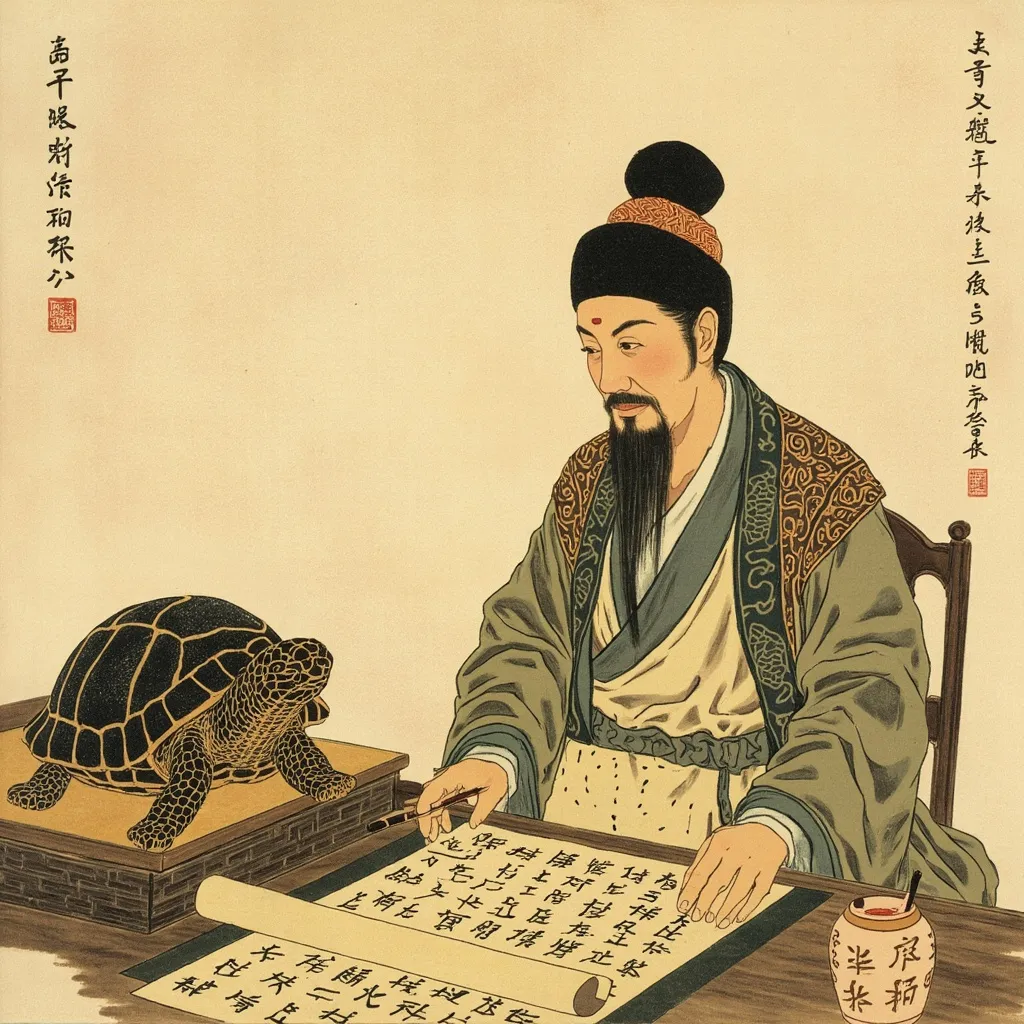
- “Traditional Chinese stationery and writing instruments” image: “/images/cangjie-inventing-characters.jpg” categories: [Chinese Mythology] alt_text: “Illustration depicting cangjie inventing characters, in a traditional Chinese cultural setting”—
Cangjie Inventing Characters: The Mythical Birth of Chinese Writing
Long before there were printing presses or keyboards, before pens and paper became everyday objects, someone had to figure out how to make written symbols represent spoken words. In most cultures, this transformation happened gradually over centuries, with writing systems evolving through many intermediate forms. In ancient China, however, the mythology attributes this revolutionary invention to a single figure: Cangjie, a historical-mythological official who supposedly created the first Chinese characters by carefully observing the natural world around him, particularly the strange markings found on turtle shells and animal footprints.
The story of Cangjie represents one of the most important origin myths in all of Chinese cultural history. Writing was not merely a convenient tool for record-keeping in ancient China—it was considered a sacred art, a bridge between the human world and the realm of spirits and ancestors. The invention of writing was therefore understood as a cosmic event, a transformation that elevated human civilization to a new level of complexity and sophistication. Understanding who Cangjie was and what his invention meant to the people who created and transmitted his story helps us appreciate why Chinese civilization developed such a distinctive relationship with written language, one that continues to shape culture, education, and artistic expression to this very day.
The Legendary Figure of Cangjie
Cangjie is described in ancient Chinese sources as a figure who served under the legendary Yellow Emperor, one of the earliest rulers of Chinese civilization, around the year 2600 BCE. Some accounts describe him as having four eyes, a detail that seems to emphasize his extraordinary powers of observation. Others describe him as a historian or official whose job was to record important events and maintain the court’s records. What all sources agree on is that Cangjie was a person of exceptional intelligence and curiosity, someone who paid attention to details that other people overlooked.
The mythology surrounding Cangjie begins with a problem that civilizations throughout history have had to grapple with. Before writing existed, people had to remember everything—laws, histories, rituals, stories, names, agreements—using only the unreliable machinery of human memory. As societies grew more complex, the demands on memory became overwhelming. Something had to be invented to supplement human recollection, to create records that could outlast any individual human life, to allow communication across distances of space and time.
According to the legend, Cangjie was struggling with this challenge when he noticed something that would change everything. He was traveling through the countryside when he came upon a dead tortoise by a river. The creature’s shell had markings on it—grooves and scratches that formed patterns of surprising regularity. Cangjie studied these markings for a long time, marveling at how they seemed to capture something about the world in visual form. Then, looking around him, he began to notice other patterns: the tracks that birds left in soft mud, the marks that animals made as they moved through tall grass, the distinctive shapes of different plants and trees. The world, he realized, was full of natural symbols waiting to be recognized and adapted for human purposes.
The Revolutionary Act of Creating Characters
Cangjie returned from his journey with a plan. He would create symbols that represented not just objects in the world but concepts, sounds, and relationships. He would develop a system where the written character could capture something essential about the thing it represented, so that anyone who learned the system could read and write, could communicate across vast distances and times, could preserve knowledge indefinitely.
The first characters he created, according to the mythology, were pictures—stylized representations of the objects they named. A sun was a circle with a line through it, a moon was a crescent shape, a mountain was a series of peaks, water was drawn as flowing lines. These pictographs were intuitive and relatively easy to learn, but they had limitations. How do you draw a concept like “justice” or “virtue” or “future”? How do you capture abstract relationships like “above” or “because”?
To solve these problems, Cangjie developed compound characters that combined pictographic elements with symbolic markers. He created characters that used the concept of sound as well as meaning, characters that showed relationships between things rather than just depicting them directly. This hybrid approach, which combined visual representation with abstract symbolism, gave Chinese characters their distinctive nature—not purely pictographic like ancient Egyptian hieroglyphics, not purely alphabetic like Greek or Arabic scripts, but something uniquely adapted to the Chinese language and Chinese ways of thinking.
The legend claims that when Cangjie presented his invention to the Yellow Emperor, the entire court was astonished. It is said that the gods themselves wept when they saw what Cangjie had accomplished—tears of joy that humans had finally achieved the ability to preserve their thoughts and communicate across generations. Grain is said to have rained from the sky, and for five days the darkness that normally falls each night did not come, as if the cosmos itself was celebrating this transformation in human capability.
The Cultural Impact of Written Characters
Whatever the literal historical truth might be about when and how Chinese writing actually developed, there is no doubt that the invention of characters transformed Chinese civilization in profound ways. The ability to maintain written records meant that laws could be codified and consistently applied, that historical events could be documented and studied, that philosophical ideas could be preserved and debated across centuries. Writing made possible the kind of cultural continuity that is characteristic of Chinese civilization—the ability to say, with some accuracy, that people living in China today are connected in meaningful ways to people who lived there three thousand years ago.
This continuity was maintained through the creation of a vast literary tradition. The classics of Chinese literature—the works of Confucius, the philosophical dialogues of the Warring States period, the poetry of the Tang dynasty, the novels of the Ming era—all exist because someone, somewhere, wrote them down and someone else copied them by hand, preserved them through wars and upheavals, and passed them on to future generations. The characters that Cangjie supposedly invented made all of this possible.
The importance of writing in Chinese culture is reflected in the reverence with which literate people were treated. In the traditional Chinese examination system, literacy was the gateway to political power and social prestige. Scholars were honored, calligraphy was valued as a fine art, and the ability to read and write beautifully was considered an essential marker of an educated person. This cultural emphasis on writing contributed to China’s remarkable literary productivity—there are more texts written in Chinese across history than in any other language, a testament to the system that Cangjie’s invention made possible.
The Mythological Dimensions of Cangjie’s Story
The story of Cangjie is not just a technological narrative about the invention of writing—it is a deeply mythological account that reveals how the ancient Chinese understood the relationship between humans, nature, and the divine. Several details in the story are worth examining for what they tell us about Chinese worldview.
First, there is the choice of the turtle shell as the object that inspired Cangjie. Turtles were revered in ancient China as sacred creatures associated with longevity, wisdom, and the cosmos itself. The shell of a tortoise was seen as a microcosm, a small representation of the vaulted heavens resting on the solid earth of the creature’s plastron. To find inspiration in turtle shells was to draw wisdom from the most respected creature in the animal kingdom, one that symbolized the very structure of reality.
Second, there is the divine response to Cangjie’s invention. The story that the gods wept tears of joy when writing was created suggests that the ancient Chinese understood writing as a spiritual as well as practical achievement. By creating a system of permanent symbols, humans were participating in the divine work of creation itself. The written character was not merely a human convention but a reflection of the patterns through which the universe itself was organized.
Third, there is Cangjie’s four-eyed appearance in some versions of the legend. This supernatural characteristic marks him as more than human—a figure who had access to levels of perception unavailable to ordinary people. The ability to see the patterns that underlie reality, to recognize the symbols that connect all things, was understood as a kind of sacred sight, a gift that justified Cangjie’s role as the bringer of writing to humanity.
Cangjie in Chinese Religious and Cultural Practice
After his death, Cangjie was deified and worshipped as the god of writing and literature. Shrines were built in his honor near rivers and mountains, and students preparing for examinations would pray to him for success. Calligraphers and scholars considered him their patron saint, and ink stones and brushes were sometimes consecrated in his name before being used for important writing projects.
This religious dimension reflects the broader Chinese understanding that writing was not a mundane activity but a sacred art. The act of writing, particularly beautiful calligraphy, was understood as a form of spiritual cultivation, a way of aligning oneself with the cosmic order that writing itself represented. To write well was not merely to communicate clearly but to participate in the divine creativity that Cangjie had originally channeled.
Traditional practices related to Cangjie linger in Chinese culture even today. Many families still observe the custom of celebrating the birthday of Cangjie, which falls on the twenty-fourth day of the twelfth lunar month. On this day, some people offer incense and food to the deity, particularly dried tofu and rice—foods associated with scholarly pursuits. These observances, though less common than in past centuries, represent a living connection to the mythological origins of Chinese writing.
The Modern Legacy of an Ancient Invention
Today, Chinese characters are used by more than a billion people, making them one of the most widely used writing systems in human history. Despite predictions that Chinese characters would be replaced by romanization or some other alphabetic system, they have remained vibrant and vital, adapting to the digital age through input methods that make typing Chinese characters as fast and convenient as typing in any other language.
The persistence of Chinese characters reflects their remarkable adaptability and their deep connection to Chinese culture and identity. Unlike purely phonetic writing systems, Chinese characters carry meaning in their visual form, making them understandable across different dialects of Chinese that are mutually unintelligible when spoken. This semantic dimension gives Chinese text a visual density and richness that has inspired artists and designers throughout history and continues to influence contemporary visual culture.
For those interested in exploring the world that Cangjie supposedly created, there are many fascinating paths to follow. The study of Chinese etymology—the history and evolution of individual characters—reveals the ingenious logic behind the writing system, showing how ancient scribes combined pictographic and symbolic elements to capture the complexity of human experience. Studying the evolution of characters from their earliest forms on oracle bones to their modern printed and digital forms can feel like watching the gradual refinement of an extraordinary tool.
Calligraphy remains one of the most accessible ways to engage with the heritage of Cangjie’s invention. The practice of writing Chinese characters with a brush, using the flowing strokes and controlled ink that characterize traditional calligraphy, connects the practitioner to centuries of literary and artistic tradition. Even those who do not read Chinese can appreciate the aesthetic beauty of well-executed calligraphy, with its dynamic balance of thick and thin strokes, its capture of movement and stillness within a single character.
Exploring Further
For those whose curiosity has been sparked by the story of Cangjie, there are many wonderful resources available for deeper exploration. Books on the history of Chinese writing trace the development of characters from the earliest archaeological evidence through their evolution into the standardized forms that dominate today. Look for works that combine scholarly rigor with accessible writing, as the subject can easily become overwhelming without careful guidance.
Replica oracle bones and turtle shells offer a tangible connection to the era when Chinese writing was first developing. These artifacts, even as modern reproductions, can help us imagine the world in which Cangjie supposedly lived—a world where the mysterious markings on a dead tortoise’s shell could spark a revolution in human communication.
Traditional Chinese stationery and writing instruments also provide opportunities to engage with the cultural heritage of Chinese characters. A good brush, quality ink, and proper paper can transform the experience of writing from mere communication into something approaching meditation—a practice that honors the sacred origins of the art that Cangjie supposedly brought to humanity.
The story of Cangjie inventing Chinese characters is more than a charming origin myth—it is a window into how ancient Chinese civilization understood itself and its place in the cosmos. Writing was not merely a useful skill but a sacred achievement, a participation in the divine work of creation itself. Whether or not Cangjie was a historical figure, the mythology that grew up around his invention tells us something profound about the value that Chinese culture placed on literacy, on continuity, and on the belief that human beings have the capacity to perceive and preserve the patterns that underlie all existence. In Cangjie’s four eyes, we see the aspiration toward a vision that transcends ordinary human perception—a vision that finds symbols everywhere, that recognizes the writing that already exists in nature, and that brings order and meaning to the chaos of raw experience.