Cantonese Cuisine: The Refined Art of Fresh and Light
If Sichuan cuisine is China’s fiery rock band, then Cantonese cuisine is its jazz quartet—subtle, sophisticated, and focused on letting the natural flavors of ingredients take center stage. This coastal cooking style from southern China has earned a reputation as perhaps the most refined regional cuisine in all of Chinese cooking, and once you understand its philosophy, you’ll never think of “Chinese food” the same way again.
Cantonese cuisine originates from Guangdong Province, the subtropical region that includes Guangzhou (historically called Canton), Shenzhen, and Macau. This area has been a trading hub for centuries, which means Cantonese cooks were exposed to exotic ingredients and culinary ideas from around the world. But rather than overwhelming these ingredients with heavy sauces, Cantonese cooking developed a philosophy of “fresh and light” (清淡, qīng dàn) that celebrates purity and natural flavor.
The Philosophy of Fresh and Light
The core principle of Cantonese cooking is elegantly simple: the best dishes don’t mask the natural taste of good ingredients—they enhance it. Where Sichuan cuisine might transform a humble piece of tofu into a spice-laden masterpiece, Cantonese cooking would let that tofu shine on its own, perhaps steamed with a few slices of ginger and a drizzle of soy sauce.
This approach makes enormous demands on ingredient quality. If you’re not masking flavors with sauce, then any flaw in the raw ingredients becomes immediately apparent. Cantonese markets are famously picky places, where fish must be swimming in the tank, live chickens clucking in the corner, and vegetables so fresh they’re still dew-dappled. A Cantonese chef will tell you that 80% of good cooking happens at the market, before you ever light the stove.
The cooking techniques themselves reflect this philosophy. Steaming is the quintessential Cantonese method—gentle, moist heat that cooks food while preserving its natural texture and flavor. Wok hei (镬气), that elusive “breath of the wok” you get from properly hot stir-frying, is achieved through quick, high-heat cooking that sears the outside while keeping the inside succulent. And braising—particularly the technique called “soy sauce braising” (卤味, lǔ wèi)—adds deep flavor without heaviness, creating dishes with glossy, lacquered surfaces that look as good as they taste.
There’s also an aesthetic dimension to consider. Cantonese cuisine places enormous emphasis on the visual presentation of food. Dishes should be colorful, with contrasting textures and shapes arranged thoughtfully on the plate. A classic Cantonese plate might combine tender chicken with crisp vegetables and a splash of color from red chili or green scallions—it’s not just dinner, it’s a small artwork.
Dim Sum: The Art of the Small Bite
No discussion of Cantonese cuisine can avoid the elephant in the room: dim sum (点心), the famous tradition of small, elaborate dishes served with tea. For Americans, dim sum has become almost synonymous with “Chinese brunch,” and once you’ve experienced the real thing in Hong Kong or Guangzhou, you’ll understand why.
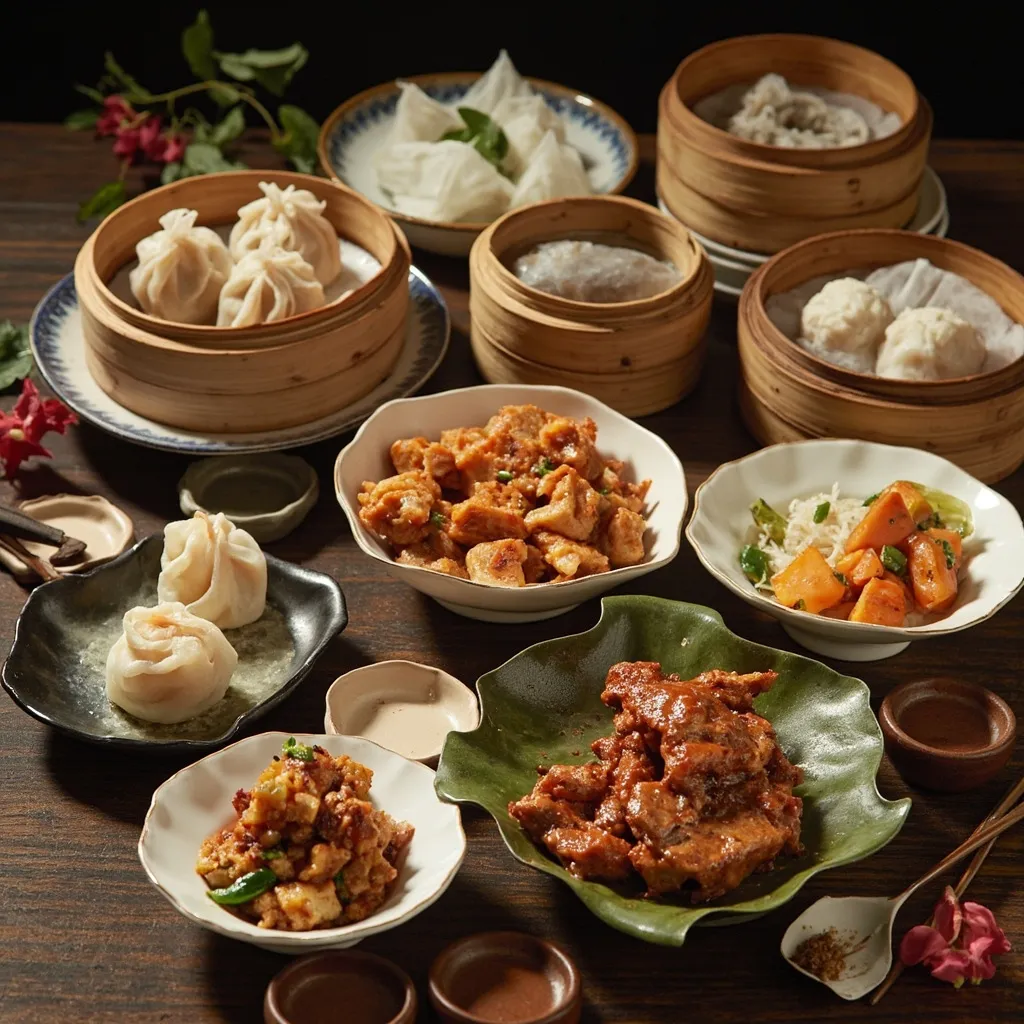
The word “dim sum” literally means “touch the heart”—a name that reflects how these little dishes are meant to be snacks that satisfy rather than overwhelming meals. Traditionally, dim sum is served in bamboo steamers stacked in towers, each basket holding three or four pieces of some delicious mini-creation. Waiters push carts through the restaurant, calling out what’s fresh, and diners grab whatever catches their eye.
Har Gow (虾饺) is often considered the king of dim sum—those translucent, pleated dumplings filled with plump shrimp. The wrapper is made from a special dough of rice flour and potato starch, which becomes beautifully chewy when steamed while letting you see the pink shrimp inside. A perfect har Gow has thin, slightly chewy skin and a generous shrimp-to-filling ratio.
Siu Mai (烧卖) is another essential—open-topped dumplings topped with a single orange crab roe that adds a pop of color and a burst of rich, briny flavor. The filling is typically a mixture of pork and shrimp, bound with just enough fat to be juicy without being greasy.
Char Siu Bao (叉烧包) are fluffy, white steamed buns filled with sweet, savory barbecued pork. The best ones have a slightly sweet dough and a generous amount of char siu (barbecued pork) that practically spills out when you tear them open. There’s also a baked version with a slightly crispy top that’s equally delicious.
Egg Tarts (蛋挞) are the dessert of champions—flaky pastry shells filled with a smooth, wobbly custard that’s slightly caramelized on top. These little tarts are absolutely addictive, with their contrast between buttery crust and silky filling.
Beyond these classics, a proper dim sum spread might include cheung fun (rice noodle rolls filled with beef, shrimp, or fried dough sticks), lo mai gai (glutinous rice wrapped in lotus leaf), turnip cakes pan-fried to crispy perfection, and countless other treasures.
Siu Mei: The Roast Masters
If dim sum is the elegant brunch of Cantonese cuisine, then siu mei (烧味) is its hearty, satisfying main course. Siu mei refers to the art of roasting and charring meats to create crispy, golden, intensely flavorful dishes that are served sliced over rice or noodles.
The star of the siu mei world is char siu (叉烧)—barbecued pork with that distinctive reddish-brown glaze. The pork is typically marinated in a mixture of honey, five-spice powder, oyster sauce, and red fermented bean curd, then roasted until the surface caramelizes into a sticky, sweet, smoky coating. The best char siu has a slightly charred exterior with a tender, juicy interior that practically melts in your mouth. You’ll find it served over rice (char siu fan), in fried rice, in bao buns, or simply on its own as a main dish.
Siu Yuk (烧肉) is Cantonese roast pork—whole pork belly roasted until the skin becomes an incredible crackling glass, while the meat beneath stays juicy and tender. The skin is scored in a diamond pattern, salted, and then roasted at high heat to create that magical combination of crunchy crackling and succulent meat. It’s often served with a sweet mustard sauce or simply with steamed rice.
White Cut Chicken (白切鸡) is the Cantonese answer to roast chicken—poached just until cooked through, then chilled and served with a simple ginger-scallion dipping sauce. This dish sounds simple, but it requires absolutely perfect timing and the freshest chicken to work. The meat should be silky, the skin gelatinous, and the flavor clean and pure.
Cantonese Roast Duck (烧鸭) is another essential—skin lacquered with maltose and vinegar to create that characteristic glossy, deep-brown finish. The duck is roasted until the skin is crispy and rendering with fat, while the meat stays incredibly moist. Served sliced over rice or in noodles with a drizzle of the rich pan juices, it’s absolutely unforgettable.
The Cantonese Kitchen at Home
Bringing Cantonese cooking into your home kitchen is easier than you might think, since many of the techniques are surprisingly simple—it’s the ingredient quality and technique precision that matter most.
First, focus on freshness. For steamed fish (a Cantonese staple), you need fish that’s so fresh it practically jumps onto your cutting board. Look for clear eyes, bright red gills, and a fresh ocean smell. If you can find it, buy whole fish and cook it that way—the head and bones add enormous flavor to the finished dish.
Master the basic sauces. Cantonese cooking relies on a few key condiments: premium light soy sauce (生抽), dark soy sauce (老抽) for color, oyster sauce, sesame oil, and rice wine. These can be combined in different proportions to create the bases for different dishes—a simple mixture of soy sauce, sugar, and rice wine becomes the glaze for char siu, for instance.
Learn to steam. Steaming is the gateway to Cantonese cooking, and it requires nothing more than a pot with a lid and a rack to hold your food above the boiling water. A simple plate of steamed fish with ginger and scallions will transform your understanding of how good plain ingredients can taste.
Finally, don’t forget the finishing touches. Cantonese dishes often get a final flourish—a drizzle of hot oil over a steamed fish to sizzle the aromatics, a scatter of chopped scallions, a few drops of sesame oil. These small gestures make a enormous difference between a good dish and a great one.
The Tea That Pairs With Everything
Dim sum isn’t complete without tea, and in Cantonese culture, the tea itself is an important part of the experience. The traditional dim sum tea is usually pu’er (普洱), a fermented dark tea from Yunnan Province that aids digestion—important when you’re eating rich, fatty foods like char siu and siu yuk. Its earthy, slightly musty flavor also cleanses the palate between bites.
Other popular choices include tieguanyin (铁观音), an oolong tea from Fujian with a floral aroma, and jasmine tea (茉莉花茶), which is scented with jasmine blossoms and has a gentle, refreshing quality. The tea is poured by the table’s elder or host, and it’s considered polite to refill others’ cups before your own.
In Hong Kong’s traditional tea houses, the pour is accompanied by a ritual: the server holds the teapot high and pours from a distance, creating a thin stream that aerates the tea and releases its aroma. There’s also the practice of “gai wang” (給罎)—the tea server walking around with a large brass pot, constantly refilling cups before they empty. These traditions are disappearing in modern, fast-paced Hong Kong, but they survive in a few heritage tea houses that have become living museums.
The Roots of Cantonese Culture
To truly understand Cantonese cuisine, you need to understand a bit about Guangdong Province itself. This region has been China’s gateway to the world for over two thousand years. The ancient maritime Silk Road passed through here, bringing not only trade goods but also culinary ideas from Southeast Asia, South Asia, the Middle East, and eventually Europe.
This long exposure to foreign influence created a distinctive cultural outlook. Cantonese people have historically been more pragmatic and business-minded than their northern counterparts—a trait that shows up in their cuisine, which emphasizes freshness and quality over elaborate preparation. They were among the first Chinese to travel and settle abroad, creating the Chinatowns that exist in cities worldwide, from San Francisco to London to Sydney.
The Cantonese dialect itself is famously different from Mandarin—it’s a tonal language with six to nine tones depending on the variety, compared to Mandarin’s four. This tonal quality is even reflected in the way Cantonese speakers seem to sing rather than speak. And while Mandarin has become the standard language of mainland China, Cantonese remains vibrant in Hong Kong, Macau, and diaspora communities around the world.
Hong Kong: The Cantonese Culinary Capital
If Guangzhou is Cantonese cuisine’s ancestral home, then Hong Kong is its glamorous, high-speed evolution. This former British colony became a melting pot where Cantonese cooking absorbed influences from around the world—British, Indian, Japanese, American—while maintaining its essential character.
The " dai pai dong" (大牌檔)—open-air food stalls that operate from tiny storefronts—are a Hong Kong institution. These no-frills restaurants serve everything from wonton noodles to clay pot rice to Hong Kong-style milk tea. Many have been operating for decades, passed down through generations, and they’ve become pilgrimage sites for food-obsessed travelers.
Hong Kong is also famous for its “cha chaan teng” (茶餐廳), hybrid cafe-restaurants that serve everything from Hong Kong-style breakfasts (buttered toast, instant noodles, tea) to Western dishes with a Cantonese twist. The menu at a cha chaan teng might include spaghetti with Hong Kong-style baked pork chop, French toast stuffed with peanut butter, and a glass of Hong Kong-style milk tea—all at remarkably affordable prices.
The city’s street food scene is legendary. From the egg waffles (雞蛋仔) that are crispy on the outside and soft inside, to the curry fish balls on skewers, to the silky smooth “silk stock” (奶茶) milk tea made with evaporated milk, Hong Kong offers a sensory overload of flavors and textures.
Cantonese Cuisine Around the World
Cantonese food was the first Chinese regional cuisine to become widely known outside China, and it remains the most familiar to Westerners. From the “chop suey” restaurants of early 20th-century America (which, whatever their authenticity, were based on Cantonese cooking techniques) to the dim sum parlors that now dot cities worldwide, Cantonese cuisine has shaped how the world thinks about Chinese food.
In America’s Chinatowns, Cantonese immigrants established the restaurants, grocery stores, and bakeries that formed the backbone of Chinese-American food culture. The roast meats hanging in shop windows, the steaming baskets of dim sum, the sweet egg tarts in the bakeries—all these are gifts from Cantonese cooking.
The cuisine has continued to evolve in diaspora. In New York, Los Angeles, and San Francisco, second- and third-generation Chinese-Americans have created new fusions—dim sum with Mexican fillings, char siu with Korean marinades, milk tea with boba pearls—that would be unrecognizable to a Cantonese grandmother, yet spring from the same culinary DNA.
This global spread has created some interesting tensions. In Hong Kong itself, there’s concern that authentic Cantonese cuisine is being lost amid an influx of mainland Chinese and international dining options. Heritage restaurants struggle to compete with sleek new establishments, and younger Hong Kongers sometimes prefer trendy Japanese or Korean food to their grandparents’ traditional fare. Yet every weekend, dim sum restaurants remain packed with families gathered around Lazy Susans, passing steamers and catching up on news—the same scene that’s played out for generations.
A Different Kind of Delicious
Cantonese cuisine offers something different from the more aggressive flavors of Sichuan or Hunan cooking. It’s cuisine that rewards patience and attention, that asks you to notice the subtle sweetness of fresh shrimp, the silkiness of perfectly steamed tofu, the satisfying crunch of roast pork skin.
In a way, learning to appreciate Cantonese food is learning to appreciate a different kind of delicious—one that whispers rather than shouts, that builds slowly rather than hitting you immediately. Once your palate adjusts to this more subtle approach, you may find yourself craving the clean, bright flavors of Guangdong more than the fiery pleasures of Sichuan.
The next time you visit a dim sum restaurant, take your time. Savor each little bite. Notice how the dough of the har gow feels slightly chewy against your teeth. Appreciate the way the char siu glaze clings to the meat. This is Cantonese cuisine at its finest—food that’s designed to touch the heart, one delicate bite at a time.