Say “Cao Cao” to most Western readers, and you’ll get the same answer: the villain from Romance of the Three Kingdoms. Sneering, scheming, treacherous, the kind of guy who murders an innkeeper just to steal his provisions and then says — gleefully — “宁我负人,毋人负我” (“Better that I betray the world than the world betray me”). It’s a fantastic line, and it’s basically how an entire continent-sized civilization remembers one of its most consequential political figures.
Here’s the problem: that line is probably made up. Or, more precisely, it’s a literary flourish taken out of context by a fourteenth-century novelist who needed a clear villain for a morally legible story. The real Cao Cao (155–220 CE) was something different, and considerably more interesting: a poet of genuine talent, an administrative reformer who reshaped northern China, a military innovator who almost unified the empire a century before the Sui actually did it, and a man whose family would go on to found one of the three great states of the Three Kingdoms era.
Unpacking who Cao Cao actually was requires setting aside the opera mask and reading the historical records. The picture that emerges is sharper than the cartoon — and far less comfortable.
Cao Cao the Man: Born in the Collapse
Cao Cao was born in 155 CE in Qiao County, Pei State (modern Anhui), into a wealthy but not elite family. His father Cao Song was a court eunuch’s adopted son who made a fortune in commerce — which in Han-dynasty terms meant Cao Cao was rich but socially suspect. The Han bureaucracy looked down on merchants, and eunuch-families were openly despised during the late Han partisanship crisis. So Cao Cao started life with talent, energy, and a chip on his shoulder about class.
What he did next tells you everything. Instead of playing it safe, he cultivated connections with the young intellectuals of the day, especially the men who would later form the so-called Xuanxue (“Mysterious Learning”) circle. He studied military texts under a retired officer. He became a low-ranking but energetic official under the Han court, and rose quickly on the strength of his competence rather than his family name. By the time he was in his thirties, he was already known as an able administrator and a sharp judge of men.
He was also ruthless in the right ways. During the campaign against the Yellow Turban rebels, he distinguished himself through bold tactics and willingness to do dirty work. When the warlord Dong Zhuo seized the capital in 189 CE, Cao Cao was one of the few who actually tried to assassinate him — and failed. When Dong Zhuo offered him a post, Cao Cao refused and fled, knowing the offer was a trap. He raised his own army in the countryside, and over the next two decades, he played the collapsing empire like a chess board, gradually consolidating control of the entire northern half of China.
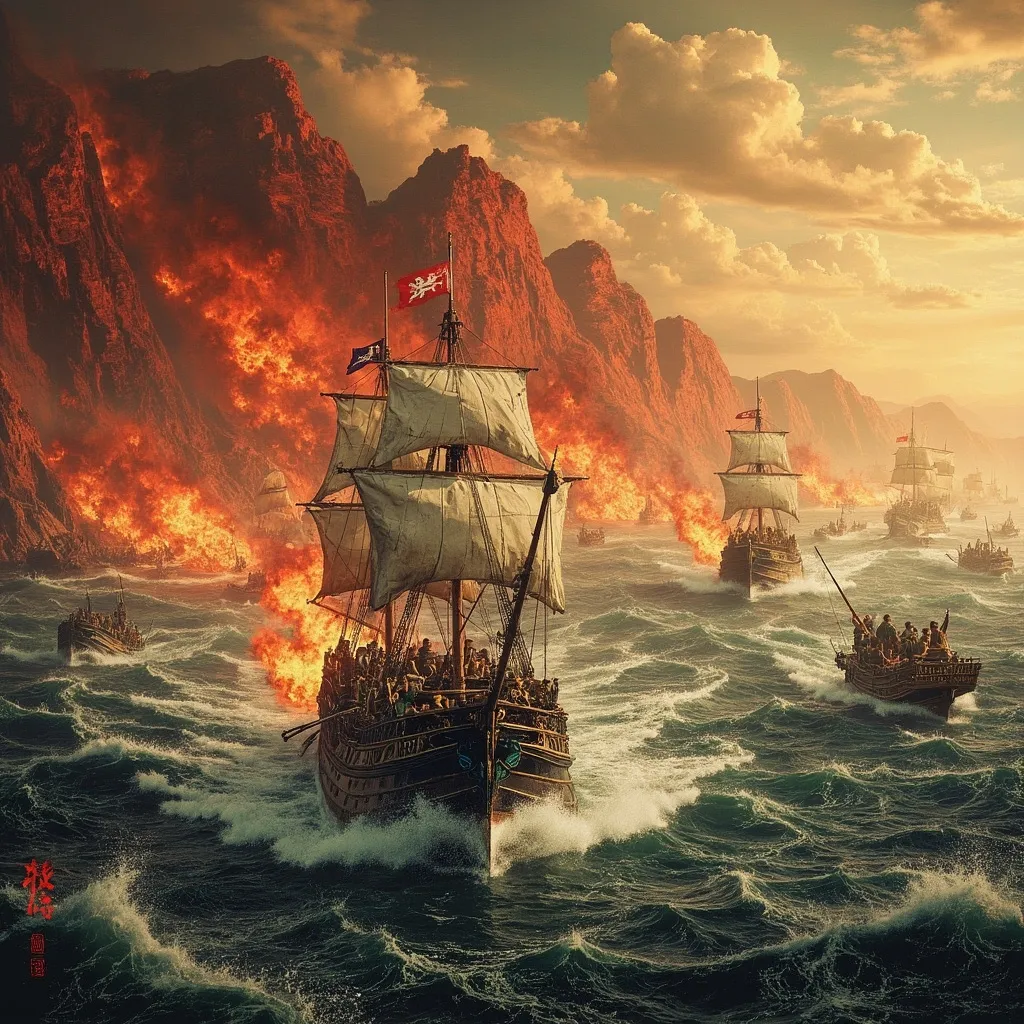
By 208 CE, when he led his forces south against the southern warlords, Cao Cao was effectively master of northern China. That campaign — the Battle of Red Cliffs — is where Romance pins its biggest fictional sins on him, but the historical Cao Cao lost at Red Cliffs because of an epidemic and poor navy, not because of any moral failing. He retreated, regrouped, and lived another twelve years consolidating his gains.
The Strategist: Battle of Guandu and Beyond
Cao Cao’s signature military victory was the Battle of Guandu (官渡之战) in 200 CE. He was vastly outnumbered by Yuan Shao, the most powerful warlord in northern China, who commanded perhaps 110,000 troops against Cao Cao’s 20,000–30,000. Conventional wisdom said Yuan Shao would crush him. Cao Cao held his nerve, struck Yuan Shao’s supply depot at Wuchao (乌巢), and won the war in a single bold stroke.
The lesson Cao Cao taught his contemporaries — and that Chinese military theorists have studied ever since — was the priority of speed, intelligence, and supply lines over raw numbers. He was, by general consensus, one of the most capable tacticians of his era. He introduced standardized infantry drills, organized cavalry units by tribal origin, used mixed-arms coordination, and kept meticulous logistics records. By the time of Red Cliffs, he was running an army that operated like a state bureaucracy — which is exactly the sort of thing Cao Cao would invent.
He also did something rarer: he wrote about it. His military treatise Commentary on Sun Tzu (孙子略解) is one of the earliest systematic interpretations of The Art of War and remains a standard reference for Chinese strategists. It’s a short, sharp text that argues Sun Tzu’s principles should be applied pragmatically, not ritualistically. If you read it, you can see the man who won Guandu thinking through the problems.
The Reformer: Building the Wei State
Cao Cao didn’t just fight wars. He ran territories, and the way he ran them was a big deal. Two of his most important reforms deserve close attention.
The first was the Tuntian System (屯田制), or “military-agricultural colonies.” After conquering war-torn farmland, Cao Cao didn’t just extract taxes from the local peasants — he organized them into state-run farming units, supplied with seed and tools, who would keep a portion of the harvest and remit the rest to the army. This solved the perennial Three Kingdoms problem of soldiers starving between campaigns, and gave peasants a reason to farm even while armies marched overhead. The Tuntian System became the backbone of Wei economic strength and was copied, with modifications, by later dynasties.
The second was the Edict Seeking Talent (求贤令) of 215 CE. This was a recruitment proclamation that explicitly told officials to ignore moral reputation and recommend capable men regardless of their reputation for integrity. Cao Cao’s exact words: “Whether a man is upright or unprincipled, talented or mediocre, you should not fail to recommend him. To make each man find his place — that is the way of Yao and Shun.” This is extraordinary. It was an explicit attack on the Han-dynasty obsession with moral purity in officials, and a pragmatic declaration that competence mattered more than virtue. Confucius would have been horrified. Modern technocrats feel right at home.
The reforms worked. By the time Cao Cao died in 220 CE, he controlled a population of perhaps 30 million — roughly half of China’s recorded households — and a functioning state apparatus that his son Cao Pi would simply inherit when he declared himself the first emperor of Cao Wei.
The Poet: Cao Cao’s Literary Legacy
Cao Cao was also one of the most important poets of the early third century. He was the leading figure of the Jian’an style (建安风骨), which prized vigor, emotional directness, and engagement with the moment over the more mannered court styles that came before. His poems are still taught in Chinese schools.
Three in particular deserve mention:
短歌行 (“Short Song Style”) — perhaps Cao Cao’s most famous poem. It’s a meditation on mortality and the fleeting nature of life, ending with the famous image of singing into the night (“对酒当歌,人生几何”). The poem works because it’s melancholy without being self-pitying. Cao Cao is mourning both his own eventual death and the futility of ambition, and somehow using that to drive himself harder.
观沧海 (“Viewing the Sea”) — a six-line poem written at the eastern coast, looking out at the ocean. The last lines (“日月之行,若出其中;星汉灿烂,若出其里”) compare the sea to a cosmic container holding the sun, moon, and Milky Way. For a warlord who spent his life managing logistics, the metaphor of vast systems containing everything is fitting.
龟虽寿 (“The Tortoise, Though Long-Lived”) — the philosophical heart of his late career. “The tortoise lives long, yet still has its end; the winged dragon soars, and yet must come to rest.” But Cao Cao refuses the consolations of fatalism: “Old war horses may still aspire to gallop a thousand li; old soldiers, their will unbroken, can still hold their own.” It’s a poem about refusing to accept decline, written by a man in his mid-fifties who’d already done more than most emperors.
His poetry has an earnest, slightly rough quality that’s striking when you compare it to later Tang dynasty refinement. Cao Cao writes like a man who also happens to be a soldier, and there’s a directness to his work that later Chinese poets always respected even when they outpaced him technically.
The Family: Cao Pi, Cao Zhi, and the Seven-Step Poem
Cao Cao had many sons, but two of them dominated his succession drama. The elder, Cao Pi (曹丕, 187–226), was competent, cautious, and politically sharp. The younger, Cao Zhi (曹植, 192–232), was the more brilliant poet — and the brother Cao Cao initially preferred for succession.
The rivalry exploded after Cao Cao’s death. Cao Pi, who became the first emperor of Cao Wei in 220 CE, feared his brother’s literary fame and political following. According to a famous (almost certainly embellished) story, Cao Pi demanded that Cao Zhi compose a poem within seven steps — under pain of death — to prove his loyalty. Cao Zhi allegedly responded with the 七步诗 (“Seven-Step Poem”):
“煮豆燃豆萁,豆在釜中泣。本是同根生,相煎何太急?”
(Boiling beans with bean-stalks as fuel, the beans in the pot weep. We share the same root — why must you torment me so urgently?)
The story is probably apocryphal, but the poem is real and the political situation is real. Cao Pi did sideline his brother for life, denying him any serious role. Cao Zhi died at 40, embittered, having written some of the most beautiful poetry of the Jian’an era — including the Ode to the River Goddess we covered earlier. The brothers’ tragedy has become a standard reference point in Chinese literature for fraternal cruelty.
The Death and the 72 Suspicious Tombs
Cao Cao died in March 220 CE in Luoyang, age 65. His health had been declining — chronic headaches, possibly early symptoms of a stroke. He left careful instructions on state policy and on the disposition of his household.
His burial is the most interesting part. According to the Wei Shu and later records, Cao Cao arranged for 七十二疑冢 — the “Seventy-Two Suspicious Tombs” — to be constructed, all identical, scattered across the plains north of the Yellow River. He ordered his body to be interred at one tomb while the other seventy-one were decoys, complete with identical funerary regalia. Then, on the day of the funeral, he had all seventy-two tombs filled simultaneously so that no one — neither rival warlords nor grave robbers — would ever know which one held him.
Whether the seventy-two tombs actually exist is disputed. Archaeologists have found what may be one of the legitimate Cao Cao tombs near Anyang in 2009, identified by the inscription on the man’s spine — a male of about 60, matching the historical Cao Cao’s age. But the full seventy-two-tomb array, if it ever existed, has never been definitively mapped. The legend has its own life: for centuries, peasants burned paper offerings at random tombs in the Anhui plains, hoping the god of war would forgive the ambiguity. The Cao family paid for the elaborate trick by leaving later generations with a real historical problem — no one is quite sure where to bring offerings or hold commemorations. It’s a fitting end for a man whose entire life was a study in calculated ambiguity.
Cao Cao never became emperor himself — that was left to his son Cao Pi. But he was the one who made Wei possible, and his legacy shaped China for centuries. The Tuntian System was copied by the Tang. His poetry anchored the Jian’an school that influenced every dynasty after. The state he founded lasted until 265 CE, longer than either Shu or Wu. And the literary Cao Cao — the scheming villain of Romance of the Three Kingdoms — is a more interesting figure than the historical Cao Cao allows, but also a less fair one. The historical man was ambitious, ruthless, competent, brilliant, and doomed like everyone else. He deserves the more honest reading.