Cao Chong Weighing the Elephant: A Child’s Genius That Defied Common Sense
Let me tell you about one of my favorite stories from ancient China. It’s the kind of story that makes you sit back and think, “How did a seven-year-old figure that out?” I’ve read a lot of historical anecdotes over the years, and this one still manages to surprise me every time.
The story is set during the late Eastern Han Dynasty, a period when China was dealing with considerable political instability. The warlord Cao Cao was one of the most powerful figures of the era—often depicted in literature and drama as a cunning strategist who played a pivotal role in shaping China’s future. His son, Cao Chong, is the hero of our story, though it’s fair to say that Cao Chong probably had no idea he would become famous for something he did as a very young child.
The Problem: An Elephant and No Adequate Scale
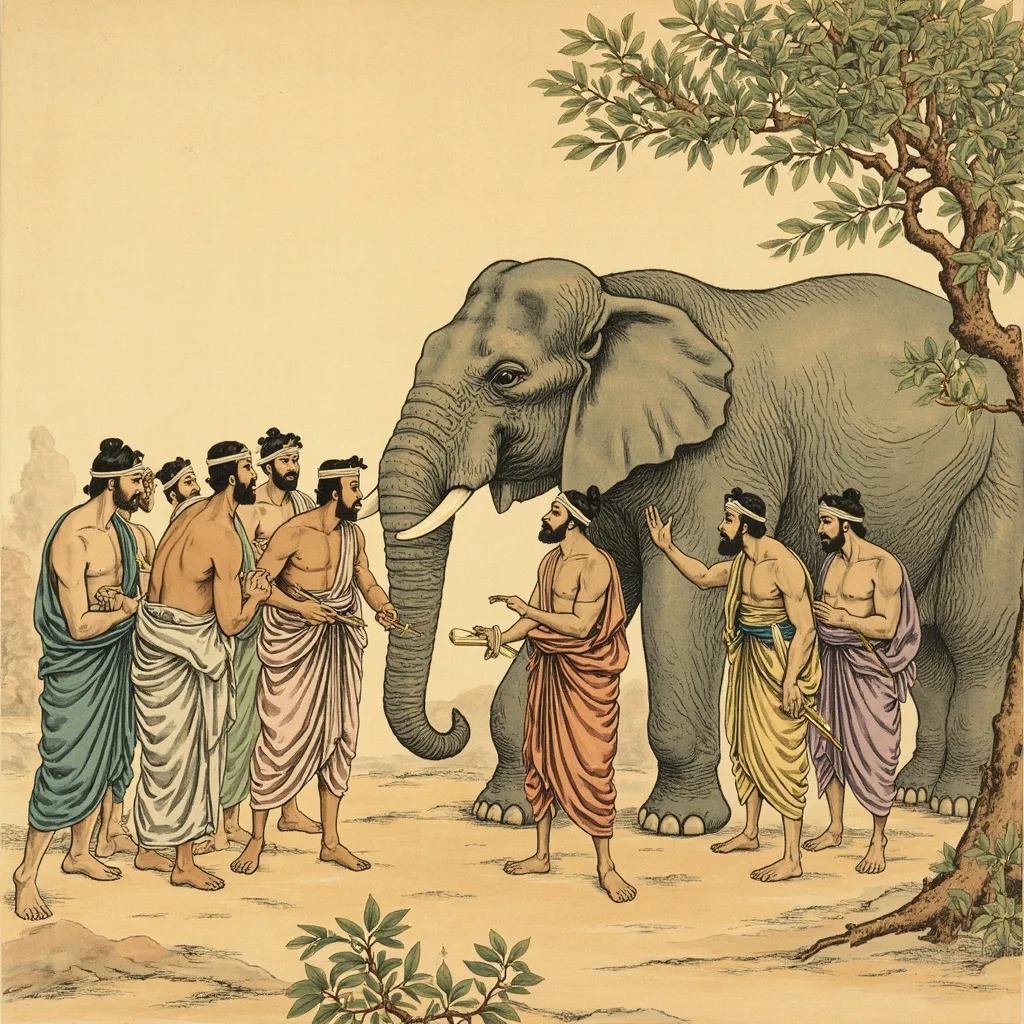
The story begins when someone—sources differ on whether it was a foreign emissary or a trader—brought a live elephant as a gift to Cao Cao’s court. This was quite an event. Elephants weren’t common in northern China, and this one was fully grown and remarkably large. Everyone gathered to see the impressive animal, and Cao Cao, ever the practical military leader, asked a deceptively simple question: “How much does this elephant weigh?”
Now, this was a genuine question, not a rhetorical one. Cao Cao wanted to know the weight, perhaps for logistical reasons (how much food does an elephant need?), perhaps to assess the value of the gift, or perhaps just out of curiosity. But here’s the problem: there was no scale anywhere in the region that could handle an elephant. The animal was simply too heavy for any existing measuring device.
The court officials scratched their heads. Some suggested cutting the elephant into smaller pieces—practical, perhaps, but it would kill the animal and defeat the purpose of having a live elephant to display. Others suggested building a massive new scale, but that would take too much time and resources. The question seemed to have no good answer.
Into this moment of collective puzzlement stepped young Cao Chong, who was probably around seven years old at the time. Now, you have to understand: in ancient Chinese court culture, young children of noble families were often present at formal occasions. They might observe, they might learn, but rarely would they contribute to serious discussions about practical matters. Cao Chong’s interjection was therefore somewhat unusual, but what he suggested was nothing short of brilliant.
The Solution: Displacement and clever Thinking
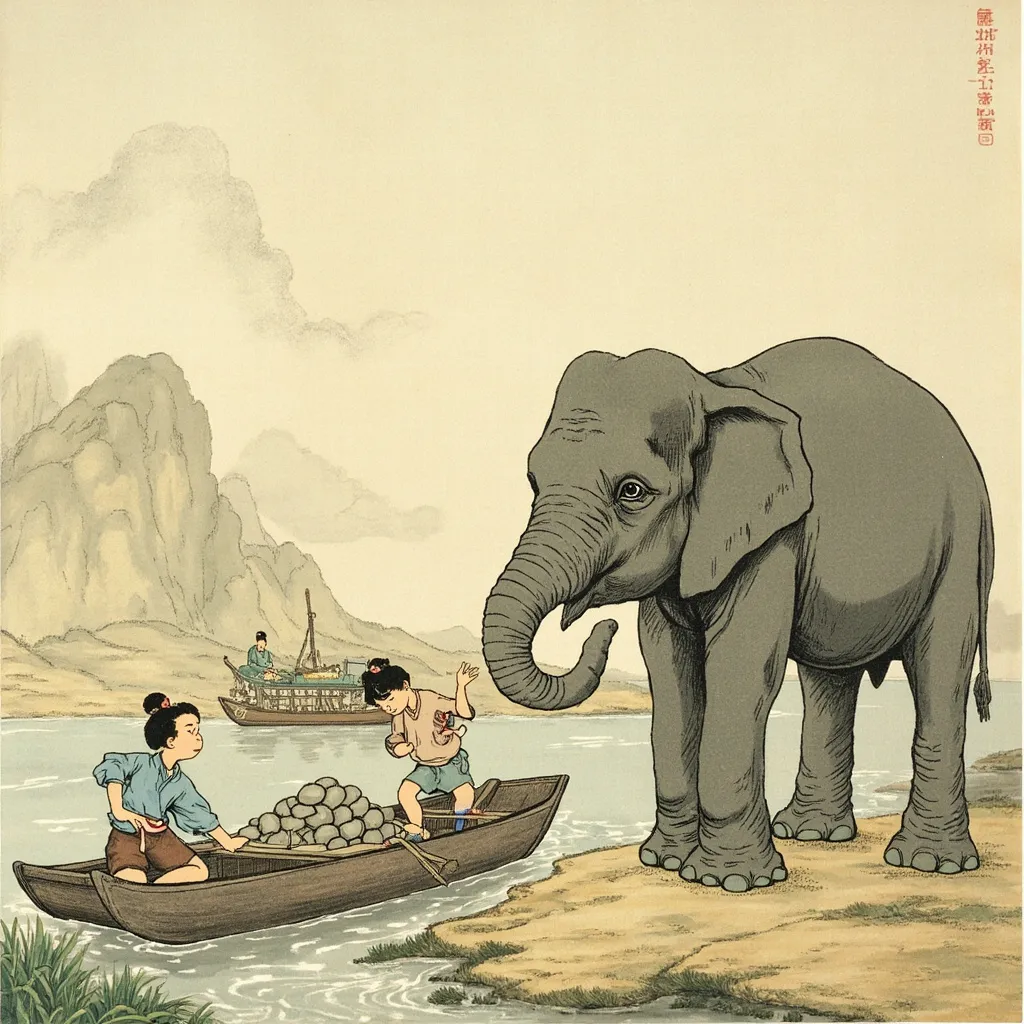
Cao Chong’s idea was elegantly simple. He proposed loading the elephant onto a boat and then marking the waterline where the boat sat. Then, after removing the elephant, they would load the boat with stones until it reached the exact same waterline. The stones could then be weighed individually on smaller scales, and the total weight of the stones would equal the weight of the elephant.
Think about how clever this is. Cao Chong recognized that the boat’s displacement—the amount of water it pushed aside—was directly related to the weight it was carrying. By using the boat as a kind of intermediate measuring device, he could convert the seemingly impossible task of weighing an elephant into the completely manageable task of weighing a bunch of stones.
The officials tried this approach, and it worked perfectly. The elephant was weighed without harm, and everyone marveled at the ingenuity of Cao Cao’s young son. This incident became one of the most famous anecdotes in Chinese history, used to illustrate the power of lateral thinking and the value of approaching problems from unexpected angles.
The Science Behind the Story: Understanding Displacement
What Cao Chong intuitively understood—and what wouldn’t be formally articulated until centuries later by Archimedes in the Western world—is the principle of displacement. An object floating in water displaces a volume of water equal to its own weight. This is why huge ships can float despite being made of heavy materials like steel: the shape of the hull causes them to displace enough water to balance their own weight.
Cao Chong didn’t need to know the formal physics principles to solve the problem. He just needed to observe that a boat sitting in water rises and falls with the weight it carries, and that equal depths correspond to equal weights. This kind of observational intelligence—the ability to notice patterns and relationships without formal training—is at the heart of what we call ingenuity.
The remarkable thing is that this principle wasn’t widely known or applied in China at the time. Cao Chong essentially reinvented the wheel, or rather, he discovered a principle that would later be formalized as Archimedes’ principle. In many ways, this story serves as a reminder that intelligence isn’t always about knowing more facts; it’s about seeing connections that others miss.
The Historical Cao Chong: A Life Cut Short
While the elephant-weighing story made Cao Chong famous, his life was unfortunately quite short. He died at the age of thirteen, depriving the world of what might have been a remarkable adult intelligence. Historical sources suggest he was a sickly child, prone to illness, and despite the best medical care available at the time, he didn’t survive into his teenage years.
This makes the elephant story even more poignant. It’s one of the few glimpses we have into Cao Chong’s thinking, and it shows us a mind that was clearly exceptional. The child who solved the weighing problem demonstrated not just raw intelligence but the kind of practical wisdom that could take abstract principles and apply them to real-world problems.
Cao Cao, his father, was reportedly devastated by Cao Chong’s death. The warlord was known for his political ruthlessness and military cunning, but he appears to have been genuinely affectionate toward his son. Some historical accounts suggest that Cao Cao favored Cao Chong as a potential successor, which adds another layer of tragedy to the story: the child who might have led the state was taken too soon.
Why Lateral Thinking Matters
Let’s zoom out from the specific details of the story and think about what it teaches us more broadly. The problem that Cao Chong solved was fundamentally a problem of measurement. How do you measure something when the standard tools aren’t adequate? The obvious answer—the one that most people probably jumped to—was to build a bigger scale. But building a bigger scale would have taken time and resources, and even if completed, it might not have been accurate.
Cao Chong’s solution was to change the problem entirely. Instead of trying to measure the elephant directly, he found a way to use smaller measurements that, when combined, would give him the answer. This is the essence of lateral thinking: instead of pushing harder against the obstacle, you look for a way around it.
This approach has applications in virtually every field. Engineers routinely solve problems by finding indirect solutions. Scientists make discoveries by approaching questions from unexpected angles. Business leaders find market opportunities by seeing connections that competitors miss. The ability to think laterally—to refuse the obvious solution in favor of a creative alternative—is one of the most valuable skills anyone can develop.
There’s also something to be said for the confidence to speak up. Cao Chong was a child in a room full of adults, and he offered an solution that would have been dismissed or ridiculed from anyone else. The fact that he felt empowered to share his idea—and that the adults actually listened—speaks to an environment that valued good ideas regardless of their source. This isn’t always easy to create, especially in hierarchical societies or organizations, but it’s essential for fostering genuine innovation.
Modern Applications: When Small Solutions Solve Big Problems
The principles behind Cao Chong’s solution are still used today, though often in more sophisticated forms. Consider how we measure things that seem impossible to measure directly. Scientists use sample counting techniques that would be recognizable as extensions of Cao Chong’s basic approach. Engineers use scale models and simulations to test designs before building full-scale versions. Businesses use market research and focus groups to gauge demand before committing to large-scale production.
The common thread in all these approaches is the same principle Cao Chong discovered: sometimes the best way to solve a big problem is to break it down into smaller pieces that you can actually handle. You don’t try to move a mountain in one lift; you carry it away one basket at a time.
I find myself thinking about Cao Chong’s approach when I’m faced with overwhelming challenges in my own life. It’s easy to feel stuck when a problem seems too big to tackle directly. The temptation is to either avoid the problem entirely or to throw massive resources at it in hopes that sheer force will prevail. But Cao Chong’s story reminds me that there’s usually a clever solution waiting to be discovered if I’m willing to look at the problem from a different angle.
Teaching Children to Think Like Cao Chong
One of the reasons this story has remained popular in Chinese culture is its value as a teaching tool. Parents use it to encourage children to think creatively and to have confidence in their own ideas. Teachers use it to illustrate principles of physics and problem-solving. The story serves multiple pedagogical purposes while also being engaging enough to capture children’s imaginations.
If you want to help a child develop lateral thinking skills, this story is a great starting point. After telling them the story, you can pose additional problems that require similar thinking. How would you measure the height of a tree without climbing it? How would you count the number of fish in a pond without draining it? How would you find the heaviest ball in a collection of balls using only a balance scale? These kinds of puzzles help children internalize the principle that problems often have non-obvious solutions.
There’s also value in letting children struggle with problems before revealing the solution. The frustration of not knowing an answer is often what drives people to find creative solutions. If Cao Chong had simply been told the answer, he wouldn’t have discovered the principle of displacement himself. The same is true for modern learners: being allowed to wrestle with a problem—even if it takes a while—builds the kind of mental resilience that leads to genuine insight.
The Story in Popular Culture
Cao Chong’s elephant-weighing story has appeared in countless forms over the centuries. It’s been adapted into children’s books, animated films, television dramas, and even video games. The image of a young boy standing next to a boat, directing workers as they load stones, has become an iconic representation of childhood genius in Chinese culture.
The phrase “Cao Chong weighing the elephant” (曹冲称象) has become a common Chinese idiom for approaching problems with cleverness and innovation. You’ll hear it used in business negotiations, academic discussions, and everyday conversations when someone proposes an unexpected solution to a difficult problem.
This cultural ubiquity speaks to how deeply the story has embedded itself in the Chinese consciousness. It’s not just a historical anecdote; it’s a frame of reference that people use to understand and describe new situations. When someone says, “That’s a Cao Chong approach,” they’re saying, “That’s a clever, indirect solution to a seemingly impossible problem.” This kind of idiomatic usage is a sure sign that a story has truly entered the cultural vocabulary.
Conclusion: The Power of Simple Observation
As I reflect on Cao Chong’s story, I’m struck by how much it reveals about the nature of intelligence and problem-solving. The solution to the elephant problem wasn’t complicated—it didn’t require advanced mathematics or specialized knowledge. It just required someone to notice something that everyone else had overlooked: that a boat’s waterline tells you everything you need to know about its cargo.
This is a reminder that insight often comes from paying attention to the obvious things that everyone else takes for granted. We’re often so focused on complex solutions that we miss the simple ones. The most elegant answers to our problems are sometimes right in front of us, waiting for someone to notice.
The next time you’re facing a problem that seems unsolvable, think of Cao Chong. Ask yourself if there’s an indirect approach you haven’t considered. Look for the “boat” in your situation—some tool or method that’s already available to you but that you’ve overlooked. The solution might be simpler than you think.
Cao Chong died nearly two thousand years ago, but he left us with something more valuable than any material legacy: a model for how to approach the impossible with intelligence, creativity, and confidence. That’s a gift that keeps on giving, century after century.