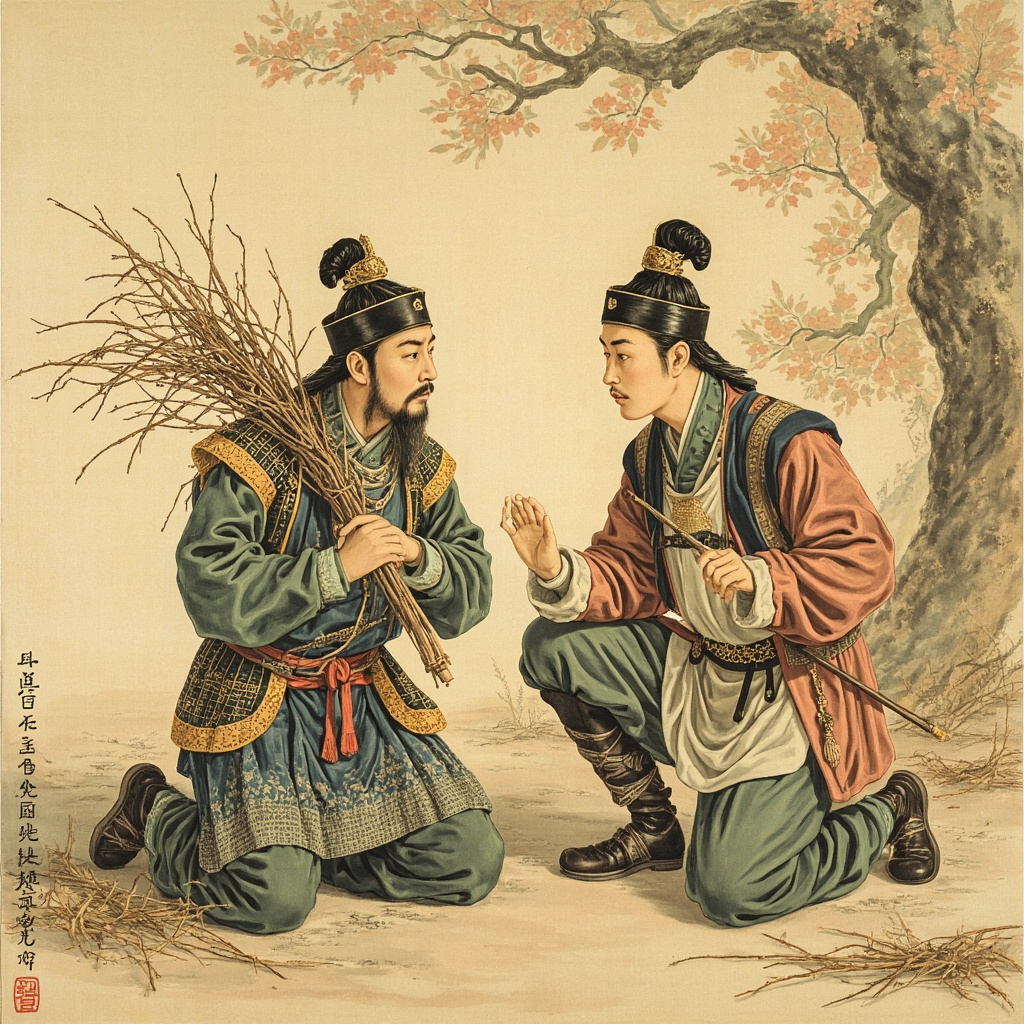
The general arrived at Lin Xiangru’s door carrying a bundle of thorny brambles on his bare back. His famous armor was nowhere to be seen. His weapons were left behind. He walked in silence through the streets of the capital, past merchants and soldiers and citizens who stared in disbelief, straight to the house of the man he had spent months trying to humiliate and destroy.
When Lin Xiangru opened his door, the old general dropped to his knees in the courtyard and spoke the words that would echo through Chinese history for twenty-three centuries: “I, Lian Po, have been a fool. I have let my jealousy and my pride blind me to the truth. I have wronged you, and I carry this bramble to symbolize the punishment I deserve. I beg you to whip me, or to have me executed if that is what justice requires. I will not rise until you forgive me.”
Lin Xiangru looked at the old man kneeling in his courtyard — the most famous general in Zhao, a man who had won fifty battles, who had defended the state through two decades of war — and felt something shift inside him. All the insults, all the political maneuvering, all the attempts to undermine his position — none of it mattered as much as this moment of genuine humility from a man who had everything to lose by offering it.
This is the story behind 负荆请罪 — fù jīng qǐng zuì — “carrying brambles to ask for sin.” The idiom describes the act of offering a genuine, public apology — specifically, the kind of apology that involves accepting humiliation as the price of admitting wrongdoing. In English, we might say someone “ate humble pie” or “swallowed their pride,” but fù jīng qǐng zuì is more dramatic and specific: it captures the particular courage required to publicly admit a serious mistake and accept whatever consequences follow.
The Background: Two Great Men in One Court
To understand why this moment was so remarkable, you need to understand who these two men were and how they had come to be enemies.
Lian Po was, by any measure, one of the greatest military commanders in Zhao’s history. He had served the state for decades, winning battle after battle against Qin’s relentless advances. He was old, experienced, respected by every soldier in the Zhao army, and deeply proud of his record. When he spoke in the war council, even the king listened carefully.
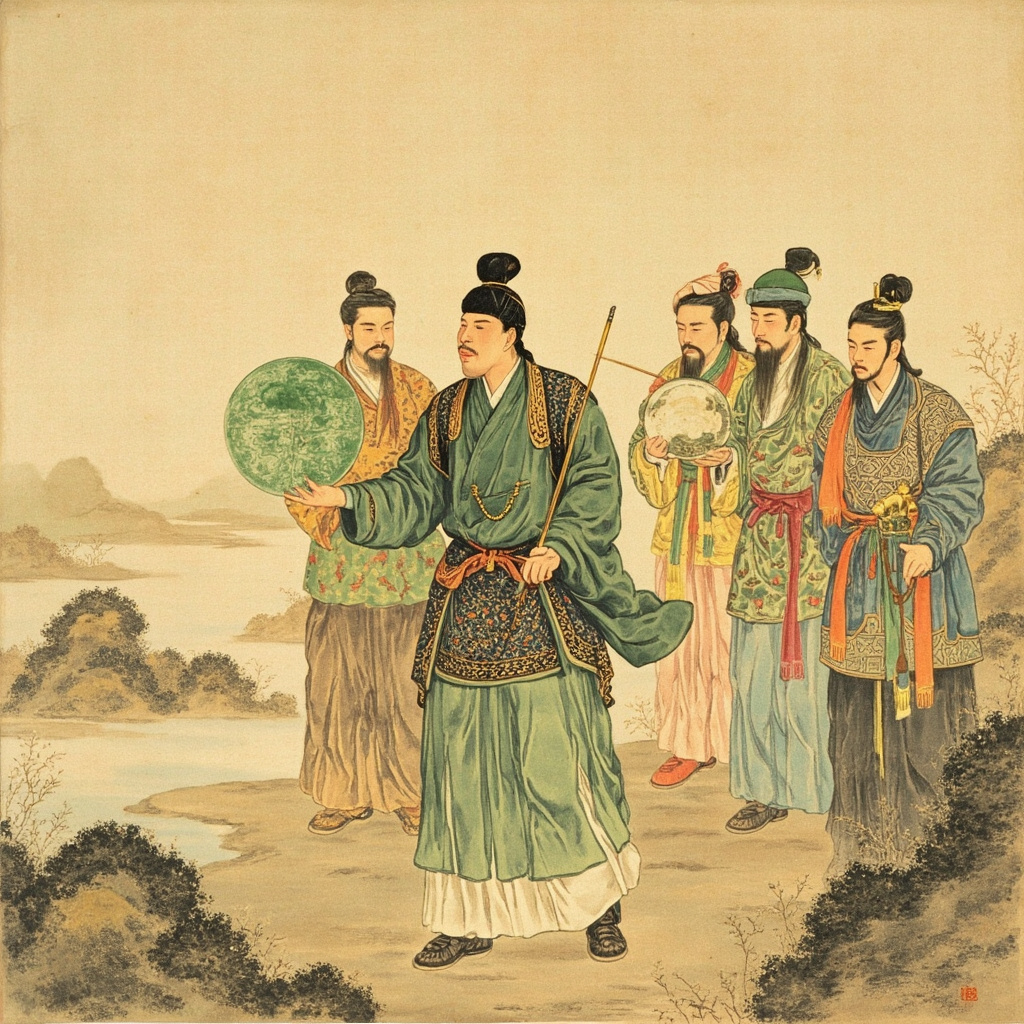
Lin Xiangru was the newcomer — the brilliant diplomat who had saved the Heirloom of Zhao and who had later matched wits with Qin again at Pingxing, where he had physically intimidated the Qin king into honoring a peace agreement. He was quick-thinking, fearless, and increasingly powerful in the Zhao court.
When Lin Xiangru’s status began to rise, Lian Po felt threatened. It was not an unreasonable concern — Lin Xiangru’s diplomatic victories were achieving results that Lian Po’s military campaigns had never matched. Where Lian Po had defended Zhao’s borders, Lin Xiangru was actually expanding Zhao’s influence and prestige. The old general watched his own star decline and did not handle it well.
He began to insult Lin Xiangru publicly. He spread rumors questioning his loyalty. He maneuvered to have him demoted or transferred away from the capital. He did everything a proud, jealous man might do when confronted with a successor who represented a threat to his legacy.
The Breaking Point
The conflict between the two men had been building for months when something happened that changed everything. A visiting diplomat from the state of Wei asked to meet with Zhao’s greatest general. The logical choice would have been Lian Po — the Wei diplomat was explicitly requesting the most famous military figure in Zhao. But Lin Xiangru, who was handling the diplomatic arrangements, directed the Wei diplomat to meet with him instead.
It was a calculated move, perhaps too calculated. Lin Xiangru wanted to demonstrate that he, not Lian Po, was the true power in Zhao’s foreign policy. The message was received loudly by everyone, including the Wei diplomat and, most painfully, by Lian Po.
When Lian Po learned that he had been passed over in favor of the man he had been undermining, his anger reached its peak. He went to the king and demanded to know why he, the army’s commander, was being sidelined in favor of an upstart diplomat. The scene in the throne room was ugly — Lian Po said things he couldn’t take back, questioned the king’s judgment, and publicly belittled Lin Xiangru’s accomplishments.
The king, caught between his two most important servants, made a decision that neither man expected: he told Lian Po the truth. He explained, carefully and diplomatically, that while Lian Po was indeed a military genius, Lin Xiangru had recently accomplished things that no military commander could have achieved. The state needed both men, but it also needed to recognize that Lin Xiangru’s skills were different and complementary. Would Lian Po — could Lian Po — find it in himself to work with Lin Xiangru rather than against him?
The Old General’s Transformation
What happened next is the moment that made fù jīng qǐng zuì one of the most respected idioms in Chinese culture. Lian Po went home and thought about what the king had said. He reviewed his own behavior over the preceding months. He considered Lin Xiangru’s actual record — the jade disc saved, the Qin king humiliated, the treaties negotiated that had bought Zhao precious years of peace.
And he realized, with the clarity that sometimes comes only to men old enough to have seen many such conflicts, that he had been wrong. Completely wrong. He had let his ego and his jealousy drive him to sabotage the state’s interests for the sake of his personal pride. He had been a fool.
The next morning, he did something that most powerful men never do: he went to apologize. Not in private, not through intermediaries, but publicly, in the most dramatic and humble way possible.
He stripped off his armor. He gathered a bundle of thorny brambles — the kind used for corporal punishment in ancient China — and carried them on his bare back, symbolizing his willingness to be punished. He walked through the capital streets where everyone could see him, to Lin Xiangru’s residence, where he knelt and offered the apology that history remembers.
The Power of Public Humility
What makes Lian Po’s apology so remarkable — and so deserving of its status as an enduring idiom — is not just that he admitted a mistake. It’s that he did it in the most public and therefore most costly way possible. He could have sent a private message. He could have asked the king to arrange a reconciliation. He could have waited for a quieter moment when fewer people would witness his humiliation.
Instead, he chose to make his apology visible to everyone. He chose to let the soldiers who respected him see their general humbled. He chose to let the court officials who had watched his campaign against Lin Xiangru see him admit he was wrong. He chose to bear the full cost of his admission in terms of lost status and wounded pride.
This is why fù jīng qǐng zuì has become the gold standard for genuine apology in Chinese culture. It’s not enough to feel sorry privately. A real apology requires accepting the consequences of your actions, including the social consequences. Lian Po understood this instinctively, which is why his gesture was so powerful.
Lin Xiangru’s response was equally significant. He could have used this moment to humiliate the old general further, to demonstrate his own power, to settle old scores. Instead, he rushed to raise Lian Po from his knees and publicly accepted the apology. He made clear that he had never wanted this confrontation, that he valued Lian Po’s service to Zhao above any personal grievance, and that from this moment forward, the two men would work together as partners.
The Broader Lesson: Ego as the Enemy
The story of fù jīng qǐng zuì encodes a deep Chinese insight about the destructive nature of unchecked ego. Lian Po was one of the most capable and accomplished men in Zhao. He had every reason to be proud. But his pride had led him to act against the interests of his country, to sabotage a valuable colleague, and to prioritize his personal status over the state’s welfare.
When he finally saw this clearly, he did something that required more courage than any battle he had ever fought: he publicly admitted his failure. This is the harder courage — the courage to acknowledge that you were wrong, that your pride blinded you, that the story you told yourself about your own behavior was not accurate.
In Chinese philosophy, this kind of self-examination is considered one of the highest virtues. The ability to recognize your own faults, particularly faults that stem from ego and pride, is seen as the foundation of wisdom. The Confucian concept of self-reflection (内省) is built on the idea that the first step toward moral improvement is honest acknowledgment of your failures.
Lian Po’s carrying of the brambles was the ultimate act of self-reflection. He didn’t just admit he was wrong — he made a public spectacle of his admission, accepting whatever consequences followed. It was a genuine transformation, not merely a diplomatic gesture.
The Idiom in Modern Life
Today, fù jīng qǐng zuì is used in Chinese to describe any situation where someone offers a major apology that involves accepting humiliation and consequences. It appears most often in contexts where someone in a position of authority makes a genuine admission of wrongdoing — a CEO who publicly takes responsibility for a company’s failure, a political leader who admits to a serious policy error, or even a family member who acknowledges that pride drove them to hurt someone they love.
The idiom is also sometimes used self-deprecatingly: if you’ve made a serious mistake and are preparing to apologize, you might say you’re about to “carry brambles” — acknowledging in advance that the apology will be painful and humbling.
There’s a secondary usage that applies specifically to forgiveness: when someone receives a genuine apology and accepts it magnanimously, they are said to have demonstrated fù jīng qǐng zuì spirit — the willingness to forgive someone who has genuinely humbled themselves. The idiom thus captures both sides of the reconciliation: the courage to apologize and the grace to forgive.
The Legacy of Two Great Men
Lian Po and Lin Xiangru went on to become one of the most celebrated partnerships in Chinese military history. Together, they defended Zhao against Qin’s relentless pressure for years. Their complementary skills — Lin Xiangru’s diplomatic brilliance and Lian Po’s military mastery — created a defense that Qin’s strategists could not crack.
When Lian Po eventually died of old age, Lin Xiangru reportedly wept like a child. The man who had once been his enemy had become his closest colleague and friend. Their reconciliation, symbolized by the bramble bundle, had made both of them better — and had made Zhao stronger.
This is the deepest teaching of fù jīng qǐng zuì: sometimes the thing that looks like weakness — admitting you’re wrong, accepting humiliation, swallowing your pride — is actually the thing that makes you stronger. Lian Po was a greater man after he carried the brambles than he was before, because he had learned the hardest lesson in leadership: that your ego is not your friend, and the first step to wisdom is honestly confronting your own foolishness.
The brambles have long since disappeared. But the lesson remains.
Discover more Chinese historical idioms that reveal the power of humility, forgiveness, and self-reflection in ancient Chinese wisdom and their relevance to modern life.