Every year, when autumn arrives and the moon hangs big and bright in the night sky, millions of people across China and around the world gather to celebrate the Mid-Autumn Festival. They eat mooncakes, light lanterns, and look up at the full moon. But beneath this beautiful celebration lies one of the most poetic stories in all of Chinese mythology — the tale of Chang’e, the moon goddess who flew to the heavens and now lives in the moonlight forever.
If you’ve ever looked up at a full moon and wondered about the stories people once told about it, this legend is a great place to start. It’s a story about love, sacrifice, and the loneliness of immortality. It’s also a story that still shapes how millions of people think about the moon today.
The Legend Begins
The story of Chang’e goes back thousands of years, woven into Chinese folklore since at least the Han Dynasty (206 BCE – 220 CE). Like many ancient myths, different versions exist depending on who tells the story. But the core elements have stayed remarkably consistent over the centuries.
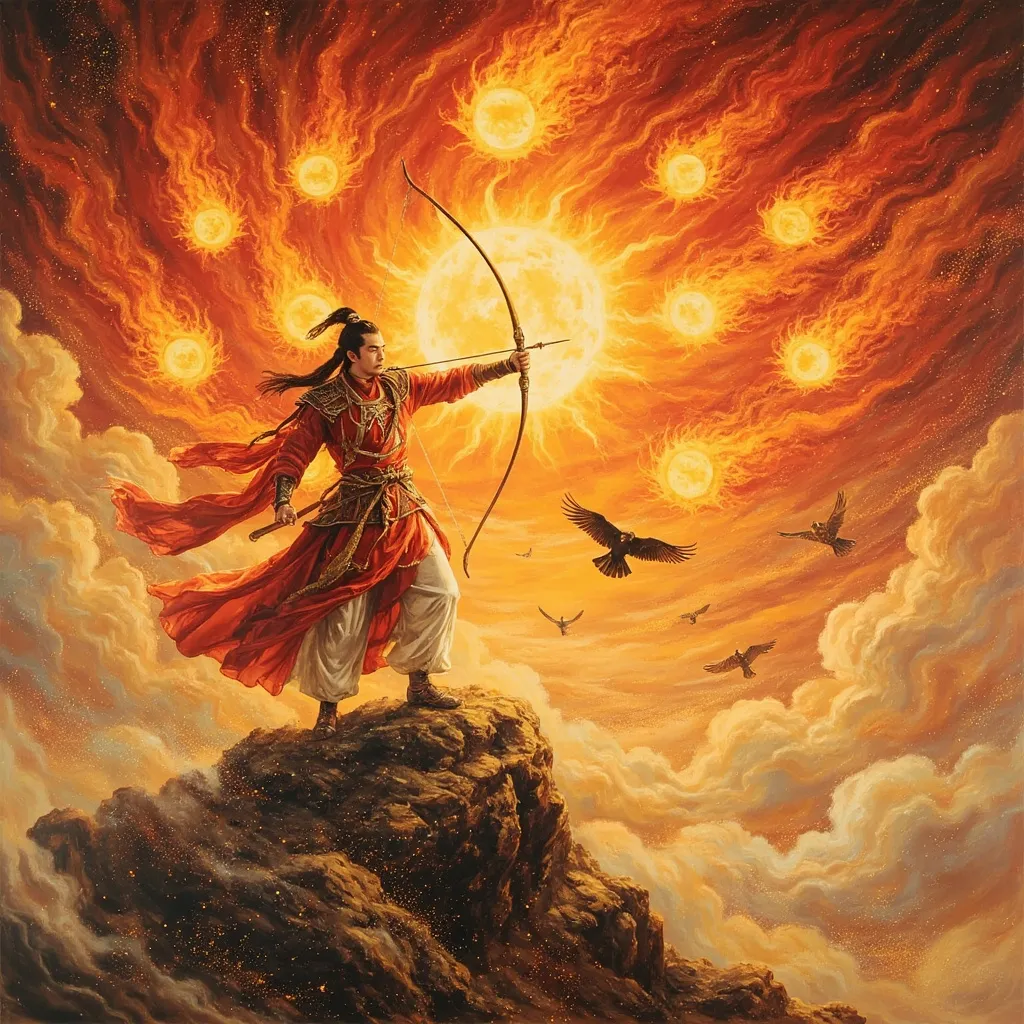
The legend starts not on the moon, but here on Earth, in a time when the world was young and immortals walked among mortals. According to the old stories, there were once ten suns in the sky instead of one. These suns rose together, burning the Earth with terrible heat. Crops died, rivers dried up, and the people suffered greatly.
This is where our story really begins — with a hero named Hou Yi, and with the beautiful woman who would become the moon goddess herself.
The Immortal Husband
Hou Yi was not an ordinary man. He was a powerful archer, one of the greatest who ever lived. The people, suffering under the heat of ten suns, begged him for help. Hou Yi answered their call. He climbed to the highest mountain and, with his mighty bow, shot down nine of the ten suns. Only one remained in the sky, and life on Earth could begin again.
For this great deed, Hou Yi became a hero. The Queen Mother of the West — a powerful goddess in Chinese mythology who ruled over a realm of immortals — rewarded him with the elixir of immortality. This was a magical potion that could grant eternal life to anyone who drank it. It was kept in a small bottle, precious and rare.
But here’s where the story gets complicated. Hou Yi had a beautiful wife named Chang’e. The two loved each other deeply. When Hou Yi received the elixir, he didn’t drink it right away. Instead, he kept it safe, planning to share it with Chang’e so they could live together forever as immortals.
In some versions of the story, Chang’e was already a celestial being — a goddess who had descended from the heavens to be with Hou Yi. In other versions, she was a mortal woman who married the great hero. Either way, she was known for her beauty, her grace, and her gentle heart.
Hou Yi was often away from home, hunting monsters and fighting evil beings that threatened the people. During one of his absences, something terrible happened. A man named Peng Meng, one of Hou Yi’s students, came to their home. He knew about the elixir of immortality, and he wanted it for himself.
What happened next depends on which version of the legend you read. Some say Chang’e drank the elixir to keep it from falling into the wrong hands. Others say she was tricked, or that she acted out of fear. Whatever the reason, Chang’e swallowed the immortal elixir.
The effect was immediate. She began to float — first gently, then faster and faster. She rose through the roof of her home and kept rising, higher and higher, until she reached the heavens. There was no way to stop it. The elixir had made her immortal, and now she was destined to live in the sky forever.
Flying to the Moon
As Chang’e floated upward, she realized she could not go just anywhere. The elixir pulled her toward the moon, the closest heavenly body to Earth. She drifted across the night sky, leaving her husband, her home, and her mortal life behind.
Legend says that when Hou Yi returned home and found his wife gone, he looked up at the sky and saw her ascending to the moon. He called out her name, but it was too late. Chang’e was already too far away to hear him.
In some versions of the story, a toad — a symbol of good luck in Chinese culture — caught Chang’e as she flew, breaking her fall and helping her land safely on the moon. In other versions, a rabbit was waiting for her there, a faithful companion who would keep her company in her celestial home.
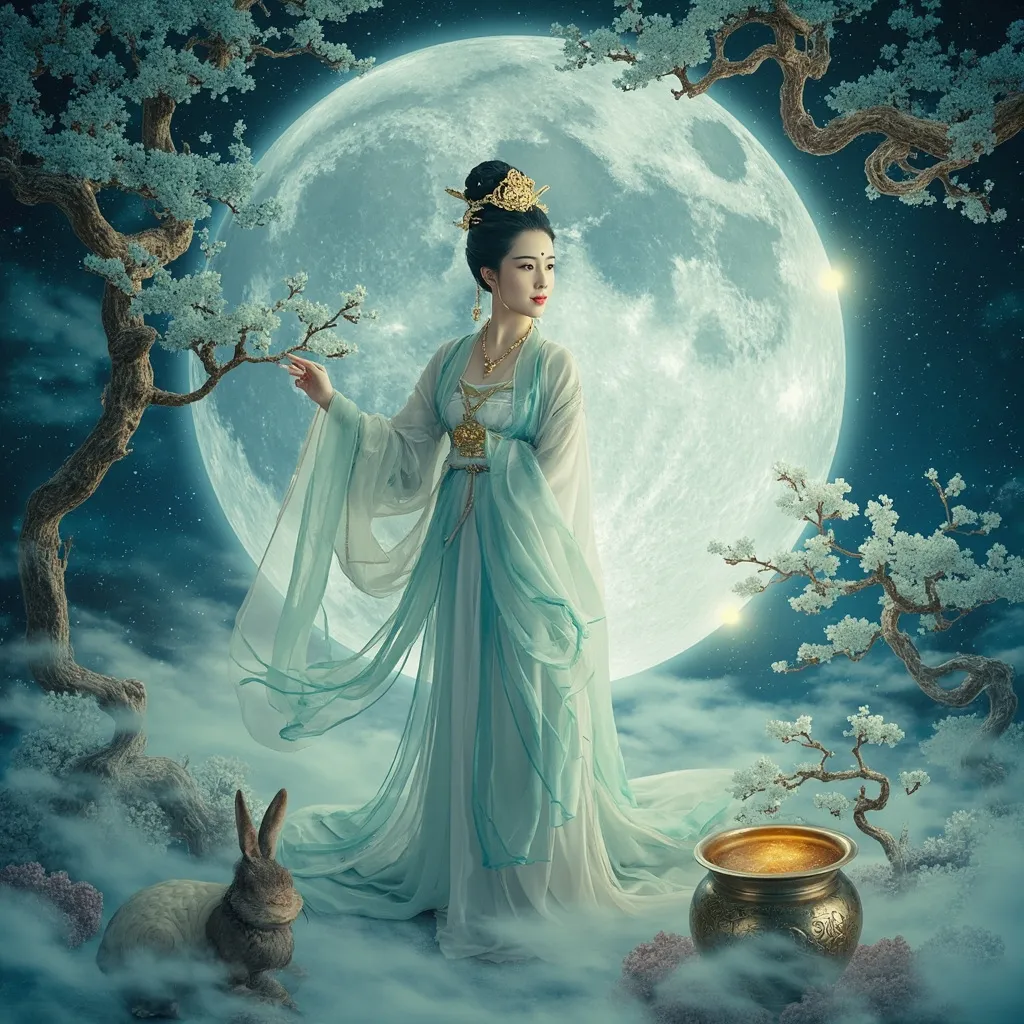
What we know for certain is this: Chang’e reached the moon, and there she stayed. She now lives in a beautiful palace on the moon, called the Guanghan Palace. The Moon Rabbit pounds the elixir of life in a mortar, preparing the drink that keeps the goddess eternal.
Chang’e on the Moon
Imagine living on the moon, alone but never truly lonely. The ancient Chinese imagined Chang’e in her palace, surrounded by jade trees and silver light. The Moon Rabbit works endlessly, grinding the immortal herbs. A toad sits nearby, ancient and wise. The cassia tree drops its fragrant flowers, filling the air with sweetness.
In Chinese culture, when you look at the full moon, you can sometimes see the dark shapes on its surface — the “Rabbit in the Moon” that the Chinese have seen for centuries. This is the same rabbit who pounds the elixir for Chang’e. The dark marks on the moon, formed by ancient volcanic activity, became the canvas for this beautiful story.
Chang’e is sometimes depicted as sad, pining for her husband on Earth. Other versions show her at peace, content in her role as guardian of the moon. Either way, she is never truly alone. The Moon Rabbit keeps her company, and once a year, on the seventh night of the seventh month, Hou Yi and Chang’e are allowed to meet. This is the Chinese Valentine’s Day, a story of separated lovers reunited across the heavens.
There’s something deeply touching about this image — a woman who made a choice, who sacrificed her mortal life, and who now watches over the world from the cold beauty of the moon. She became a goddess not through power or conquest, but through love and loss. That’s what makes her story resonate even today.
The Legend Today
Today, the legend of Chang’e is more alive than ever. Every year during the Mid-Autumn Festival, which falls on the 15th day of the 8th lunar month (usually September or October), Chinese families gather to celebrate under the full moon. They eat mooncakes — round pastries that symbolize reunion and completeness. They light lanterns and let them float into the night sky. They tell the story of Chang’e to their children.
The Mid-Autumn Festival is now one of the most important traditional holidays in China, celebrated not just in China but in Taiwan, Hong Kong, Singapore, and communities of Chinese descent around the world. The full moon of the festival symbolizes the completeness of family — just as Chang’e floated away from her husband, families today pray that no one will be separated, that all loved ones will be reunited.
China’s space program has even named its lunar missions after Chang’e. The Chang’e lunar probe program has sent multiple spacecraft to explore the moon, including the first spacecraft to land on the far side of the moon. It’s a beautiful way to honor an ancient story — giving a modern technological achievement the name of an ancient goddess.
In art and literature, Chang’e continues to inspire. She’s featured in countless paintings, poems, and films. Fashion designers have created clothing inspired by her celestial elegance. The story has been retold in children’s books and animated movies, introducing new generations to the moon goddess.
When you look up at the moon this Mid-Autumn Festival, think of Chang’e. Think of a woman who loved deeply, who made an impossible choice, and who now shines down on us from the heavens. That’s the magic of this legend — it takes something as distant as the moon and makes it feel intimate, personal, and full of human emotion.
The next time you see a bright full moon, remember the story. Remember Hou Yi and his mighty bow. Remember the elixir of immortality. Remember Chang’e, rising like a silver spirit into the night sky, finding her home among the stars. It’s a story that has been told for thousands of years, and it will be told for thousands more.
The moon belongs to Chang’e now. And in sharing her story, we keep her legend alive.
📚 Recommended Reading & Products
Disclosure: This article contains affiliate links.
Happy Mid-Autumn Festival! May your life be as full and bright as the moon.