slug: chang-e-flying-moon description: “Learn about Chang’e, the legendary Chinese moon goddess who flew to the heavens after drinking the immortality elixir, and explore this beautiful myth about love, sacrifice, and longing.” keywords: [“Chang’e”, ‘moon goddess’, ‘Chinese mythology’, ‘immortality elixir’, ‘Hou Yi’, ‘Chinese legend’, ‘moon festival’] categories: [‘Chinese Mythology’, ‘Legendary Women’] tags: [‘mythology’, ‘moon goddess’, ‘immortality’, ’love’, ‘ancient china’] image: “/images/chang-e-flying-moon.jpg” alt_text: “Beautiful Chang’e floating gracefully toward the moon” author: Jaie affiliate_products:
- name: “Moon Goddess Chang’e Statue” url: “https://example.com/chang-e-statue" description: “Exquisite handcrafted statue of Chang’e on the moon”
- name: “Jade Rabbit Pendant Necklace” url: “https://example.com/jade-rabbit-pendant" description: “Beautiful jade pendant featuring the Moon Rabbit”
- name: “Mid-Autumn Festival Mooncake Mold Set” url: “https://example.com/mooncake-molds" description: “Traditional mooncake molds featuring moon and rabbit designs”
- name: “Chinese Mythology: Gods and Goddesses Book” url: “https://example.com/chinese-gods-book" description: “Comprehensive guide to deities in Chinese mythology”
- name: “Celestial Silk Scarf - Moon Design” url: “https://example.com/moon-scarf" description: “Luxurious silk scarf featuring moon and star motifs”
Chang’e Flying to the Moon: The Story of China’s Moon Goddess
Of all the celestial beings in Chinese mythology, none captures the imagination quite like Chang’e, the Moon Goddess. Her story intertwines romance, sacrifice, and eternal longing—a tale that has been told for thousands of years and continues to enchant audiences today. She floats alone in her lunar palace, watching over the earth below, a symbol of love that transcends even death itself.
The Beautiful Wife of Hou Yi
Long ago, in the age when heroes walked the earth and gods mingled freely with mortals, there lived a beautiful young woman named Chang’e. She was known across the land for her gentle nature, her grace, and her devotion to her husband, the legendary archer Hou Yi.
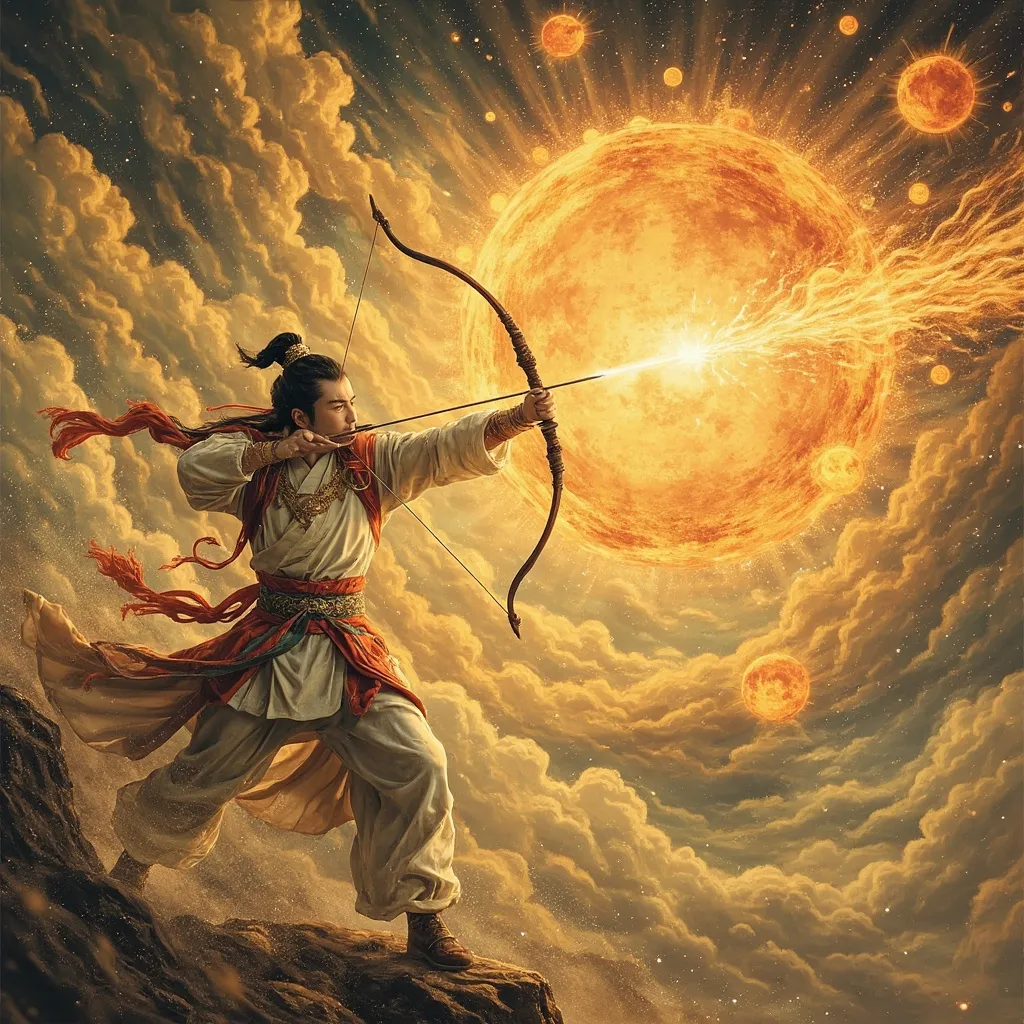
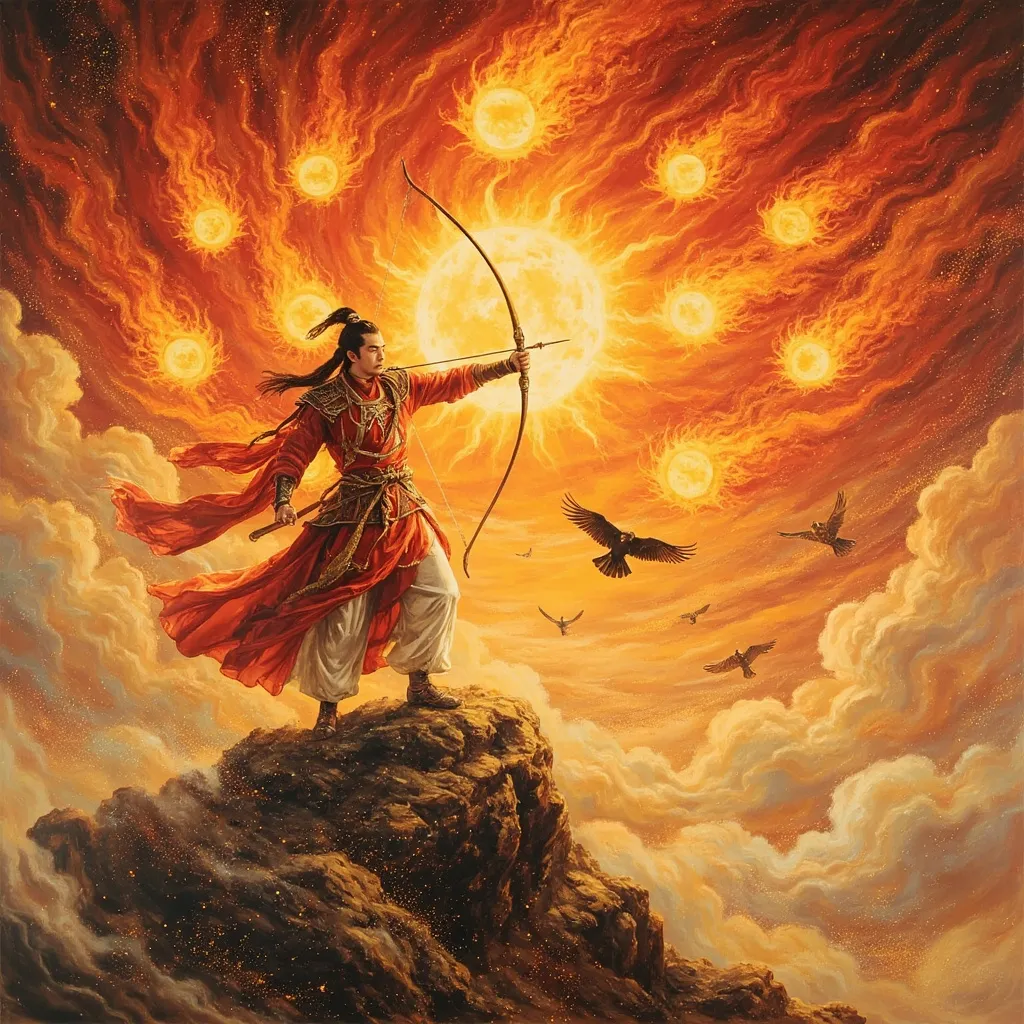
Hou Yi had just accomplished the impossible—he had shot down nine of the ten suns that had been scorching the earth, saving humanity from destruction. The grateful Emperor Yao granted Hou Yi many honors, but none brought him more joy than the day he met and married Chang’e.
Their life together was peaceful and happy. They lived in a modest home surrounded by mountains and forests, spending their days tending to their garden and their evenings watching the stars. Chang’e loved to listen to Hou Yi tell stories of his adventures, and he cherished her quiet wisdom and compassionate heart.
But happiness in the mortal world is often fleeting, and the gods had planned a test for the devoted couple. The same heroic deeds that brought Hou Yi fame and honor would also bring unexpected danger into their lives.
The Gift of Immortality
Word of Hou Yi’s heroic deeds reached the heavens themselves. The Queen Mother of the West, ruler of the immortal realm, decided to reward the brave archer. She summoned him to her palace beyond the clouds and presented him with a precious gift—the Elixir of Immortality.
The elixir was contained in a small jade bottle. A single drop would grant eternal life; drinking the entire contents would transform the drinker into a true immortal, ascending to the heavens to live among the gods forever. The Queen Mother gave the elixir to Hou Yi as a reward for his heroism.
Hou Yi returned home, eager to share this wonderful news with his beloved wife. Together, they marveled at the jade bottle, understanding that they held eternal life in their hands. But there was a problem—the elixir was meant for only one person.
This presented an impossible choice. Should Hou Yi drink it and leave Chang’e to face the sorrows of mortal life alone? Should Chang’e drink it and ascend to immortality while her husband grew old without her? Neither could bear to be separated, especially not in such an eternal way.
Hou Yi decided to wait. They would find a solution together. He buried the jade bottle in the earth beneath their home, deciding to keep it safe until they could find a way to share its gift.
The Betrayal and the Desperate Choice
But secrets have a way of being discovered. Hou Yi’s student, Peng Meng, had always been greedy and ambitious. When he learned of the immortality elixir, he could think of nothing else.
One evening, while Hou Yi was away hunting, Peng Meng snuck into their home. He confronted Chang’e, demanding she tell him where the elixir was hidden. Chang’e refused, but Peng Meng threatened to harm her if she didn’t comply.
Faced with an impossible choice—surrender the elixir to a greedy villain or drink it herself and face the consequences—Chang’e made her decision. She ran to the spot beneath their home where the bottle was hidden, dug it up, and drank every last drop.
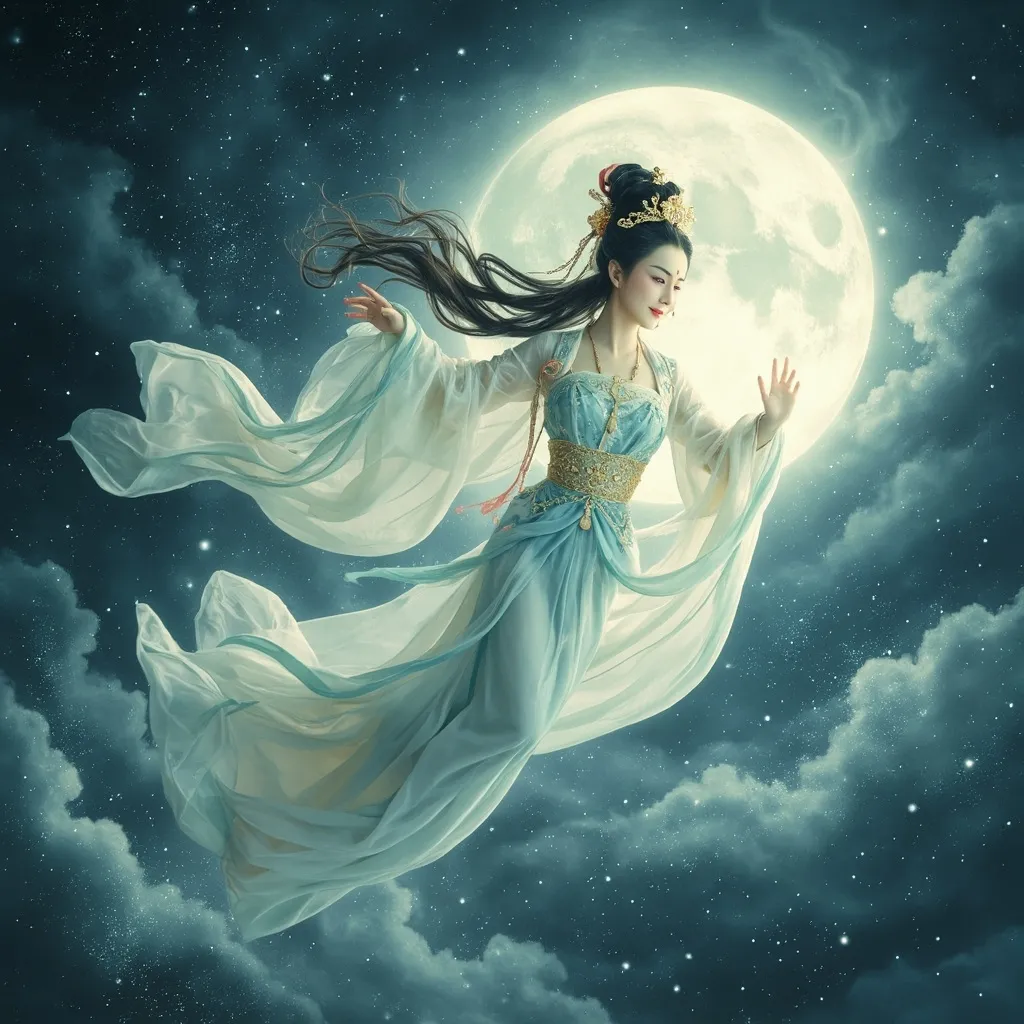
The effect was immediate. The elixir burned through her veins like liquid fire. Her body became weightless, and she felt herself lifting toward the heavens. Peng Meng reached for her but caught only empty air as Chang’e floated higher and higher, leaving the mortal world behind forever.
The tragedy of that moment has resonated through Chinese culture for millennia. Chang’e didn’t drink the elixir out of selfishness or ambition—she drank it to protect something precious from falling into the wrong hands. Her sacrifice, though it cost her everything she loved, was an act of moral courage.
The Flight to the Moon
As Chang’e ascended, she looked down at the world she was leaving—the mountains and rivers she had known all her life, the modest home she had shared with her beloved husband, and the student who had betrayed them both. Her heart ached with grief, but there was no turning back.
The moon hung in the sky before her, closer and larger than it had ever appeared from earth. Chang’e felt drawn to it, as if the moon itself was calling to her. The celestial bodies seemed to welcome her, wrapping her in silver light as she approached.
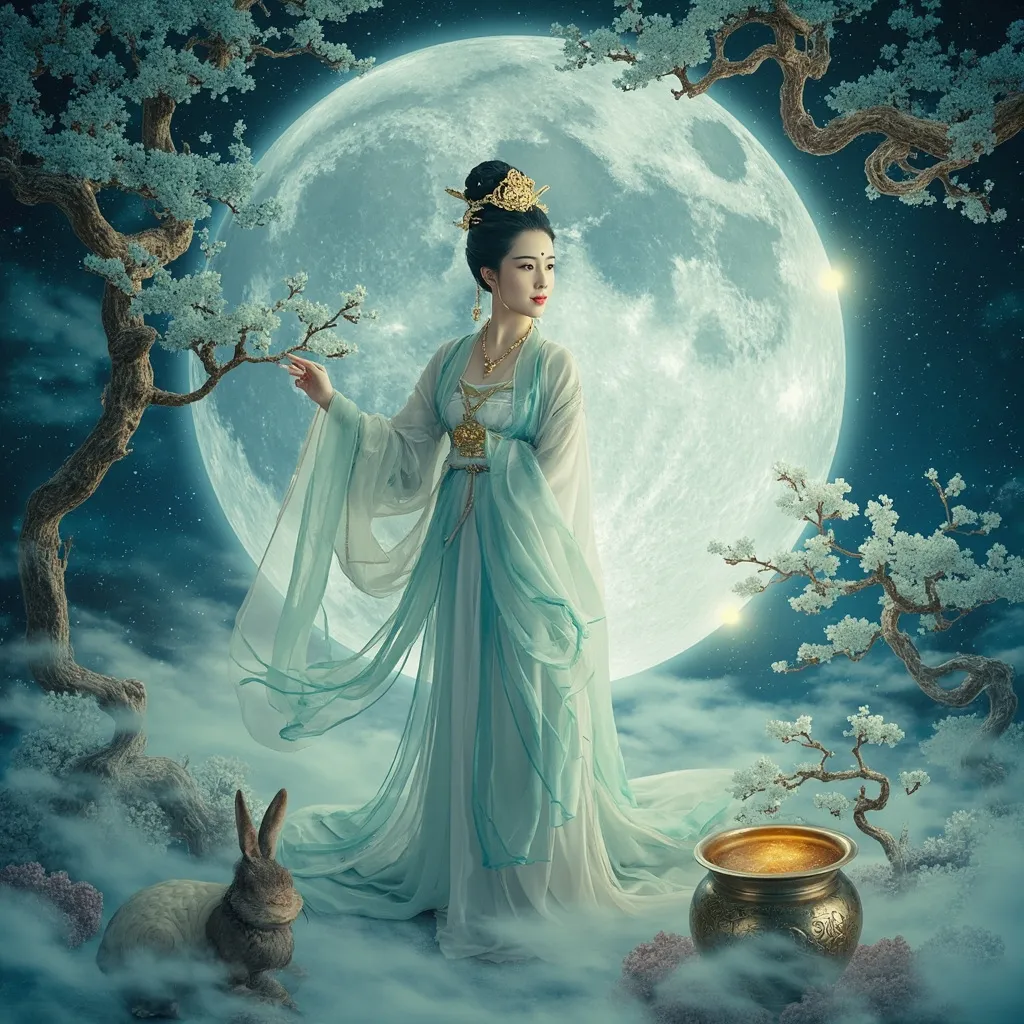
When she finally landed on the moon’s surface, Chang’e found herself in a beautiful palace. Crystal towers rose from the lunar landscape, and everything shimmered with an otherworldly glow. A jade rabbit lived there, always busy grinding immortality herbs in a mortar. A helpful toad also resided in the palace, keeping Chang’e company in her eternal exile.
But despite the palace’s beauty, Chang’e was lonely. She spent her days watching the earth below, searching for any sign of her beloved Hou Yi. She sent her spirit to visit him each night in their dreams, telling him how much she missed him, how much she loved him, and how sorry she was that their story had ended this way.
The Rabbit in the Moon
According to legend, Chang’e was not alone on the moon. A jade rabbit lived there with her, constantly grinding elixirs in a mortar. The rabbit had its own story—when the gods tested the Immortals by requiring them to offer something as a sacrifice, the rabbit offered itself, jumping into the fire to prove its devotion. The gods were so moved that they placed the rabbit on the moon to honor its sacrifice.
Today, when people look at the moon, some say they can see the shape of the rabbit—the dark markings on the lunar surface that form the silhouette of a rabbit gathering herbs. This connection between Chang’e and the rabbit symbolizes the patient, enduring nature of love and devotion.
The rabbit’s presence also represents self-sacrifice. Just as the rabbit gave itself to the fire, Chang’e gave up her mortal life to protect what she loved. Both acts demonstrate that true love sometimes requires giving up everything we have, even our place in the world.
The Mid-Autumn Festival Connection
The Mid-Autumn Festival in China celebrates Chang’e’s reunion with Hou Yi. Families gather to watch the full moon, eat mooncakes, and tell the story of the moon goddess. Lanterns float skyward, carrying wishes for happiness and reunion. It’s a time when the separation between heaven and earth seems to narrow, when the moon feels closer than ever.
The festival typically falls on the fifteenth day of the eighth lunar month, when the moon is fullest and brightest. This timing is deliberate—the full moon represents completeness and reunion, the opposite of Chang’e and Hou Yi’s separation.
Mooncakes, the festival’s signature treat, often feature designs of Chang’e, the moon rabbit, or the moon palace itself. Round mooncakes symbolize the full moon and family unity. Families share them as a way of honoring the goddess and expressing hope for their own reunions, whether with distant loved ones or with those who have passed away.
Love Across Distance
The story of Chang’e raises universal questions about love and sacrifice. Chang’e drank the elixir not out of selfishness, but because she could not bear to let a villain have it. Her choice, though it separated her from her husband forever, was an act of moral courage.
In Chinese culture, Chang’e represents the bittersweet nature of love. True love, the story suggests, doesn’t end with separation. Chang’e watches over the earth from her lunar palace, and Hou Yi lights the night with his torches as the sun. They are apart, yet they remain connected by their love and their memory.
This theme resonates deeply in Chinese literature and art. Countless poems speak of Chang’e’s longing, of the pain of separation, and of the hope that love can transcend even death. The moon itself has become a symbol of reunion and longing—lovers separated by distance look at the same moon and feel connected.
Modern psychology echoes these ancient insights. Research on long-distance relationships shows that emotional connection can survive physical separation. The key is maintaining communication, cherishing shared memories, and never losing hope. Chang’e and Hou Yi embody these principles—they can never be together physically, yet their love remains eternal.
Chang’e in Space Exploration
Today, Chang’e’s story has spread far beyond China. The Chinese space program named its lunar missions after the moon goddess—the Chang’e program has sent multiple probes to the moon, including the first landing on the far side. When Chinese astronauts visit the moon in the future, they will walk in the footsteps of the goddess who has lived there for millennia.
This naming choice connects ancient mythology to modern scientific achievement. China’s lunar exploration program has already accomplished remarkable feats, including the Chang’e 4 mission, which landed on the far side of the moon in 2019—a first in human history. The program continues to expand our understanding of Earth’s celestial neighbor.
The blend of ancient myth and modern science represents something uniquely Chinese: a culture that honors its past while reaching for the future. Chang’e flew to the moon in legend; Chinese scientists are making her journey a reality.
The Philosophy of Sacrifice
Chang’e’s story offers profound insights into the nature of sacrifice. She gave up immortality multiple times—first by marrying a mortal instead of staying in heaven, then by drinking the elixir to protect it rather than surrendering it to a villain. Each choice demonstrates that some things are worth more than eternal life.
In Confucian philosophy, this kind of sacrifice exemplifies the virtue of selflessness. The concept ofxiaozi—filial piety and personal virtue—teaches that individuals should be willing to sacrifice personal gain for the greater good. Chang’e embodies this principle, choosing to protect her husband and preserve the elixir even at tremendous personal cost.
The story also speaks to the Taoist concept ofwu wei, or non-action. Chang’e didn’t fight her fate or struggle against the elixir’s power. She accepted what was happening and made the best choice available to her in that moment. This acceptance, rather than resistance, allowed her to find peace in her new life on the moon.
Chang’e in Popular Culture
In popular culture, Chang’e appears in video games, animated films, and television dramas. Her story has been reimagined countless times, but the core elements remain the same—a woman faced with an impossible choice, a love that transcends distance, and a longing that echoes across the heavens.
Mobile games frequently feature Chang’e as a character, often pairing her with Hou Yi as a dual-hero combination. The visual language of these games draws directly from traditional depictions of the moon goddess: flowing robes, ethereal beauty, and lunar imagery.
Television adaptations range from historical dramas that emphasize the human tragedy of the story to fantasy series that explore the mythological elements in depth. Whatever the medium, Chang’e’s story retains its emotional power, speaking to audiences across cultures and generations.
Conclusion
The legend of Chang’e flying to the moon speaks to something fundamental in the human experience—the pain of separation, the enduring nature of love, and the hope that connection can survive even the greatest distances.
When you look at the moon tonight, think of Chang’e. Think of a woman who made an impossible choice, who floats alone in her celestial palace, watching over the earth she can never return to. But think also of Hou Yi, lighting up the world as the sun, keeping watch over his beloved even though they can never be together.
The moon is not just a celestial body—it’s a symbol of reunion, of longing, and of the love that persists across all boundaries. Chang’e’s story reminds us that true love never ends, that separation is not the same as abandonment, and that sometimes the greatest sacrifice is made not in anger, but in love.
Let the Moon Goddess watch over your nights, and may her story bring you comfort when distance keeps you apart from those you love. For in the end, we are all searching for our own moon—a place where love can exist forever, untouched by time or separation.