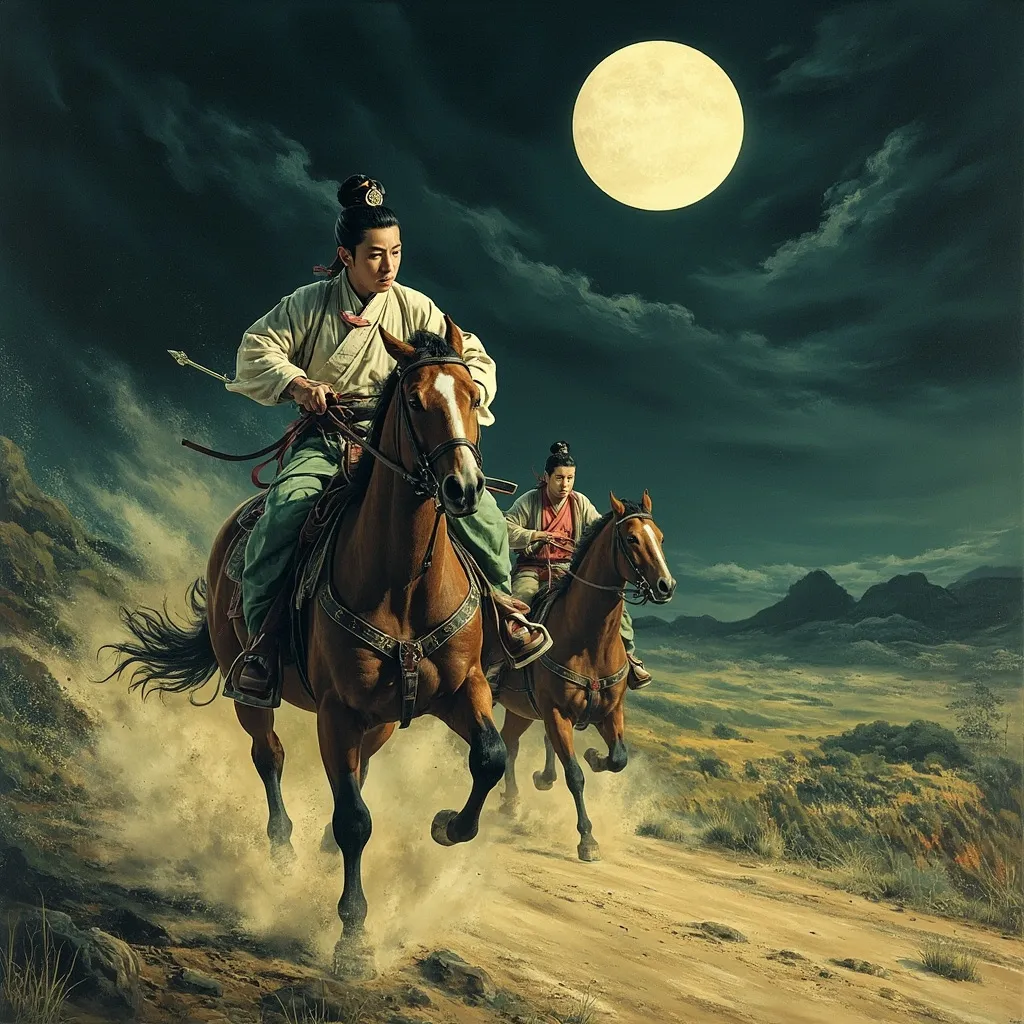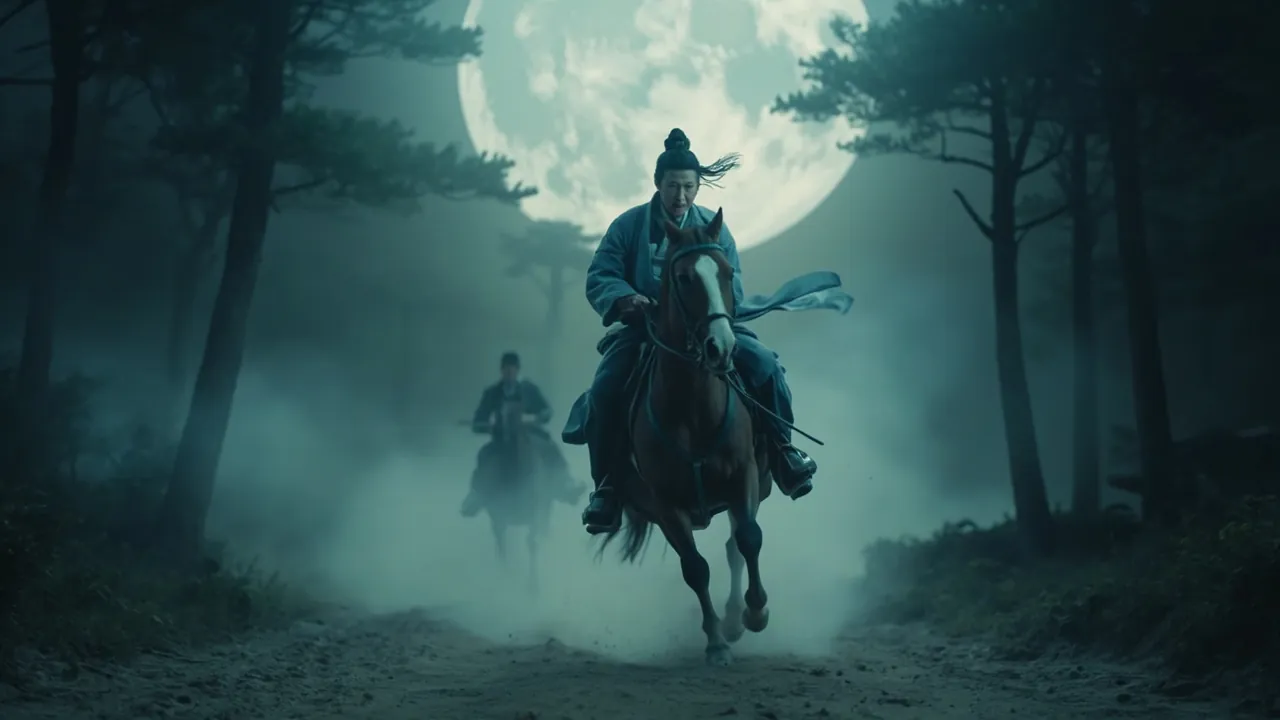
The night was cold and the moon was bright over the汉中 plateau, and萧何—Xiao He, chief minister and closest advisor to the warlord Liu Bang—was riding hard. He had already changed horses twice. His robes were soaked with sweat despite the cool mountain air. Behind him, a small group of his own riders followed in a desperate line, the hoofbeats muffled against the dirt path that wound through the hills. Ahead, somewhere on this road that connected Sichuan to the outside world, a man was fleeing—and if Xiao He did not catch him before dawn, the entire future of China might be different.
The man he was chasing was韩信—Han Xin—and he was one of the most extraordinary military minds in Chinese history, even if almost no one knew it yet. Han Xin had been in Liu Bang’s camp for months, a quiet officer who wore patched clothes and carried himself with the peculiar dignity of someone who knows he is worth far more than the position he occupies. He had tried to offer strategic advice to Liu Bang directly and been ignored. He had proposed tactical plans to senior generals and been laughed at. The army’s officers looked at his worn clothing and his quiet manner and assumed he was just another failure who had talked his way into a post. They did not know that they were looking at the man who would help Liu Bang found an empire.
Han Xin had decided to leave. He had had enough of being ignored, enough of watching lesser minds promoted over him, enough of a life spent in obscurity when he knew he had the capability to reshape the strategic landscape of China. In the late afternoon, as the sun was setting over the 汉中 camp, Han Xin had simply walked away. He had taken one of the camp’s horses—one of the few possessions he owned—and ridden east along the road that led out of Sichuan, toward a horizon that might hold better opportunities for a man of his talents.
Xiao He heard about the departure by evening. And what he did next has been remembered for over two thousand years.
Who Was Xiao He
Before we can understand why this chase mattered, we need to understand who Xiao He was—and what he saw in Han Xin that everyone else had missed.
Xiao He was not a military commander. He was, by training and temperament, an administrator—a man who understood paperwork, logistics, systems, and the unglamorous but essential work of keeping an army fed, paid, and organized. He had been one of Liu Bang’s earliest and most loyal supporters, joining his cause before the fall of the Qin Dynasty and serving as his chief of staff throughout the chaotic years of the Chu-Han Contention. Xiao He was the man who kept things running while Liu Bang fought battles and negotiated alliances. He was methodical, patient, and exceptionally good at reading people.
It was Xiao He who had first recommended Liu Bang to serve as a regional lord in Sichuan after the infamous Feast at Hong Gate. It was Xiao He who had negotiated the complex politics that kept Liu Bang’s coalition together during the difficult early months of exile. And it was Xiao He who, in the months following their arrival in 汉中, had noticed the quiet officer in the worn robes who moved through the camp without drawing attention—but who, in Xiao He’s observation, seemed to understand military strategy at a level that none of Liu Bang’s other advisors could match.
Xiao He had begun to talk with Han Xin in his spare moments. He had asked him about the strategic situation—the rival Xiang Yu, the geography of the region, the prospects for Liu Bang’s eventual return to power. What he heard impressed him more with each conversation. Han Xin did not speak casually or boastfully about his abilities. He spoke with the quiet confidence of someone who had studied warfare for years and who saw patterns that others missed. He had opinions about how to defeat Xiang Yu that no one else in the camp had articulated. And yet Liu Bang, overwhelmed with the logistics of their exile and distracted by the insult of being pushed so far from power, had never given Han Xin a serious hearing.
Xiao He understood what he was looking at. He had seen enough of the world to know that genius often wore unremarkable clothes and walked past observers who lacked the eyes to see it. He also understood, with the urgency of a man who had built his career on getting details right, that if Han Xin left and went to join Xiang Yu’s camp—or worse, if he simply disappeared into the vast anonymity of China—the opportunity to use his talents for Liu Bang’s cause might be gone forever.
The Chase
When Xiao He heard that Han Xin had left, he did not hesitate. He did not first go to Liu Bang to get permission—time was too short for that. He simply rode.
The road out of Sichuan was difficult, winding through mountainous terrain where a single fast rider could get ahead and disappear into the night. Xiao He had no guarantee that he was even going in the right direction. He rode through the darkness, changing horses when he could find them, following any rumor of a man in worn robes on a horse heading east. The moonlight was bright enough to see by but cold enough to make the ride miserable. His companions—the few loyal riders who had joined him—were equally exhausted, equally uncertain about whether they were pursuing a ghost on a dark road.
Then, somewhere in the hills above the river, he saw him.
Han Xin was resting by the roadside. Perhaps he had stopped to let his horse breathe, or to consider his next move, or simply to sit under the stars and wonder what would become of him. The sight of Xiao He—Liu Bang’s chief minister, the second most powerful man in the entire camp—riding up at dead of night with a small party of horsemen must have been bewildering. No subordinate chased after a departing officer in the middle of the night. No man of Xiao He’s position would waste his time on someone as insignificant as Han Xin.
And yet here he was.
Xiao He dismounted and walked to where Han Xin sat. He told him, simply and directly, that he needed to come back. That Liu Bang needed him. That China would be shaped by what happened next, and Han Xin’s talents were too important to waste on a road leading away from the greatest challenge of the age.
Han Xin was reportedly surprised—not just that Xiao He had come after him, but by the earnestness and specificity of his appeal. Xiao He did not simply say “please come back.” He argued. He made the case. He explained why he believed Han Xin was uniquely suited to help Liu Bang overcome Xiang Yu, why the path they were on—exile in Sichuan—was not an ending but a beginning, and why Han Xin’s decision to leave would be a mistake not just for Liu Bang’s cause but for Han Xin himself.
The conversation by that moonlit roadside lasted long enough. And at the end of it, Han Xin agreed to return.
What Xiao He Said to Liu Bang
The story does not end with the chase. When Xiao He returned to camp with Han Xin at his side, he went immediately to Liu Bang—still awake, probably irritated about something unrelated—and made a recommendation that must have sounded insane given Han Xin’s lack of rank and reputation.
He told Liu Bang to make Han Xin a general.
Not a junior officer. Not a consultant. A general—commander of troops, with all the authority and responsibility that implied. Xiao He staked his own reputation on this recommendation. He told Liu Bang that if Han Xin did not prove himself in the field, Xiao He himself would take responsibility.
Liu Bang, who had been frustrated with his exile and desperate for any edge against Xiang Yu, agreed. He gave Han Xin command of a small force—not the massive army he would eventually lead, but enough to prove himself. And prove himself he did.
Han Xin’s first test came with the campaign to retake the Guanzhong plain from Xiang Yu’s forces—the campaign that would eventually produce the famous 暗渡陈仓 (dark passage at Chen Cang) deception. Han Xin’s strategic planning was instrumental in the early success of Liu Bang’s counterattack. From there, his role only grew. He became the chief military strategist of the Han forces, planning campaigns that would ultimately exhaust Xiang Yu’s resources and lead to the establishment of the Han Dynasty.
Without Xiao He’s moonlight ride, Han Xin would have walked into history as nothing more than a name in a forgotten census—a man of extraordinary talent who lived and died in obscurity because no one bothered to look closely enough to see him. Instead, he became one of the most celebrated military figures of the Han Dynasty, and his strategies shaped Chinese warfare for generations.
The Idiom’s Meaning
萧何月下追韩信—Xiao He chasing Han Xin under the moon—is used in Chinese today to describe the act of recognizing and pursuing true talent when you see it, especially when that talent is not immediately obvious to others. The phrase captures both the urgency of the chase and the insight required to know that the chase was worth making.
The idiom is often invoked in contexts involving hiring, mentorship, and leadership. A manager who recognizes that a seemingly ordinary employee is actually a hidden gem and makes a personal effort to retain them is engaging in萧何月下追韩信. An investor who spots potential in a founder that other investors have passed over is doing the same thing. The phrase implies not just recognizing talent but acting on that recognition with speed and commitment—Xiao He did not send a letter; he rode through the night.
There is also a note of serendipity in the expression. The moon provided the light that allowed Xiao He to track Han Xin in the darkness. The idiom suggests that sometimes the difference between finding and losing a brilliant person is as simple as being in the right place at the right time—or, more accurately, being willing to go to that place at whatever hour is necessary.
The Lesson About Looking Beneath the Surface
What makes this story resonate across twenty-two centuries is not just the dramatic chase but what it reveals about how talent gets recognized and wasted. Han Xin was not obscure by accident. He was obscure because he lacked the social markers that usually signal capability—the right clothes, the right family name, the right network of contacts. He looked like a failure because he dressed like one, because he carried himself without the swagger that lesser men used to pretend at significance. It took someone with the patience to look past surface appearances—like Xiao He—to see what was actually there.
This is a problem that has not changed. Organizations routinely miss extraordinary talent because they are filtering for the wrong signals. They hire based on pedigree, on interview performance, on confidence rather than competence. The person who truly has the ability to transform an operation often looks, on the surface, like someone who barely qualifies for the job. The man in the worn robes turns out to be the architect of an empire.
Xiao He had the insight to look beneath the robes. And he had the energy to act on that insight immediately, riding through the mountain night before Han Xin could disappear into a world that would never know what it had missed. That ride—urgent, improbable, illuminated by moonlight—has been remembered as one of the most consequential journeys in Chinese history. Because sometimes, saving the future is simply a matter of recognizing it when it passes you on a dark road, and being willing to chase it before it is gone.