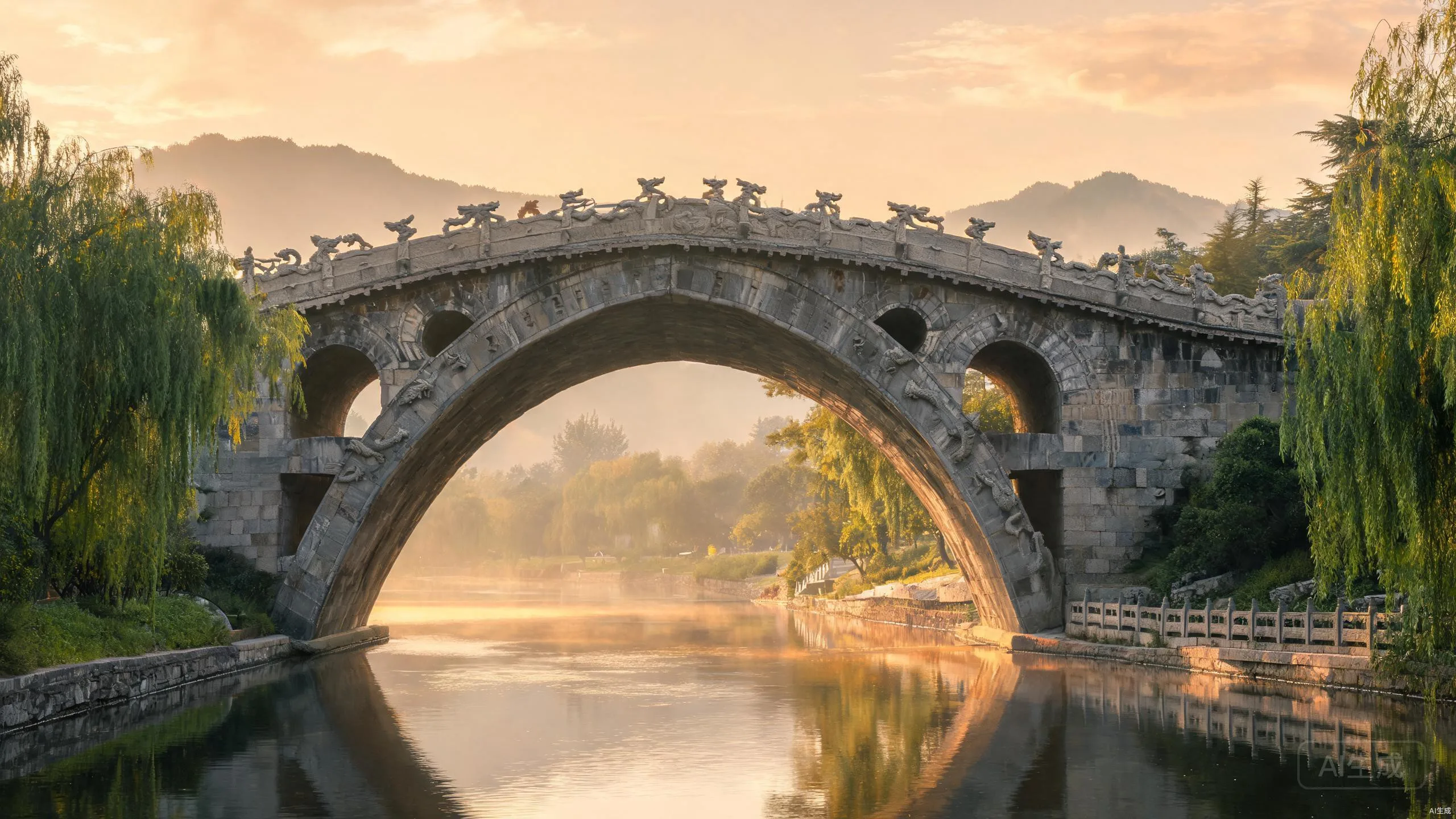
In the year 605 AD, a bridge was completed over the Xiao River in Hebei Province, China. It was a single arch—an open-spandrel stone arch, to be precise—spanning 37 meters (about 120 feet) of open water. The bridge was simple in design and revolutionary in execution. It was built entirely from stone, without any mortar or metal fasteners to hold the pieces together. The stones were carved and fitted so precisely that the structure held itself in place through the pure geometry of the arch.
The bridge was called Zhaozhou Bridge, and it is still standing today.
That makes it the oldest surviving bridge in China and, by most accounts, the oldest open-spandrel stone arch bridge in the world.
To appreciate how remarkable this is, consider that the average modern highway bridge in the United States is designed for a service life of 75 years. The Zhaozhou Bridge has been standing for 1,400 years—an eighteen-fold difference. It has outlasted the dynasty that built it, the dynasty that succeeded it, the imperial system that defined Chinese civilization, and the political upheavals of the 20th century. It has survived while being crossed by armies, merchants, farmers, and modern vehicles. It has been repaired numerous times, but it has never needed to be rebuilt. The stones that form its arch are still the original stones, fitted together by craftsmen whose names are unknown, using techniques that modern engineers are still trying to fully understand. It has survived fourteen centuries of floods, earthquakes, wars, and the steady pressure of traffic. It has been repaired several times—most recently in the 1950s, when a truck driver drove a heavy vehicle over it and caused minor damage—but the core of the structure is the same stones that were fitted together in 605 AD by engineers whose names are unknown.
The question that engineers and historians have asked for centuries is: how did the ancient Chinese builders achieve this?
The Engineering Problem: Building a Bridge That Could Last
The challenge of building a bridge across a river is one of the oldest engineering problems in human civilization. Water flows, it carries sediment, it erodes. Flood seasons raise the water level dramatically. Bridges need to span the water without obstructing the flow, and they need to survive the seasonal cycles of erosion and pressure for centuries, not just years.
The open-spandrel stone arch design solves both problems elegantly. The arch transfers the weight of the bridge deck and its loads into horizontal forces pushing against the abutments at each end—the same principle that makes a Roman aqueduct or a medieval cathedral arch work. The open spandrels—those empty spaces between the arch and the deck—allow floodwater to pass through rather than building up pressure against the structure. This is a critical feature in a region with seasonal monsoons that can raise river levels by several meters.
But building an open-spandrel arch in stone is technically demanding. Each stone must be precisely shaped to fit the curve of the arch. The arch must be self-supporting during construction—each stone wedging the next into place—until the keystone is set and the entire structure locks together. And the whole thing must be assembled without the benefit of mortar to fill gaps or compensate for imperfect shaping. The tolerance for error is essentially zero.
Built Without Mortar: The Dry Stone Technique
The Zhaozhou Bridge is built entirely from limestone, cut and carved into roughly 28 different shapes, each piece numbered and fitted to its neighbors. The builders used iron clamps to hold certain stones in place, but the primary structural system is the arch itself—the precise geometry of curved stones pressing against each other, locked in place by the weight of the structure above.
The dry-stone technique has a counterintuitive advantage over mortared construction: it is more durable in earthquake-prone areas. When seismic waves pass through a mortared stone structure, the rigid mortar cannot flex, and cracks propagate through the structure. A dry-stone arch, by contrast, can flex slightly at the joints, absorbing and dissipating seismic energy. The Zhaozhou Bridge has survived at least eight major earthquakes in its 1,400-year history, including several in the 20th century that destroyed many modern structures in the same region.
The engineering explanation for this resilience is elegant. The arch of a stone bridge distributes forces efficiently through compression—the weight of the bridge deck pushes down and outward, and the abutments at each end push back. In a dry-stone arch, where each stone is fitted precisely to its neighbors without mortar, the joints can accommodate tiny movements during an earthquake. The structure essentially flexes slightly, absorbing seismic energy rather than cracking under it. Modern engineers have studied the bridge using finite element analysis and found that its geometry is close to optimal for load distribution. The ancient builders, working without computers, arrived at a design that modern analysis confirms is structurally sound. This was not luck. It was the result of centuries of accumulated empirical knowledge about stone arch construction.
This principle—that flexibility confers resilience—is one that modern structural engineers are increasingly recognizing. Modern engineers who study the Zhaozhou Bridge have found that its structural behavior under load is remarkably close to what modern finite element analysis would predict for an optimal design. The ancient builders, working without computers or sophisticated mathematics, arrived at a solution that modern engineering science has validated. This is not a coincidence. It reflects centuries of accumulated empirical knowledge about stone arch construction—a tradition of practical engineering that was handed down from master builder to apprentice through practice, not through written manuals or formal education. Many modern materials, despite their strength, are brittle under stress. Stone, when properly fitted, can move and adjust in ways that rigid modern materials cannot.
The Record of Survival: Floods, Earthquakes, and Wars
The Zhaozhou Bridge has survived conditions that would have destroyed most ancient structures. The Xiao River, which it spans, is prone to dramatic floods—the water level can rise by meters during the rainy season, with powerful currents that would destroy a poorly anchored structure. The bridge’s open spandrels allowed the floodwater to pass through without building destructive back-pressure against the arch.
In terms of earthquakes, the region around Zhaozhou in Hebei Province sits near several active fault lines. The 1976 Tangshan earthquake—one of the deadliest in recorded history, centered about 100 kilometers from the bridge—caused catastrophic damage throughout the region. The Zhaozhou Bridge survived with only minor damage to its balustrades. The bridge had already survived seven centuries of the same tectonic environment before that earthquake, including several magnitude-7 events or higher.
The bridge also survived periods of war. During the Second Sino-Japanese War (1937–1945), Japanese forces occupied northern China and destroyed numerous ancient structures. The Zhaozhou Bridge, then over 1,300 years old, was not destroyed—though Japanese soldiers did pass over it, and military vehicles stressed the structure in ways it had never been designed to承受.
The Zhaozhou Bridge Today
Today, the Zhaozhou Bridge carries the designation of UNESCO World Heritage Site, as part of the broader Ancient City of Zhengding and the Zhaozhou Bridge itself. It is still standing in Hebei Province, open to visitors who want to see what a 1,400-year-old piece of engineering looks like.
The bridge is surrounded by a small park and a modest visitor center. The approach to the bridge reveals its most striking feature: the extreme flatness of the arch. Most ancient stone arch bridges have a pronounced hump—the arch rises sharply from the waterline. The Zhaozhou Bridge’s arch is so flat that a person standing on the bridge deck at its center is only about 7 meters (23 feet) above the water—roughly the height of a two-story building. This flatness was intentional: it allowed the bridge to accommodate the passage of boats without requiring a steep climb, and it minimized the obstruction to flood flow. It also made the bridge look elegant and modern—almost impossibly so, given its age.
Walking across the bridge today, you can see the original stones in the arch—weathered, some of them replaced in various repairs over the centuries, but clearly the same structure that was completed in 605 AD.
The repairs tell their own story. In over a thousand years of use, no engineer has ever concluded that the bridge needed to be demolished and rebuilt. Each repair has been a localized intervention—replacing a damaged stone here, repointing a joint there—without disturbing the overall structure. This is the ultimate vindication of the original design: a structure that can be maintained indefinitely through routine care, rather than requiring periodic reconstruction. The bridge has outlasted the political systems, the building traditions, and the material sources that produced it. It continues to function as a bridge, serving the local community, while the institutions that built it have long since vanished.
The balustrades, added in the Song Dynasty
An Engineering Philosophy: Why It Lasted So Long
The Zhaozhou Bridge is more than a historical curiosity. It is a lesson in engineering philosophy—one that modern engineers are increasingly interested in learning.
The bridge worked because it was designed with an understanding of what it would have to endure. The builders did not simply solve the immediate problem of crossing the river. They solved the problem of crossing the river for centuries, in a region prone to floods and earthquakes, with maintenance that could be performed by local craftsmen using local materials. They built in redundancy—the arch itself is the structure, and individual stones can be replaced without bringing the whole thing down. They built in flexibility—the dry-stone joints can absorb movement that would crack a mortared structure.
This approach to engineering—designing for longevity, for adaptability, for the ability to survive unpredictable conditions—has become increasingly important in modern civil engineering as climate change increases the frequency and intensity of extreme weather events. The ancient Chinese builders of the Zhaozhou Bridge did not have computers or modern materials science. They had something more valuable: fourteen centuries of empirical knowledge about what works. What they built was not just a bridge. It was a proof of concept for an engineering philosophy that prioritizes resilience over strength, flexibility over rigidity, and longevity over performance. In an age of infrastructure that is often designed to last decades, the Zhaozhou Bridge stands as a quiet argument for building things that last.
The contrast with modern infrastructure is striking. The American Society of Civil Engineers gives US infrastructure a grade of C- on its latest report card. Bridges, roads, water systems, and power grids are aging faster than they are being replaced, and the replacement materials are often chosen for low upfront cost rather than long-term durability. The average lifespan of a modern highway bridge is 50-75 years. The Zhaozhou Bridge has been serving its community for 1,400 years, through countless floods and earthquakes, with only periodic maintenance—not replacement. The question of why we build things to last 75 years when we know how to build things to last 1,400 is not just an engineering question. It is a question about values, about the relationship between present costs and future benefits, about whether we plan for the long term or the short term.
Image Prompt: Detailed photograph of Zhaozhou Bridge’s ancient stone arch spanning a calm river, ornate carved stone balustrades visible on both sides, traditional Chinese countryside setting, morning light casting long shadows across the water.
Related Articles:
- Ancient Chinese Architecture: Engineering Marvels You Should Know — more Chinese engineering achievements
- The Sui Dynasty: China’s Short-Lived Unifying Empire — the era that built the Zhaozhou Bridge
Affiliate Products:
Explore ancient Chinese engineering and the world of the Zhaozhou Bridge:
- Chinese History: A Comprehensive Survey — Covers the Sui Dynasty and the engineering achievements of early imperial China.
- Engineering History: Bridges and Structures of the Ancient World — Places Zhaozhou Bridge in the context of world engineering history.
- Ancient Chinese Architecture — Detailed coverage of Chinese architectural achievements across the dynasties.
- Photography Book: Ancient Chinese Monuments — Striking photographs of ancient Chinese structures including the Zhaozhou Bridge.
- Travel Guide: Historic China — Practical guide for visiting ancient Chinese engineering marvels.