The first time I watched a lion dance performance in San Francisco’s Chinatown, I was standing outside a bakery on Grant Avenue at 9 AM on New Year’s Day. The street was still slick with rain from the night before, and the crowd was maybe forty people deep. Then the drums started — that urgent, syncopated heartbeat — and the lion appeared around the corner. The crowd surged forward. Children climbed onto their parents’ shoulders. An old woman in a bathrobe came out of her apartment window above the bakery and just watched, smiling.
The lion was magnificent. It blinked. It yawned. It shook its massive head and stared down a piece of lettuce someone had thrown on the ground, nudging it with mock suspicion before gobbling it up (the lettuce is symbolic — the word for lettuce, wong, sounds like the word for “gold” or “wealth” in Cantonese). The whole performance took about eight minutes. When it ended, the restaurant owner came out and handed the lion’s head a red envelope, and the performers gave a little bow.
That was twenty years ago. I’ve watched lion dances in Hong Kong, Taipei, Singapore, and Melbourne since then. The basic choreography is always the same — the lion eats the lettuce, accepts the red envelope, and leaves — but the style changes dramatically depending on where you are. That’s the thing about the lion dance: it’s one of those rare cultural practices that has maintained its core identity for fifteen centuries while evolving into distinctly different regional styles.
The Legend: How the Lion Came to China
Every lion dance starts with a story, and that story goes back to around 200 CE, during the Han Dynasty.
The legend says a Buddhist monk named Suma Qian (sometimes attributed to a monk named Amitabha or simply “the Buddha”) traveled from India to China carrying a new form of religious art: a ceremonial dance performed in lion masks, accompanied by drums and cymbals, designed to honor the Buddha and drive away evil spirits. The lion wasn’t a Chinese animal — real lions never lived in China. The creature in the legend was an Indian lion, imported along with Buddhism as a symbolic guardian.
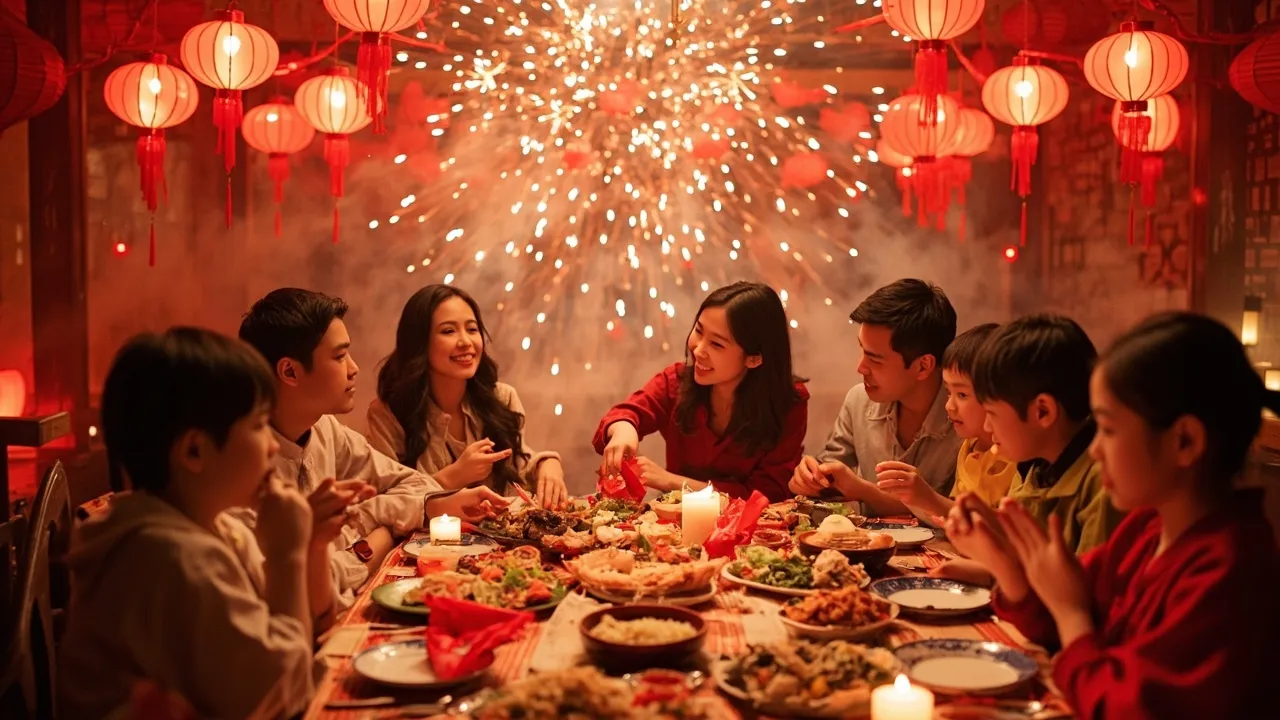
The Buddhist lion was white, and it was a serious religious artifact. But somewhere between the Han Dynasty and the Tang Dynasty (618-907 CE), the lion absorbed a much older Chinese folk legend: the Nian beast. In Chinese folklore, Nian was a monster that lived underwater and emerged once a year to devour villagers, particularly children. The monster was afraid of three things: loud noise, fire, and the color red. Villagers discovered that if they set off firecrackers, beat drums, and decorated their doors with red paper, Nian would be scared away and would not return until the next year.
The Tang Dynasty merged these two traditions. The Buddhist ceremonial lion became the guardian against the Nian beast. The result was a lion that was simultaneously a religious symbol, a folk protector, and a performance art — a creature that chased away evil while bringing good luck. Emperors commissioned lion dances for their courts. Common people performed them in village squares. The tradition was established.
By the time of the Ming Dynasty (1368-1644), the lion dance had become a permanent fixture of Chinese New Year celebrations, wedding ceremonies, business openings, and religious festivals. It has remained so ever since.
Northern Lion vs. Southern Lion: Two Styles, One Spirit
Here’s where things get interesting for Western audiences. When you watch a lion dance in a Chinatown in New York or London, you’re almost certainly watching a Southern Lion. But if you catch a performance in Beijing or Harbin, you’ll see something quite different: the Northern Lion.
The two styles diverged sometime during the Qing Dynasty (1644-1912), when regional performance traditions developed along distinct lines. They share the same mythological DNA, but they look different, move differently, and require different levels of acrobatic skill.
The Northern Lion (北狮, Běi Shī)
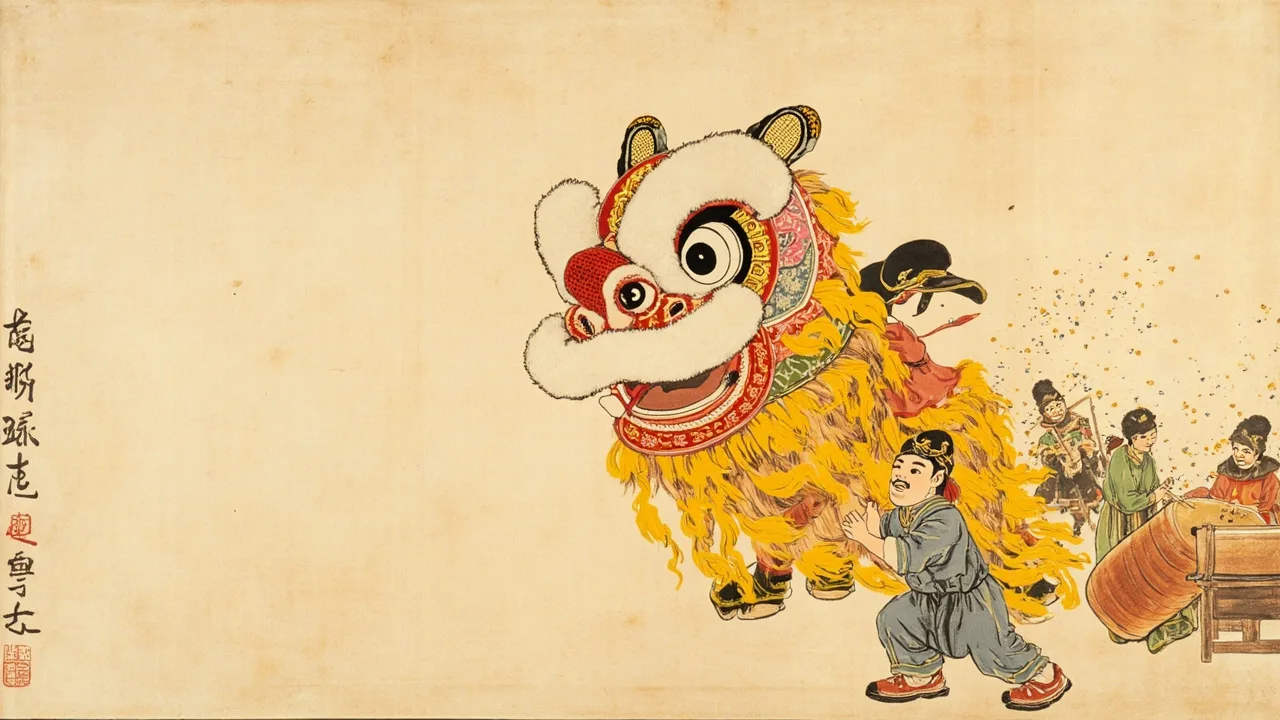
The Northern Lion is the older of the two styles in terms of documented choreography. It developed in the Beijing-Tianjin region, the heart of the Qing imperial performance tradition. Northern lions are typically operated by two dancers: the lion head (持头者, chí tóu zhě) and the lion tail (持尾者, chí wěi zhě). The costumes are浑黄 (hun huang) — a golden-yellow base with black detailing, red accents, and a very large, expressive lion head with big eyes and a prominent forehead mirror (照妖镜, zhào yāo jìng — literally “demon-scouting mirror,” meant to ward off evil).
The Northern style emphasizes the lion’s animal personality. The movement is more grounded, more quadrupedal — the dancers crouch low and mimic a lion’s walking, pouncing, and playing behaviors. Northern lions don’t do the dramatic acrobatic jumps that Southern lions are known for. The choreography is more like a skit: the lion wakes up, stretches, plays with a绣球 (xiù qiú — embroidered ball), and interacts with its handler, the “lion boy” (or 舞狮人, wǔ shī rén), who carries a pole, a fan, or a decorative ball called a qiu.
Northern lions are common at Beijing Opera performances and at the Mid-Autumn Festival in northern cities. The style is theatrical, a bit clownish, and emphasizes character acting over athletic prowess.
The Southern Lion (南狮, Nán Shī)
The Southern Lion is the style most Americans encounter. It developed in Guangdong and Guangxi provinces, the heartland of Cantonese culture, during the Qing Dynasty. Where the Northern lion is theatrical, the Southern lion is athletic. Where the Northern lion is grounded, the Southern lion leaps.
Southern lions are operated by two dancers, but the style emphasizes extreme acrobatic maneuvers. The most famous Southern lion maneuver is the plum blossom pole (梅花桩, méi huā zhuāng) — a series of narrow wooden pillars arranged in a pattern resembling plum blossom petals, set at varying heights (typically 1-3 meters off the ground). The dancers must jump from pillar to pillar, performing stunts while maintaining the lion’s balance and expression. Falling off the poles is not uncommon in training, and the best lion dance troupes spend years mastering this discipline.
The Southern lion head is smaller and more angular than the Northern version, with a wider color range (red, yellow, green, black, and gold — each color representing a different personality or virtue). The movement vocabulary includes shaking, nodding, head-stands, backflips, and the dramatic lion’s yawn where the head operator opens the lion’s jaw wide with a synchronized pull on a rope mechanism.
Cantonese lion dance is inseparable from martial arts tradition. Most serious lion dance troupes are affiliated with martial arts schools (武馆, wǔguǎn). The training regimen for a lion dancer includes the same conditioning as martial arts — leg strength, core stability, balance, and coordination. In Hong Kong and Guangdong, lion dance competitions draw hundreds of troupes and are serious sporting events judged on technique, choreography, music, and overall performance quality.
The Music: Why the Drum Matters More Than the Lion
Here’s a detail most Western audiences miss: the music is half the performance.
A lion dance is driven by a drum and cymbal ensemble (鼓镲, gǔ chā). The lead drummer is the de facto conductor — the dancers follow the drum’s rhythm, not the other way around. Different regions have developed distinct drum patterns, but the basic structure follows the action:
Cai Qing (踩青, cǎi qīng — “stepping on greens”): This is the lettuce-eating portion of the dance. The drum plays a slow, exploratory pattern as the lion approaches the lettuce with suspicion and curiosity. The cymbals clash softly.
Gao Tang (高凳): The “high bench” section, where the lion climbs onto a table or bench. The drum intensifies, building tension.
Fo Shan (佛山, named after the famous lion dance city): The dramatic finale, with fast, complex drum patterns, rapid cymbal clashes, and the lion’s most athletic moves.
In the Southern tradition, a skilled drummer is as respected as a skilled dancer. Some drummers train for decades on the drum alone. The drum patterns carry emotional weight — the audience knows what’s coming next based on what they hear. When I watched a competition in Hong Kong five years ago, I noticed that the crowd’s energy shifted in direct response to the drumming before it shifted in response to the dancing. The music leads; the lion follows.
The Training: What It Takes to Be a Lion Dancer
I visited a lion dance school in Richmond, British Columbia, two years ago — a city with a large Cantonese-Canadian community. The school trains kids starting at age six. The youngest students start by learning to walk in formation, then graduate to the lion tail, then eventually to the lion head. The head is considered the harder position: it requires upper body strength (the lion head weighs 10-15 kilograms), neck endurance (holding the head up for a full 8-10 minute performance), and the ability to express emotion through the lion’s eyes and jaw while simultaneously navigating obstacles.
The school had a set of plum blossom poles in their main practice hall. The advanced students trained on these every Saturday morning. The youngest were practicing on a low horizontal beam. One kid, maybe eight years old, kept falling off. His teacher just said “again” each time. He got back on. He fell again. He got back on. By the end of the hour, he had made it across three times.
The school director told me the dropout rate is high — about sixty percent quit within the first year. The physical demands are real, and the training culture can be intense. But those who stick with it develop not just acrobatic skill but a deep connection to a tradition that spans centuries.
Most Western cities with significant Chinese populations have at least one lion dance troupe. They perform at Chinese New Year, at business openings (where a lion dance is believed to bring good fortune to the establishment), at weddings, and at community festivals. If you’re in a city with a Chinatown, there’s probably a troupe near you — and they’ll typically perform for a donation and a red envelope.
The Lion Dance in the Modern World
The diaspora changed the lion dance in interesting ways.
In Chinatowns from San Francisco to London to Sydney, the lion dance became one of the most visible markers of Chinese cultural identity. It was performed not just for Chinese audiences but as a spectacle for the broader public — which meant it had to be visually spectacular enough to attract crowds who might not understand the cultural context. The Southern style, with its dramatic acrobatics, traveled better than the Northern style’s subtle theatricality.
Movies spread the lion dance’s international reputation further. Wong Fei-hung, the 19th-century martial artist and folk hero, was depicted performing a lion dance in dozens of Hong Kong action films — and in the process, became associated with the art form in the popular imagination. Bruce Lee and Jackie Chan both appeared in films featuring lion dance sequences. The 1990s saw a minor genre of lion dance competition films, though these were largely confined to Asian markets.
Today, lion dance troupes compete internationally. The biennial World Lion Dance Championship, held in Malaysia, brings together the best troupes from around the world. The competition categories include traditional performance, high-pole stunts, and artistic interpretation. Taiwanese and Malaysian troupes have dominated in recent years, but North American and European troupes have improved significantly, reflecting the growing global interest in the art form.
The pandemic disrupted live performances — you can’t maintain social distance while operating a lion costume — but many troupes pivoted to online performances, streaming choreographed routines that reached audiences who might never have attended a live event. The art form survived, as it has survived wars, famines, and regime changes for fifteen centuries.
What I find most remarkable about the lion dance is its persistence. It doesn’t require expensive equipment (a basic lion costume costs a few hundred dollars; professional costumes run higher). It doesn’t require a formal venue. It just needs drummers, dancers, and an audience willing to believe, for eight minutes, that a lion is real and that it has come to bring good luck.
That belief, it turns out, is portable. It travels with Chinese communities wherever they go. And it endures.