In 1976, a Yi calendar was found carved into a bronze drum in Yunnan Province. Scholars dated it to the 15th century. Then NASA got involved. Researchers at the Langley Research Center were studying ancient astronomical records and happened across references to the Yi calendar’s intercalary month system — a sophisticated leap-month mechanism for keeping lunar and solar calendars aligned. The NASA team published a paper noting that the Yi calendar’s leap-month calculations matched modern astronomical computations with remarkable precision.
That story tells you something important about the Yi people: this is a civilization with serious intellectual infrastructure, not a “minority group” in the reductive sense that term sometimes implies. The Yi developed one of the few ancient writing systems still in active use today. They maintain a living religious tradition with professional priests, cosmological texts, and ritual specialists. And they host one of the most spectacular festivals in all of China — the Torch Festival — a celebration of fire, fertility, and ancestor veneration that draws hundreds of thousands of visitors to Liangshan each year.
Yet the Yi remain one of the least-known major ethnic groups in China. Most Westerners have heard of the Miao, the Zhuang, even the Uyghurs. The Yi — despite being the second-largest ethnic minority in China, with nearly 10 million people — exist in a kind of cultural shadow. This article is an attempt to drag them into the light.
Who Are the Yi? Population, Geography, and Identity
The Yi (彝族, Yízú) are an ethnic group indigenous to the mountainous southwest of China. Their primary territories span four provinces: Sichuan (particularly the Liangshan Yi Autonomous Prefecture), Yunnan (especially the Honghe Hani and Yi Autonomous Prefecture), Guizhou, and a small pocket of Guangxi. The total population is approximately 9.8 million — making them China’s second-largest ethnic minority after the Zhuang (who number around 16 million).
The Yi are not a homogeneous group. There are significant cultural differences between the Liangshan Yi of Sichuan (who maintain the most conservative Yi cultural traditions, including the pictographic script and Bimo priestly tradition) and the Sani Yi of Yunnan (who are more integrated with local Han and other ethnic groups and have developed distinct customs around the Stone Forest region). Linguistically, Yi languages belong to the Tibeto-Burman branch of Sino-Tibetan — they are related to Tibetan and Burmese, but not to Mandarin Chinese. Six distinct Yi linguistic varieties are recognized, some mutually unintelligible.
The Yi are believed to have originated in the same region as the ancient Qiang peoples of Sichuan before migrating southward into their current territories over roughly 2,000 years. Historical Chinese records from the Tang and Song dynasties describe Yi kingdoms and chiefdoms in Yunnan and Sichuan — organized societies with their own governance structures, not “primitive” tribal groups.
In 1956, the Chinese government officially recognized the Yi as an ethnic group and established the Liangshan Yi Autonomous Prefecture in Sichuan — one of the first such autonomous regions created. The region covers approximately 31,000 square kilometers and has a population of around 2.5 million, of whom about 50% are Yi.
The Yi Script: One of the World’s Last Living Pictographic Writing Systems
This is the part of Yi culture that blows people’s minds when they first hear about it.
The Yi script (彝文, Yíwén, also called �️诺苏文, Nuosu Wen) is a pictographic writing system that has been in continuous use for at least 500 years — and possibly longer. Some scholars argue the script has roots going back to the Tang Dynasty (7th century CE). What makes it extraordinary is not just its age but its vitality: the Yi script is still used today in Liangshan for newspapers, textbooks, legal documents, religious texts, and personal correspondence. It is one of the few ancient writing systems in the world that is not purely historical — it is a living script.
The script has approximately 10,000 individual characters. Unlike Chinese characters (which evolved from pictographs to increasingly abstract forms), Yi characters remain recognizably pictographic: a character for “mountain” looks like a mountain, a character for “water” looks like flowing water. The script is written top to bottom, left to right — the same as classical Chinese.
The Yi script was historically used primarily by the Bimo priests (see below), who were the literate class. Ordinary Yi people were often illiterate in both Yi script and Chinese. In the Liangshan region, Yi literacy campaigns since the 1950s have increased script literacy, though bilingualism with Mandarin is now widespread.
A personal note: I spent an afternoon in Xichang (Sichuan) at a small market where a Yi calligrapher was selling hand-written Yi text strips — short blessings or names written in the pictographic script on red paper. He charged 20 yuan per strip. I bought two — one with my name (or something approximating it), one with a blessing for safe travel. The calligrapher’s brush technique was fluid and practiced, and the characters were beautiful in a completely different aesthetic register from Chinese calligraphy. They had a more geometric, almost Olmec quality to them.
Recommended Products
[product_affiliate: “Nuosu Yi Script Dictionary” - https://www.amazon.com/dp/7308104892] [product_affiliate: “Yi Ethnic Minority Cultural History” - https://www.amazon.com/dp/7222047857] [product_affiliate: “Traditional Yi Silver Headdress (Handcrafted)” - https://www.etsy.com/market/yi_silver_headdress]
Torch Festival: Fire, Fertility, and the Biggest Yi Celebration of the Year
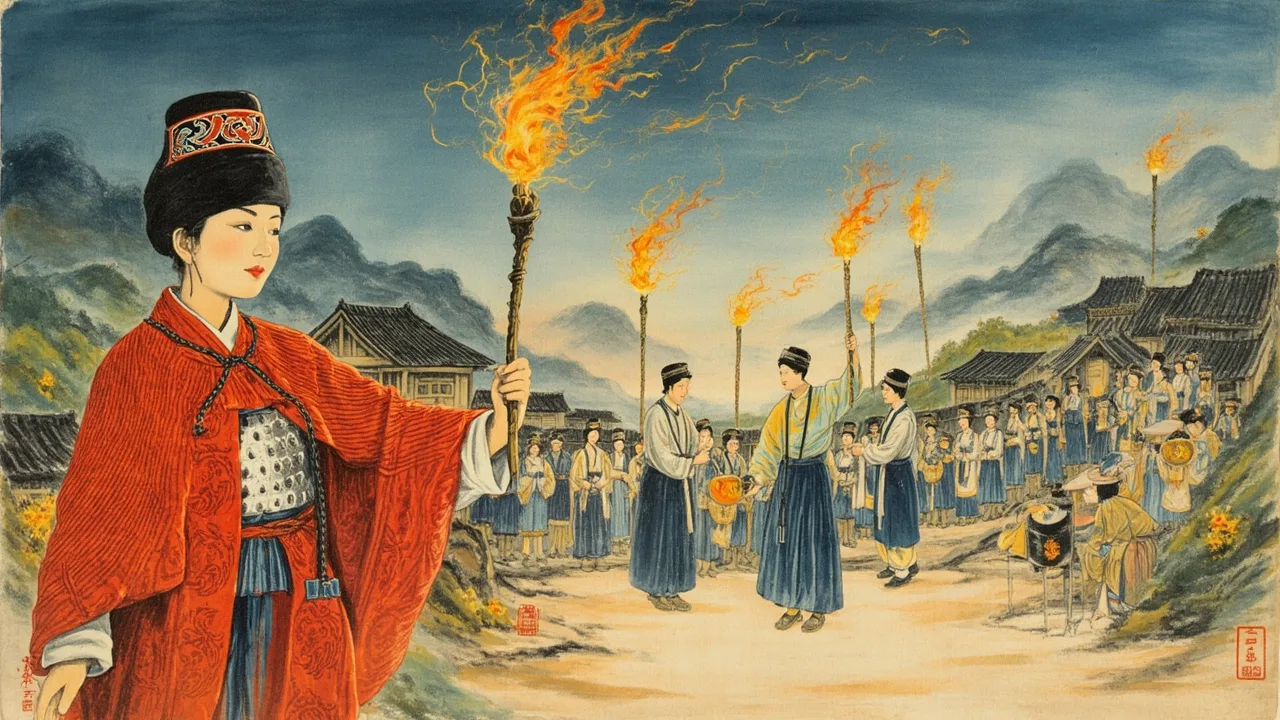
If you’ve never heard of the Torch Festival (火把节, Huǒbǎ Jié), put it on your list. It is the most important festival in Yi cultural life, a three-day celebration held on the 24th day of the sixth lunar month (typically late July or August). In 2026, the 24th day of the sixth lunar month falls in late August — the exact date varies by region and calendar tradition.
The festival has multiple layers of meaning. The most common origin narrative involves a legendary Yi hero named Tian Tian (sometimes translated as “Skull Breaker” or just “Tian”) who led the Yi people in rebellion against a cruel local ruler. The ruler had been oppressing the Yi for years, and Tian organized a resistance. The plan involved hiding weapons in torches and using the festival as cover for an uprising — hence the fire imagery, which commemorates the torches that carried hidden weapons. The rebellion succeeded, the ruler was killed, and the Yi celebrate Torch Festival to commemorate their freedom.
There is also a more agrarian layer: the festival marks the harvest transition, a moment when the main crops are approaching maturity but the most dangerous agricultural period (pest damage, extreme heat) has passed. Fire is used to cleanse the fields, drive away pests, and symbolically prepare the harvest for collection. In this sense, the Torch Festival shares conceptual DNA with fire festivals across many cultures — Beltane in Celtic tradition, the bonfire celebrations of European midsummer.
During the three days of the festival, Yi people across Sichuan, Yunnan, and Guizhou gather for celebrations. The main events include:
Torch carrying: Each family carries a torch (traditionally a bundle of pine resin torches, now often more sophisticated) from their home to the village gathering point. The procession has a festive, slightly chaotic energy — thousands of small flames moving through the darkness.
Bullfighting and yak racing: These are serious sporting events, not tourist spectacles. Yi bullfighting is conducted with actual bulls (not the matador style — it’s bull versus bull, placed in an arena and encouraged to fight), and the winners are prestigious. Yak racing is primarily a Sani Yi tradition in Yunnan, run on hillside tracks with impressive views.
Huqiao circle dancing: The Yi have a traditional circle dance called huqiao (或巧) or sometimes tiaoyue (跳月, “jumping to the moon”). It’s similar to the circle dances found in many ethnic minorities across southwest China: participants hold hands or link arms and move in a synchronized circle, typically to the accompaniment of a bamboo flute and percussion. The dance is performed at festivals and social gatherings.
Beauty contest: A more controversial tradition in modern times — the “选出美女” or “选出美男子” competitions where young Yi men and women are judged on appearance. This tradition has roots in Yi matchmaking customs but has become a more commercialized event in recent decades.
I attended the Torch Festival in Zhaotong, Yunnan, about six years ago. The scale was larger than I expected — the town had clearly prepared for significant tourism. There were food stalls, vendors selling Yi crafts, and a main stage with performances. But the most memorable moments were the unstructured ones: walking through a Yi village at midnight during the festival and seeing every household sitting in their courtyards with torches, the air thick with the smell of pine resin, children running between the flames.
Bimo Priests, Tiger Cosmology, and Yi Religion
The Bimo (毕摩) are the traditional priest-scholars of the Yi people. They are not shamans in the stereotypical sense — they are institutional religious specialists with a defined training path, a corpus of religious texts, and a social role that is both sacred and scholarly.
The Bimo tradition is one of the oldest continuous priestly lineages in China. Bimo priests conduct funeral rites (the most important of Yi religious ceremonies — the dead must be properly guided to the afterlife, and errors in the ritual can cause harm to the living), ancestor veneration rituals, healing ceremonies, and divination. They are the keepers of Yi religious texts, which are written in the Yi script on paper, bamboo, or cloth.
Training to become a Bimo takes years. A would-be Bimo must learn the Yi script (which is largely restricted to religious and ceremonial use), memorize hundreds of ritual texts, learn the proper chant melodies and ritual gestures, and complete apprenticeships under established Bimo. In Liangshan, some families have produced Bimo priests for generations.
Yi cosmology is centered on a tiger-based worldview. The Yi believe that the world was created by a supreme deity called Axi Misi (sometimes identified with the sun or sky father) and that the tiger is the chief animal totem — the king of animals, the bridge between the human and spirit worlds. Yi mythology includes a flood myth in which humanity is repopulated by two survivors who emerge from a gourd; the tiger plays a protective role in some versions of this myth.
The Yi calendar, as noted above, is a sophisticated lunisolar system. The Yi zodiac includes 12 animal signs (similar to but not identical with the Chinese zodiac — the Yi animal sequence includes a moth and a dragon, for example). The Yi zodiac is used for divination and life planning in ways that parallel Chinese practices.
Yi Crafts: Lacquerware and Silver
The Yi are known for two crafts that have achieved national and international recognition: lacquerware and silver ornaments.
Yi lacquerware — produced primarily in the Butuo and Jinyang areas of Liangshan — uses a traditional urushi lacquer derived from the Toxicodendron vernicifluum tree (the same lacquer tree used in Japanese and Chinese lacquerware traditions). The Yi produce black and red lacquer items: bowls, plates, boxes, and the distinctive “huiping” — a ceremonial wine vessel with a lid. The craft involves multiple layers of lacquer applied to a wooden base, with each layer dried and polished before the next is applied. A single item can take months to complete.
Yi silver ornaments are particularly associated with the Sani Yi tradition. The silver headdress — called a “huosha” or “kacol” depending on region — is the most elaborate piece: a multi-layered silver crown adorned with stylized floral and bird motifs, worn by Yi women during festivals and weddings. A complete traditional Yi silver headdress can weigh several kilograms and represents both significant craftsmanship and significant family investment. In traditional Yi culture, a bride’s silver ornaments were her personal wealth, stored and inherited across generations.
Yi music is another underappreciated art form. The Yi xianzi (mouth harp) is a民族乐器 with a small metal or bamboo frame and a vibrating tongue that produces a distinctive buzzing tone. The yi “big mustache” flute (大胡须箫, a transverse flute with distinctive finger-hole spacing) produces a mournful, slightly out-of-tune-by-Western-standards sound that I found deeply compelling in a way that Western equal-tempered instruments can’t replicate.
Famous Yi Figures
A few Yi people have achieved national and international prominence:
Zhu Yichuan (朱以撒), a prominent calligrapher and professor at a Chinese university, is one of the most respected living practitioners of traditional Chinese calligraphy — and a Yi person.
Zhang Yiming, the founder of ByteDance (owner of TikTok/Douyin), is of Yi descent from a rural Guizhou family. He became one of China’s most prominent tech entrepreneurs and one of the wealthiest people in the country.
In sports, Yi athletes have represented China in wrestling, track and field, and weightlifting at national and international competitions.
The NASA Yi calendar story from 1976 (mentioned at the top of this article) sparked academic interest in Yi astronomical knowledge, though the actual NASA paper was a brief note in a technical journal rather than a major study. The story has taken on a slightly mythological life of its own in Yi cultural discourse — an example of how a diaspora community can amplify and reframe an obscure external validation.
Conclusion
The Yi people are not a footnote in Chinese history. They are 10 million people with a writing system that goes back centuries, a priestly tradition that is still active, a harvest festival that draws hundreds of thousands of celebrants, and a material culture — lacquerware, silver, music — that has genuine artistic significance beyond its “ethnic craft” categorization. They live in one of the most geographically spectacular parts of China — the mountains of Sichuan, Yunnan, and Guizhou — and they have managed to maintain a recognizable cultural identity despite centuries of contact with Han Chinese and other ethnic groups.
If you’re interested in the cultural diversity of southwest China, the Yi are a good place to start. The Torch Festival alone is worth the trip.
Quick Reference: Yi Culture at a Glance
| Aspect | Detail |
|---|---|
| Population | ~9.8 million |
| Primary provinces | Sichuan, Yunnan, Guizhou, Guangxi |
| Language family | Sino-Tibetan (Tibeto-Burman branch) |
| Yi script | ~10,000 pictographic characters, still in active use |
| Religious specialists | Bimo priests (毕摩) |
| Major festival | Torch Festival (火把节), 24th day of 6th lunar month |
| Key cultural region | Liangshan Yi Autonomous Prefecture, Sichuan |
| Traditional crafts | Lacquerware, silver ornaments |
| Cosmology | Tiger totem, sky-worship, ancestor veneration |
| Notable crafts | Yi mouth harp (xianzi), big mustache flute |
{ “subject”: “Hundreds of Yi people in vibrant traditional costumes — women in elaborate silver headdresses adorned with hanging coins and coral, men in indigo robes with geometric embroidery — gathered in a vast outdoor arena at night, each person holding a burning torch raised high, the flames creating a sea of flickering orange light against the deep blue-black night sky, with distant mountains silhouetted on the horizon”, “style”: “Traditional Chinese landscape painting with bold flat-color regions and dynamic composition. Rich saturated reds, silvers, indigos, and golds. Cinematic lighting from the torches creating warm glow against cool night atmosphere. Festival energy captured in painterly brushwork.”, “negative_prompt”: “Avoid cartoonish style, avoid AI-generated flat digital look, avoid generic Chinese stock photo, avoid Western oil painting realism, avoid modern clothing, avoid sparse crowd, avoid day-time scene”, “characters”: “Hundreds of Yi ethnic minority people, diverse ages, in full traditional festival dress, torches raised aloft, faces illuminated by firelight with expressions of joy and celebration”, “environment”: “Night scene at Yi Torch Festival in Liangshan mountains, vast outdoor gathering, torches creating dramatic warm lighting, mountainous landscape with starry sky above, summer season”, “composition”: “Wide panoramic view from slightly elevated angle, ocean of torch flames filling lower two-thirds of frame, mountains and starry sky in upper third, sense of vast scale and communal celebration” }