category: Chinese Culture tags: [“Chinese Brocade”, “Silk Weaving”, “Traditional Textiles”, “Chinese Craftsmanship”, “Intangible Cultural Heritage”] image: /images/chinese-brocade.jpg categories: [Chinese History, Traditional Crafts] alt_text: “Illustration depicting chinese brocade, in a traditional Chinese cultural setting” affiliate_products: [silk-fabric-scarf, chinese-knot-kit, chinese-history-book]
Long before synthetic fabrics and mass production, there was silk. And among all the things human hands have ever wrought from that shimmering thread, nothing quite matches the magnificence of Chinese brocade. It’s the fabric that emperors wore to signify their heaven-sent right to rule. It’s the textile that adorned the walls of palaces, wrapped sacred relics, and symbolized wealth so profound that owning a single bolt was a statement of power. Today, Chinese brocade remains one of the most extraordinary craft traditions on Earth — a living art form where every thread carries centuries of accumulated skill, every pattern tells a story, and the finished cloth takes your breath away.
The two great traditions of Chinese brocade are云锦 (Yúnjǐn, “Cloud Brocade”) from Nanjing and 蜀锦 (Shǔjǐn, “Shu Brocade”) from Sichuan. Both are recognized as national intangible cultural heritage treasures, and both represent the absolute pinnacle of silk weaving achievement. While they differ in technique, color palette, and regional character, both share a common commitment to perfection that has defined the very finest Chinese craftsmanship for more than a thousand years.
The Origins and Imperial History of Chinese Brocade
The story of Chinese brocade begins with silk itself, which Chinese tradition attributes to the discovery by Lady Xilingji, the wife of the legendary Yellow Emperor, some 5,000 years ago. Whether or not you take that literally, the archaeological record confirms that silk production was well established in China by the time of the Shang Dynasty (c. 1600–1046 BCE), and the earliest forms of brocade — a weave structure that incorporates supplementary weft threads to create raised patterns — appear around the Warring States period (475–221 BCE).
But it was during the Han Dynasty that brocade truly came into its own as an imperial fabric. The great Silk Road trade routes were opening China to the world, and Chinese silk — including brocade — became one of the most coveted luxury goods on the planet. Roman senators debated sumptuary laws to try to keep silk out of their own wardrobes. Parthian merchants made fortunes dealing in it. And at the heart of this global trade was brocade — the most elaborate and expensive silk of all.
The Ming Dynasty (1368–1644) represents the golden age of Yunjin (Cloud Brocade). Nanjing had long been a center of silk production, but during the Ming period, the imperial court established dedicated workshops — Huangjijin (Imperial Brocade Bureaus) — to oversee the production of brocade for the sole use of the emperor, his family, and the highest-ranking officials. The quality standards were extraordinary: every piece had to meet exacting specifications for thread count, colorfastness, and design precision. Imperfect pieces were destroyed rather than sold.
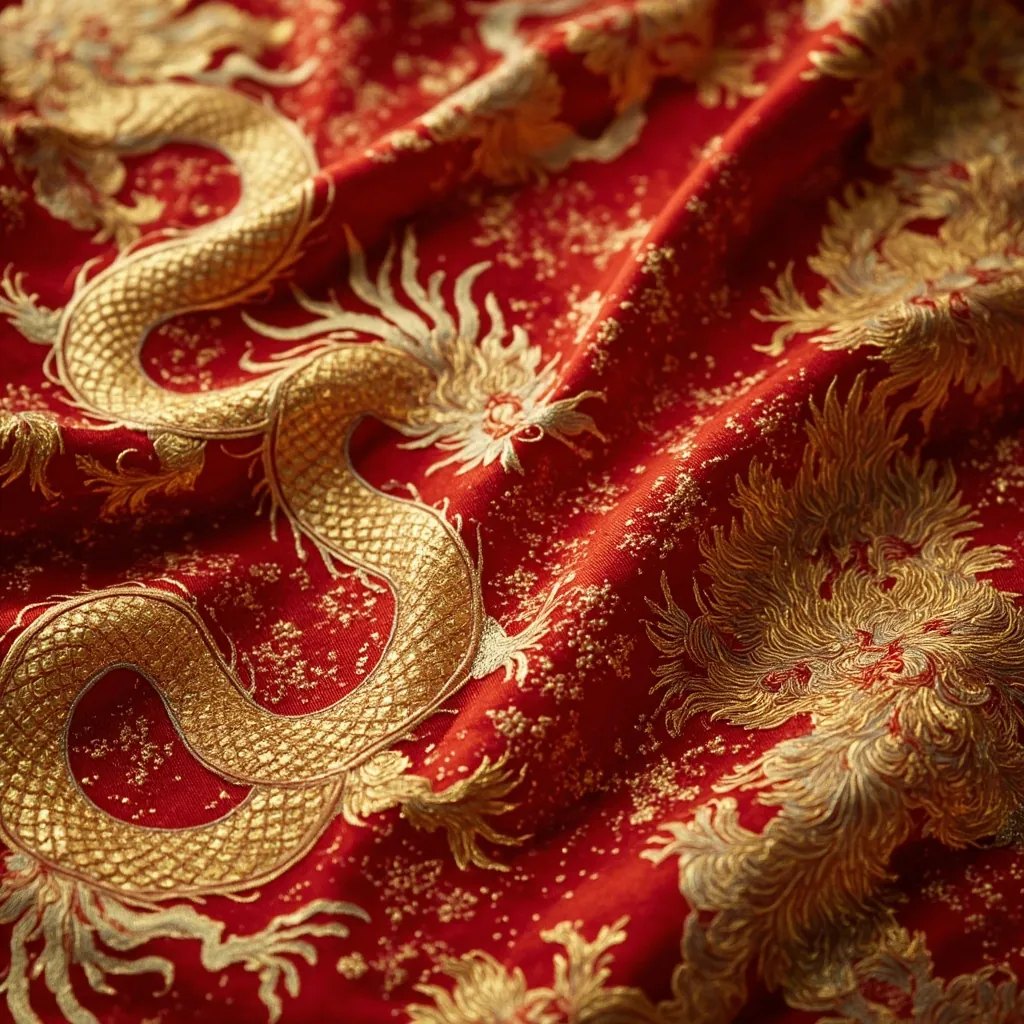
During this period, Yunjin reached a level of complexity that has rarely been equaled. Weavers developed a technique called纬锦 (wěijǐn, “weft brocade”) that allowed them to create intricate, multi-colored pictorial designs — dragons coiled among clouds, phoenixes spreading wings across a field of peonies — using hundreds of individual shuttles, each carrying a different colored thread. A single Yunjin weaving project could take months or even years to complete, and the resulting fabric was so densely packed with silk threads that it had a three-dimensional quality, the pattern seeming to float above the background.
Shujin (Shu Brocade) from Sichuan has its own imperial heritage. Sichuan’s connection to brocade weaving stretches back at least to the Qin and Han dynasties, when the province’s favorable climate — mild temperatures, abundant water from the Min Mountains, and access to premium mulberry leaves for silkworm feed — made it an ideal silk-producing region. The ancient蜀锦 was a staple of trade along the southern Silk Road, and it was so prized that the Han Dynasty government established official supervision of Shu brocade production.
The Extraordinary Weaving Techniques Behind Every Thread
Understanding even the basics of how Chinese brocade is made makes you appreciate it in an entirely different way. These are not fabrics that can be produced quickly or easily. Every single piece of genuine Yunjin or Shujin represents hundreds of hours of skilled labor, performed on looms that are themselves engineering marvels.
The fundamental difference between brocade and ordinary silk fabric lies in the weave structure. In standard silk weaving, warp threads (the vertical threads held under tension on the loom) and weft threads (the horizontal threads woven over and under them) create a flat, planar fabric. In brocade, additional supplementary weft threads are introduced selectively to create raised, three-dimensional patterns. These extra threads are not woven into the body of the fabric — they float on the surface, anchored only at the points where they form part of the design. This technique allows for extraordinary richness and depth, with patterns that seem to glow against their background.
Yunjin weavers in Nanjing developed a particularly sophisticated variation called妆花 (zhuānghuā, “decoration weave”) that takes this principle to its ultimate expression. In zhuānghuā weaving, weavers use a individually actuated supplemental thread for each color in the design, allowing for virtually unlimited color variation within a single piece. A dragon might shimmer through twenty shades of gold, crimson, and azure in a single scale. This technique requires the weaver to manipulate hundreds of tiny wooden rods, each attached to a different colored thread, in precise sequence — a physical and mental challenge that takes years to master.
Shujin weavers in Sichuan favor a slightly different approach, with a heavier emphasis on tapestry-style weaving that creates dense, carpet-like patterns. Shujin is characterized by bold, graphic designs with strong color contrasts — often featuring geometric patterns, medallions, and stylized cloud and wave motifs — that reflect Sichuan’s artistic sensibility, which tends toward the direct and the vivid rather than the subtle and the nuanced.
Both traditions use exclusively natural silk fibers, and the dyeing process is itself an art form. The silk threads are dyed using traditional plant-based and mineral dyes — indigo for blues, madder for reds, turmeric for yellows, of pomegranate rind for golds — and the colors are mixed and layered to achieve tones so deep and complex that modern synthetic dyes simply cannot replicate them. The cost of natural dyes alone, not to mention the expertise required to use them properly, is a significant part of what makes authentic Chinese brocade so expensive.
Iconic Patterns and Their Deep Symbolic Meanings
Every pattern in Chinese brocade is a language — a system of symbols understood by anyone educated in Chinese imperial culture. Understanding these patterns transforms the experience of looking at brocade from merely admiring beauty to reading a story.
The dragon — specifically the五爪龙 (wǔzhuǎ lóng, “five-clawed dragon”) reserved exclusively for imperial use — is the most prestigious motif in Yunjin. The imperial dragon (long) represents the emperor himself, and a robe embroidered or brocaded with a dragon was quite literally a statement of sovereign power. Dragon patterns in brocade are typically shown in dynamic poses — writhing through clouds, rising from waves, chasing a flaming pearl — and the skill required to render the dragon’s sinuous form in silk is immense.
The phoenix (fenghuang) is the female complement to the dragon in Chinese symbolic language. The imperial phoenix represents the empress, and phoenix-and-dragon brocade — depicting both creatures side by side — was traditionally used for imperial wedding ceremonies. The phoenix motif also appears extensively in court ceremonial dress for high-ranking female officials and aristocrats.
Cloud patterns (yunwen) are ubiquitous in Yunjin, and they’re not merely decorative. In Chinese cosmological thought, clouds were the means by which celestial messages descended from heaven to earth. Clouds represent good fortune, official promotion, and the blessing of the heavens. In brocade, they’re often rendered in swirling, stylized forms that resemble actual clouds viewed from below — a perspective that carries its own spiritual significance.
Wave and water patterns (shuiwen) represent prosperity and abundance, as water was associated with wealth and the flow of commerce. Lotus flowers (lianhua) symbolize purity and spiritual awakening. Pomegranates (shiliu) represent fertility and numerosity of offspring. Peonies (mu dan) are the “king of flowers” and symbolize wealth, honor, and worldly success. All of these appear in Chinese brocade with great frequency, layered and combined in compositions that are as semantically rich as they are visually stunning.
The Modern Survival of an Ancient Art
There is no sugarcoating the fact that Chinese brocade nearly disappeared in the 20th century. The political upheavals of the Republic of China, the Japanese occupation, the Chinese Civil War, and especially the Cultural Revolution (1966–1976) dealt devastating blows to the craft. Workshops were shuttered, master weavers were persecuted as exponents of “feudal superstition,” and years of accumulated knowledge were lost. The looms were burned, the pattern books were destroyed, and for a dark period, it seemed that the art of Yunjin and Shujin might vanish from the Earth entirely.
The revival began in the 1980s and 1990s, as China began to reassess and protect its cultural heritage. In 2006, both Yunjin and Shujin were listed as national intangible cultural heritage items, and the Chinese government began providing funding and institutional support for training new generations of weavers. Today, workshops in Nanjing and Chengdu continue the tradition, though the number of active master weavers remains small — perhaps a few dozen for each tradition — and the training period for a fully qualified brocade weaver is measured in years, not months.
The economics are challenging. A single piece of museum-quality Yunjin brocade can take a team of weavers several years to complete and command prices in the hundreds of thousands of dollars. There is simply no way to mass-produce this fabric without destroying what makes it valuable. Every thread is placed by human hands, every color choice is made by a skilled artisan, and the final product carries a uniqueness that no machine can replicate.
For collectors, acquiring a genuine piece of Chinese brocade — whether a small wall hanging, a silk panel for framing, or even a modern accessory like a brocade pouch or scarf — is a meaningful way to support living craftsmanship and own a piece of cultural heritage.
Bringing Chinese Brocade Into Your Life
If the beauty of Chinese brocade speaks to you, there are ways to own a piece of this extraordinary tradition — even if your budget doesn’t stretch to a Ming Dynasty-style wall hanging.
Recommended Products:
Authentic Nanjing Yunjin Silk Scarf — A genuine hand-woven Yunjin silk scarf featuring classic cloud-and-dragon motifs, made by artisans at the Nanjing Brocade Research Institute. Each scarf is a unique piece of living craftsmanship.
Chinese Brocade Wall Panel - Phoenix and Peony Design — A museum-quality silk brocade wall panel, hand-woven with phoenix and peony patterns in traditional natural dyes. Comes with a certificate of authenticity from the Chengdu Brocade Workshop.
Vintage-Inspired Shujin Brocade Coin Purse Set — A set of three coin purses crafted from Shujin-style brocade in bold Sichuan colorways. Perfect for carrying cards, coins, or small keepsakes while carrying a piece of Chinese heritage in your pocket.
Traditional Chinese Textile Art Book - Brocade and Silk of China — A comprehensive illustrated volume documenting the history, techniques, and masterpieces of Chinese brocade weaving, featuring photographs from museum collections around the world.
Silk Brocade Laptop Sleeve - Dragon Cloud Pattern — A functional and beautiful laptop sleeve lined with genuine Yunjin-inspired brocade, combining modern utility with centuries of silk weaving tradition.
Chinese brocade is one of those rare art forms that manages to be simultaneously ancient and utterly contemporary. Its colors are vivid enough to feel modern, its patterns are sophisticated enough to reward endless study, and the skill embedded in every thread reminds us what human hands can achieve when they’re devoted to beauty for its own sake. Whether you encounter it in a museum, a palace, or draped across the shoulders of a performer at a Chinese New Year celebration, take a moment to look closely. You’re witnessing a tradition that has been refined for over two thousand years, and it shows in every single thread.