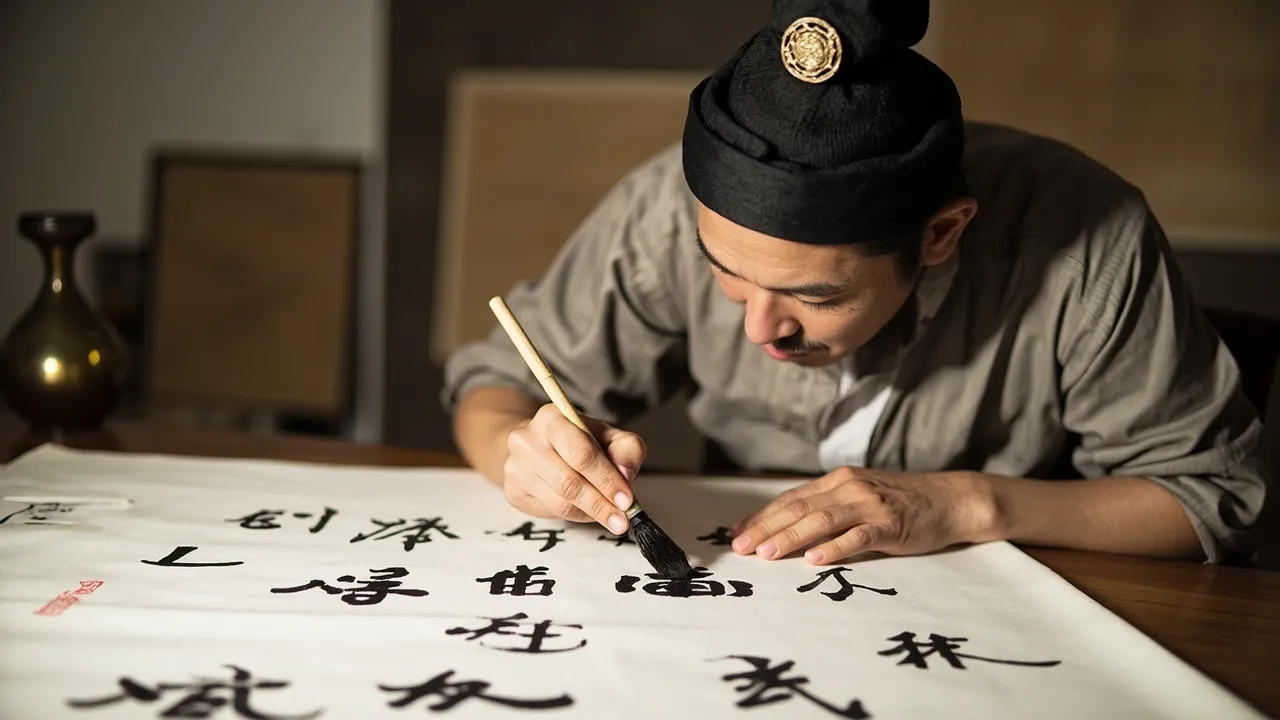
The Elegant Art of Chinese Calligraphy: Brush Writing Through the Ages
Imagine sitting in a quiet room with a fresh sheet of rice paper before you. You dip a brush made from animal hair into ink ground from pine soot, feeling the weight of centuries in your hand. The tip touches paper, and suddenly you’re not just making marks—you’re participating in a tradition that has defined Chinese aesthetic sensibility for over two thousand years.
Welcome to the world of Shufa (书法), the art of beautiful writing. More than mere handwriting, Chinese calligraphy represents one of the highest forms of artistic expression in Chinese culture. It’s practiced by millions, admired by billions, and continues to evolve while maintaining its classical roots. For anyone seeking to understand Chinese culture at a deeper level, calligraphy offers a window into the Chinese soul—their values, their aesthetics, and their philosophy of life.
Walking through any Chinese city, you’ll see calligraphy everywhere: on shop signs, in parks where elderly practitioners practice their daily strokes, in museums displaying masterworks that sell for millions at auction. This isn’t mere decoration—it’s a living tradition that connects modern Chinese people to their ancient ancestors in an unbroken chain of artistic transmission.
Understanding Calligraphy Basics
At its core, Chinese calligraphy is about capturing the essence of characters through the controlled movement of a brush. Unlike western calligraphy, which emphasizes uniform letterforms, Chinese calligraphy celebrates the dynamic energy flowing through each stroke. The same character, written by different calligraphers or even by the same calligrapher at different moments, can convey vastly different emotional qualities.
The tools matter enormously, and Chinese calligraphers have refined their equipment over millennia. A traditional calligraphy setup includes the “four treasures” of the study: the brush (笔), the ink stone (砚), the ink stick (墨), and the paper (纸). Each element has been refined over centuries to create the perfect writing experience, and serious calligraphers spend considerable time selecting and caring for these tools.
Brushes are typically made from羊毛 (yangmao, goat hair), 黄鼠狼 (huangshulang, weasel hair), or混合 (hunhe, mixed hair). Each type produces different effects—goat hair holds more ink and creates softer lines, while weasel hair provides precision for fine details. A good brush, properly cared for, can last decades, and experienced calligraphers develop deep relationships with their favorite brushes. The animal hair is carefully shaped and bound to a bamboo or wooden handle, creating a tool that can produce marks ranging from hair-thin lines to broad, sweeping strokes.
The paper is traditionally rice paper (宣纸, xuanzhi), named after the city of Xuan where it was first produced during the Tang Dynasty. This paper has a unique texture that allows ink to spread slightly, creating the characteristic “ink wash” effects that distinguish Chinese calligraphy from other writing traditions. The absorbency of xuan paper allows ink to penetrate the fibers, creating a three-dimensional quality that flat paper cannot achieve. Modern alternatives exist, but serious calligraphers still prefer traditional xuan paper for important works.
Ink is made by grinding an ink stick against an ink stone with water. This simple process connects the calligrapher to ancient practices—the same method used by scholars millennia ago. The grinding itself is considered meditative, preparing both the ink and the calligrapher’s mind for the work ahead. The ink stick is traditionally made from pine soot (soot from burning pine wood) mixed with animal glue, formed into sticks, and dried. The quality of the ink stick affects the color, flow, and permanence of the resulting ink.
The History and Evolution of Shufa
Chinese calligraphy didn’t emerge suddenly—it evolved gradually alongside the development of Chinese characters themselves. Understanding this evolution helps appreciate why calligraphy became so deeply revered in Chinese culture.
The earliest Chinese characters, found on oracle bones and bronze inscriptions from the Shang Dynasty (1600-1046 BCE), were pictographic—simple drawings representing objects and concepts. These ancient forms already showed an aesthetic sense, with careful attention to balance and proportion. The craftsmen who created these early inscriptions were not merely recording information; they were making deliberate aesthetic choices that would influence Chinese art for millennia.
The 小篆 (Xiaozhuan, Small Seal Script) of the Qin Dynasty (221-206 BCE) represented the first standardization of Chinese writing. The First Emperor, Qin Shi Huang, unified the Chinese script and commissioned scholars to standardize the characters while maintaining a rounded, flowing quality. Though rarely used today, Xiaozhuan remains important for understanding the visual roots of Chinese characters. The aesthetic of balanced curves and uniform stroke width established principles that continue to influence calligraphy today.
The 隶书 (Lishu, Clerical Script) emerged during the Han Dynasty (206 BCE – 220 CE), simplifying the complex seal script into more practical, quickly-written characters. This script introduced the characteristic horizontal and sweeping strokes that still define Chinese writing today. Many scholars consider Lishu the direct ancestor of modern Chinese characters—it was the script used for everyday administration during the Han Dynasty’s expansion. The transition from seal script to clerical script represents the democratization of writing, making it accessible to more people.
The 楷书 (Kaishu, Regular Script) developed during the Tang Dynasty (618-907 CE) and represents the most formal, readable style. Kaishu is what most westerners recognize as “Chinese writing”—the carefully balanced characters used in books, newspapers, and formal documents. This is typically the first style students learn when studying calligraphy, as it establishes the fundamental principles of stroke order and character structure. The Tang Dynasty calligraphers established standards of beauty that remain influential today.
In addition to these formal scripts, Chinese calligraphy developed two more expressive styles. 行书 (Xingshu, Running Script) flows more freely, with connected strokes that allow faster writing while maintaining legibility. It represents a middle ground between the formal regular script and the highly artistic grass script. 草书 (Caoshu, Grass Script) is the most abstract and artistic, with strokes so abbreviated and flowing that it’s often unreadable to the uninitiated—but absolutely beautiful as pure visual art. Learning to read Caoshu is a specialized skill, but appreciating its visual beauty requires no such training.
The Five Great Masters of the Tang and Song Dynasties—Yan Zhenqing, Liu Gongquan, Ouyang Xun, Su Shi, and Mi Fu—established aesthetic standards that still guide calligraphers today. Their works are studied reverently, analyzed for the subtle qualities that make their writing extraordinary. These masters transcended mere technical proficiency to achieve something like divine inspiration—their characters seem to breathe with inner life.
Major Styles and Their Characteristics
Understanding the major calligraphy styles helps you appreciate what you’re looking at when viewing Chinese calligraphy art. Each style has its own aesthetic goals and technical requirements, representing different approaches to the fundamental challenge of making Chinese characters beautiful.
Kaishu (Regular Script) emphasizes clarity, balance, and precision. Every stroke has a defined beginning, middle, and end. Characters are carefully constructed with attention to overall structure, individual stroke proportions, and the relationships between strokes. Learning Kaishu teaches discipline and control—essential skills for all other styles. Students typically spend years mastering Kaishu before moving on to more expressive scripts. The precision required to write proper Kaishu builds muscle memory and develops the sensitivity to brush pressure that all calligraphy requires.
Xingshu (Running Script) balances legibility with artistic freedom. Strokes flow into each other naturally, sometimes connecting where it makes visual sense. The style feels more spontaneous than Kaishu while still being readable. Many scholars used Xingshu for everyday writing, making it both practical and beautiful. The flowing quality of Xingshu requires the calligrapher to maintain control while allowing the brush to move more freely, creating a tension between discipline and spontaneity that gives the style its characteristic energy.
Caoshu (Grass Script) pushes expression to its limit. The character forms become almost abstract, with strokes flowing continuously and individual characters sometimes merging. While challenging to read, Caoshu is prized for its dynamic energy and the pure visual pleasure of its swirling forms. The best Caoshu appears completely spontaneous, yet each character remains identifiable to trained eyes. This apparent simplicity conceals enormous technical skill—the calligrapher must know the precise structure of each character to abbreviate it appropriately.
Zhuanshu (Seal Script) and Lishu (Clerical Script) are more specialized but important historically. Seal script, with its elegant curves, appears on formal occasions and seals. Its ancient heritage gives it a dignified, timeless quality that makes it appropriate for formal inscriptions and artistic works meant to convey classical learning. Lishu, with its squared-off forms, influenced modern printing and is still studied for its historical significance. Understanding these earlier scripts gives context to the more commonly used scripts.
Within each style, regional and personal variations create endless diversity. A piece of calligraphy reflects not just the character being written but the personality, mood, and training of the calligrapher. This is why Chinese calligraphy is considered a window into the soul—what appears on paper reveals the inner character of the one who held the brush.
Cultural Significance and Philosophy
In China, calligraphy is far more than beautiful handwriting—it embodies core philosophical concepts and reflects deep cultural values. Understanding these connections reveals why calligraphy holds such a prestigious place in Chinese civilization.
The practice of calligraphy is linked to 禅 (Chan, Zen) Buddhism and traditional meditation practices. The concentration required to write well mirrors the focus sought in meditation. Many calligraphers describe entering a peaceful, focused state while practicing—the same mental clarity that meditation practitioners pursue. The brush moving across paper becomes a form of moving meditation, requiring the same present-moment awareness that seated meditation develops. Calligraphy teachers often describe the practice as “meditation through action.”
Calligraphy also reflects 道 (Dao, Tao) philosophy, particularly the concept of 自然 (ziran, naturalness). The best calligraphy appears effortless, with strokes seeming to flow naturally rather than being carefully constructed. Yet achieving this apparent simplicity requires years of disciplined practice—the Taoist paradox of mastering art through forgetting art. The calligrapher must practice until the techniques become unconscious, until the hand responds to artistic intention without conscious thought, allowing true creativity to emerge.
The concept of 气 (Qi, vital energy) appears frequently in calligraphy discussions. A skilled calligrapher’s work is said to contain qi—the life force that animates the brushstrokes. This isn’t metaphorical; experienced observers can feel the energy in a piece of calligraphy, distinguishing work done with genuine skill and presence from mechanical copying. Characters written with qi feel alive—they seem to pulse with inner energy, while characters written without it feel flat and dead, no matter how technically proficient.
Calligraphy is also deeply connected to 文人 (Wenren, scholar-officials) culture. For centuries, the ability to write beautiful calligraphy was essential for anyone seeking government positions. The imperial examination system tested calligraphy skills, recognizing that beautiful writing reflected an educated, cultivated person. A candidate with poor handwriting would be judged as insufficiently educated, regardless of their intellectual abilities. This elevated calligraphy from mere penmanship to a marker of moral and intellectual cultivation.
In traditional Chinese homes, calligraphy scrolls hung in the most important rooms—often a study or reception hall. The content of the calligraphy was carefully chosen: classic poetry, philosophical maxims, or wishes for happiness and prosperity. The calligraphy itself was considered a blessing, bringing good qi into the home. The placement of calligraphy scrolls, the subjects chosen, and even the style of calligraphy selected all carried meaning, communicating the family’s values and aspirations to every visitor.
Calligraphy in the Modern World
Chinese calligraphy continues to thrive despite (or perhaps because of) the digital age. While fewer people write by hand daily, interest in calligraphy as an art form has actually grown.
Contemporary calligraphers experiment with new materials, sizes, and concepts while honoring traditional techniques. Some create monumental works several meters long, transforming the intimacy of traditional calligraphy into public art. Others explore minimalist approaches that strip characters to their essential essence, revealing the underlying beauty of the strokes themselves. Digital artists incorporate calligraphy elements into their work, and street artists have popularized large-scale public calligraphy performances that draw crowds and generate viral attention.
Western interest has expanded significantly. Art museums worldwide feature Chinese calligraphy exhibitions, introducing new audiences to this ancient art. Non-Chinese students increasingly study the art form, finding in calligraphy a practice that develops patience, focus, and aesthetic sensitivity. The meditative benefits of calligraphy appeal to people seeking screen-free activities that challenge both hands and mind in an age of digital overload.
For those wanting to learn, the path is open but requires patience. Basic supplies are affordable—perhaps $30-50 for a starter kit including brush, ink, stone, and paper. Online tutorials and books can introduce fundamentals, though nothing replaces learning from a master teacher who can observe your grip, posture, and stroke execution and make real-time corrections. Many cities now have calligraphy clubs and classes, making in-person instruction more accessible than ever.
Traditional practice involves copying master works, stroke by stroke, character by character. This may seem repetitive, but it’s the proven method for internalizing the aesthetic principles that distinguish excellent calligraphy from merely competent writing. Students begin by copying the works of ancient masters, learning first to replicate their forms and eventually absorbing their spirit. Only after years of this apprenticeship can a calligrapher hope to develop a personal style that builds upon tradition rather than simply repeating it.
Chinese calligraphy offers something increasingly rare: a chance to slow down, focus deeply, and create something beautiful with your own hands. In a world of instant digital communication, the deliberate, meditative act of writing with a brush connects us to something profound—a human tradition of making meaning through marks on paper, going back to the earliest Chinese scholars and continuing today. Whether you ever pick up a brush yourself, understanding calligraphy enriches your appreciation of Chinese culture and, perhaps, invites you to find similar depth and meaning in your own creative pursuits.