Chinese Cloisonné: The 700-Year Fire-Gilded Art Almost Erased by the Qing Court
The Mongol Workshop Behind a French Name
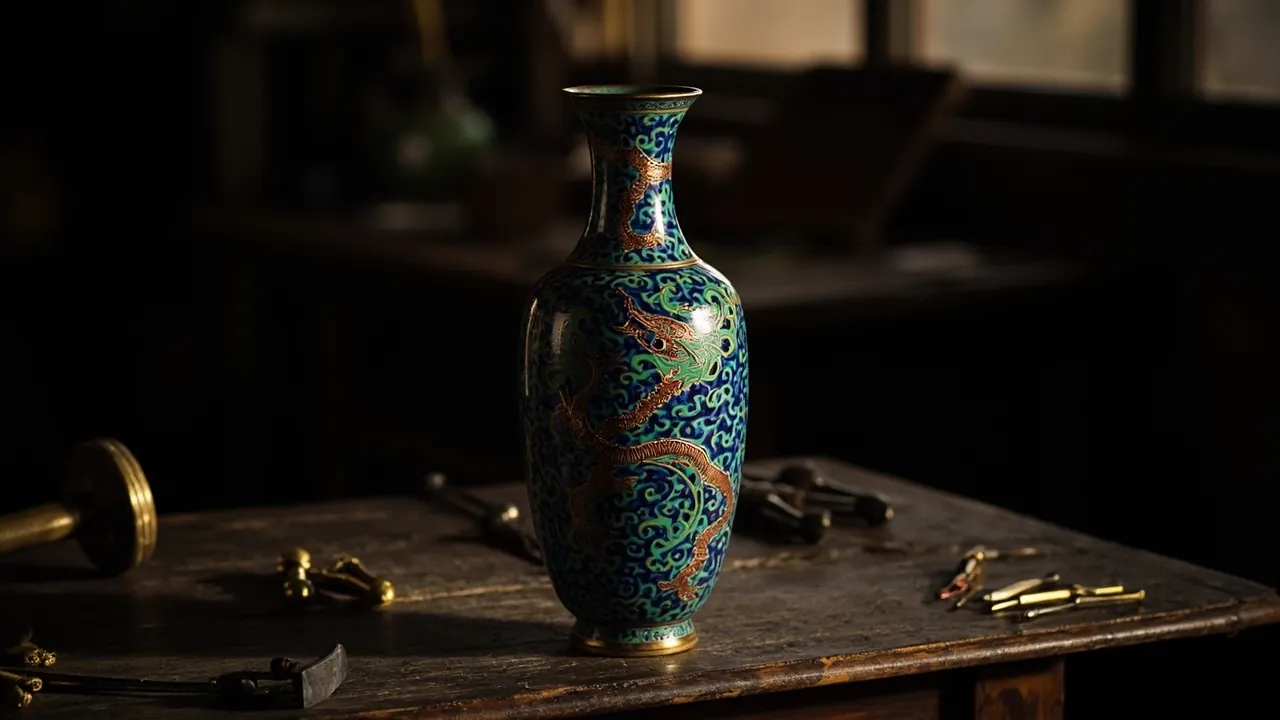
A Chinese cloisonné vase can look impossibly calm: blue fields, fine gold lines, a dragon turning through clouds. Its surface suggests patience and control. The making of it is much less serene. Copper is bent, fired, ground, polished, and fired again until a small vessel survives a series of heat shocks. One bad firing can blister an entire panel.
The word most English speakers use, cloisonné, is French. It comes from cloison, a partition or compartment. European collectors applied the term to objects whose surfaces were divided by thin metal wires, then filled with colored enamel. In China, the craft is usually called jingtailan, or “Jingtai blue,” a name tied to the Ming emperor Jingtai. The names tell two different stories: one about a technical feature noticed by foreigners, the other about imperial taste and Chinese branding.
The technique reached China during the Yuan dynasty, when the Mongol empire connected workshops across Asia more closely than before. Craftsmen and luxury objects moved along the same routes as horses, textiles, gems, and military technology. The precise origin of Chinese cloisonné is debated, but the Yuan court clearly had access to West Asian and Islamic metalwork traditions. Enamelware with compartmented designs was not invented in Beijing. Chinese artisans adapted an imported court craft, changed its palette and motifs, and gave it a new place inside their own material culture.
That distinction matters. Cloisonné is a method, not a single national invention. In Europe, the same broad idea appears in Byzantine and medieval religious objects. In West Asia, copper and brass vessels carried enamel or inlaid decoration. In China, the process became unusually associated with brilliant blue, gilt copper, imperial dragons, lotus scrolls, bats, peaches, and auspicious landscapes. The finished objects look Chinese because generations of local makers made the technique answer to Chinese design.
Do not confuse enamel with faience. Faience is a glazed, often quartz-based material shaped as a body or bead; its color comes from a surface glaze and its body is not simply an enameled copper vessel. Cloisonné enamel is glass powder fused onto metal. The copper body gives the piece strength and conducts heat, while each wire compartment holds a separate pool of glassy color.
Why the Ming Court Made “Jingtai Blue” Famous
The craft’s famous name points to the Ming court of the Jingtai era, 1449 to 1457. The emperor’s reign was short and politically difficult, but later connoisseurs linked it to a distinctive style: rich blue enamel, dense decoration, and gilded metalwork. The exact history behind the name is messy. Some objects labeled “Jingtai” were made later, and the idea of a pure, easily dated Jingtai style is partly a collector’s construction. Still, the branding stuck.
Blue was not the only color in the workshop, but it became the signature. Cobalt blue set off gold wire and pale turquoise with a depth that reminded viewers of porcelain. Chinese ceramic traditions had already trained court taste to value blue-and-white surfaces. Cloisonné offered something different: color with a metallic skeleton, a raised texture, and a flash of gold along every boundary.
The Ming court used such objects as ritual and diplomatic goods as well as furnishings. A censer, altar vessel, bowl, or vase could signal access to skilled labor and expensive materials. The dragon was not mere decoration. Its placement, number of claws, clouds, waves, and associated emblems could carry rank and imperial meaning. Yet workshop objects were also practical. Cloisonné covered incense burners, boxes, brush holders, lamps, cups, and small ornaments.
The craft’s appeal lies in the tension between line and mass. A wire may be thinner than a thread, but it controls the whole composition. It divides a dragon’s body from the cloud behind it; it keeps turquoise from running into red; it turns a broad blue surface into a net of deliberate decisions. When the vessel is gilded, the copper wire becomes a warm outline, almost like drawing in light.
Ming makers also developed a visual language that could tolerate dense surfaces. Lotus petals, scrolling leaves, stylized waves, and geometric borders fill the gaps around a central motif. To a modern buyer, that abundance can feel luxurious. To the maker, it is a technical problem: every enclosed cell needs enough enamel, and every color has to survive the kiln at roughly the right temperature.
The Ten-Step Dance of Copper, Glass, and Fire
A traditional piece begins with a copper body, known as tong tai. Copper is chosen because it is workable and handles repeated heating better than many metals. The body may be hammered, spun, or assembled from sections. Its shape has to be stable before decoration begins; any weakness can show up after firing.
Next comes qia si, the wire work. The artisan bends thin copper wire into outlines and attaches it to the body, often with adhesive. This is the moment when a flat drawing becomes a three-dimensional map. A single vase may require thousands of tiny segments. The wire has to sit cleanly, with curves that look intentional rather than jagged. In hand workshops, this stage still rewards eyesight, tweezers, a steady hand, and a willingness to redo a line.
Then comes dian lan, filling the cells with enamel. Enamel is powdered glass mixed with water or a binder. The worker places it into each compartment with a small tool. Colors may settle, shrink, or behave differently from one another. A blue that looks strong in powder can emerge softer after firing. The artisan often leaves room for later additions because the enamel contracts as it fuses.
The fourth step is shao lan, firing the enamel. This is pulse-fire enameling on copper: short, controlled kiln firings rather than one long bake. The heat fuses the powder, but the vessel’s shape, the copper’s thickness, and the chemistry of each color all affect the result. The piece may return to the kiln several times. Uneven cells are filled again; missing spots receive another layer. Traditional accounts often describe repeated firing as a test of judgment, and that is fair. The kiln reveals mistakes that were invisible on the bench.
After the colors are complete, the artisan grinds the surface, or mo guang. Enamel often rises above the wire or leaves a slightly uneven plane. Grinding levels the surface so the metal divisions and glass colors sit together. It is dusty, physical work, and too much grinding can expose a cell.
The final stage listed in many simplified explanations is gilding, or du jin. The exposed copper wire and rim are coated with gold, sometimes by electroplating and sometimes through other finishing methods. Gilding protects the metal from oxidation and gives the piece its familiar fire-gold edge.
In practice, the ten-step process is more detailed than that short chain suggests: copper body; cleaning and preparation; wire design; wire attachment; enamel filling; drying; firing; repeated filling and firing; grinding and polishing; gilding and final inspection. The order can loop back. A maker may polish, discover a pinhole, refill it, and fire again. Quality depends on those unglamorous corrections.
Qianlong Luxury, Then the Fire of 1900
Under the Qing emperor Qianlong, court demand pushed cloisonné toward spectacle. The palace collected, commissioned, repaired, and displayed objects in a world where visual richness was part of political theater. Qianlong-era designs could be crowded, technically ambitious, and carefully matched to court interiors. Large vases, censers, ritual objects, and decorative vessels filled imperial rooms with saturated color.
Court patronage helped workshops survive, but it also narrowed the craft’s social world. The best materials, designs, and labor flowed toward the palace. Objects made for imperial use were not simply merchandise; they belonged to systems of rank, ritual, gifting, and controlled access. The court could preserve a technique while making it dependent on a fragile institution.
That fragility became painfully clear in 1900. During the Boxer Rebellion and the foreign intervention that followed, Beijing suffered extensive violence and looting. The Fangshan cloisonné workshop, associated with imperial production, was burned. The loss was not just a destroyed building. Tools, patterns, materials, unfinished objects, and skilled workers were scattered or lost. A craft already tied to court structures came close to breaking apart.
It is tempting to tell the story as a clean rise, fall, and revival. The reality was rougher. Some artisans continued in private shops. Techniques survived in fragments. Buyers wanted souvenirs and export goods, sometimes encouraging simplified forms and cheaper finishes. The same market that kept cloisonné visible could also reward speed over subtlety.
This is where the phrase “almost erased” earns its place. The art did not disappear entirely, but the institutional center that had supported its most demanding work was damaged. A living craft depends on more than a recipe. It needs teachers, suppliers, customers, workspaces, and enough time for an apprentice to make mistakes. When those links fail, a technique can remain famous while becoming harder to practice well.
Beijing Workshops and the Factory Afterlife
Modern Beijing still has hand workshops where artisans make cloisonné in stages recognizable from older examples. The work may take place in a cramped room rather than a palace studio, with shelves of colored powders, coils of wire, copper bodies, kilns, grinding wheels, and half-finished vessels. Visitors often see the contrast immediately: the finished vase looks polished and effortless, while the bench is crowded with residue, tools, and repairs.
Contemporary production exists on a spectrum. At one end are painstaking pieces with hand-bent wire, layered enamel, careful polishing, and substantial gilding. At the other are factory reproductions made for the overseas gift trade. These may use printed or machine-assisted designs, thinner wire, fewer firings, synthetic colors, and lighter bodies. That does not make every factory object worthless. It does mean that “cloisonné” alone tells you little about labor, age, or quality.
When shopping, inspect the wire joins, the evenness of the enamel, the weight, and the finish around the rim and base. A hand-finished piece may show tiny variations. Perfect repetition across a large batch can point toward industrial production. Look for a maker’s information rather than assuming that a dramatic dragon proves antiquity. Many modern pieces borrow imperial motifs because they sell well.
The export market has shaped what Americans commonly encounter: blue vases, small boxes, elephants, birds, and decorative plates. These objects can be dismissed as tourist goods, but that dismissal misses the complicated afterlife of the craft. A factory reproduction may carry a recognizable design language into homes far from Beijing. It may also introduce someone to the technique, leading them to study the history or buy a better-made object later.
I like cloisonné best when I can see both its polish and its construction. The gold lines should not erase the labor beneath them. They should make it visible. A small pendant, a tea caddy, or a modest bowl can communicate the technique more honestly than an oversized palace-style vase made only to fill a hotel lobby.
For beginners, a starter kit offers a useful experiment, though it will not reproduce the full experience of a professional workshop. Working with copper wire and powdered or liquid enamel teaches the central idea: color is not painted onto a blank surface but held in separate compartments, then changed by heat. A kit cannot give you seven centuries of accumulated judgment, but it can make that judgment easier to appreciate.
Chinese cloisonné has survived because it keeps changing without losing its basic drama. Mongol-era exchange brought the method into a new imperial setting. Ming taste gave it the memorable “Jingtai blue” identity. Qianlong patronage expanded its scale and prestige. The fire at Fangshan showed how quickly a court-dependent craft could be damaged. Beijing makers and modern factories then carried it into a mixed world of heritage, tourism, collecting, and gifts.
The next time you see a blue-and-gold vase, look past the dragon first. Follow one wire around a petal. Notice where the enamel dips, where the gold thickens, where a color changes after firing. That small boundary is the whole story in miniature: imported technique, Chinese design, imperial demand, workshop risk, and a modern market still deciding what kind of future this old art will have.