In May of 1981, a team of Chinese ornithologists drove into the remote mountainous region of Yang County in Shaanxi province, in central-northwest China. They were not on a routine expedition. For months, they had been following up on a disturbing rumor: the crested ibis, a large wading bird that had once been common across much of East Asia, might be extinct in China. The last confirmed sighting in the wild had been in 1964, and in the seventeen years since, nobody had managed to find a single bird.
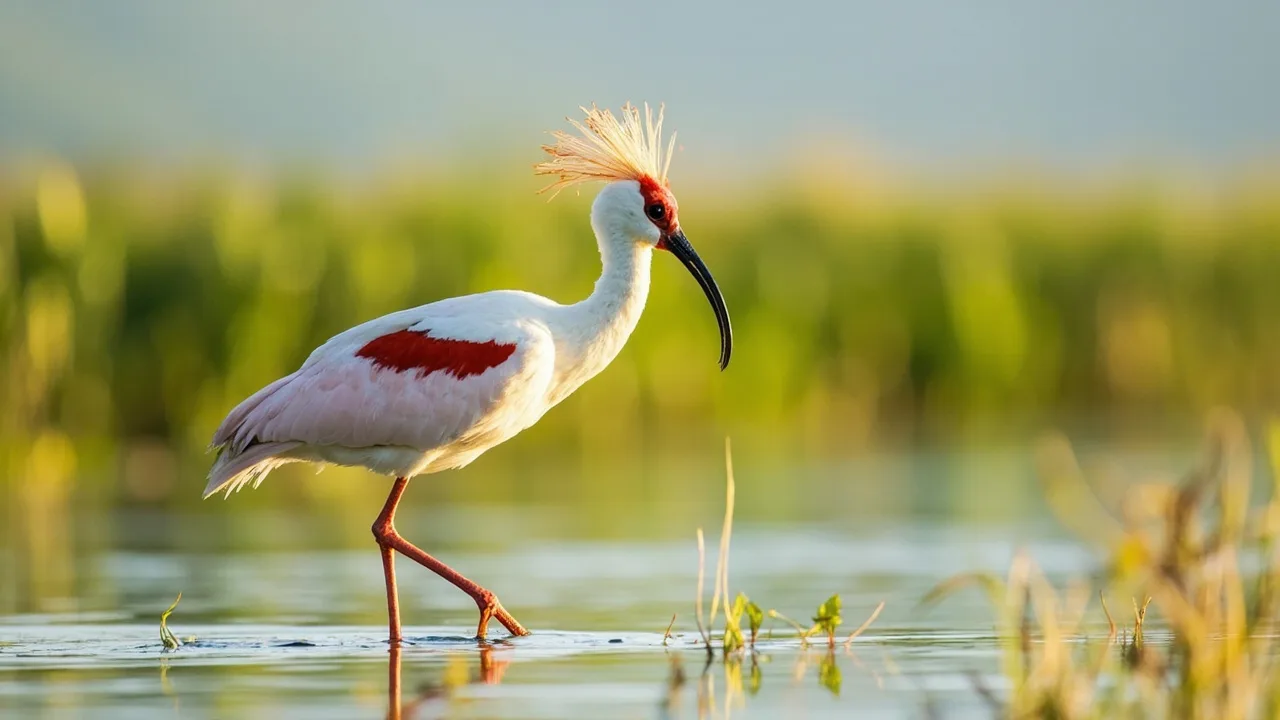
This was not a local matter. The crested ibis (Nipponia nippon) had once ranged across a vast territory that included China, Japan, Korea, and the Russian Far East. It was a species that had survived virtually unchanged for millions of years — paleontologists have found fossils that look almost identical to modern specimens, earning the bird the nickname “living fossil.” Its distinctive appearance, with pure white plumage, a tufted crest, and a vivid red face, made it unmistakable. But habitat destruction, hunting, and the widespread use of pesticides like DDT and PCBs had devastated populations across its entire range. By the 1970s, most ornithologists had concluded that the species was gone.
The team of scientists from the Shaanxi Provincial Institute of Zoology had no expectation of success. They were following protocol, documenting an extinction. But on the third day of their survey, in a small village called E’rong, an elderly farmer named Liu Huanxin told them something remarkable: he had seen the birds. Large white birds with red faces, feeding in the rice paddies behind his house. He had been seeing them for years, he said. He thought they were a good omen.
The scientists asked him to show them where. What they found changed everything: a small breeding colony of seven birds — the last known population of Chinese crested ibis in the world.
The Discovery That Shocked the World
The finding of seven birds, including one breeding pair with chicks, was an extraordinary piece of luck. Or perhaps it was more than luck. Liu Huanxin and his neighbors had protected the birds instinctively, without understanding their significance. The rice paddies where the ibises fed were too shallow and muddy for efficient modern farming, so they had been left fallow — unintentionally creating the kind of shallow-water habitat that crested ibises need. The use of pesticides in this remote region had been slower than in the more developed eastern provinces, which meant that the birds’ food supply was still relatively uncontaminated.
The scientific community responded with a combination of excitement and anxiety. Seven birds, with perhaps only one breeding pair, meant that the species was functionally on the edge of biological extinction. Even with perfect protection, genetic diversity would be catastrophically low. A single disease, a harsh winter, a predator event could wipe out the entire population in a single season.
The Chinese government moved quickly. The State Council designated the E’rong area as a protected nature reserve, and the seven birds became the most closely watched wildlife population on earth. Scientists established around-the-clock observation, fitted the birds with radio tracking bands, and began the delicate process of trying to understand why this tiny population had survived when all others had perished.
The answer, it turned out, was a combination of factors that were specific to this location and this community. The E’rong area had traditionally been a region of small-scale, low-intensity rice farming. The paddies were shallow, the water was clean, the fish and frog populations were abundant. The local people had an instinctive respect for the birds — Liu Huanxin called them “fairy birds” and had actively discouraged his neighbors from disturbing them. In modern conservation terms, this was a perfect example of “community-based conservation,” though nobody had used that phrase at the time.
The Long Road to Recovery
The early years of the recovery program were fraught with setbacks. Of the original seven birds, several were elderly or physically compromised. Only one pair — a male named Dongdong and a female named Huahua — showed strong breeding behavior. Their first nesting attempt in 1982 produced three eggs, but the chicks were weak and one died within days. The second year was more successful: two chicks survived to fledge, giving conservationists their first real hope that the population could grow.
But the fundamental problem of genetic diversity remained. With only a handful of founding birds, inbreeding was inevitable. Scientists began exploring a technique that had never been used for crested ibis: captive breeding. The idea was to establish a backup population in controlled conditions, where birds could be monitored, treated for diseases, and managed to maximize genetic diversity for as long as possible.
The first captive breeding facility was established in 1986, and within a few years it had produced enough offspring to begin the process of expanding the wild population. The strategy was to release captive-bred birds into suitable habitats across the bird’s historical range, establishing new populations that could eventually become self-sustaining.
By the 1990s, the program had produced remarkable results. The wild population in Shaanxi had grown from the original seven to more than 300 birds. More importantly, Chinese scientists had developed a technique for artificially incubating eggs and hand-rearing chicks that dramatically increased survival rates. The method involved carefully monitoring the eggs, keeping them at precisely controlled temperatures and humidity levels, and feeding the chicks a specially formulated diet that replicated the nutritional content of the natural diet.
A Global Rescue: From China to Japan and Korea
In 1981, when the world learned that a small breeding population of crested ibis had survived in China, the news was met with particular interest in Japan. The crested ibis had once been abundant in Japan — it was even featured in classical poetry and art from the Edo period (1603–1868) — but Japanese populations had collapsed even faster than Chinese ones. By the time of the Chinese discovery, Japan had lost its last wild crested ibis, and the species had been declared extinct in Japan.
The Japanese government immediately requested permission to borrow some of the Chinese birds for a captive breeding program in Japan. This was a sensitive request, given that the Chinese population was so small, but Chinese officials recognized that the survival of the species depended on more than just one country’s efforts. In 1999, as a gesture of diplomatic friendship, China gifted two crested ibises to Japan. They were named Yokohuo and Shinano, after two famous Japanese rivers.
The gift was an enormous success. The Japanese breeding program, working from a base in the city of Sado, produced dozens of offspring over the following years, and in 2008, Japan was finally able to release captive-bred birds back into the wild. The reintroduction was celebrated as a national event, and the crested ibis was featured on Japanese television and in newspapers for months.
Similar programs followed in South Korea and North Korea. The bird had become a symbol not just of conservation but of international cooperation — a “peace and friendship bird,” in the words of Chinese President Deng Xiaoping, who had personally approved the gift to Japan. In 2003, China sent three more birds to Korea. The species now exists in three countries, with wild and captive populations interacting through carefully managed exchange programs.
By 2024, the total global population — including both wild and captive birds — exceeds 10,000, with more than 7,000 of those in the wild across China, Japan, and Korea. It is one of the most successful species recovery stories in the history of conservation biology.
The numbers tell the story. In 1981, the world population of Chinese crested ibis in the wild was approximately seven. Today, the total global population — including both wild and captive birds — exceeds 10,000, with more than 7,000 of those in the wild across China, Japan, and Korea. It is one of the most successful species recovery stories in the history of conservation biology.
But success has brought new challenges. The crested ibis was reclassified from “Critically Endangered” to “Endangered” by the IUCN (International Union for Conservation of Nature) in 2012, and in 2021 it was further downlisted to “Vulnerable” — a remarkable trajectory, but one that comes with new pressures. As populations grow, habitat becomes more contested. Birds that were once protected because they were rare now compete with human development for space.
In China, the biggest challenge has been the expansion of commercial agriculture into the shallow wetlands that crested ibis depend on. The success of the captive breeding program has made it possible to release birds into new areas, but those areas are not always suitable for long-term survival if local communities are not engaged in protection. The lesson from the E’rong community — that local people are the most effective conservationists — has had to be relearned again and again in different contexts.
Why the Crested Ibis Matters: Lessons for Conservation
The story of the crested ibis is not just a conservation success story. It is a window into a set of larger questions about humanity’s relationship with the natural world.
The first question is about what we mean when we say a species is “endangered.” The crested ibis was saved in 1981 not by a global conservation campaign or by a massive infusion of international funding, but by the observation and instincts of a single farmer in a remote Chinese village. Liu Huanxin could not have told you what “Nipponia nippon” meant or why the bird’s survival mattered to the scientific community. He just knew that large white birds with red faces were beautiful, that they seemed to bring good luck, and that they deserved to be left alone.
This raises uncomfortable questions about the model of conservation that dominates in wealthy countries — the model that emphasizes scientific expertise, centralized management, and sometimes adversarial relationships with local communities. The crested ibis was saved by ordinary people living close to the land, not by conservation professionals flying in from international organizations. That does not mean expertise is unimportant, but it does suggest that the best conservation happens when scientific knowledge and local wisdom work together.
The second question is about the meaning of extinction. The crested ibis was once declared functionally extinct — a technical term that means a species has declined past the point where it can maintain a viable population. The formal declaration of extinction, however, requires exhaustive surveys across a species’ entire historical range. In the case of the crested ibis, those surveys were never completed in the 1960s because the political turmoil of the Cultural Revolution made fieldwork impossible. It was only by chance that ornithologists returned to the remote mountains of Shaanxi in 1981 and found what they were not looking for.
For American readers, there are some striking parallels between the crested ibis story and the history of wildlife conservation in the United States. The bald eagle, America’s national symbol, was pushed to the edge of extinction by DDT poisoning in the 1950s and 1960s. At its lowest point in 1963, there were only 417 breeding pairs known to exist in the contiguous United States. Rachel Carson’s Silent Spring, published in 1962, documented the damage that pesticides were doing to bird populations and helped spark the environmental movement that led to the banning of DDT in 1972. Today, there are more than 10,000 breeding pairs of bald eagles in the lower 48 states.
The lesson from the crested ibis is not that we should rely on luck. It is that we should recognize and protect the communities and habitats that are doing the quiet, unglamorous work of conservation every day, often without any recognition or reward. Liu Huanxin did not set out to save a species. He was just living his life in a way that happened to be compatible with the survival of a very particular bird. That kind of compatibility is rarer than we think, and we should value it when we find it.
The Future of the Species
The crested ibis remains a flagship species for East Asian conservation — a symbol of what is possible when governments, scientists, and local communities work together. But the work is not finished. Climate change is altering wetland ecosystems across the bird’s range. New diseases have emerged that pose threats to captive populations. And the ongoing tension between development and habitat protection requires constant negotiation and compromise.
What seems certain is that the crested ibis will never again be as abundant as it was before the modern era. The wetlands that once stretched across the floodplains of East Asia have been converted to rice paddies, cities, and industrial zones. Even with the best conservation efforts, the bird’s habitat will be smaller and more fragmented than it was historically.
But the fact that the bird exists at all is a cause for hope. In 1981, a team of scientists thought they were documenting an extinction. Instead, they found the beginning of a recovery. Liu Huanxin, the farmer who first spotted the birds, lived to see his “fairy birds” become a national symbol of conservation. He died in 2005, at the age of 89, and was mourned by ornithologists across China. He had done something that billions of dollars of conservation funding and thousands of scientific papers could not do: he had paid attention, and in paying attention, he had given the crested ibis a chance to survive.