If you have ever heard a flute solo in a Chinese film or opera that sounded somehow brighter and more buzzing than any Western flute you knew, you were probably hearing a dizi. The dizi (笛子) is a transverse bamboo flute, blown sideways like a Western concert flute, and it is one of the two great flutes of Chinese music — the other being the xiao (箫), which is held vertically and blown across the top like a bottle. They look different. They feel different in the hand. They sound completely different from each other, and the reason is a tiny rectangle of plant tissue glued over a hole on the side of the dizi.
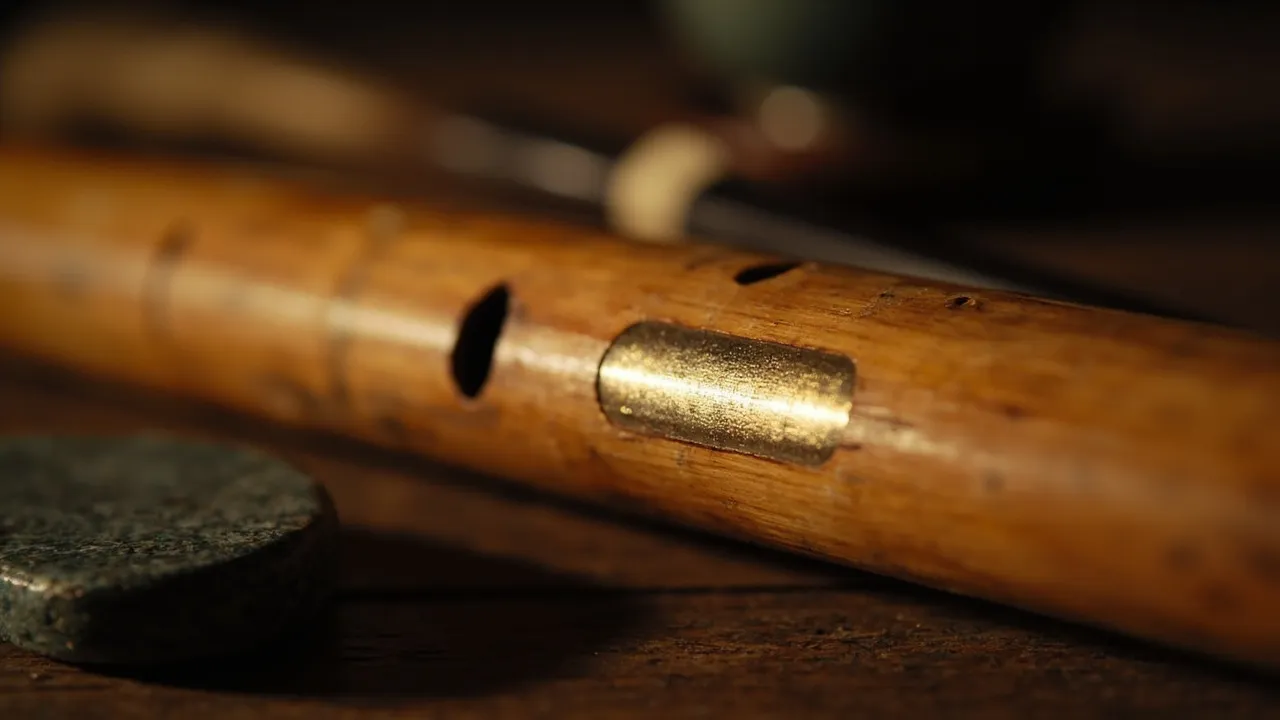
That little rectangle is called the dimo (笛膜), and it is the most distinctive feature of the Chinese dizi. Without it, the dizi would just be another bamboo flute. With it, the instrument takes on a particular buzzing, almost humming timbre that no other flute in the world quite replicates. Western players sometimes compare it to the kazoo membrane, or to the mirliton used in some European folk instruments. Both comparisons are partly right and partly wrong. The physical principle is similar — a thin membrane vibrates sympathetically when air passes over a hole — but the dimo predates any known Western use of the same idea. It is one of those quiet technical details that turns out to be the soul of an instrument.
Why Dizis and Xiaos Sound So Different
The dizi is a transverse flute, held horizontally and blown across an embouchure hole near one end, exactly like a Western concert flute or a fife. The xiao, by contrast, is a vertical end-blown flute: you hold it upright and blow across the top, the way you would blow across a bottle. This single difference in geometry produces very different sounds. The xiao has a smooth, cool, slightly veiled tone — closer to a recorder than to a concert flute. The dizi has a sharper, brighter, more penetrating sound, with that characteristic buzz from the dimo on top. Most Chinese folk melodies you have ever heard on television or in a film score were probably played on a dizi. Pieces that want a softer, more meditative mood often use the xiao.
The dizi is also significantly louder than the xiao, which is why it became the dominant flute in Chinese opera, in outdoor folk performances, and in the large-scale ensemble pieces of the twentieth century. The xiao, being quieter and more intimate, is the flute of the scholar’s studio and the mountain hermit. If the xiao is a flute you play alone with tea, the dizi is a flute you play in a crowd.
The Membrane and What It Does
The dimo is made from the inner skin of a young bamboo shoot, scraped very thin — almost transparent — and then cut into small rectangles about the size of a fingernail. The player glues one of these rectangles over a small hole drilled into the flute body, slightly above and between two of the finger holes. When the flute is played, the airstream vibrates across both the embouchure hole and the membrane hole, and the membrane itself begins to vibrate sympathetically. The result is a buzz of overtones layered on top of the fundamental note. The buzz is not a defect. It is the entire point.
A dizi without a dimo is a perfectly serviceable flute. It will play all the notes. It will sound like a plain bamboo flute. But Chinese players describe the dimo as giving the instrument its “voice” or “personality.” The buzzing quality makes the dizi sound alive and present in a way a plain bamboo flute does not. Different membranes, different glues, different tensions produce slightly different sounds, and experienced players will swap dimo patches the way a violinist changes strings — for warmth, for brilliance, for projection in a noisy room.
The same principle appears, much later, in the Western kazoo (19th century) and in the mirliton used in some European folk instruments. The Chinese were doing it first, by a comfortable margin. Exactly how much earlier is hard to say, because bamboo membrane patches do not survive in the archaeological record, but the dimo is mentioned in Tang dynasty music theory texts from the eighth century, which puts it at least a thousand years before the Western invention.
The Jiahu Bone Flute, 8,000 Years Ago
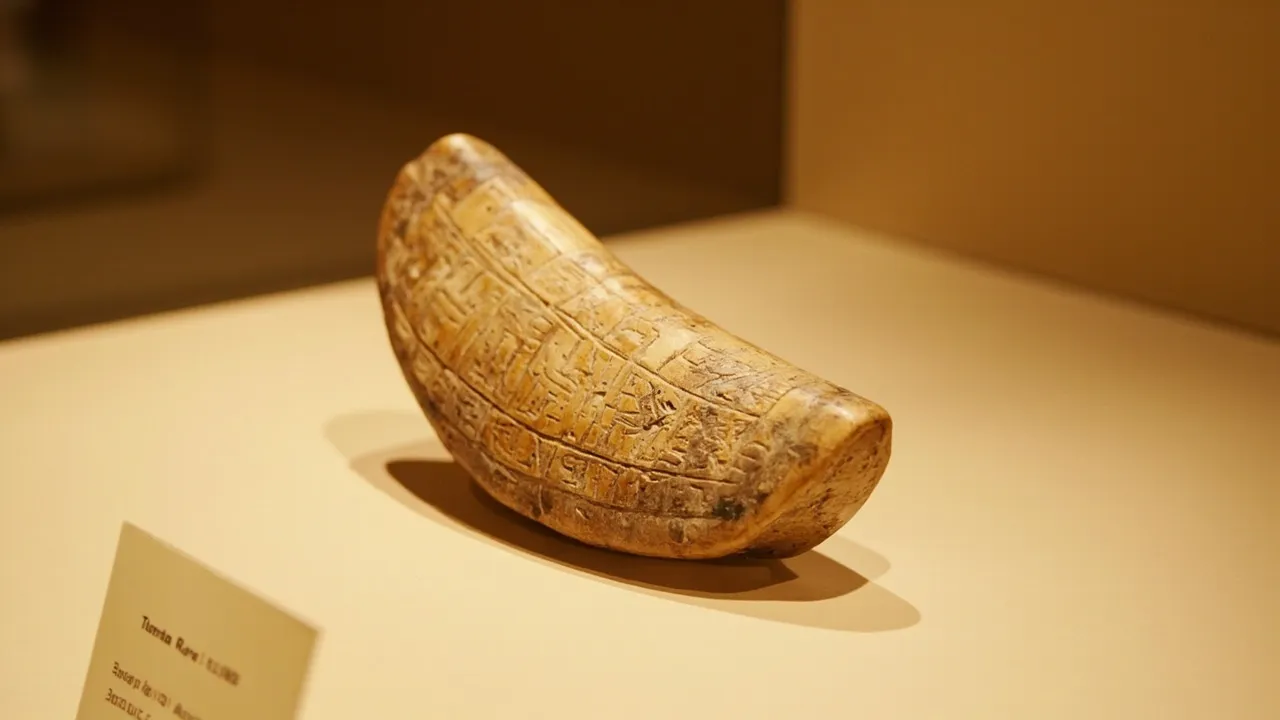
Every Chinese flute, including the dizi, has an older ancestor that is worth knowing about, because it complicates the story in an interesting way. In 1987, archaeologists excavating the Neolithic site of Jiahu, in Henan Province, found a set of small flutes carved from the wing bones of red-crowned cranes. They were not bamboo. They were bone. And when the archaeologists dated them, they turned out to be roughly 7,000 to 9,000 years old — older than any confirmed musical instrument anywhere in the world.
There were more than thirty of these Jiahu flutes. Most had five to eight holes. Several were in good enough condition to be played. When a team of musicologists in 1999 actually performed on a replica and on one of the original bones, the flute produced a fully chromatic scale. Not just a few notes. Not just a primitive pentatonic. A proper, full chromatic scale across about two octaves. The Jiahu bone flutes, in other words, were not toys. They were serious musical instruments used by a culture that understood acoustics well enough to carve flutes that still work today.
The Jiahu people did not write things down. We do not know what music they played, or whether they played the same kind of music the later dizi players would have recognized. What we know is that, eight thousand years before the bamboo dizi existed, someone in Henan was already making flutes sophisticated enough to play in multiple keys. The dimo was a much later invention. The transverse flute itself, blown across a hole in the side rather than across an open end, was already there.
How Bamboo Replaced Bone
Bone flutes like the Jiahu instruments persisted for thousands of years, but bamboo gradually took over as the standard flute material in China, just as wood took over in Europe. Bamboo is hollow by nature. You do not have to bore out the center. Bamboo also grows straight and in convenient diameters. By the time we get reliable written sources, in the Han dynasty (around the first century BCE), the dizi is already a bamboo instrument, described in court records as part of the imperial music bureau.
By the Tang dynasty (618-907 CE), the dizi had acquired nearly all its modern features, including — according to Tang music theory texts — the dimo. The flute was widely used in court orchestras, in Buddhist temple rituals, and in folk ensembles. It appears in Tang poetry. The Tang poet Li Bai, who wrote some of the most famous Chinese poems of all time, refers to the dizi by name and to the romantic figure of the traveling flute player. The instrument had already become a literary image by the eighth century, which is to say it had become part of how educated Chinese imagined music itself.
Two Schools, One Instrument
If you listen to Chinese flute music today, you will notice that there are two recognizable performance traditions. They are usually called the southern school and the northern school, or sometimes the Jiangnan school and the Beijing school.
The Jiangnan school, centered on Shanghai and the lower Yangtze region, emphasizes a softer, more lyrical tone. The flutes tend to be slightly longer and use thicker-walled bamboo. The melodic lines are smoother, with longer phrases and more ornamental bending of notes. The most famous Jiangnan dizi player of the twentieth century was Lu Luling (陆春龄, 1921-2018), whose recording of the folk melody “The Beautiful Moonlight on the Spring River” (春江花月夜) is considered a benchmark for the southern style.
The northern school, centered on Beijing and surrounding regions, uses shorter flutes and emphasizes a brighter, sharper tone. The melodic lines are punchier and more percussive. The northern tradition is closely tied to Chinese opera, where the dizi has to cut through loud ensembles and project to the back of a theater. The northern school’s most famous modern representative is arguably Zhao Songting (赵松亭), though many northern players could claim equal fame.
Both schools use the same instrument, the same fingerings, and the same dimo technique. The difference is mostly aesthetic — about how much breath to use, how much vibrato, how aggressively to ornament a phrase. If you are listening to a piece and it sounds smooth and meditative, it is probably Jiangnan. If it sounds sharp and almost playful, it is probably northern.
How to Listen
If you want a single piece to hear what the dizi can do, the safest choice is “The Beautiful Moonlight on the Spring River” (春江花月夜) — the Jiangnan classic that Lu Luling recorded. It is slow, melodic, and showcases the dimo buzzing effect very clearly in the higher registers. For a more upbeat northern sound, listen to recordings of Hebei bangzi opera, where the dizi is the lead wind instrument. For modern composition, the Chinese-American dizi player Wu Wei has recorded a number of pieces that put the flute in dialogue with Western chamber ensembles, and the result is interesting — the dimo buzz does not disappear in an orchestral setting. It just becomes a different layer of color.
The instrument that started as a crane’s bone eight thousand years ago is now played in concert halls from Beijing to Berlin. The dimo has survived everything in between.
Where to Hear It (and Where to Find One)
If you live in North America or Europe, hearing a live dizi requires some effort. Chinese opera companies tour occasionally. The Shanghai Peking Opera Company visits major cities every few years, and the Beijing Kunqu Opera Troupe performs at university arts centers fairly regularly. Chinese New Year celebrations in major Chinatowns often feature dizi players alongside erhu and pipa. The most reliable option, honestly, is YouTube — search for “陆春龄” (Lu Luling) or “俞逊发” (Yu Xunfa, another major Jiangnan player) and you will find hours of high-quality recordings from the twentieth century.
If you want to try playing one yourself, the practical thing to know is that Chinese bamboo flutes sold as “dizi” in Western music stores often arrive without a dimo membrane and without proper sizing. The most common keys for beginners are G (G dizi) and D (D dizi), with G being the easiest to start on. A student-grade bamboo dizi with dimo sheets and a cleaning rod can be had for $20-40; intermediate flutes run $60-120, and professional instruments in purple bamboo (紫竹) can cost several hundred. The flute is not a difficult instrument to make a sound on, but the embouchure takes practice, and the dimo will tear at awkward moments, especially in dry indoor air. Keep spare membrane sheets in your case.
One last note on the dimo. The membrane is fragile on purpose. It is supposed to be replaceable, and a good player will swap it several times a year. Do not be afraid to peel off an old dimo and glue on a new one. The dimo is consumable, not permanent — and that is, in a small way, the dizi’s whole point. The instrument is designed to make the membrane part of the sound, and the membrane is designed to be a renewable surface that lives with the player’s breath, the room’s humidity, and the seasons. Keep a small bottle of dimo-specific glue in your case, and store spare membranes in a sealed envelope so they do not dry out before you need them. Apply the glue sparingly and evenly along the edges, never across the middle of the membrane. That way the surface can vibrate freely and the buzz stays bright and clean.
Recommended Products
- [bamboo-flute-replica]: Traditional Bamboo Dizi Flute — Hand-made dizi with dimo membrane, perfect starter instrument in G key
- [chinese-music-cd]: Chinese Classical Music Anthology — Recordings of Moonlit Night and other dizi classics from both Jiangnan and northern schools
- [calligraphy-scroll-set]: Chinese Calligraphy Scroll Set — Brush + ink + scroll for writing music-themed poetry from Tang dynasty
- [tea-ceremony-set]: Gongfu Tea Ceremony Set — Traditional Chinese tea brewing vessel to accompany slow listening
Disclosure
Some links above are affiliate links. We earn a small commission if you purchase through these links, at no extra cost to you. We only recommend products we genuinely believe enhance your understanding of Chinese culture.