Chinese Dragon Culture: The Sacred Serpent
There’s something undeniably captivating about dragons. These legendary creatures pop up in myths across nearly every culture on Earth, from the fire-breathing monsters of European folklore to the serpent-like beasts of ancient Mesopotamia. But if there’s one culture that truly elevated the dragon to sacred status, it’s China. The Chinese dragon — called loong (龙) — isn’t a creature to be slain or feared. It’s a symbol of power, good fortune, and imperial authority that has shaped Chinese civilization for thousands of years.
If you’ve ever seen a Chinese New Year parade, gazed at a temple ceiling, or watched a kung fu movie, you’ve encountered the loong. These serpentine creatures coil through Chinese art, architecture, and celebration with a presence that’s hard to miss. But what exactly is a Chinese dragon, and why does it hold such an important place in Chinese culture? Let’s dive in and explore the fascinating world of the sacred serpent.
What Is a Chinese Dragon?
First things first: the Chinese dragon looks nothing like the winged, fire-breathing monsters you might see in Game of Thrones or The Hobbit. Forget everything you know about European dragons for a moment.
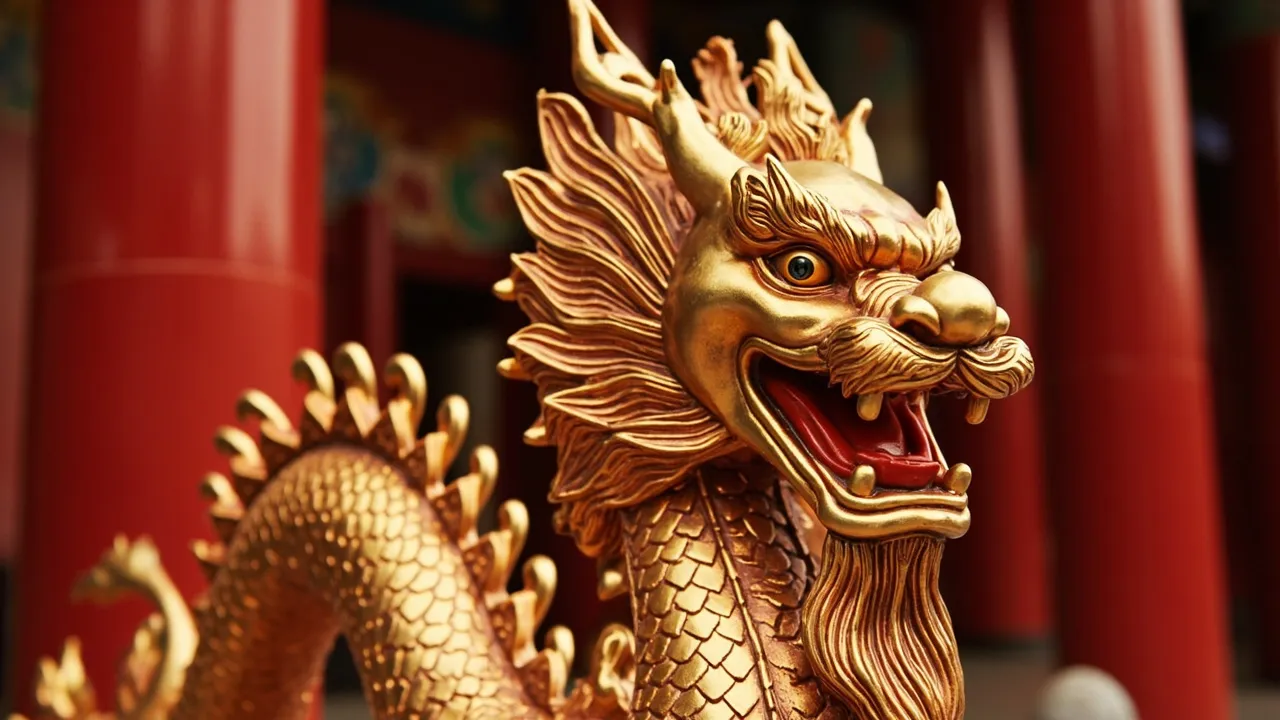
A Chinese dragon is more serpent than lizard. It has a long, sinuous body that winds through the air like a living river. Instead of wings, it has antler-like horns, a camel-like head, deer antlers, rabbit eyes, cow ears, a serpent neck, a hawk’s claws, and tiger paws. Its belly has the scales of a fish, and it often sports a prominent ridge of spines running along its spine. The creature’s mouth is usually open, revealing a protruding tongue. Some descriptions give it 81 or 117 scales — numbers tied to Chinese numerology and the concept of yang energy.
This elaborate anatomy wasn’t randomly invented. Each body part carries symbolic meaning. The fish scales represent adaptability. The hawk claws symbolize strength and the ability to grasp opportunities. The tiger paws denote power. The antlers suggest vitality and the ability to overcome obstacles. Together, the dragon combines the most admired qualities of many animals into one powerful symbol.
Chinese dragons also control the weather, particularly rain. Farmers across ancient China would pray to dragons during droughts, believing these creatures had dominion over precipitation. This connection to water and storms explains why many Dragon Boat Festival traditions revolve around offerings meant to appease water spirits.
Here’s something that might surprise you: Chinese dragons don’t have fixed sizes. They’re said to grow and shrink at will, capable of filling an entire ocean or coiling around a single incense burner. Some legends describe dragons so enormous that their eyes alone could light up the night sky. Others speak of tiny, pet-like dragons that live in private ponds. This flexibility reflects the dragon’s role as a creature of transformation and limitless power.
The Dragon in Chinese History
Dragons have slithered through Chinese mythology for an astonishingly long time — some scholars trace dragon imagery back to Neolithic cultures dating to 4500 BCE or earlier. The famous “jade dragon” artifacts unearthed at Hongshan sites in northern China date to around 4500-3000 BCE, making these creatures among the oldest symbols in Chinese civilization.
But the dragon’s journey through Chinese history wasn’t static. Its meaning evolved dramatically over the millennia.
During the Shang Dynasty (1600-1046 BCE), dragons appeared primarily on bronze ritual vessels. These early dragons were more abstract, often resembling curled serpents or stylized zoomorphic patterns. They served as symbols of cosmic forces and ancestral power, used in religious ceremonies to connect the living with spiritual realms.
The Zhou Dynasty (1046-256 BCE) saw dragons become associated with heaven and imperial authority. Texts from this period began referring to the dragon as the supreme creature — a being that could ascend to heaven or dive into the depths. Rulers started adopting dragon imagery to signal their divine right to rule.
By the Han Dynasty (206 BCE – 220 CE), the dragon had fully transformed into a symbol of imperial power. The emperor was often called the “true dragon” (zhen long) or the “dragon son of heaven.” Imperial garments, palaces, and official seals featured dragon motifs prominently. The famous jade burial suits found in Han tombs often included dragon imagery to protect the dead and ensure their ascent to the celestial realm.
The association between dragons and imperial authority reached its peak during the Ming and Qing Dynasties (1368-1912). The imperial throne was called the “Dragon Throne” (longyi). The emperor’s robes featured five-clawed dragons — only the ruler was allowed to wear five claws; nobles wore four, and commoners were forbidden from wearing dragon imagery at all. The iconic image of a coiled dragon clutching a flaming pearl — a symbol of wisdom, enlightenment, and spiritual energy — became the definitive dragon motif.
Interestingly, dragons weren’t exclusively imperial. Taoist folklore often portrayed dragons as celestial beings who served the gods, inhabiting sacred mountains and deep oceans. Common people found ways to honor dragons too, through local temple festivals, rain-calling rituals, and protective amulets. The dragon belonged to everyone in Chinese culture, even as it served as the ultimate symbol of royal power.
Dragons in Chinese Art and Festivals
Walk into any Chinese temple, museum, or historic site, and you’ll quickly realize that dragons are everywhere. They’re carved into stone pillars, painted onto ceiling beams, etched into bronze bells, and embroidered onto silk robes. Chinese artists have been depicting loong for millennia, and they’ve developed an incredibly rich visual vocabulary in the process.
One of the most recognizable dragon motifs is the erlong xizhu — “two dragons playing with a pearl.” This design shows two dragons in dynamic, S-shaped poses, their sinuous bodies intertwined as they reach for a glowing orb. The pearl often represents the moon, wisdom, or spiritual enlightenment. You’ll find this pattern on everything from imperial robes to ceramic vases to modern restaurant decorations.
Dragon dances are perhaps the most joyful expression of dragon culture. Performers manipulate a long, undulating dragon puppet on poles, making it twist, dive, and leap to the beat of drums and cymbals. The dance is meant to summon good luck and drive away evil spirits. Every Chinese New Year, dragon dances fill streets across China and Chinese communities worldwide. The longer the dragon, the more prosperity it’s believed to bring — some festival dragons stretch over 100 feet.
The Dragon Boat Festival, celebrated on the fifth day of the fifth lunar month, is another dragon-centered celebration. Rowing races in boat shaped like dragons honor the poet Qu Yuan, who drowned himself in protest of government corruption around 278 BCE. The festival also incorporates dragon imagery, zodiac traditions, and protective rituals meant to ward off disease and evil during the hot summer months.
Dragons also appear in less obvious places. Traditional Chinese gardens often feature dragon motifs in water features or rock arrangements. Feng shui practitioners recommend dragon imagery for homes and businesses to attract positive energy (qi), particularly in the northeast corner associated with educational and spiritual growth. Even today, many Chinese families keep small dragon statues or paintings for good fortune.
The Dragon and Modern China
Dragons haven’t stayed trapped in ancient history. They’ve evolved alongside modern China, adapting to new contexts while retaining their core symbolism.
In contemporary Chinese society, the dragon remains a powerful symbol of national pride. The phrase “descendants of the dragon” (long de chuanren) is a common expression of Chinese identity and cultural heritage. When China hosted the 2008 Olympics, the dragon featured prominently in opening ceremonies and branding, representing the nation’s rise as a global power.
The Chinese zodiac plays a huge role in modern dragon culture. People born in Dragon years — 1940, 1952, 1964, 1976, 1988, 2000, 2012, 2024 — are considered particularly lucky, charismatic, and destined for success. Dragon years see a spike in births across China, as parents hope their children will inherit the dragon’s noble qualities. The most recent Dragon year, 2024, saw millions of couples planning pregnancies to welcome “Dragon babies.”
Modern Chinese media is packed with dragon imagery. Blockbuster films feature dragon characters, contemporary artists create dragon-themed installations, and fashion designers incorporate dragon patterns into their collections. The dragon has proven remarkably adaptable — it can appear on high-end fashion runways, in video game graphics, or as a mascot for tech startups.
Chinese communities around the world keep dragon traditions alive. Chinatowns across the United States, Canada, Europe, and Australia host vibrant Lunar New Year celebrations complete with dragon dances. Immigrants brought these traditions with them, and new generations continue performing and preserving them. For many Chinese diaspora families, dragon dances and zodiac celebrations are vital connections to their heritage.
Conclusion
The Chinese dragon is one of the most enduring symbols in human history. For over five thousand years, the loong has slithered through Chinese civilization — from Neolithic jade carvings to modern Olympic ceremonies. It has been a rain god, an imperial emblem, a protector of temples, and a symbol of national pride. Through wars and revolutions, migrations and modernizations, the dragon has remained a constant, evolving yet always distinctly Chinese.
What makes the Chinese dragon so special isn’t just its visual drama or ancient pedigree. It’s the philosophy embedded in this creature. The loong isn’t a monster to be conquered — it’s a symbol of harmony between opposites: heaven and earth, water and fire, power and wisdom, tradition and transformation.
So the next time you see a dragon dancing through the streets during Chinese New Year, or spot a dragon motif on a temple roof, or notice the Year of the Dragon on a calendar — you’re witnessing thousands of years of continuous cultural devotion. The sacred serpent has truly earned its place as one of humanity’s most beloved mythical creatures.
Whether you celebrate the Lunar New Year or simply appreciate rich cultural traditions, the Chinese dragon offers a fascinating window into a civilization that has cherished these legendary creatures for millennia. Gong xi fa cai — may you have good fortune!