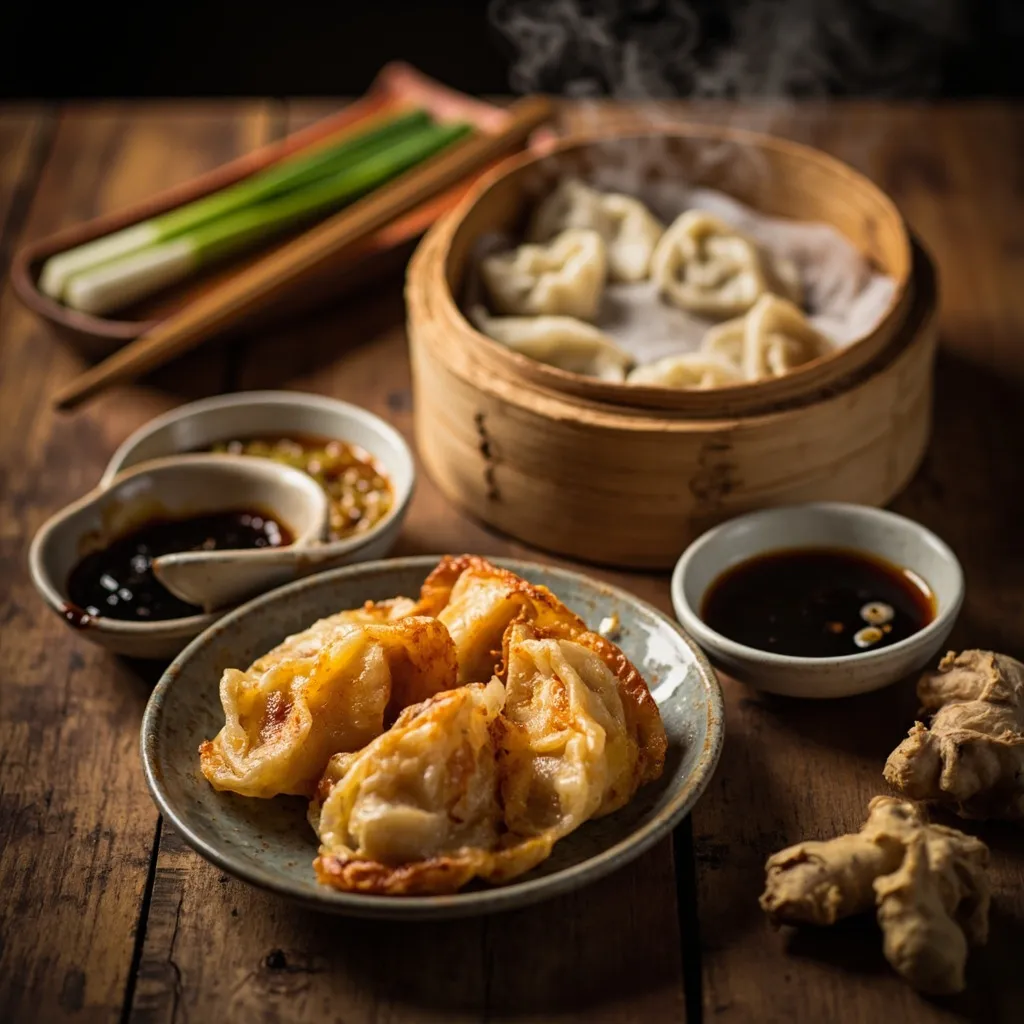
Chinese Dumplings: Everything You Need to Know About Jiaozi
There’s something magical about folding dough around a savory filling, sealing it with your fingertips, and watching steam rise from a pot of boiling dumplings. For thousands of years, this simple pleasure has brought Chinese families together around the dinner table, especially during winter months and festive celebrations. If you’ve ever wondered what makes these little parcels so special, you’re in the right place.
What Are Chinese Dumplings?
Chinese dumplings, known as jiaozi (饺子), are a staple of Chinese cuisine that consist of a thin dough wrapper filled with various savory mixtures. The dough is made from wheat flour and water, rolled into circles, then filled and folded into different shapes. Most commonly, they’re shaped like little crescent moons or half-moons, though some regions have their own signature folds.
The filling is where things get interesting. Traditional jiaozi typically contain ground pork, cabbage, and ginger, but the possibilities are nearly endless. Beef, chicken, shrimp, fish, and vegetables all make excellent fillings. What ties them together is the method of cooking—usually boiled, steamed, or pan-fried—and served with a dipping sauce made from soy sauce, vinegar, and sometimes chili oil.
Compared to other dumpling varieties you might find in Asian cuisines, Chinese jiaozi tend to have a thicker, more substantial wrapper than Japanese gyoza or Korean mandu. They’re designed to be satisfying, comfort food—the kind of dish that warms you from the inside out during cold weather.
A Brief History
The story of jiaozi stretches back over 1,800 years, to the Eastern Han Dynasty (25-220 AD). According to Chinese tradition, dumplings were invented by a physician named Zhang Zhongjing, who created them as a remedy for frostbitten ears during a harsh winter. He shaped the dumplings to resemble耳朵 (ěrduo), the Chinese word for “ears”—hence the old saying that eating jiaozi during winter prevents your ears from freezing.
This origin story has become so deeply embedded in Chinese culture that there’s even a traditional saying: “Dumplings on Winter Solstice, noodles on Summer Solstice” (冬至饺子夏至面). The Winter Solstice, which falls around December 21st, marks the point when days start getting longer again—a cause for celebration that often involves gathering family to make and eat dumplings together.
By the Tang Dynasty (618-907 AD), dumplings had become associated with wealth and good fortune. Their shape, resembling ancient Chinese gold ingots, made them a symbol of prosperity. This symbolism only grew stronger over time, and by the Ming Dynasty (1368-1644 AD), jiaozi had become an essential part of Chinese New Year celebrations—a tradition that continues today.
Types of Chinese Dumplings
Chinese cuisine is incredibly regional, and dumplings are no exception. Different parts of China have developed their own unique styles, each with distinct flavors, textures, and cooking methods.
Jianbing Jiao (Pan-Fried Dumplings): These are perhaps the most famous internationally, often called “potstickers” in American Chinese restaurants. They’re boiled first, then pan-fried until the bottoms become golden and crispy. The contrast between the chewy wrapper and crunchy bottom is absolutely addictive.
Zheng Jiao (Steamed Dumplings): Light and fluffy, steamed dumplings feature a thinner wrapper that becomes slightly translucent when cooked. Shanghai’s xiaolongbao are a famous example—soup dumplings filled with pork and a rich, savory broth that bursts in your mouth.
Tang Jiao (Soup Dumplings): These are like xiaolongbao but even more soup-forward. The filling includes aspic that melts into a rich broth when steamed. They’re delicate creatures that require careful handling and a specific eating technique (bite the top, sip the soup, then eat the rest).
Shui Jiao (Boiled Dumplings): The classic jiaozi style—simply boiled until the dough becomes translucent. This is the most common preparation in northern China, where wheat is a dietary staple.
Guo Bao (Fried Dumplings): Unlike potstickers, these are deep-fried until completely crispy all over. They’re crunchier and have a more intense flavor from the frying oil.
Regional differences also show up in the fillings. Northern Chinese dumplings tend to be heartier, with cabbage and pork being the dominant flavors. Southern versions often include shrimp, ginger, and bamboo shoots. In Sichuan, you might find dumplings with spicy chili oil and numbing Sichuan peppercorns.
How to Make Dumplings
Making jiaozi at home is one of those cooking projects that feels much more impressive than it actually is difficult. The key is breaking it down into manageable steps.
The Dough: Mix two cups of all-purpose flour with about three-quarters cup of warm water. Stir until a shaggy dough forms, then knead for about 10 minutes until smooth. Let it rest for 30 minutes, covered with a damp towel. This resting time is crucial—it allows the gluten to relax and makes rolling out the dough much easier.
The Filling: Classic pork and cabbage is a great starting point. Finely chop half a pound of napa cabbage, sprinkle with salt, and let it sit for 15 minutes to draw out moisture. Squeeze out the excess water, then mix with one pound of ground pork, minced ginger, green onions, soy sauce, sesame oil, and a pinch of sugar. Mix in one direction only—this develops the proteins and gives you a bind that holds together when cooked.
Assembly: Divide the dough into small pieces, roll each into a circle about three inches in diameter. Place a small spoonful of filling in the center, then fold and pleat. The classic method involves creating small folds along one edge while pressing the edges together—aim for about 8-10 pleats for a professional look. Don’t worry if yours aren’t perfect; homemade dumplings have character.
Cooking: Boil a large pot of water, add the dumplings, and give them a gentle stir so they don’t stick to the bottom. Once the water returns to a boil, add a cup of cold water to stop the boiling. Repeat this twice more (three boils total), then remove and drain. This method ensures the filling cooks through without the wrappers becoming waterlogged.
Serve immediately with a dipping sauce made from equal parts soy sauce and black vinegar, with a drizzle of chili oil if you like heat.
Dumplings and Culture
In China, jiaozi are far more than just food—they’re a cultural symbol that carries deep meaning. During Chinese New Year, families gather for what might be the most important dumpling-making session of the year. The act of making dumplings together is as significant as eating them.
Here’s why: the Chinese word for dumpling (jiaozi 饺子) sounds very similar to the word for “交子” (jiāozi), meaning “exchange” or “turning point.” This wordplay connects dumplings to the idea of welcoming the new year and exchanging good fortune. There’s also a tradition of hiding a clean coin inside one of the dumplings—whoever finds it is said to have good luck for the coming year.
Beyond New Year, dumplings appear at many important occasions. They’re served during Winter Solstice celebrations, at family reunions, and as comfort food during illness. A bowl of hot dumplings can be the ultimate expression of care—a grandmother’s way of saying “I love you” without saying a word.
The communal aspect of dumpling-making deserves special mention. In China, making dumplings is often a group activity—family members or friends sit around a table, chatting and catching up while they fold dozens of dumplings together. It’s a social ritual as much as a cooking one, fostering connection and conversation in a way that few other foods can match.
Dumplings Around the World
Chinese dumplings have traveled far beyond their homeland, adapting to local tastes while maintaining their essential character.
In Japan, they became gyoza—typically smaller, with a thinner wrapper and a garlicky filling. Japanese gyoza are almost always pan-fried and served with a dipping sauce that emphasizes rice vinegar over black vinegar.
In Korea, mandu follows similar principles but often includes kimchi in the filling, giving them a distinctive spicy kick. Korean mandu can also be bigger and heartier than their Chinese counterparts.
In the United States, Chinese-American restaurants popularized the “potsticker” style—pan-fried dumplings that have become a ubiquitous menu item. While these often differ from traditional jiaozi in flavor and preparation, they’ve created millions of new fans who might never have tried the originals.
Perhaps most interestingly, dumplings have become a global food that transcends cultural boundaries. You’ll find Japanese gyoza in London, Chinese jiaozi in Moscow, and Korean mandu in Los Angeles. They’ve become a gateway for people to explore Chinese food culture, and for many, folding their first dumpling is the start of a lifelong culinary journey.
Conclusion
Chinese dumplings represent something beautiful about food—they’re simultaneously simple and profound, everyday and celebratory. A humble mixture of flour, water, and filling becomes a vessel for family, tradition, and cultural identity. Whether you’re eating them on a cold winter night, sharing them with family during Chinese New Year, or discovering them for the first time at a local restaurant, jiaozi have a way of making any meal feel special.
The next time you have the chance to make dumplings—from scratch or even from a quality frozen pack—take a moment to appreciate what’s in your hands. You’re participating in a tradition that stretches back nearly two millennia, connecting you to countless generations of families who have gathered around tables just like yours to fold, boil, and share these little parcels of joy.
📚 Recommended Reading & Products
Disclosure: This article contains affiliate links.
Now go find some dumplings. Your taste buds—and maybe your family—will thank you.