Every New Year, more fireworks are set off in a single night than in some countries use in a year. The crack, the boom, the smell of sulfur that lingers for days — it’s the smell of a 1,300-year-old tradition, the most visible inheritance of one of the most consequential inventions in human history. Forget, for a moment, that gunpowder changed warfare. Forget the cannon, the rifle, the bomb. The technology that gave us all those things started as a Chinese festival toy, and in some ways it’s still that.
The story of Chinese fireworks is the story of how an accidental alchemical discovery got repurposed for celebration, and then exported, and then transformed into the global entertainment industry we now call pyrotechnics. It’s also a story about a quiet innovation culture that took centuries to develop its signature invention into something safe, beautiful, and reliably fun.
The Accidental Discovery: Li Tian and the Tang Alchemists
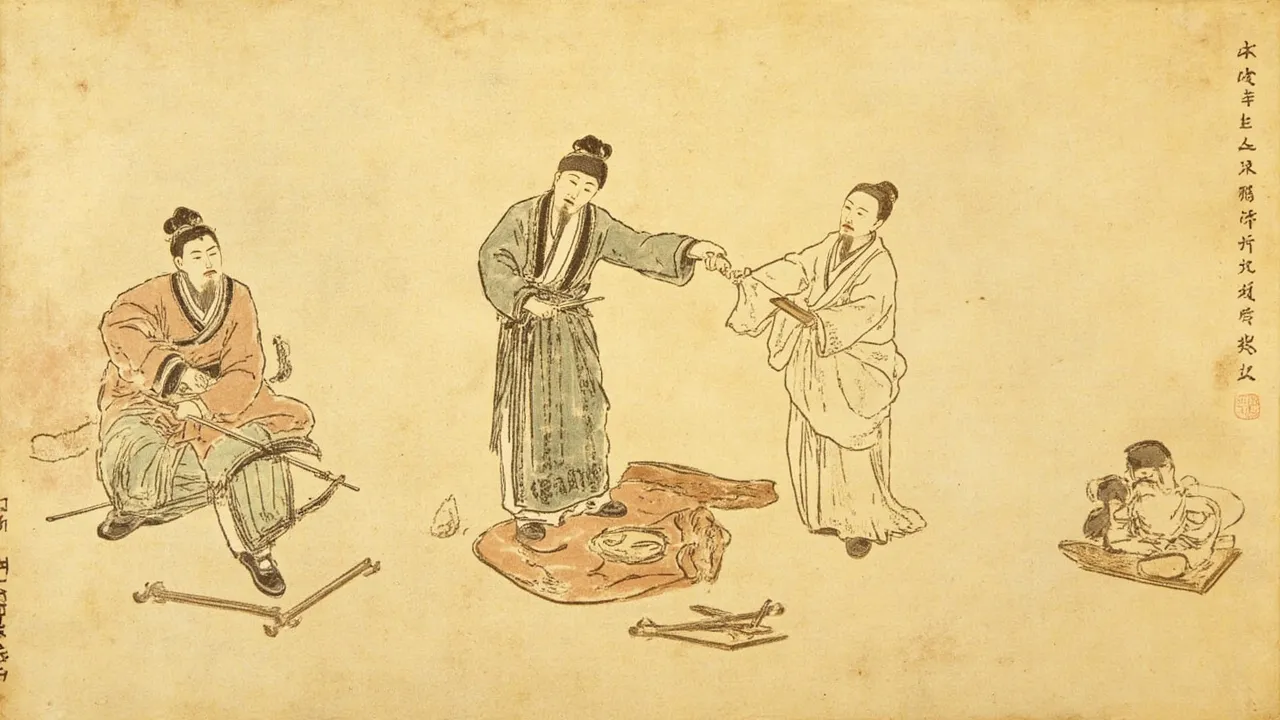
The traditional origin story is set in the Tang dynasty, around the 800s CE. According to a legend recorded in the Song dynasty text Wenbian (文辨) by Mao Huhong, a Taoist alchemist named Li Tian (李畋) was working in Hunan province, trying to synthesize the elixir of immortality from sulfur, saltpeter, and charcoal. The mixture exploded. The elixir of immortality, it turned out, was an explosive powder.
This is almost certainly a back-projected legend — gunpowder wasn’t invented by a single person, and its development was gradual — but the core historical claim is sound. Tang dynasty alchemists were indeed mixing sulfur (硫磺), saltpeter (硝石, potassium nitrate), and charcoal (木炭) in their search for elixirs, and they did occasionally ignite themselves in the process. By the mid-9th century, the formula was being written down in alchemical texts, and the explosion was no longer a complete surprise.
The earliest confirmed reference to gunpowder as such appears in the Taoist text Wuyouzi Jiadan (物原子火药) and the military manual Wujing Zongyao (武经总要) of 1044, which lists three different gunpowder formulas for military use. So the progression was alchemy → accidental explosion → weaponized powder → entertainment firework, all within roughly two centuries.
What’s interesting is the priority. For most of Chinese history, gunpowder was used for fireworks and rockets long before it was used for guns. The first true gunpowder weapons — fire lances, bombs, rockets — appeared in the late Tang and Song, but they were crude and didn’t immediately displace older weapons. The crossbow still ruled the battlefield until the 13th century. The gunpowder cannon didn’t become militarily decisive until the Mongol conquests carried the technology west.
In other words, the thing we now think of as gunpowder’s main legacy — firearms — was almost a side effect. The main cultural legacy, the one China developed first and kept longest, was the firework.
The Chemistry: Saltpeter, Sulfur, Charcoal
The basic chemistry of gunpowder — and of fireworks — is straightforward enough that you can still make it in your kitchen (though we don’t recommend it). The three ingredients do different jobs.
Saltpeter (硝石, potassium nitrate) is the oxidizer. It provides the oxygen that lets the other two ingredients burn fast — too fast for normal air to supply enough oxygen. This is what makes gunpowder self-contained: it doesn’t need a draft or a bellows. Once ignited, it generates its own oxygen.
Sulfur (硫磺) lowers the ignition temperature. Without sulfur, you’d need a much hotter spark to set off the mixture, and you couldn’t reliably light it with a simple fuse. Sulfur also helps stabilize the burn rate and adds a little extra energy.
Charcoal (木炭) is the fuel. It burns and releases energy. The quality and source of charcoal matters — willow charcoal was traditionally preferred for higher-quality powders, while cheaper woods were used for bulk firecrackers.
The standard ratio for “black powder” — historically the standard for Chinese gunpowder and most early modern gunpowder worldwide — is roughly 75% saltpeter, 15% charcoal, 10% sulfur, though Chinese alchemists experimented with many different recipes. Modern Chinese fireworks use a wider range of oxidizers and additives, including aluminum and magnesium powders for bright white sparks, iron filings for golden sparkles, copper compounds for blue, strontium for red, and barium for green.
The smell of a fireworks display — that acrid sulfur-and-charcoal smell — comes from unburned sulfur compounds and from charcoal particles. It’s the smell of the original Tang formula. You’re smelling the 9th century.
Song Dynasty Records: The Oldest Detailed Firework Accounts
The earliest detailed account of fireworks as entertainment comes from the Southern Song dynasty, particularly the 武林旧事 (Wulin Jiushi, “Old Matters of Hangzhou”) by Zhou Mi, written in the late 13th century. Zhou Mi’s book describes the Spring Festival celebrations in the Southern Song capital Hangzhou — and the descriptions of fireworks are surprisingly modern.
The text mentions “煙火” (yanhuo, “smoke and fire”), which probably refers to combination firecrackers and aerial displays. It describes children playing with small firecrackers in the streets, professional fireworks performers hired by wealthy households, and elaborate set pieces that included rotating wheels, paper figures that “moved” through smoke, and exploding bamboo stalks that threw sparks in all directions.
By the Song dynasty, the fireworks industry was already substantial. Specialist craftsmen in cities like Hangzhou, Kaifeng, and later Nanjing, Liuyang, and Foshan produced fireworks for the imperial court, for wealthy merchants, and for sale to ordinary households during festivals. The technology was already sophisticated enough that different types — quick-burning crackers, slow-burning pinwheels, aerial rockets — were clearly distinguished.
It was the Song dynasty that also produced the first known gunpowder rocket — a bamboo tube stuffed with powder and attached to a stick for stability. The Song navy used these “fire arrows” against the Mongols in the 13th century, and the technology spread west with the Mongol conquests, eventually reaching Europe by the 14th century. So in a real sense, fireworks and rockets are sister technologies, both born in Song China.
Types of Fireworks: From Crackers to Aerial Shells
Chinese fireworks come in roughly four main categories, each with its own history and use.
Firecrackers (鞭炮, bianpao) are the simplest: tubes of gunpowder wrapped in red paper, often strung together in long chains. When ignited, they explode in sequence with sharp cracks. The name literally means “fire whip” — they’re meant to sound like a string of explosions, not unlike the ritual whip-cracking of older Chinese ceremonies. Firecrackers are the most ubiquitous form, set off by the millions during Spring Festival, weddings, business openings, and funerals.
Aerial fireworks (烟花, yanhuo) are the showpiece: shells, rockets, and mines that explode in the air. A typical aerial shell has a lift charge that propels it out of a mortar tube, a time fuse that ignites the bursting charge at altitude, and the bursting charge itself loaded with metal salts to produce colored stars. The craft of building these shells — determining the right grain size for the lift charge, the timing of the burst, the spread of the stars — is a skill passed down in families, often in specific regional traditions.
Ceremonial fireworks (礼花, lihua) are the large display shells used at national celebrations, business openings, and major weddings. They include chrysanthemum shells, peony shells, willow shells, palm shells, and a thousand other named patterns. Modern Chinese ceremonial fireworks can reach altitudes of 300 meters and burst diameters of 200 meters.
Sparklers (仙女棒, xiannu bang, “fairy wands”) are the personal, handheld version: long metal sticks coated with a slow-burning pyrotechnic composition that produces a steady shower of sparks. They’re especially popular at weddings and children’s festivals because they’re safe to hold and produce a beautiful visual effect. Some sparkler compositions include iron or titanium for bright white or golden sparks.
Regional Capitals: Liuyang and Foshan
Two Chinese cities dominate the global fireworks industry, and their names are essentially synonymous with Chinese fireworks.
Liuyang (浏阳), in Hunan Province, is widely called the “Fireworks Capital of the World.” The tradition reportedly goes back to the Tang dynasty — Liuyang is one of the regions that claims Li Tian as a local son — and the industry has been continuously active for over a thousand years. Today Liuyang produces roughly 70% of China’s fireworks exports and a large share of the world’s total. The local fireworks industry supports around 300,000 jobs, and the city has an annual International Fireworks Festival in autumn where competing pyrotechnic teams from around the world perform.
Foshan (佛山), in Guangdong Province, is the other major center, especially for ceremonial fireworks and fireworks-and-lantern combinations. Foshan is also famous for traditional Chinese paper lanterns, and the Foshan fireworks displays often combine both crafts — paper lanterns lit by firework effects, or firework shells that produce fire-breathing dragon shapes. The Foshan-style 烟花灯彩 (yanhua dengcai, “firework-lantern colored”) is a distinctive form recognized as intangible cultural heritage.
Other notable regional traditions include Wanzai in Jiangxi, Hunan’s other fireworks hub; Nanyang in Henan; and various smaller centers across southern China. Each region has its own specialty: Wanzai for signal and stage pyrotechnics, Nanyang for industrial display shells, and so on.
Festival Use: Spring Festival, Weddings, and Ancestral Rites
Fireworks are woven into Chinese festival life in ways that would be hard to untangle. The traditions serve overlapping purposes — celebration, scare-evil, marking transitions — and most festival-goers don’t consciously distinguish them.
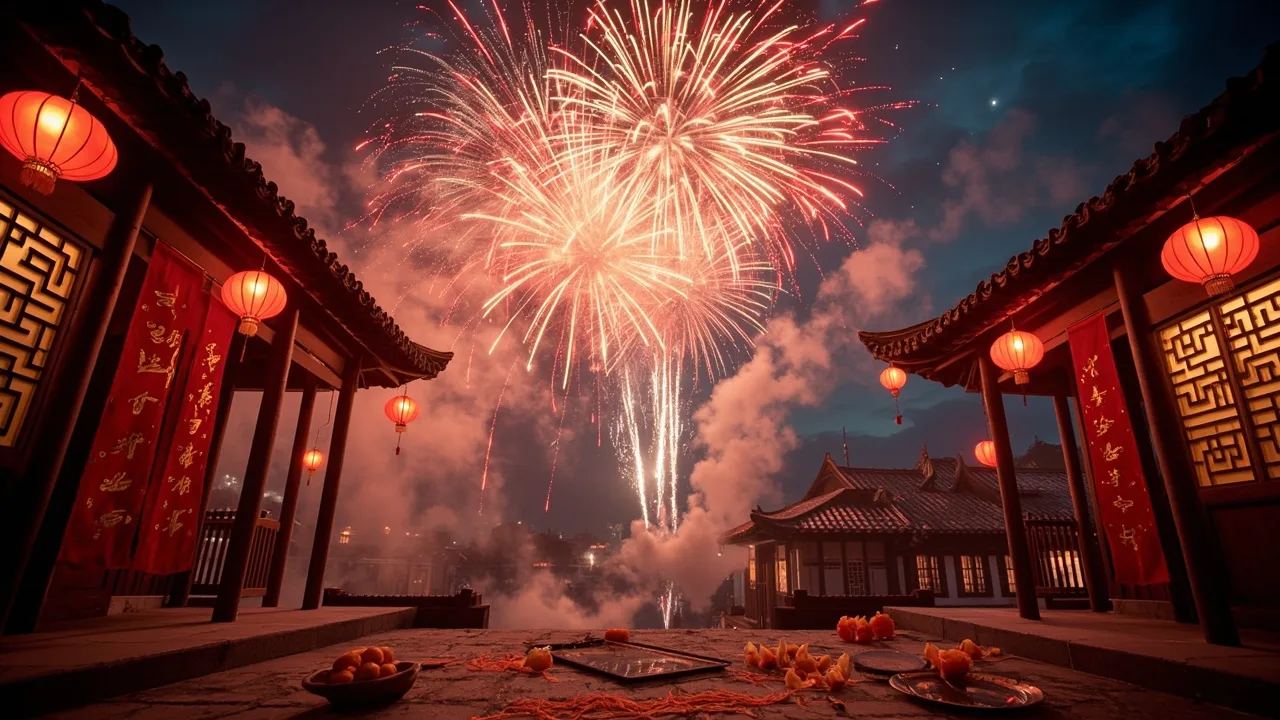
Spring Festival (春节, Lunar New Year) is the biggest fireworks holiday of the year. From New Year’s Eve through the Lantern Festival (15 days later), cities and villages erupt in continuous firecracker noise. The tradition has pre-modern roots: in an agricultural society, loud noises were thought to scare away the mythical beast Nian (年), which supposedly came at New Year to devour livestock and children. The firecrackers were defensive — a way of keeping the beast at bay. The custom has persisted even after the rational explanation of Nian disappeared; people set off firecrackers because everyone does.
Weddings traditionally use firecrackers to mark the bride’s arrival and the couple’s departure. The louder and more elaborate the firecracker display, the more prestigious the wedding. Modern weddings in cities often use smaller, cleaner indoor fireworks or confetti cannons, but the tradition of noisy celebration persists.
Business openings (especially in southern China) often feature long strings of firecrackers at the door, sometimes stretching across entire streets. The noise and red paper are meant to bring prosperity and drive away bad luck from the new venture.
Ancestral rites and grave-sweeping (清明节, Qingming) sometimes use small firecrackers to signal respect for the dead. The Qingming tradition is more subdued than New Year, but firecrackers remain part of the ritual vocabulary.
Mid-Autumn Festival (中秋节) and Dragon Boat Festival (端午节) have lighter fireworks traditions — the focus is on lanterns and dragon boats respectively — but ceremonial fireworks still mark the occasions in many regions.
Modern Safety and Environmental Concerns
The same qualities that make fireworks spectacular — noise, smoke, fire — have made them controversial in modern China. There are three main concerns.
Safety. Fireworks injuries are an annual problem. The Chinese government has issued repeated safety warnings, banned individual use of large fireworks in major cities, and restricted sales to licensed vendors. Beijing banned fireworks within the Fifth Ring Road entirely for years, only loosening the rules recently for specific festivals. The official position is that firecrackers should be handled with care, and large displays should be left to professionals.
Air pollution. Fireworks release sulfur dioxide, nitrogen oxides, and particulate matter. After major Spring Festival celebrations, air quality in major Chinese cities sometimes dips into the “unhealthy” range for days. Environmental advocates have called for further restrictions, and some cities (including Shanghai and parts of Beijing) have moved the legal cutoff times earlier to limit the cumulative pollution.
Fire hazard. Rural fires caused by careless firecracker use are common. The Chinese New Year tradition of leaving firecrackers unattended, or of children playing with them, has produced countless house fires and the occasional major conflagration. Insurance industry data consistently shows a spike in fire claims during the Spring Festival week.
In response, there’s been a quiet shift toward professional display shows and away from individual firecracker use in cities. Many apartment complexes now ban personal fireworks, and young urban families sometimes opt out of firecrackers entirely, preferring electronic noisemakers or simply quiet family dinners. But in rural areas, traditional firecracker use remains nearly universal.
The historical irony is sharp: an invention designed to make celebration louder and brighter is now being phased out in many places for being too loud and too bright. If Li Tian could see his legacy — both the joyful display and the air-quality monitor — he might be torn.
For travelers and cultural readers, the best way to experience Chinese fireworks today is to time a visit to one of the major festivals, head to a recognized public display, and stand well back from the launch zone. You don’t need to light your own firecrackers. The cultural point — that something ancient, something alchemical, something accidentally discovered by a Tang dynasty Taoist has become a global entertainment industry — comes through loud and clear from the audience. Sometimes, watching is the more thoughtful way to participate.