I keep a folded fan in the drawer of my desk most evenings. Sometimes I pull it out just to feel the weight — somewhere between a deck of cards and a small book — and watch the slats fan open with a soft wooden sigh. It does almost nothing useful. The room is air-conditioned. And yet the gesture still feels like something.
That small ritual is, oddly, the whole point of the thing. A Chinese folding fan is not really a cooling device. It’s a piece of portable literature, a status badge, a frame for a painting, and a polite way to hide half your face when someone at the tea table asks an awkward question. The Chinese word for it, zheshan, literally means “folding fan,” but the cultural meaning stretches far beyond the mechanism.
If you want the full picture of Chinese fan culture — round fans, fixed-handle fans, dance fans, the whole family of shanzi — my comprehensive guide to Chinese hand fans covers the broader territory. This article is about one specific member of that family, the folding kind, because its story is genuinely strange: nobody is quite sure where it came from, almost everyone agrees it changed China, and the craftsmanship peaked three centuries later in a rivalry between two cities about a hundred miles apart.
The mechanism: why a folding fan folds
Before we talk about who made these, or who painted on them, it’s worth understanding what makes a folding fan mechanically different from every other fan in the Chinese toolkit.
A round fan — the tuanshan you see in Ming dynasty paintings — is one rigid disc, usually silk stretched over a paper frame, with a single handle. Fold it and it breaks. A folding fan, by contrast, is essentially a tiny, decorative accordion.
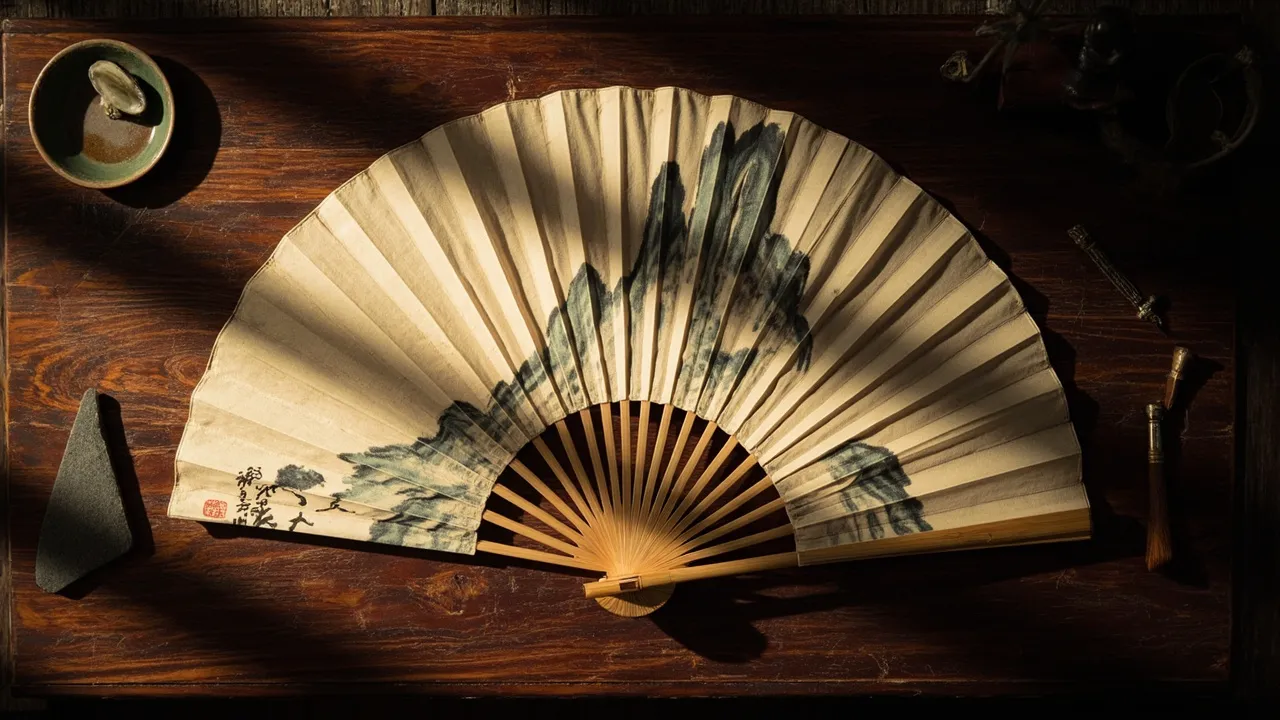
The skeleton is a set of thin ribs — historically bamboo, sometimes sandalwood, occasionally ivory or bone for the wealthy — that are pinned together at one end. That pivot point is the genius of the object. Each rib can rotate around the pin, so the ribs spread out into a half-moon when the fan opens, and nest tightly against each other when it closes. The outermost two ribs are usually thicker than the rest. They serve as the guard sticks that protect the inner ribs and give the fan its visual frame when closed.
Then comes the leaf. A long, pleated sheet of silk or paper — sometimes both, with a painted silk face and a paper lining — is glued along the inner edge of each rib. When the fan opens, the pleats expand and the leaf forms the curved surface that catches the air. When it closes, the leaf folds with the ribs, accordion-style, into a thin sliver.
That accordion pleat is the detail most people miss on first encounter. It’s not just decorative. The pleats are what let the fan collapse to roughly one-fifth of its open size, which is why you can tuck a fan into a sleeve or a sash pocket and walk around with it all day without anyone noticing. The pivot is the hinge; the pleats are the storage trick.
A well-made Ming or Qing fan might have anywhere from 13 to 40 ribs, depending on the size and the era. A “seven-inch” scholar’s fan is small enough to fit in a sleeve; a “one-foot” court fan is meant to be carried openly in the hand during formal occasions. The number of ribs isn’t fixed — it’s a design choice that affects how tightly the fan folds and how wide an arc it covers when open.
Where did the folding fan actually come from?
Here is where the honest history gets uncomfortable, and where a lot of pop-culture writing about Chinese folding fans quietly fudges.
For most of the twentieth century, the standard textbook story went like this: folding fans were not invented in China. They were imported from Japan or Korea into China during the Northern Song dynasty, sometime around the late 1000s CE, through tribute trade and Buddhist pilgrim traffic. Chinese scholars then adopted the form and made it their own. The Song dynasty poet and calligrapher Su Shi is sometimes credited as one of the early popularizers. By the Ming dynasty, the form was fully sinicized, and the Japanese themselves were importing Chinese-style fans back the other direction.
That story isn’t wrong, exactly. It just isn’t complete.
In 1984, archaeologists working at the Mogao caves near Dunhuang — that trove of Buddhist murals along the Silk Road — published images from a late Tang dynasty cave (roughly 850-900 CE) showing figures holding what are recognizably folding fans. That’s a full century or two before the supposed Song import. The mural paintings are not photographs, of course, and a stylized painting of a folding fan can be tricky to interpret, but the iconography is consistent enough that art historians now take the Tang-dynasty presence of folding fans seriously.
There’s a parallel line of evidence from Japan itself. Folding fans — specifically the rigid sensu style with bamboo ribs and paper leaf — appear in Nara-period (8th century CE) Japanese court paintings and in surviving fragments held in the Shosoin treasury at Nara, the imperial storehouse associated with Emperor Shomu. If Japan had folding fans in the 8th century, and China’s Tang dynasty is contemporaneous, then the simple “China got it from Japan” narrative starts to wobble.
So what probably happened? Honestly, we don’t know with certainty. A few possibilities are still on the table among historians:
- Independent invention in both China and Japan from shared Buddhist-era prototypes (the kind of small, pleated ritual fan used in ceremonies), with the form developing in parallel.
- A Korean origin in the Three Kingdoms or early Goryeo period, with the form spreading both east to Japan and west to China through maritime trade routes that predated Song tribute missions.
- A genuine Song-dynasty introduction of a more refined Japanese or Korean version into China, building on top of an older, cruder Tang-era form that hadn’t yet caught on culturally.
The most defensible answer is “the form existed in multiple places before it became a Chinese cultural mainstay in the Song dynasty.” That isn’t as clean as a single origin myth, but it matches the evidence. The Song dynasty is when folding fans stopped being a curiosity and became a Chinese cultural institution. That part is uncontroversial.
Song dynasty: when scholars made it a status symbol
The Northern Song was a period when the scholar-official class was at the height of its social prestige. The imperial examination system had matured. Civil bureaucrats, not military aristocrats, ran the empire. Aesthetics mattered. A gentleman was expected to be able to compose poetry, paint, play the qin, and choose his objects with discrimination.
Folding fans slid into this world almost perfectly. They were portable, like a book. They were personal, like a writing brush. And — crucially — they had a flat, fan-shaped surface that was ideal for ink painting and calligraphy, with none of the awkwardness of trying to paint on a rigid round fan.
Su Shi (1037-1101), the poet, calligrapher, painter, and perennial thorn in the side of the New Policies reformers, is one of the earliest figures associated with painted folding fans. Several works attributed to him are recorded in later catalogues, though like most Song-dynasty paintings, the originals haven’t survived. What matters is that Su Shi wrote about fans, painted on them, and gifted them to friends. Once a cultural figure of that stature put a fan in his hand in public, the form acquired an unmistakable stamp of respectability.
Mi Fu (1051-1107), another of the great Song literati painters, is similarly linked to fan painting in the historical record. Like Su Shi, Mi Fu had a reputation for eccentricity — he was once so obsessed with a particularly fine rock that he bowed to it and called it his elder brother — but his standing as a painter was genuine. When he picked up a fan as a canvas, that, too, was a kind of social signal.
By the Southern Song period, scholar-officials regularly commissioned fans from specialist workshops. The fan became a gift currency: you wrote a poem or painted a landscape on a friend’s fan, and that fan traveled with them as a token of your relationship. There’s a whole literary sub-genre of Song dynasty “fan poetry” — short verses written specifically to be displayed on a fan leaf, addressed to whoever the fan was being made for.
The fan wasn’t yet the elaborate object it would become in the Ming and Qing dynasties. Song fans were usually fairly austere — bamboo ribs, a plain silk or paper leaf, calligraphy or ink landscape, no carving, no inlay. The status came from who had painted it and what they had written, not from the materials.
Ming and Qing: the golden age of the nine crafts
If the Song dynasty gave the folding fan its cultural meaning, the Ming and Qing dynasties gave it its material form. Between roughly 1400 and 1850, Chinese fan-making went through what collectors call its golden age, and the craft vocabulary expanded to the point where connoisseurs started classifying fans by the “nine crafts” (jiuzhong gongyi).
The nine crafts aren’t a single official list — different sources enumerate them slightly differently — but the most commonly cited categories include:
- Bamboo rib preparation: selecting, aging, straightening, and polishing the ribs. The best bamboo came from specific regions and had to be cut at specific times of year.
- Rib carving: intricate openwork or relief carving on the outer guard sticks. Master carvers could spend months on a single pair.
- Painting and calligraphy on the leaf: the visible face of the fan, usually ink or light color on silk or sized paper.
- Mounting and lining: the hidden side of the leaf, often a contrasting color or pattern, sometimes inscribed with the maker’s seal or the owner’s name.
- Pivot assembly: drilling, fitting, and pinning the rib assembly. A poorly fitted pivot either sticks or wobbles.
- Sandalwood (tanxiang) ribs: fragrant, dense wood used for high-end fans, sometimes carved in openwork.
- Purple sandalwood (zitan) ribs: even rarer and darker than ordinary sandalwood, used for the most formal court fans.
- Xiangfei bamboo (xiangfeizhu): a mottled bamboo with natural dark spots, prized because the pattern looks intentional and cannot be faked. Translates roughly as “Hunan consort bamboo.”
- Lacquer, inlay, or gilding work: applied to ribs or guards, sometimes with mother-of-pearl or carved bone inlay.
Xiangfei bamboo deserves a small digression. The spotted pattern comes from a parasitic fungus that affects the living bamboo plant — it’s not painted or stained. Real xiangfei bamboo has been harvested for centuries and is now strictly protected; most modern “xiangfei” fans on the market use either bamboo that has been chemically induced to spot, or a visual imitation. Old xiangfei fans are collector’s items.
By the late Ming, two rival fan-making traditions had crystallized, each centered on a different city and a different aesthetic philosophy.
Suzhou fans, in the Suzuo (“Suzhou work”) tradition, are the ornate school. Suzhou craftsmen favored carved ribs — sometimes pierced openwork showing miniature landscapes or calligraphy, sometimes relief carving in deep, sculptural detail. The painting on a Suzhou fan tends to be dense, refined, almost miniature in scale. A typical Suzhou fan might have 20 or 30 ribs, all individually shaped, with the outer guards carved in different patterns on each side. Suzhou was already famous as a center of literati culture, woodcarving, silk embroidery, and garden design; fan-making fit naturally into that ecosystem of decorative refinement.
Hangzhou fans, in the Hangzuo (“Hangzhou work”) tradition, are the restrained school. Hangzhou craftsmen emphasized the natural beauty of the bamboo itself. Ribs were usually left plain, with no carving. The painting was often a single ink landscape — sometimes just a few brushstrokes of distant mountains — designed to harmonize with the grain of the bamboo rather than compete with it. A Hangzhou fan is meant to look effortless, the way a perfectly hung scroll in a scholar’s studio looks effortless. Hangzhou’s association with this aesthetic made sense: the city had been the Southern Song capital, with a deep literary and tea culture, and its craftsmen understood restraint.
Both traditions are still alive in modern Suzhou and Hangzhou, though in much-diminished form. Antique Ming and Qing fans from either school are now museum pieces; surviving examples in major collections include fans attributed to court painters, imperial seals indicating ownership, and rib carvings so fine that they look like miniature ivory screens.
Carrying culture: which fan went with which robe
Once folding fans became common, they developed their own etiquette — a kind of silent language about who was allowed to carry what, and when.
A scholar-official in the Song dynasty would carry a small folding fan most of the time, especially in warm weather. It went in a sleeve pocket or was held loosely in the left hand while the right hand was free for gesturing. The fan was partly functional (cooling), partly social (showing you had taste), and partly defensive (you could use it to gesture someone away without making direct eye contact — the “fan wave” of dismissal).
By the Ming dynasty, the rules had tightened. A formal court audience demanded a specific style of fan — usually larger, with carved ribs and a plain or politically appropriate painting. A literati gathering called for a smaller, plainer fan, ideally one painted by a friend or a famous artist. A Buddhist monk would not carry a fan with secular paintings on it. A young woman of a good family, by the Qing dynasty, might carry a small round fan in summer and a small folding fan in winter — both being part of the formal wardrobe, both indicating that the household had the leisure and the taste for such accessories.
The fan also became a wedding gift and a coming-of-age gift. A father commissioning a fan for his daughter’s eighteenth birthday, with a specific painting and a specific calligraphic inscription, was making a statement about the family’s standing and about his hopes for her marriage. The fan wasn’t just carried — it was inherited. Some families kept a stock of inscribed fans going back several generations.
There’s a darker side to this culture, too. Fans became a vehicle for political satire, coded messages, and even — occasionally — secret correspondence. The painted side of a fan was public, but the inner lining, or a small inscription tucked between the ribs, could carry private content. In the politically fraught late Ming period, scholars sometimes used fans to smuggle critiques past the censors. In the Qing dynasty, the Qianlong Emperor, who was himself an enthusiastic calligrapher and painter, sometimes had fans confiscated and examined when their imagery struck him as subversive.
That history is part of why folding fans remained culturally loaded long after their practical cooling function became irrelevant. Even in the early twentieth century, an educated Chinese man carrying a folding fan in public was making a small statement about belonging to a particular kind of tradition.
If you want to read about how folding fans fit alongside the older round fan tradition in the broader hand fan craft story, my full guide to Chinese fans covers both forms, the materials, the regional differences, and the surviving workshops. You might also enjoy reading about how fans surface in seasonal customs — they show up in the Double Ninth Festival, where chrysanthemum viewing and fan-carrying both belong to the autumn ritual calendar.
Holding one in your hand
What surprises me, when I think about folding fans honestly, is how much cultural weight an object can carry and still feel light in the hand. A Song scholar’s fan was a piece of poetry. A Ming dynasty Suzhou fan was a piece of miniature sculpture. A Qing court fan was a political document. And the same physical object — a few dozen bamboo ribs, a pivot pin, a pleated silk leaf — carried all of that.
The honest history of where the form came from is messier than the textbook version, and that messiness is part of why the fan is interesting. It didn’t spring fully formed from a single inventor’s mind in a single country. It probably emerged from a network of Buddhist, trade, and court cultures across East Asia in the 8th to 11th centuries, and the Chinese version of it became a cultural carrier in a way that the Japanese and Korean versions didn’t quite match. The Song scholars gave it meaning. The Ming and Qing craftsmen gave it beauty. The rest of us get to inherit a small object that still works exactly the same way it did a thousand years ago.
If you’ve never actually opened one, try it. Hold the pivot firmly and flick the outer rib outward. There’s a soft snap, a slight breeze, and then a half-moon of painted silk or paper in your hand. The mechanism hasn’t changed. The meaning still does.
Recommended Products
- [chinese-folding-fan-replica]: Traditional Folding Fan Replica — https://www.amazon.com/dp/chinese-folding-fan-replica — Hand-crafted bamboo rib fan with silk surface, perfect for home display or costume
- [silk-fan-painting]: Hand-Painted Silk Fan — https://www.amazon.com/dp/silk-fan-painting — Authentic Suzhou-style silk fan with mountain landscape
- [calligraphy-ink-set]: Chinese Calligraphy Ink Set — https://www.amazon.com/dp/calligraphy-ink-set — Ink stone + brush + ink stick for writing fan poetry
- [rice-paper-scroll]: Xuan Rice Paper Scroll — https://www.amazon.com/dp/rice-paper-scroll — Traditional painting surface for fan art practice
Disclosure
Some links above are affiliate links. We earn a small commission if you purchase through these links, at no extra cost to you. We only recommend products we genuinely believe enhance your understanding of Chinese culture.